
Healthcare Checklist Software
Make sure your protocols are followed. Every time. With proof.
CheckFlow gives healthcare teams, from GP surgeries and dental practices to care homes, clinics, and allied health providers, a structured, automated way to execute recurring operational protocols. Tasks are assigned to the right team members, completed in the enforced order, and backed by a timestamped audit trail you can show at a CQC inspection or regulatory review.
The WHO Surgical Safety Checklist reduced complications by more than 30% in the eight-hospital study that introduced it (from 11.0% of patients to 7.0%). That improvement didn’t come from new clinical knowledge. It came from making sure the right steps were followed in the right order, every single time. CheckFlow applies the same principle to your operational and safety protocols, without requiring an IT project to get started.
14-day free trialNo credit cardUnlimited free guests
Last updated
Healthcare checklist software turns recurring operational and safety protocols into checklists that run in order and leave a record. In CheckFlow, infection control audits, ward and clinic safety checks, equipment checks and staff inductions become templates: schedules start them, each step goes to a named person or role, halt tasks stop steps being skipped, and every completion is logged with a name and time. It suits GP surgeries, dental practices, care homes and clinics.
Sound Familiar?
1 in 10 patients is harmed in health care globally, according to the WHO, and more than half of that harm is preventable. Often the root cause isn’t a lack of clinical knowledge. It’s inconsistent execution of the processes already in place: steps skipped under pressure, paper checklists that can’t be enforced, and no audit trail to show what was actually done.
Paper checklists that can’t be enforced
Paper forms let staff tick boxes in any order, skip inconvenient steps, or complete them from memory at the end of the day. When a CQC inspector asks to see your infection control records, a folder of handwritten sheets with gaps and inconsistent dates is worse than nothing.
No audit trail for regulatory evidence
CQC’s single assessment framework, still in use while CQC pilots new sector-specific frameworks, expects ongoing evidence of compliance, not a binder assembled the night before an inspection visit. Regulation 17 (good governance) asks for systems that assess, monitor and improve quality and safety. Without a system that timestamps each completion and records who did what, you can’t produce the up-to-date evidence inspectors ask for.
High staff turnover undermines consistency
Research from the University of Surrey, published in The BMJ in 2024, linked higher nurse and senior doctor turnover in NHS hospitals to increased patient mortality. When new staff, including locums and bank workers, have no enforced protocol system to follow, the quality of care depends entirely on verbal handover.
Recurring safety tasks fall off the calendar
Annual gas safety checks. Weekly fire alarm tests. Quarterly infection control audits. These don’t happen reliably through calendar reminders and goodwill. Without a scheduled, auto-assigned checklist system, compliance dates are missed, and the consequences can be severe.
Steps get skipped under pressure
When a shift is busy, it’s easy to skip steps that feel optional in the moment. But steps in infection control, medication management, and equipment safety protocols are not optional, and a system that allows them to be skipped isn’t really a system at all.
CQC inspections reveal documentation gaps
Providers can be rated “Requires Improvement” not because of poor clinical intent, but because the evidence trail is incomplete or inconsistent. They can feel stuck in that rating despite genuine effort to improve, because the documentation isn’t there. The free CQC Inspection Readiness Checklist keeps that evidence current between visits.
How CheckFlow Works for Healthcare Teams
Build your protocol once. Run it every time. Prove it was done.
Build your healthcare protocol templates once
Map each recurring operational protocol into a CheckFlow template: infection control audits, medication management checks, equipment maintenance, staff induction, fire safety drills. Define every task, assign it to the right role or team member, enforce the order steps must happen in, and set recurring schedules for daily, weekly, monthly, quarterly, and annual tasks. Add a required photo upload for steps that need visual documentation.
Run protocols consistently across every shift and every staff member
When a protocol is due, its schedule starts the checklist, CheckFlow assigns each task to the named person or role and notifies them, and overdue alerts go out if the deadline passes without completion. Whether the task falls to a permanent staff member, a locum, or a bank worker, the checklist guides them through the exact steps in the exact order, with no reliance on verbal handover or memory.
Produce inspection-ready evidence automatically
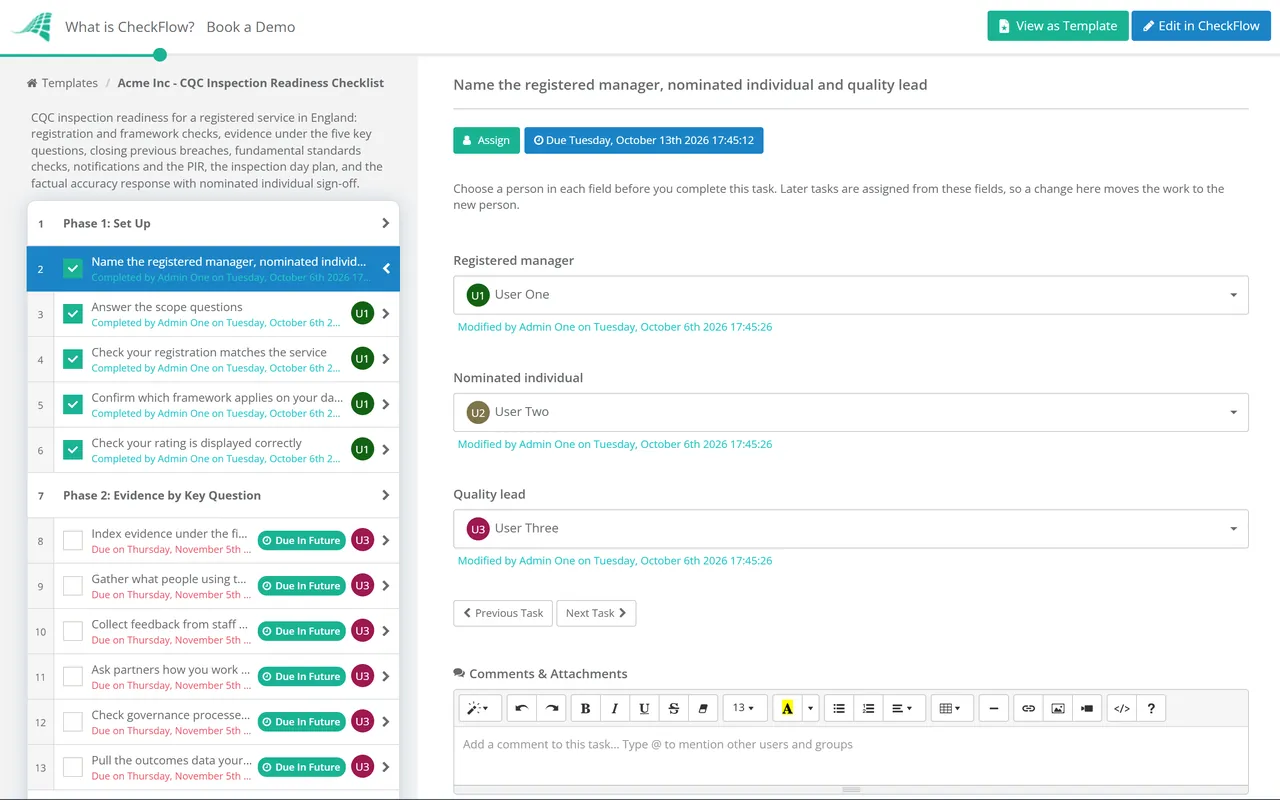
Every step completion is logged with a timestamp, the name of the person who completed it, and any photos or evidence attached. When a CQC inspector, clinical governance lead, or fire safety officer asks for evidence of your compliance record, the answer is a filterable, exportable list of every protocol run in the Reports Grid, with each checklist showing every step completed and when it happened.
Built for Operational Healthcare Compliance
CheckFlow is not clinical software. It does not integrate with your EHR or EPR. It handles the operational and safety protocols that run alongside clinical care: the processes that keep your organisation safe, inspection-ready, and consistently run across every shift, every staff member, and every site.
Step order
Enforced step order: staff can’t skip steps
Use halt tasks to prevent later steps being marked complete before earlier ones are done. An infection control audit can’t be signed off until every zone has been individually checked. A medication management checklist can’t be completed until controlled drug counts are confirmed. Enforced order removes the option to skip steps under pressure, exactly the gap checklists like the WHO’s were designed to close.
- Halt tasks lock every later step until the earlier one is complete
- Required fields and photos must be filled in before a step can be completed
Schedules
Recurring scheduled checklists for every cycle
Set any healthcare protocol to start automatically on a daily, weekly, monthly, quarterly, or annual schedule. Daily opening checks. Weekly equipment inspections. Monthly IPC audits. Annual gas safety checks. Annual fire safety drills. Each cycle starts on time, tasks are assigned to the right person, and reminders go out if completion is overdue.
- Each schedule starts at a set time in its own time zone
- Every run is a new checklist with its own record
Timestamped audit trail for every step
Every completion is logged with who did it, when, and what evidence was attached, creating a record you can show CQC, fire safety, and health and safety inspectors. The audit trail is always ready when an inspector visits, without any last-minute document collation. Print any checklist or save it as a PDF for the evidence file.
Learn moreMobile-friendly for ward and clinic use
Staff complete checklists from a phone or tablet at the point of care: in a treatment room, a storage area, or on a ward round. No paper forms, no clipboards, no handwriting. Photo evidence can be attached directly from the camera at the moment of completion. CheckFlow runs in the browser and needs a connection to save, so check the signal where your team works.
Learn moreRole-based task assignment for multi-disciplinary teams
Assign individual protocol steps to specific roles, set up as groups: Registered Nurse, Practice Manager, Health and Safety Lead, Receptionist. When a checklist runs, each person is notified of their own tasks and finds them in their Tasks Grid, and steps marked exclusive can only be opened or changed by their assignees. The manager sees the complete picture. Effective for any multi-disciplinary team where different staff members own different parts of the same protocol.
Learn moreReal-time compliance visibility across all sites
See the live status of every active protocol across every location in the Reports Grid. Know at a glance which checklists are in progress, which are overdue, and which sites need follow-up, without manually calling each location for a status update. Add a site field or tag and filter by it. Critical for care home groups, dental chains, and primary care networks managing multiple sites.
Learn more
Ready-to-Use Healthcare Templates
Don’t start from a blank page. Pick a proven healthcare checklist template, customise it to your facility, protocols, and compliance requirements, and run it in minutes. Each one is fully editable in the CheckFlow template designer.
Healthcare & Medical Staff Credentialing Checklist
Healthcare Appointment Scheduling Workflow Checklist
Healthcare Incident Reporting Process Checklist
HIPAA Compliance Audit Checklist for Healthcare & Medical Organisations

Medical Equipment Sterilization Checklist
Patient Intake Checklist
Newer in the library: the patient discharge checklist coordinates each discharge from admission to the follow-up call, the new nurse onboarding checklist runs unit orientation, competency validation and preceptorship, and the Joint Commission survey readiness and CQC inspection readiness checklists keep survey evidence current between visits.
What Your Healthcare Checklists Should Cover
The four operational areas where structured checklists make the greatest difference to patient safety, compliance, and inspection readiness.
01Infection Control
- Hand hygiene audit: correct technique observed at all five WHO moments, soap and sanitiser available at all stations
- PPE availability check: correct type available in all clinical zones, donning and doffing procedure posters visible
- Environmental cleaning schedule: all zones cleaned to schedule, cleaning records completed and signed
- Instrument sterilisation log: autoclave cycle records completed, biological indicator results recorded
- Sharps and clinical waste disposal: bins not overfilled, disposal records completed, collection confirmed
- High-touch surface decontamination: door handles, light switches, keyboards, and equipment cleaned between patients
- Outbreak response checklist: contact tracing initiated, isolation protocol activated, infection control lead notified, UKHSA health protection team notified where required
- Monthly IPC audit: formal structured audit completed against NICE IPC guidelines, findings recorded and corrective actions assigned
02Safety & Fire Compliance
- Weekly fire alarm test: weekly test completed at same time each week, duration and result recorded, any faults logged and reported
- Fire extinguisher monthly check: all extinguishers inspected, pressure gauges checked, access clear, seals intact
- Annual fire risk assessment: formal assessment completed by competent person, findings documented, action plan assigned
- Annual fire drill: evacuation completed, time recorded, issues noted, all staff participation confirmed
- COSHH risk assessments: all hazardous substances identified, risk assessment completed and reviewed annually, COSHH data sheets accessible
- Manual handling assessments: all manual handling tasks risk-assessed, staff training records current
- Electrical equipment PAT testing: schedule maintained, in-date stickers visible on all equipment
- Gas safety check: annual gas safety check completed by a Gas Safe registered engineer, record stored and accessible, renewal date tracked
03Staff Protocols
- New staff induction checklist: mandatory briefings completed (fire exits, safeguarding contacts, medication protocols, emergency procedures, infection control), signed confirmation recorded
- Locum and bank staff orientation: site-specific briefing completed, relevant protocols covered, key contacts provided, emergency procedure location confirmed
- Mandatory training records: BLS/CPR, safeguarding, fire safety, manual handling, infection control, all current, expiry dates tracked, renewals scheduled
- Patient discharge checklist: discharge letter completed, medication reconciliation done, follow-up booking confirmed, patient education completed, GP notification sent
- Incident reporting workflow: event documented immediately, responsible manager notified, evidence preserved, duty of candour requirements reviewed
- Medication management check: controlled drug register checked, stock counts completed, expiry dates reviewed, waste bins within capacity, keys secured
- Staff competency sign-off: clinical competencies assessed, signed by assessor and staff member, record filed
04Equipment & Facility
- Equipment maintenance schedule: all clinical and safety equipment on a named maintenance schedule with next service date tracked
- Calibration records: measuring equipment (BP monitors, weight scales, thermometers, blood glucose monitors) calibrated on schedule with records maintained
- Fridge temperature monitoring: daily minimum and maximum temperature recorded, out-of-range alerts actioned and documented
- Emergency equipment checks: resuscitation equipment checked daily (defibrillator charged, pads in date, oxygen cylinder pressure), check records signed and filed
- Facility opening and closing checks: all clinical areas prepared, security checks completed, alarm set, utilities checked
- Waste management: clinical waste bins not overfilled, recycling separated correctly, chemical waste disposed of correctly
- Medical gas cylinder checks: cylinder pressures checked, spare cylinders available, manifold system functioning, gas safety records current
CheckFlow’s free healthcare templates are a starting point for all of the above, ready to customise and schedule for your team in minutes. No IT setup required.
Ask your AI assistant which safety checks are overdue.
CheckFlow works with any AI assistant. Connect it once and it reads and works your checklists with the same permissions as the person whose API key it holds.
Ask your AI assistant
Through the CheckFlow MCP server, Claude, ChatGPT, Gemini, Grok, Copilot or any other AI assistant can list the protocol steps that are overdue, find this month’s IPC audit, and comment on a task to remind the person it is assigned to.
Read the MCP guideDraft the template from a sentence
Describe a protocol in a sentence, such as a daily fridge temperature check or a monthly IPC audit, and the free AI checklist generator drafts the template, ready to schedule.
Try the AI generatorConnect your other systems
Start a checklist from another system through Zapier or the REST API, and get a webhook when an audit completes.
Developer overview
Is any fire alarm test overdue across our surgeries?
template: "Weekly Fire Alarm Test"
status:   "Overdue"
One: “Record the test result” on Fire alarm test – Northgate Surgery, due Monday at 08:00 and assigned to Priya N. Shall I add a comment to remind her?
Used by great companies









This is a great app for documenting and managing your processes. … It is particularly good for time sensitive processes as you can set up a sequence of task due reminder emails at whatever time frames you want.
Frequently Asked Questions
What is healthcare checklist software?
Healthcare checklist software is a tool that turns recurring operational and safety protocols into structured, trackable, automated workflows. Instead of relying on paper forms, verbal handover, or calendar reminders, the software assigns tasks to the right staff member, enforces the order steps must be completed in, sends reminders if tasks are overdue, and creates a timestamped audit trail for every protocol run.
CheckFlow handles the operational and compliance side of healthcare (infection control audits, safety compliance checklists, staff protocols, and equipment maintenance schedules) rather than clinical or EHR systems.
Is CheckFlow suitable for GP surgeries, care homes, and dental practices?
Yes. CheckFlow is well-suited to any healthcare organisation where a practice manager or clinical manager is responsible for running protocols consistently, managing compliance evidence for CQC inspections, and coordinating tasks across a multi-disciplinary team. It doesn’t require clinical IT integration and can be set up without any technical support. It is not a digital social care record or a clinical system: it keeps the evidence for the operational checks that run alongside them.
Does CheckFlow create an audit trail that satisfies CQC inspectors?
It creates the record inspectors ask to see; whether your service meets the standard is for CQC to judge. Every step completion is logged with a timestamp, the name of the person who completed it, and any photos or evidence attached. This creates a complete, filterable record of every protocol run: evidence of the systems and processes Regulation 17 (good governance) requires. When an inspector asks for evidence of your infection control compliance or fire safety records, filter the Reports Grid and export it to CSV, Excel or PDF, or print any checklist, without any last-minute document collation.
Can CheckFlow enforce step order so staff can’t skip protocol steps?
Yes. CheckFlow’s halt task feature prevents later steps from being marked complete until earlier steps are done. Staff cannot sign off an infection control audit without completing every zone check first, cannot mark a medication management checklist complete without confirming controlled drug counts, and cannot close a fire safety check without confirming all equipment is serviceable. Enforced step order removes the ability to skip inconvenient steps, a common way protocols fail in practice.
Can recurring safety compliance tasks be scheduled automatically?
Yes. CheckFlow’s recurring checklist feature lets you set any protocol to start automatically on a daily, weekly, monthly, quarterly, or annual schedule. Weekly fire alarm tests, monthly IPC audits, annual gas safety checks, annual fire risk assessments: each cycle starts automatically, tasks are assigned to the named person, and reminders are sent if the deadline passes without completion.
How does CheckFlow handle multi-site healthcare organisations?
CheckFlow gives operations directors and compliance managers the Reports Grid, a live list of all active protocols across all sites. You can see at a glance which locations are up to date, which checklists are overdue, and which sites need follow-up, without calling each practice or location individually. Templates can be standardised across sites so every location runs the same protocol in the same order with the same documentation standard.
How much does CheckFlow cost?
CheckFlow’s Business plan is $10 per user per month, or $9 billed annually, with no minimum seat count. All features, including recurring scheduled checklists, enforced step order, photo evidence through file upload fields, auto-assignments, the full audit trail, and custom notifications, are included. There’s a free trial with no credit card required. See the full pricing page for details.
Start Running Safer, More Consistent Healthcare Protocols Today
Free trial, no credit card required.
14-day free trial, no credit cardFull refund in your first 30 daysUS or EU hosting