
Is this person cleared to be employed as a nurse?
- Licence or registration verified with the issuing body
- Identity, references and background checks
- Owned by HR or the credentialing team
- Ends with a cleared file, before the first shift
Last reviewed: October 2026
No Credit Card Required
Printed from checkflow.io/templates/healthcare-medical/nurse-onboarding-checklist
Hospitals run nurse orientation through a mix of HR systems, paper competency booklets and the preceptor’s memory. This free new nurse onboarding checklist gives nurse educators, nurse managers and preceptors one workflow per new hire, from the week before day one to release into independent practice: the hand-off from credentialing, organisational induction, unit orientation, competency validation, preceptored practice and the manager’s sign-off. Two questions at the start add a transition-to-practice phase for newly qualified nurses and a practice-context orientation task for internationally educated nurses new to practice in your country.
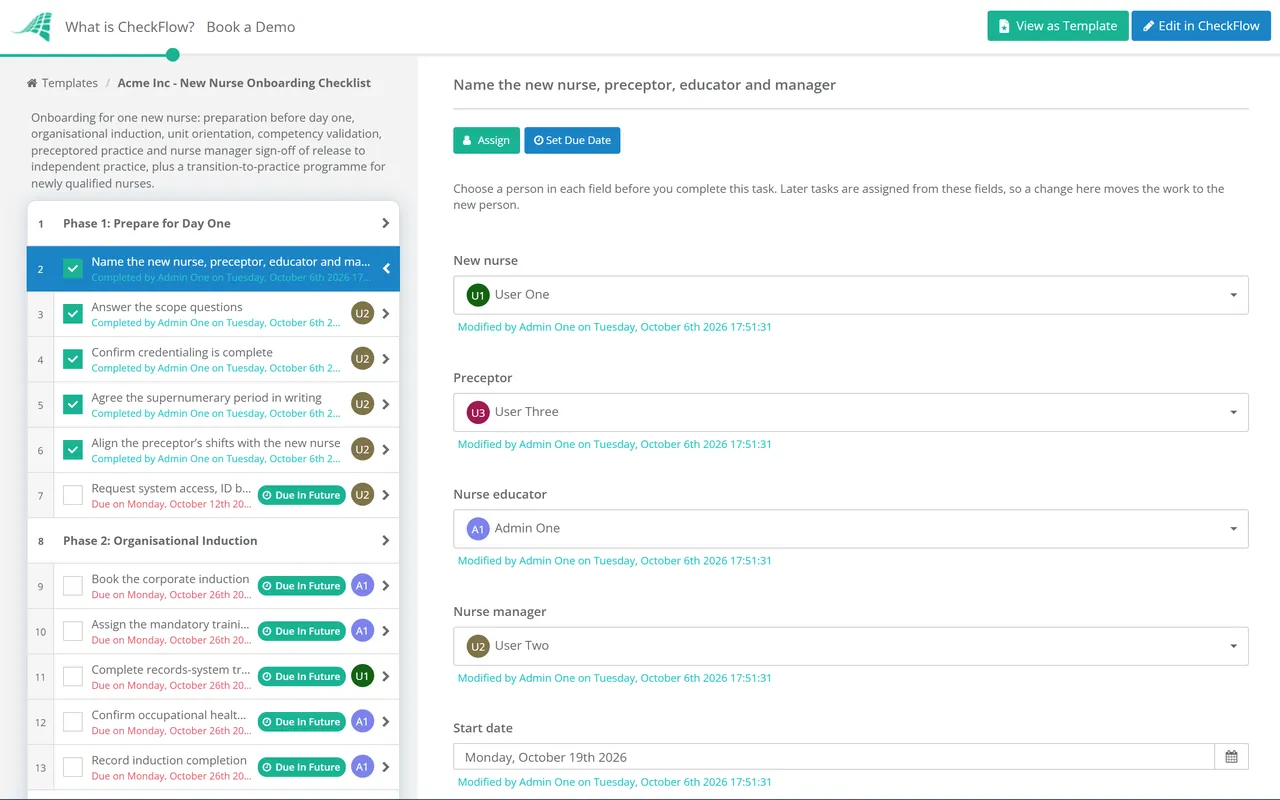
A newly hired nurse goes through two processes that are easy to blur. Credentialing establishes that the person is who they say they are and holds a current licence or registration, checked with the primary source, plus the background and health checks your policy requires. That work belongs to HR or a credentialing team, and the Healthcare Staff Credentialing Checklist covers it. This checklist starts where credentialing ends. One task confirms the hand-off, and the nurse does not start a unit shift until it is ticked.
Onboarding is the clinical half: orientation to the organisation and the unit, validated competence, a period of supported practice with a preceptor, and a decision that the nurse can work independently. In the US, The Joint Commission’s hospital standards, renumbered under its Accreditation 360 model from January 2026, put orientation, education and training under HR.11.03.01 and competence under HR.11.04.01, which expects staff competence to be assessed initially as part of orientation and then at least every three years, or more often if your policy or the law requires. Its published guidance applies the human resources standards to contract staff as well as employees.
For newly qualified nurses there is a further layer. The NCSBN Transition to Practice model calls for a formal programme integrated into the organisation, with a preceptor educated for the role, and its multi-site study supports programmes of nine to twelve months. In England, NHS England’s National Preceptorship Framework for Nursing (October 2022) sets core standards that include at least two weeks or 75 hours of supernumerary time and a preceptorship of at least six months, with twelve months as the gold standard. The NMC’s principles of preceptorship (July 2020) are not mandatory, but the regulator strongly recommends preceptorship for every newly registered nurse. Supernumerary simply means the nurse works on the unit without being counted in the staffing numbers. How long that lasts is your policy’s decision, and this checklist records the dates rather than assuming them.
Seven phases run from the week before the start date to release into independent practice. The practice-context task in Phase 3 appears only for internationally educated nurses new to practice in your country, and Phase 7 appears only for newly qualified nurses.
Answer the two scope questions first. They decide whether the practice-context task and the transition-to-practice phase appear.
The practice-context task appears only for internationally educated nurses new to practice in your country.
The nurse manager’s sign-off halts the checklist. The nurse is not counted in the numbers until it is given.
Shown only when the nurse is newly qualified. It starts with orientation and runs on after release.
Both kinds of hire run the same checklist. The scope question changes what it contains, and your policy changes the dates. An experienced nurse still has to show competence on this unit, with this equipment and these policies, because sign-offs from a previous employer do not transfer on their own.
| Element | Newly qualified | Experienced hire |
|---|---|---|
| Supernumerary time | Longer; England’s framework sets a minimum of two weeks or 75 hours | Usually shorter, set by your policy and the unit |
| Competencies | Full unit list, validated by observation | Full unit list; earlier experience speeds it up but does not replace it |
| Preceptor | Named preceptor for orientation and the programme | Named preceptor for orientation |
| Formal programme | Transition or preceptorship programme, often six to twelve months | Not usually; ongoing education instead |
| Release | Manager sign-off; the programme carries on afterwards | Manager sign-off ends orientation |
Agency, travel and bank nurses. Joint Commission’s guidance applies its human resources standards to contract staff who provide care, so they need orientation and a competence check too, usually shorter. Start the same checklist, answer the scope questions, and record the agreed supernumerary period, even if it is a single shift.
Internationally educated nurses. A nurse who is experienced but new to practice in your country may be clinically confident and still unfamiliar with local law, documentation, escalation routes and team culture. England’s preceptorship framework includes international registrants. The second scope question adds a practice-context task to unit orientation, with a pastoral contact who is not their assessor.
Each task carries a due date offset from the day the checklist starts, so credentialing, induction, the first preceptor meeting and the mid-point review land in the right weeks. Tasks are assigned from the new nurse, preceptor, educator and manager fields as each hire begins.
Release to independent practice is an approval step: the checklist halts until the nurse manager answers. Assessor sign-offs, attached certificates and preceptor comments stay in the checklist history, ready for the staff file.
Dropdown answers show the transition phase and the practice-context task only where they apply. Reports show who is still in orientation and which competencies are overdue, and the API and MCP server can start a checklist when your HR system records a new starter.
Licence and registration checks run in the Healthcare Staff Credentialing Checklist, before this one starts. Orientation records and competency evidence are among the files surveyors and inspectors ask for, so the Joint Commission Survey Readiness Checklist and the CQC Inspection Readiness Checklist both draw on what this checklist leaves behind. New ward nurses often learn the discharge process first through the Patient Discharge Checklist.
Onboarding nurses across several units or sites? CheckFlow for healthcare teams runs every orientation the same way, and CheckFlow’s onboarding software covers the non-clinical staff who start alongside them.

Healthcare Staff Credentialing Checklist

Joint Commission Survey Readiness Checklist

CQC Inspection Readiness Checklist
Patient Discharge Checklist

Hand Hygiene Audit Checklist
Describe the process in a sentence and the AI checklist generator drafts the phases and tasks for you.
Everything between a cleared credentialing file and a nurse working independently: confirmation that credentialing is complete, an agreed supernumerary period, a named preceptor with matching shifts, organisational induction and mandatory training, unit orientation, competencies validated by an assessor, regular preceptor reviews, and a recorded decision to release the nurse into independent practice. Newly qualified nurses add a transition or preceptorship programme that continues after release.
Orientation tells the nurse how the organisation and the unit work. Competency validation proves the nurse can do specific things to your standard, observed and signed by an assessor; attending a session is not the same as being assessed. Preceptorship is the supported period in which a named preceptor works alongside the nurse while the caseload builds. A complete onboarding record shows all three.
Your policy decides, and it should vary with the nurse’s experience and the unit. For reference, NHS England’s National Preceptorship Framework for Nursing sets a core standard of at least two weeks or 75 hours supernumerary for newly registered nurses and a preceptorship of at least six months, with twelve months as the gold standard. In the US, NCSBN’s transition-to-practice research supports programmes of nine to twelve months for new graduates.
Under the hospital standards that took effect with Accreditation 360 in January 2026, the main orientation requirement sits in the National Performance Goals chapter at NPG.12.05.01, HR.11.03.01 covers ongoing education and training, and HR.11.04.01 expects staff competence to be assessed and documented initially as part of orientation and then at least every three years, or more often if your policy or the law requires. Check the current manual for the exact elements of performance that apply to your programme, because the numbering changed in 2026.
Usually the nurse manager, on the evidence of the preceptor and the nurse educator. The preceptor has seen the nurse work and recommends release, the educator confirms the competency record is complete, and the manager decides, because the manager owns the staffing numbers the nurse is about to join. Record any limits that remain, such as a procedure the nurse should not yet do unsupervised, and give each a date to close. In this template that decision is an approval step, so nothing after it moves until the manager answers.
Not by law. The NMC’s principles of preceptorship, published in July 2020, are voluntary, but the regulator strongly recommends that every newly registered nurse, midwife and nursing associate has a period of preceptorship. In England, NHS England’s 2022 framework sets the core standards employers are expected to meet, and many organisations write them into their own preceptorship policy.
14-day free trial, no card required. The Business plan is $10 per user per month after the trial. Full details at checkflow.io/pricing.
14-day free trial, no credit cardFull refund in your first 30 daysUS hosting, EU on request