Medication Management Audit Checklist Template

Most medicines problems an audit finds are small: a gap on a MAR chart, a fridge reading nobody acted on, a ‘when required’ dose with no reason written down, a controlled drugs balance one tablet out. Left without an owner, they are how people come to harm.

Last reviewed: October 2026

This free medication audit checklist is for care home managers, nurses in charge, medicines leads and pharmacists who audit how a service handles medicines. One run is one audit of one care home, ward, GP practice or clinic. It plans the audit from last time’s open actions, checks the policy, training and competence, then follows medicines through the service: ordering and receipt, locked storage, room and fridge temperatures, expiry and opened dates, the medicines administration records, a medicines round watched in practice, controlled drugs, disposal, medicines reconciliation and incidents. It ends with ratings, an action plan with owners, the manager’s sign-off and the next audit date. Answers on the first task add the checks your service needs and show notes for England, the rest of the UK or the United States. The audit checks your service against its own policy and the law; for advice about a medicine, ask your pharmacist or regulator.

A Medicines Audit Checks the Whole System, Not One Dose

A medicines audit checks the whole system a service uses to handle medicines, not one person or one dose. The auditor reads the policy and training records, checks how medicines are ordered, received and stored, samples the medicines administration records, watches a medicines round, counts the controlled drugs and follows recent admissions and incidents through. In England, Regulation 17 of the Health and Social Care Act 2008 (Regulated Activities) Regulations 2014 requires providers to have assurance and auditing systems, and CQC’s guidance on medicines reconciliation says to monitor the process through regular audit. The audit checks your service against its own policy and the law. It is not clinical advice: your pharmacist, prescribers and regulator remain the people to ask about a medicine.

It sits beside the other audits a service runs, such as the Infection Control Audit Checklist and the Hand Hygiene Audit Checklist. One medicines error is investigated through the Healthcare Incident Reporting Process Checklist, and the audit results become part of the evidence the CQC Inspection Readiness Checklist gathers.

Medicines audit

Checks the whole medicines system in one service

Asks: are medicines ordered, stored, given, recorded and disposed of as our policy and the law require?

When: on the cycle your policy sets, and again after a poor result.

Output: ratings by section, findings, an action plan with owners and the manager’s sign-off.

Incident investigation

Looks into one medicines error

Asks: what happened in this error or near miss, why, and what will stop it happening again?

When: each time an error or near miss is reported.

Output: a root cause, actions and the reports to the people who must be told.

Inspection readiness

Prepares the evidence for the regulator

Asks: can we show the regulator our systems work, including how we manage medicines?

When: continuously, ahead of an inspection.

Output: evidence organised by the regulator’s questions, with your medicines audits among it.

What the Medication Management Audit Checklist Covers

Nine phases take one medicines audit from planning to sign-off. Phases 2 to 7 follow the medicines journey through the service, from the policy and ordering to storage, records, a medicines round, controlled drugs, disposal and transfers. Answers on the first task add the fridge, covert administration and self-administration checks, hide the controlled drugs phase where none are held, and show notes for your setting and country. Phase 9 appears only when an item is rated not met.

  1. Phase 1

    Phase 1: Plan the Audit

    5 tasks

    Agree what the audit covers and read the records before the visit. Answer the questions on the first task first: they show the controlled drugs, fridge, covert administration and self-administration checks that apply, and the notes for your setting and country. Every due date counts from the audit start date.

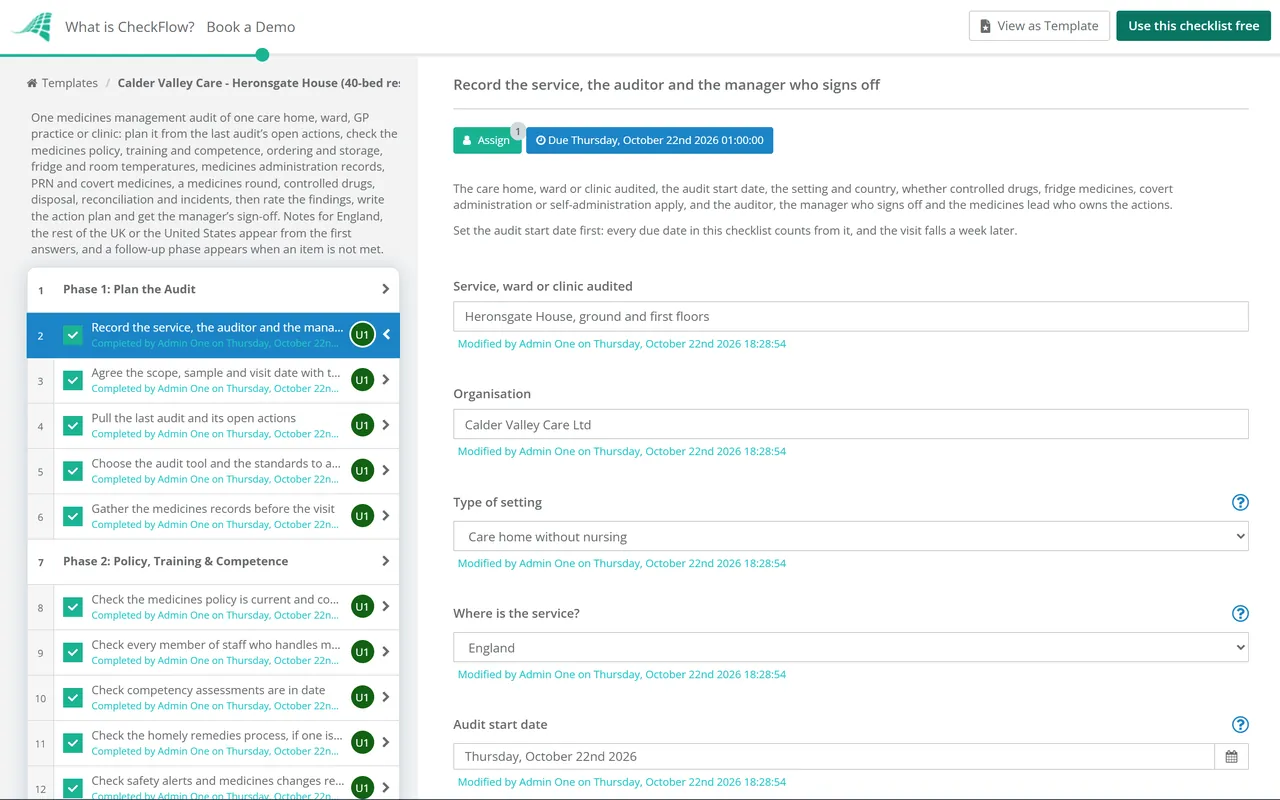
    • Record the service, the auditor and the manager who signs off — the care home, ward or clinic audited, the audit start date, the setting and country, whether controlled drugs, fridge medicines, covert administration or self-administration apply, and the auditor, the manager who signs off and the medicines lead who owns the actions
    • Agree the scope, sample and visit date with the manager — which sections apply, how many people’s medicines records to sample, which medicines round to observe, and the visit date
    • Pull the last audit and its open actions — which actions were closed, which slipped, and which sections were rated lowest last time
    • Choose the audit tool and the standards to audit against — your own medicines policy first, then the law and guidance for your country and setting, using your organisation’s tool or one from your pharmacy or local medicines optimisation team
    • Gather the medicines records before the visit — the medicines policy, the sampled medicines administration records and care plans, the controlled drugs register, room and fridge temperature records, order and delivery records, returns and disposal records, and incident and training records since the last audit
  2. Phase 2

    Phase 2: Policy, Training & Competence

    5 tasks

    Check the paperwork behind safe medicines handling before the visit: the policy, who is trained and who has been assessed as competent. NICE SC1 lists the written processes a care home medicines policy should include, and asks for an annual review of each person’s medicines competence.

    • Check the medicines policy is current and complete — reviewed on the date it promised, based on current law and guidance, and covering ordering, receiving, storing, administering, records, controlled drugs, covert administration, self-administration, transfers, incidents and disposal
    • Check every member of staff who handles medicines is trained — induction and medicines training recorded for each one, including bank and agency staff, plus training for any specialist technique they use, such as inhalers, eye drops or feeding tubes
    • Check competency assessments are in date — each member of staff assessed as competent before they first gave medicines, and their knowledge, skills and competence reviewed every year, or sooner after a medicines incident
    • Check the homely remedies process, if one is used — each non-prescription product named with who it is for and not for, the dose, the maximum daily dose, where it is recorded and when to refer to a GP, and signed by each member of staff who gives it
    • Check safety alerts and medicines changes reach staff — national patient safety alerts actioned within the time set, and changes to people’s medicines from letters, emails and phone calls recorded and acted on
  3. Phase 3

    Phase 3: Ordering, Receipt & Storage

    8 tasks

    Medicines must be stored securely, with only authorised staff having access, and in the conditions the manufacturer sets. No law sets one temperature range for every medicine: the range comes from each product’s own instructions. The fridge check appears when the service keeps medicines in a fridge.

    • Check how medicines are ordered — the service orders from the prescriber itself rather than leaving it to the pharmacy, at least two members of staff are trained to order, and a record is kept of every order
    • Check deliveries are checked against the order — each delivery checked against the record of the order, with missing or wrong items followed up so nobody goes without a medicine
    • Check medicines are locked away and keys are controlled — trolleys, cupboards and rooms locked when not in use, keys held by authorised staff only, spare keys stored securely, and nothing but medicines kept in medicines storage
    • Check the medicines room temperature record — a reading on every day the policy asks for, readings within the range the manufacturers set for the medicines stored there, and action recorded whenever a reading was out of range
    • Check the medicines fridge and its temperature record — shown when medicines are kept in a fridge: a fridge used only for medicines and locked or in a locked room, current, minimum and maximum readings recorded every day, the thermometer reset after each reading, and what was done when a reading was out of range
    • Check external medicines are kept apart from internal medicines — creams, ointments and lotions stored separately from tablets and liquids, each labelled for the person it was prescribed for, and any kept in people’s rooms covered by a risk assessment
    • Check expiry dates and opened-date labels — no expired stock in use, and the date of opening written on any product that expires sooner once opened, as its instructions say, such as eye drops, liquids and creams
    • Check each person’s medicines are used only for them — no medicines borrowed between people, ‘when required’ medicines kept in their original packs, and emergency medicines such as an adrenaline auto-injector quick to reach and in date
  4. Phase 4

    Phase 4: Medicines Administration Records

    8 tasks

    Read each sampled medicines administration record (MAR) against the care plan and the stock. Refer to people by room number or initials in the audit record. The covert administration check appears when anyone is given medicines without their knowledge.

    • Check each sampled MAR has the person’s details and allergies — full name, date of birth, weight where appropriate, the GP, and any known allergies with the type of reaction, matching the care plan
    • Check for gaps, unexplained codes and unsigned doses — every dose signed for once it was taken, or coded with a reason when it was not, codes explained on the chart, and mistakes corrected with a single line, a signature, the date and the time
    • Check refused and missed doses were followed up — each refusal recorded, the prescriber told when the policy says so, and a pattern of refusals or missed doses raised with the GP or pharmacist
    • Check ‘when required’ (PRN) records — a PRN plan for each medicine saying what it is for, the dose, the maximum in a day and the minimum gap between doses, and each dose recorded with the reason, the amount given and whether it worked
    • Check variable and time-sensitive doses — the dose actually given recorded when a range is prescribed, and medicines the prescriber or pharmacist has marked as time-sensitive given at the time set
    • Check handwritten entries and changes to the MAR — new handwritten records made only in exceptional circumstances, by a trained member of staff, and checked and signed by a second before first use, with the source of each change recorded
    • Check records for patches and creams — where each patch was applied and when the old one was removed, the site changed as the instructions say, and cream records showing what was applied, where and by whom
    • Check covert administration is lawful and recorded — shown when anyone is given medicines covertly: a mental capacity assessment, a best-interests decision agreed with the prescriber, a pharmacist and a family member or advocate, a plan for each medicine with pharmacist advice on how to give it, a review date, and the MAR showing which doses are given covertly
  5. Phase 5

    Phase 5: Administration Observed

    4 tasks

    Watch at least one medicines round as it happens. Record what you saw, not what staff say they usually do, and ask about anything you could not judge by watching. The self-administration check appears when anyone looks after their own medicines.

    • Observe a medicines round — the right person, medicine, route, dose and time checked for each dose, the person’s right to refuse respected, the record made as soon as the dose is taken, each person finished before the next, and interruptions kept to a minimum
    • Check ‘when required’ medicines are offered when needed — staff ask about pain and other symptoms and offer PRN medicines when the person needs them, not only at round times, including people who cannot ask
    • Check self-administration risk assessments and storage — shown when anyone looks after their own medicines: a risk assessment for each person, reviewed when it says, their medicines stored as the assessment says, such as in a lockable drawer in their room, and a record of what was supplied to them
    • Ask staff what they do after an error, a refusal or a reaction — who they tell, how they record it, how they get advice in and out of hours, and that a suspected adverse effect is reported to the prescriber
  6. Phase 6

    Phase 6: Controlled Drugs

    7 tasks

    This phase applies when the service holds controlled drugs; answer No on the first task to hide it. Count every controlled drug against its register balance. A balance that does not match adds a task to investigate and report it.

    • Check controlled drugs are stored in a CD cabinet — controlled drugs that need safe custody kept in a cabinet that meets the Misuse of Drugs (Safe Custody) Regulations 1973, nothing else stored in it, access limited to staff who need it, and spare keys secure
    • Check the controlled drugs register — a bound register with numbered pages or a compliant electronic register, a separate page for each medicine, strength and form, entries made on the day in date order, and corrections made in the margin with the date, never crossed out
    • Count each controlled drug against its register balance — every running balance counted, with a second member of staff where your policy asks for one, and the count recorded with the date and signatures
    • Investigate and report the controlled drugs discrepancy — shown when a balance did not match: trace the register and records back to the last correct balance, report it to the controlled drugs accountable officer and, where the policy says so, the police, and record what was found
    • Check controlled drug doses are signed and witnessed — each dose recorded in the register and on the MAR, signed by the member of staff who gave it and by a trained witness where your policy asks for one, with the site recorded for patches
    • Check controlled drug returns and destruction are recorded — unwanted and out-of-date controlled drugs kept apart from current stock, each return or destruction recorded in the register with a witness and the new balance, and destroyed only in the presence of an authorised witness where the law requires one
    • Check who controlled drug concerns are reported to — the policy names the controlled drugs accountable officer for the service, with current contact details for them, the police and anyone else to tell about a discrepancy, loss or theft
  7. Phase 7

    Phase 7: Disposal, Transfers & Incidents

    5 tasks

    Medicines errors often happen when people move between care settings. Check a sample of recent admissions and transfers, then review every medicines incident and near miss since the last audit.

    • Check medicines for disposal are stored and recorded — unwanted and expired medicines, including those of anyone who has died, kept in a tamper-proof container within a cupboard, recorded, and returned or collected promptly
    • Check medicines were reconciled for recent admissions — for each person admitted or back from hospital since the last audit, a current list checked against what they arrived with and their discharge information, any differences resolved with the prescriber or pharmacist, and the MAR updated, with the date and who did it
    • Check medicines information goes with people who leave — for a transfer, complete information about their medicines shared with the new service, ideally within 24 hours, and for a short absence, their medicines with clear directions and the times of the last and next doses
    • Review medicines errors and near misses since the last audit — each one recorded, including near misses and errors that caused no harm, its root cause found, action taken, and the learning shared with staff
    • Check medicines incidents were reported to the right people — safeguarding concerns through local safeguarding processes, notifiable incidents to the regulator, controlled drug incidents to the accountable officer, and the person or their family told what happened
  8. Phase 8

    Phase 8: Findings, Action Plan & Sign-off

    7 tasks

    Rate each section the same way every time, so this audit can be compared with the last. Any item rated Not met adds Phase 9. The manager signs off the report and action plan, and nothing after the sign-off can be completed until they do.

    • Escalate anything unsafe before you leave — tell the person in charge about any risk to someone’s safety, such as a missed critical dose or an unexplained controlled drug loss, and record what was done on the day
    • Rate each section and the overall result — each section from Phase 2 to Phase 7 rated by its items met, partly met and not met, leaving out items not observed; any item rated not met adds Phase 9
    • Write the action plan with owners and dates — one action for each item partly met or not met, with who will do it and by when, the most serious first
    • Write the audit report — what was audited and sampled, what was done well, the ratings, the actions, and anything that could not be checked and why
    • Manager signs off the audit report and action plan — Approved, Approved with conditions or Not approved, with any conditions or reasons recorded
    • Feed back the results to staff and governance — what went well, what must change and who owns each action, shared with the team, the pharmacist and the governance or medicines safety meeting
    • Set the date of the next audit — on the cycle your policy sets, sooner after a poor result, with open actions carried into it
  9. Phase 9

    Phase 9: Actions & Follow-up Check

    3 tasks

    Shown only when an item was rated Not met. Each action is put right by its owner, then the items that fell short are checked again.

    • Put right each item rated not met — each action done by its owner and evidenced, including retraining or reassessing staff where practice fell short
    • Re-check the items rated not met — the same items checked again with the same method, each recorded as now met or still not met
    • Manager closes the action plan — or sets a further check date if an item is still not met

Medicines Law and Guidance: What Each Source Says and Who It Covers

These are the main rules and guidance the notes in this checklist quote, what each one says and who it applies to. Several apply only to some settings, so check the right-hand column before you audit against a row. Your own policy, your pharmacist and your regulator have the final word for your service.

Source What it says Who it applies to
Misuse of Drugs (Safe Custody) Regulations 1973, regulation 3Controlled drugs not exempted by Schedule 1 are kept in a locked safe, cabinet or room built and maintained to prevent unauthorised access, unless the drug is under the direct personal supervision of the pharmacist or, on the other premises listed, the person in charge or a member of staff they designate.The premises the regulation lists, including retail pharmacies and the nursing homes and similar establishments it names. CQC says the regulations apply to all care homes providing adult social care in England.
Misuse of Drugs Regulations 2001, regulations 19 and 20A register of every quantity of a Schedule 1 or 2 drug obtained and supplied, with a separate page for each strength and form, entries on the day or the next day, no alterations, and corrections only by a dated marginal note or footnote.People authorised to supply Schedule 1 or 2 drugs. Regulation 19(3)(c) excludes the senior registered nurse in charge of a ward in a hospital or care home. CQC asks care homes to keep a register for Schedule 2 drugs.
Misuse of Drugs Regulations 2001, regulation 27A Schedule 1 to 4 drug is destroyed only in the presence of a person authorised by the Secretary of State or an accountable officer, and the record shows the date, the quantity and that person’s signature.People required to keep records under the regulations. CQC says Schedule 2 stock in a care home with nursing must be destroyed in the presence of an authorised witness.
Controlled Drugs (Supervision of Management and Use) Regulations 2013, regulations 7 and 8Each designated body appoints a controlled drugs accountable officer, and NHS England appoints one for each local intelligence network area.In England: NHS trusts, NHS foundation trusts, independent hospitals and NHS England. Care homes report to the NHS England accountable officer.
NICE guideline SC1, Managing medicines in care homesA medicines policy with written processes (1.1.2), storage temperatures and monitoring in the storage process (1.12.2), MAR contents (1.14.8), a trained witness for controlled drug doses (1.14.16), the covert administration process (1.15.3) and an annual competency review (1.17.5).Care homes, and the commissioners and practitioners who work with them, in England.
NICE guideline NG5, Medicines optimisationMedicines information shared when a person moves between settings, ideally within 24 hours (1.2.2), and medicines reconciliation within 24 hours in an acute setting (1.3.1).All care settings, in England.
CQC medicines information for adult social care servicesGuidance on controlled drugs, storage, MARs, ‘when required’ medicines, covert administration, medicines reconciliation and reporting medicines incidents.Adult social care providers registered with CQC in England.
42 CFR 483.45, pharmacy servicesA monthly drug regimen review by a licensed pharmacist, controlled drug records that allow an accurate reconciliation, PRN psychotropic orders limited to 14 days, medication error rates below 5 percent, locked storage under proper temperature controls, and separately locked, permanently affixed compartments for Schedule II drugs.Skilled nursing facilities in Medicare and nursing facilities in Medicaid (United States).
21 CFR 1301.75, 1301.76, 1304.04 and 1304.11 (DEA)Controlled substances in a securely locked, substantially constructed cabinet, theft or significant loss notified within one business day and DEA Form 106 filed within 45 days, records kept for at least two years, and an inventory at least every two years.DEA registrants, such as practitioners and pharmacies (United States).

Storage temperatures. No law quoted here sets a single temperature range for medicines. CQC says medicines must be stored as the manufacturer recommends, and NICE SC1 asks your storage process to say what the temperatures are and how they are monitored. Take each range from the product’s own instructions, and ask your pharmacist when a reading falls outside it.

Rating and the result. No national tool or pass mark is quoted here for a medicines audit. Rate each item Met, Partly met, Not met or Not observed, leave out what you could not observe, and rate every audit the same way so you can compare them. Any item rated not met adds the follow-up phase.

Why Run Medication Audits in CheckFlow?

1

The checks fit the service

The first task records the setting and the country, and whether the service holds controlled drugs, keeps medicines in a fridge, gives medicines covertly or has people looking after their own. The matching checks appear, the controlled drugs phase is hidden where none are held, and notes quote the rules for England, the rest of the UK or the United States.

2

No report goes out unsigned

The manager who signs off is chosen on the first task. The sign-off is assigned to them, and nothing after the approval step can be completed until they record a decision. A controlled drugs balance that does not match adds a task to investigate and report it.

3

Every audit on its cycle

Start each service’s audit on a recurring schedule. The due dates count from the audit start date, every run keeps its ratings, findings and action plan, and Analytics shows overdue and late tasks by person and step.

CheckFlow does not give clinical advice or decide whether a medicine is safe for someone. That judgement belongs to the prescriber, the pharmacist and the staff who know the person. It runs the audit around it: who checks what, by when, with what evidence, and who signed it off. CheckFlow’s healthcare checklist software shows how the same approach handles other clinical processes.

A medicines error found on the audit goes through the Healthcare Incident Reporting Process Checklist. Medicines lists for people leaving hospital are part of the Patient Discharge Checklist, US hospitals prepare medication management evidence with the Joint Commission Survey Readiness Checklist, and new nurses get their medicines competence signed off through the New Nurse Onboarding Checklist.

AI generator

Didn’t find what you need? Describe it.

Describe the process in a sentence and the AI checklist generator drafts the phases and tasks for you.

Frequently Asked Questions

What is a medication audit?

A medication audit is a structured check of how one service handles medicines, such as a care home, a ward or a clinic. The auditor reviews the medicines policy and training records, checks ordering, storage and temperatures, samples the medicines administration records, watches a medicines round, counts the controlled drugs and follows recent admissions and incidents through. The result is a rating for each section, findings, an action plan with owners and dates, and a manager’s sign-off. It checks the service against its own policy and the law; it is not a clinical review of each person’s medicines.

What should a medication audit checklist include?

At least the medicines policy, staff training and competence, ordering and receipt, secure storage with room and fridge temperature records, expiry dates and opened-date labels, the medicines administration records (gaps, codes, allergies, PRN, variable doses, patches and creams), a medicines round watched in practice, controlled drugs storage, register and balances, disposal and returns, medicines reconciliation on admission and transfer, and medicines errors and near misses. Add covert administration and self-administration where they apply, then finish with ratings, an action plan, a sign-off and the next audit date.

How often should a medicines audit be done?

None of the sources quoted on this page sets one national frequency. In England, Regulation 17 requires providers to have assurance and auditing systems, and CQC’s guidance on medicines reconciliation says to monitor the process through regular audit. Set the cycle in your medicines policy, audit sooner after a poor result or a serious incident, and run it as a recurring schedule so no service is missed. In US certified nursing homes, a licensed pharmacist must also review each resident’s drug regimen at least once a month under 42 CFR 483.45(c).

Do controlled drugs need two signatures?

The register rules in regulations 19 and 20 of the Misuse of Drugs Regulations 2001 do not ask for a second signature on each entry. Guidance does: NICE SC1 recommendation 1.14.16 says the member of staff who gives a controlled drug and a trained witness should both sign the register, and CQC calls it good practice for two trained members of staff to witness and sign when stock is received, balances are checked, doses are given and drugs are disposed of. CQC also says Schedule 2 stock in a care home with nursing must be destroyed in the presence of an authorised witness. Follow your policy, and audit against it.

What temperature should medicines be stored at?

The manufacturer’s instructions decide it, not a single legal range. CQC says all medicines have storage requirements set by the manufacturer and that your policies must say how staff monitor storage temperatures, and NICE SC1 asks the storage process to state the temperatures and how they are monitored. In US certified nursing homes, 42 CFR 483.45(h) requires storage under proper temperature controls. Record the readings your policy asks for, act on every reading out of range, and ask your pharmacist whether affected medicines can still be used.

When is covert administration of medicines allowed?

CQC says it is only likely to be necessary or appropriate when a person actively refuses a medicine, has been assessed under the Mental Capacity Act 2005 as lacking capacity to understand the consequences, and the medicine is essential to their health and wellbeing. A person with capacity has the right to refuse. NICE SC1 recommendation 1.15.3 asks for a capacity assessment, a best-interests meeting with care staff, the prescriber, a pharmacist and a family member or advocate, a recorded plan and regular reviews. The audit checks that each step is on record for each medicine.

Who should carry out a medication audit?

Someone trained and competent in managing medicines, using a standard tool, ideally from outside the team being audited. CQC’s guidance on good governance says staff in community pharmacies, medicines optimisation teams in integrated care systems and local authority teams may be able to help complete medicines reviews or medicines audits. The manager signs off the result, and the medicines lead owns the actions. For questions about a particular medicine or person, ask the prescriber or pharmacist.

Is CheckFlow free for this template?

14-day free trial, no card required. The Business plan is $10 per user per month after the trial. Full details at checkflow.io/pricing.

Audit Your Medicines, Then Close Every Action

Free trial — no credit card required.

14-day free trial, no credit cardFull refund in your first 30 daysUS hosting, EU on request