
Process Management Software for Real Estate Agencies
Real estate is a people and transactions business.
The quality of service a client receives depends almost entirely on which agent handles their instruction, whether that agent follows a consistent transaction process, and whether the brokerage gave them the tools and structure they needed to succeed. When a new agent leaves early, poor onboarding, the absence of consistent systems or a lack of structured follow-through is often part of the story. The agent who leaves after nine months often wasn’t unsuited to the industry. They weren’t given the process infrastructure that turns early potential into a sustainable practice.
CheckFlow gives real estate agencies and brokerages the documented, repeatable workflows that turn agent onboarding, transaction management, and client compliance from individual habits into firm-wide standards. Every new agent gets the same structured onboarding experience. Every property instruction follows the same listing and transaction sequence. Every client is onboarded with the same compliance checks and communication commitments. And every completed transaction is followed up on the same schedule, so referrals don’t get lost and repeat business doesn’t depend on the agent remembering to call.
14-day free trialNo credit cardUnlimited free guests

Last updated
Process management software for real estate agencies turns the work around every agent and every sale into checklists that run the same way each time. In CheckFlow, estate agent onboarding, listings and transactions, client onboarding and AML checks for estate agents, and post-sale follow-up each get a template with named owners, due dates and steps that cannot be skipped. UK estate agencies and US brokerages get a dated record of every step.
Where Process Breakdowns Cost Real Estate Agencies
Real estate transactions do not fail only because of market conditions or difficult clients. They fail because of process breakdowns: the offer that was never communicated because the weekend cover agent wasn’t briefed on the transaction. The buyer who went cold because nobody followed up for two weeks while the chain progressed. The exchange that was delayed because the solicitor chasing was the client, not the agent. The new agent who had every quality needed to succeed but left after six months because nobody structured their first quarter properly and their pipeline never materialised. Every one of these is a process failure, not a talent failure, not a market failure. And every one is preventable with a structured, consistently applied workflow.
Every client gets the same quality of agent
The client who instructs the top-performing agent gets a specific, consistent experience: regular updates, proactive transaction management, and a follow-up rhythm that feels organised and professional. CheckFlow deploys the same structured process to every agent, so the quality of the client experience is determined by the agency’s standards, not by the individual agent’s habits.
Transactions tracked to completion, not left to momentum
A property transaction involves a sequence of interdependent steps across multiple parties, each of which can stall if not actively chased. CheckFlow structures the transaction progression workflow: sale agreed actions, legal instruction confirmation, survey scheduled, mortgage offer received, exchange date set, completion confirmed. Every critical milestone tracked, every overdue step flagged.
Compliance built into the transaction, not bolted on at the end
AML checks, material information disclosure, agency agreement compliance, and data protection obligations apply to every transaction. CheckFlow embeds the compliance steps into the transaction workflow at the correct stage, requiring completion before the process can advance. The step to launch the marketing stays locked until the material information is signed off. The step to accept an offer stays locked until AML is documented.
Why Real Estate Agencies Choose CheckFlow
Agent retention starts with structured onboarding
Early agent attrition in real estate is not primarily a talent problem. It is a support system problem. Agents who leave the industry early often point to unclear expectations, no system for generating leads consistently, and no structured progression through the early months. CheckFlow structures the new agent onboarding experience so that expectations are set clearly, systems are established in the first week rather than the first quarter, and the 30/60/90 day milestone reviews happen on schedule rather than when the manager finds time.
Transaction management that scales with the pipeline
An agent managing one or two transactions can hold the full picture in their head. An agent managing twelve simultaneous transactions across different stages, with different legal teams, and different exchange timelines, cannot, and the transaction that falls through because an exchange date wasn’t chased is a commission that cannot be recovered. CheckFlow structures every active transaction as a running checklist: current stage, next required action, overdue flags, and the comments and activity on the file. The pipeline visible to the agent, the manager, and the covering agent when someone is on holiday.
Compliance applied at the right moment, not after it
AML checks completed after the offer is agreed, material information compiled after viewings have happened, agency agreement signed after the marketing has launched: these are the compliance failures that create regulatory exposure. CheckFlow embeds the compliance steps into the transaction workflow at the correct stage, requiring completion before the process can advance. The process enforces the sequence that protects the agency.
How Real Estate Agencies Use CheckFlow
From the day a new agent joins to the moment a completed transaction generates a referral, CheckFlow structures the recurring workflows that determine whether a real estate agency scales with consistent quality or consistent variability.
Agent onboarding
New Agent Onboarding
The brokerage that gives a new agent a desk and a target on day one and expects them to figure out the rest produces the attrition rate the industry accepts as inevitable.
CheckFlow structures the new agent onboarding process from before day one: licence verification and documentation, system and MLS access setup, brand standards and compliance training (fair housing, disclosure requirements, agency agreement terms), CRM configuration, territory or panel introduction, lead generation approach, and a 30/60/90 day milestone plan with structured check-ins. The agent who completes a structured onboarding programme doesn’t just start faster: they start with the systems a sustainable practice is built on.
- Check-ins fall due 30, 60 and 90 days after the start date you enter
- Reminders go to the agent and the branch manager before each one
Instruction to completion
Property Instruction & Transaction Management
Every new instruction follows the same sequence: valuation and pricing agreed, agency agreement signed, material information compiled and approved, photographs and floor plan completed, listing copy reviewed and published, portal syndication confirmed. Once a sale is agreed: both parties notified in writing, solicitors instructed on both sides, survey scheduled, mortgage application status monitored, exchange timeline set, and completion logistics confirmed.
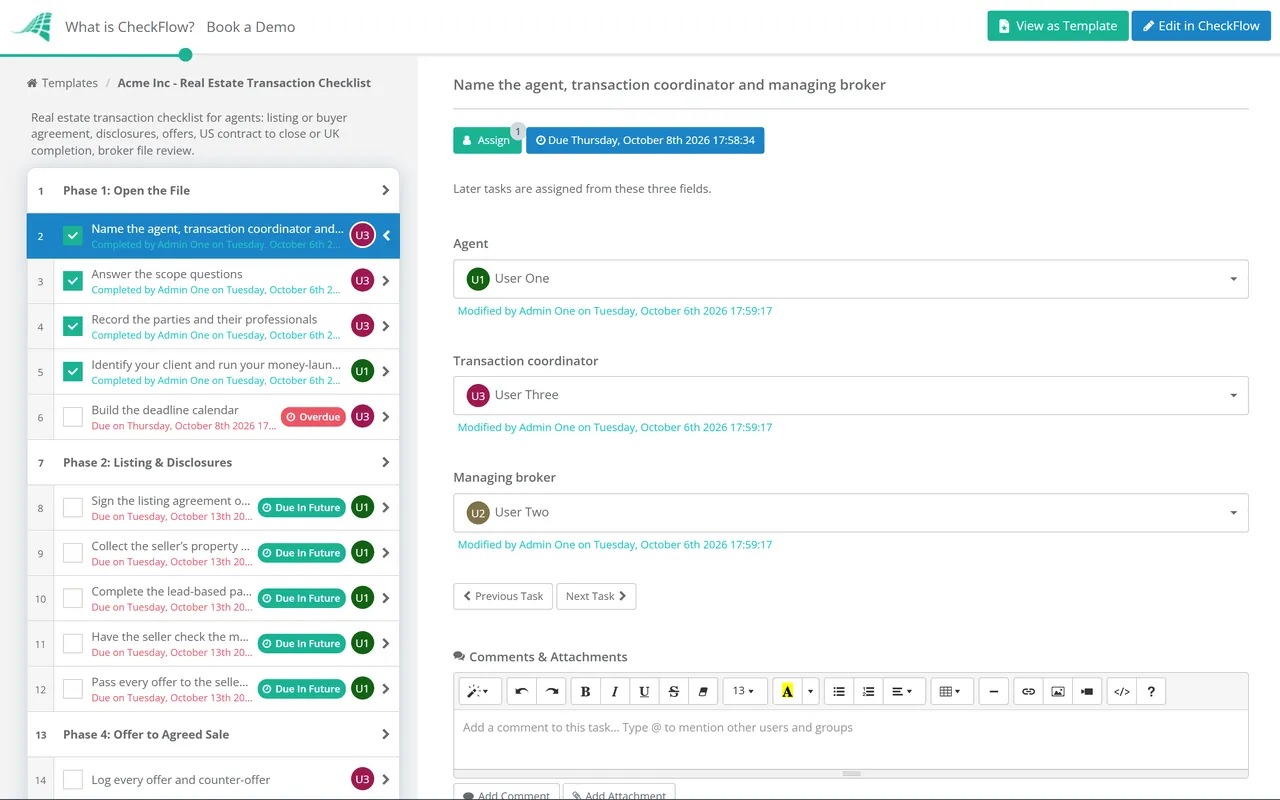
CheckFlow structures every stage of the transaction lifecycle, so every deal is managed to the same standard, the same communication rhythm, and the same proactive chasing schedule regardless of which agent holds the instruction. The free Real Estate Transaction Checklist runs that sequence from listing to completion, with separate steps for UK and US sales.
- One answer at the start shows the England and Wales or the US phases
- Every deadline is assigned to the person who has to meet it
Client Onboarding & AML Compliance
Conveyancing and property transactions are among the highest-risk areas for money laundering: large sums change hands, property values are difficult to dispute, and the transaction process provides legitimate cover for funds movement. In the UK, estate agents must carry out AML checks on both the buyer and the seller under the Money Laundering Regulations, and the EU’s anti-money laundering rules also cover estate agents. CheckFlow structures the client AML and onboarding workflow: identity verification for buyers and sellers, source of funds assessment for cash buyers or unusually large deposits, PEP and sanctions screening, risk classification, and the agency agreement sign-off that establishes the terms of the relationship. Every client onboarded with a dated, attributed record.
Customer Due Diligence ChecklistPost-Sale Follow-Up & Client Retention
The completed transaction that is never followed up is the referral that never happened. The vendor who sold through the agency and was called once, six months later, by an agent who had forgotten most of the details of their sale. The investor client who bought two properties and was never contacted about a third. CheckFlow structures the post-completion follow-up programme: completion confirmation and congratulation, satisfaction check-in at 30 days, referral request at 90 days when the move is settled, six-month and annual follow-up for investor clients, and market update for potential future vendors. The database of past clients that many agencies never systematically reactivate.
Sales Follow-Up Checklist
Ready-to-Use Templates for Real Estate Teams
Start from a template for the process causing the most fall-throughs or the most compliance risk, adapt it to your market, and run it on your next instruction. Each one is fully editable in the CheckFlow template designer.

Real Estate Transaction Checklist

Real Estate Client Onboarding Checklist

Customer Due Diligence Checklist
Purchase and Sales Agreement Process Checklist

Employee Onboarding Checklist

Sales Follow-Up Checklist
Relevant Template Libraries for Real Estate Teams
CheckFlow’s template library covers the core operational processes that real estate agencies and brokerages run repeatedly, from new agent onboarding and property instruction through to client compliance, transaction management, and post-sale retention.
Customer Management Templates
Client onboarding, relationship management, and customer success: the structured workflows for managing buyer and seller relationships from first registration through to post-sale follow-up and referral management.
Browse customer templatesSales Templates
Pipeline management, follow-up cadence, sales call tracking, and pitch preparation: the business development processes that determine instruction win rates and the consistency of new business generation across the team.
Browse sales templatesEmployee Onboarding Templates
New hire onboarding, expectations setting, development planning, and performance milestones: the structured process that gives every new agent the system foundation they need to establish a sustainable practice rather than failing in their first year.
Browse onboarding templatesDue Diligence Templates
Customer due diligence, AML checks, and counterparty assessments: the structured KYC and AML workflows that must be completed consistently for every buyer, seller, and cash purchaser under applicable estate agent money laundering regulations.
Browse due diligence templatesLegal & Contract Management Templates
Contract review, NDA processing, and agreement management: the document workflows that govern agency agreements, offer letters, and the legal documentation that real estate transactions require at every stage.
Browse legal templatesHuman Resources Templates
Recruitment, interviewing, performance reviews, and team capacity management: the HR processes for building and retaining a high-performing agent team in an industry where turnover is the primary operational risk.
Browse HR templates
Ask your AI assistant which sales need chasing this week.
CheckFlow works with any AI assistant. Connect it once and it reads and works your checklists with the same permissions as the person whose API key it holds.
Ask your AI assistant
Through the CheckFlow MCP server, Claude, ChatGPT, Gemini, Grok, Copilot or any other AI assistant can find a transaction or agent onboarding checklist, list the steps still open and who owns them, and open the file for the next instruction.
Read the MCP guideDraft the template from a sentence
Describe your sales progression process or paste your AML procedure and the free AI checklist generator drafts the template, with phases, fields and due dates in place.
Try the AI generatorConnect your other systems
Start a transaction checklist when a sale is agreed in your CRM, through Zapier or the REST API, and get a webhook when it completes.
Developer overview
Which of my sales are waiting on the buyer’s money-laundering checks?
template: "Real Estate Transaction"
status:   "InProgress"
Seven transactions are in progress. On two, “Identify your client and run your money-laundering checks” is still open. Shall I list those two files and who owns each step?
Used by great companies









This is a great app for documenting and managing your processes. … It is particularly good for time sensitive processes as you can set up a sequence of task due reminder emails at whatever time frames you want.
Real Estate Process Management: Frequently Asked Questions
Why do so many real estate agents fail in their first few years, and how does process management address this?
The causes agents and brokers describe are consistent, and they are not market difficulty or insufficient sales skill: the absence of a systematic approach to lead generation and follow-up, unclear expectations at the start of the role, and a lack of structured support during the critical first months when pipeline is being established and habits are being formed. Effective onboarding means structured process as well as compliance training. The agent who starts with a 30/60/90 day plan, a configured CRM, and a structured daily activity workflow is far better placed to succeed than the one who starts with a desk and a target.
What AML compliance obligations apply to estate agents?
Estate agents in the UK are covered by the Money Laundering Regulations 2017 (as amended) and are supervised by HMRC for AML compliance. This means agents must conduct customer due diligence on both buyers and sellers, including identity verification, beneficial ownership checks for corporate clients, and source of funds assessment for cash buyers or unusual funding arrangements. Checks on the buyer must be finished before a binding contract is entered into, and records must be kept for five years after the business relationship ends. Letting agents are covered where the monthly rent is £10,000 or more. Failure to comply can result in HMRC civil penalties and, in serious cases, criminal prosecution. In the US, FinCEN’s Residential Real Estate Rule, which would require reports on certain non-financed transfers of residential property to entities and trusts, took effect on 1 March 2026, but a federal court vacated it on 19 March 2026. FinCEN has appealed; while that order stands, no reports are required, and the duty to report falls on closing and settlement professionals rather than on agents acting as agents. CheckFlow structures the AML due diligence workflow and creates the contemporaneous record that demonstrates compliance, but note that CheckFlow is a process management tool, not a compliance advisory service. Always consult qualified legal and compliance counsel for jurisdiction-specific obligations.
How does CheckFlow help manage multiple simultaneous property transactions?
Each active transaction is managed as a running CheckFlow checklist, showing the current stage, the next required action, any overdue steps, and the comments and activity on the file. When an agent has twelve simultaneous transactions at different stages, the Tasks Grid shows exactly which steps are due or overdue today across all of them, which milestones are approaching, and which legal teams haven’t been chased. When a team member is absent, the covering agent sees the full transaction status without needing a handover call, and their open tasks can be reassigned in one action. Managers can see the pipeline status across the whole team in the Reports Grid, not to micromanage, but to identify transactions that are stalling and intervene before they fall through.
Can CheckFlow be used across both residential and commercial real estate operations?
Yes. CheckFlow supports separate process templates for different transaction types: residential sales and purchases can follow one workflow, commercial lettings another, and development project management a third. Each reflects the specific stages, compliance obligations, and communication requirements of that transaction type. Commercial real estate teams can add lease negotiation stages, heads of terms documentation, and due diligence workstreams specific to commercial transactions. Residential teams can focus on the buyer and seller communication rhythms, chain management, and AML obligations specific to residential conveyancing. Templates can also be differentiated by market type: new build, resale, auction, or land and development.
Give Every Agent the Systems They Need to Succeed, From Day One
Free 14-day trial, no credit card required. Pick the process causing the most fall-throughs, start from a template, and run it with your team today.
14-day free trial, no credit cardFull refund in your first 30 daysUS hosting, EU on request