
Sales Onboarding Software
Give every new sales rep the same structured start, whoever’s managing them.
The difference between a rep who ramps in 3 months and one who takes 7 usually isn’t talent. It’s the manager. When onboarding lives in a Google Doc, a Notion page or someone’s memory, results are inconsistent. Great managers run thorough onboarding. Disorganised ones don’t. And you don’t find out which kind you have until the rep hands in their notice at month 4.
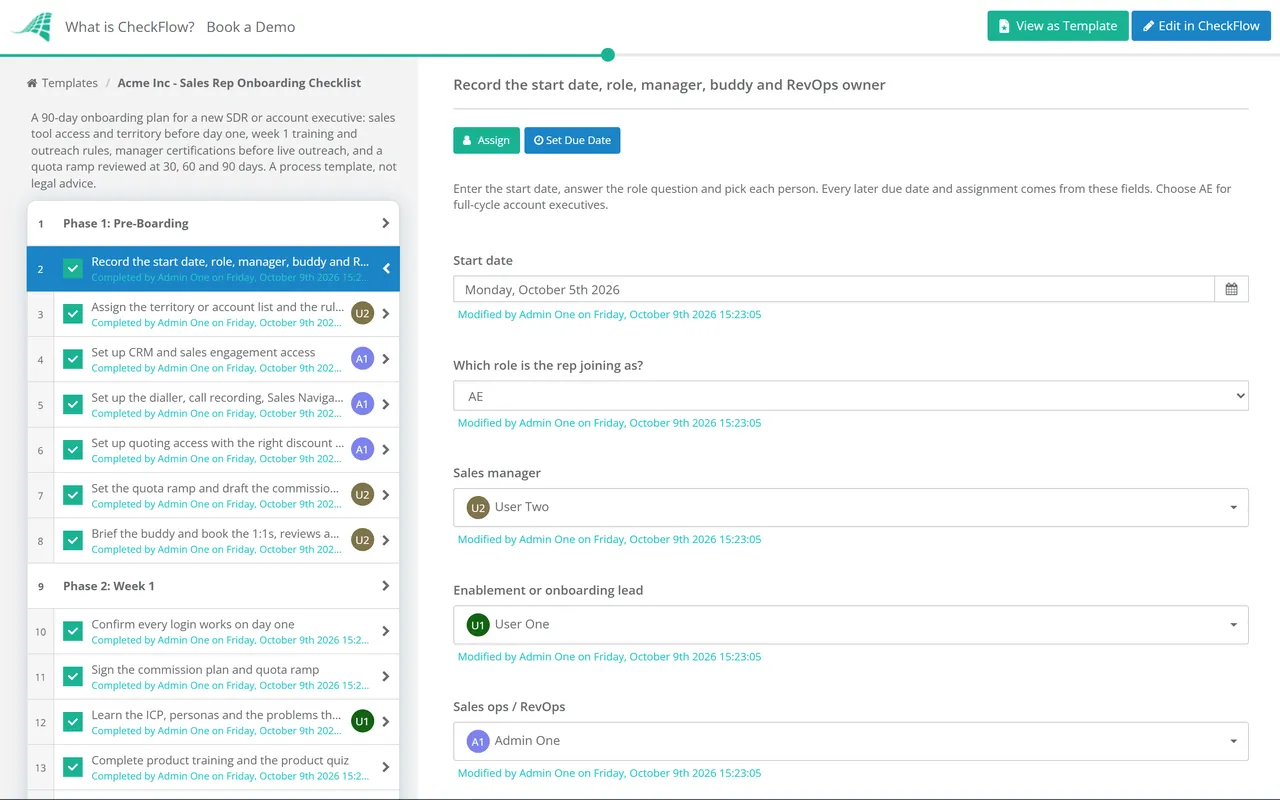
CheckFlow turns your sales onboarding into a structured, repeatable process: CRM access provisioned before day one, product training completed by the end of week one, call shadowing signed off, qualification gates in place, 30-60-90 milestones tracked. Every step assigned to the right person (IT, HR, the manager, the rep), every completion visible in real time, every new hire on the same path to hitting quota.
14-day free trialNo credit cardUnlimited free guests
Last updated
Sales onboarding software gives every new rep the same structured ramp, whoever manages them. In CheckFlow you build the onboarding once: pre-start setup for IT and HR, week-one training, call shadowing and 30-60-90 milestones that need a manager’s sign-off. Each new hire gets a checklist with every task assigned and dated, and Sales Ops sees exactly where every rep is.
Sound familiar?
Sales onboarding fails for one of two reasons: either the process doesn’t exist, or it exists but it’s manager-dependent. When the process lives in a manager’s head, every new hire gets a slightly different experience. Some get a thorough first week. Others get a laptop, a Salesforce login and “ask if you have questions”. You only find out which kind they got once the ramp data comes in, or once the rep leaves.
The laptop and logins aren’t ready on day one
IT was waiting on HR. HR thought the manager handled it. The rep spends their first three days watching other people work, and the impression it creates is exactly the wrong one for a team you want to retain for three years.
Onboarding quality depends on the manager
The rep who got Manager A ramped in 10 weeks. The rep who got Manager B is still finding their feet at month 5. Same role, same territory, same product. Different managers, wildly different outcomes.
No visibility into where each rep actually is
Sales training said they covered the competitive landscape. Did they cover it with this specific rep? Did the rep actually retain it? Without a checklist that requires a sign-off, you’re guessing, at the moment when accuracy matters most: before the rep goes live on pipeline.
Pre-boarding left to the last minute
The offer was accepted three weeks ago. Day one arrives and the manager hasn’t set up Salesforce, hasn’t scheduled intro calls, hasn’t briefed IT about the start date. The first week is reactive improvisation instead of structured orientation.
Early leavers are the most expensive kind
Poor onboarding drives early attrition. A rep who leaves at month 3 because they never felt set up for success costs you the recruiting fee, the ramp time and the pipeline they never built: one of the most expensive problems in sales operations.
Ramp time varies wildly across the same team
You’ve built a team of 20. Each rep was onboarded slightly differently, by a different manager, in a different order. Some got the ICP deep-dive; some didn’t. Some had a 30-day milestone review; some were already on cold calls by week 2. Standardising now is a retroactive project. It didn’t have to be.
How CheckFlow works for sales teams
One checklist template per role. Runs for every new hire, with every task assigned to the right person before day one.
Build your sales onboarding checklist once
Capture every step: pre-start IT provisioning, day one introductions, product training, competitive positioning, call shadowing, CRM hygiene standards, 30-60-90 day milestones. Assign each step to the right person: IT handles system setup, HR handles compliance steps, the manager handles training schedules, and the rep completes their own tasks. Takes an afternoon to set up; runs the same way from then on.
Start it for each new hire in seconds
When a new rep joins, start a new checklist. The pre-start tasks go out straight away: IT gets their setup tasks, HR gets theirs, the manager gets theirs, all before day one. No coordinating emails, no hoping someone remembers. Each person sees what they need to do and gets automatic reminders as their steps fall due.
Track every rep’s progress in real time
The manager, HR and Sales Ops see real-time completion status across every current new hire. Who’s completed CRM training? Who still needs to finish their call shadowing? Who’s on track for their 30-day sign-off? Every step visible, every milestone on record, every gap surfaced before it becomes a 90-day problem.
Built for how sales onboarding actually works
Sales onboarding isn’t just the manager’s job. IT provisions the tools. HR handles compliance. The manager runs training. The rep does the learning. When four parties are involved in a single process with no shared system, steps fall between them. CheckFlow closes those gaps: one checklist that spans every person, every step, every stage of the ramp.
Milestones
30-60-90 day milestone gates
Build specific milestones the rep must hit before advancing: first CRM-logged call, first solo demo, first self-sourced meeting. Each milestone needs a manager sign-off before the rep moves on to unsupervised pipeline activity. The ramp has structure, not just hope. And every sign-off is on record.
- A halt task keeps the next phase locked until the manager signs off
- Only Assignees Can Complete means only the manager can sign it
Visibility
Manager and Sales Ops visibility
A live view of every new hire’s checklist: which steps are complete, which are in progress and which are overdue. Not “how are you getting on?” over Slack, but a factual record of exactly where each rep is in the process. Step in early when a rep is behind. Confirm readiness before they go live on pipeline.
Pre-start provisioning checklist
Send IT their setup tasks the moment the checklist starts: laptop ordered, email provisioned, CRM account set up, sales intelligence tools configured, phone system active. Separate tasks go to IT, HR and the manager, all due before day one and all tracked. The rep arrives to a working setup, not a waiting game.
Learn moreDay one and week one structure
Give the first week a backbone. Assigned tasks cover team introductions, systems access confirmation, product demo watch, sales methodology training, ICP session, competitive positioning and initial call shadowing. The rep knows exactly what to do each day. The manager doesn’t have to reinvent the orientation for every hire.
Learn moreNo new-hire login required
New hires complete their steps on a shared link, with no new platform to learn in an already overwhelming first week, or log in as a free Guest to see just the tasks assigned to them. They complete them on any device. The record is created, and the manager sees it update in real time.
Learn moreConsistent onboarding at scale
The same checklist template runs for every new hire, regardless of which manager they report to, which office they’re in, or whether they’re employee 5 or employee 50. Scale the sales team without onboarding quality varying with the luck of the draw on managers. Best practices are in the template. The template is the standard.
Learn more
Ready-to-use sales templates
Don’t start from a blank page. Pick a proven sales template, customise it to your pipeline, process and team, and run it in minutes. Each one is fully editable in the CheckFlow template designer.
Sales Rep Onboarding Checklist
Sales Pitch Checklist
Sales Follow-Up Checklist
Sales Call Tracker Checklist
Sales Pipeline Stages Checklist
Call Center Sales Quality Assurance Checklist
For phone-based sales and service teams, the Call Centre Agent Onboarding Checklist covers scripts, call recording rules and nesting. For SDRs and account executives, start with the Sales Rep Onboarding Checklist: four phases to a ramp decision at 90 days.
What a structured sales onboarding checklist looks like
The four phases every new sales hire should move through, and the tasks that typically fall between the cracks when there’s no system enforcing them.
01Before day one
- Offer letter and contract signed and filed
- Laptop ordered, shipped and confirmed arriving before start date
- Email address and calendar provisioned
- CRM account created with territory assignment and deal stage configuration
- Sales intelligence tools set up: LinkedIn Sales Navigator, Apollo, Gong or equivalent
- Phone and communication tools configured and tested
- Onboarding buddy assigned and notified
- Week 1 calendar pre-populated with intro meetings and training sessions
- Welcome email sent from the hiring manager
- Preboarding materials sent: company overview, product docs, competitive landscape summary, ICP definition
02Day one & week one
Day one tasks
- Full team introductions: Sales, Marketing, Product, Customer Success
- Systems access confirmed working: CRM, Slack, email, call recording tools
- Recorded product demo watched independently
- Company pitch deck and core value proposition reviewed with manager
- Compliance and data protection training completed
Week one tasks
- Sales methodology training completed (MEDDIC / SPIN / Challenger / BANT as applicable)
- Ideal Customer Profile (ICP) and buyer persona deep-dive session
- Competitive positioning workshop or structured self-study completed
- CRM navigation training: logging activities, updating pipeline stages, maintaining hygiene
- Shadow 3 or more discovery calls with senior reps
- Review 5 recent call recordings from top performers
03Weeks two to four
- First solo discovery call completed with manager present and structured feedback
- Objection-handling role-play session completed and scored
- Full product demo delivered independently to manager for assessment
- CRM data hygiene standards understood: pipeline stages, activity logging, next action dates
- 5 recorded calls self-reviewed with written self-assessment submitted
- First self-sourced meeting booked through independent outreach
- Product knowledge quiz or certification passed
- Manager sign-off: rep is ready to run unsupervised discovery calls
0430-60-90 days
Day 30
- All foundational training completed and sign-offs on record
- CRM pipeline at shadow quota level with correctly staged opportunities
- First full product demo delivered independently, without manager present
- Manager confirms: rep can progress to independent pipeline development
Day 60
- First self-sourced meeting held and documented in CRM
- First formal proposal sent to a qualified prospect
- Pipeline at the required coverage ratio for the role
- Manager reviews and signs off on 60-day milestone
Day 90
- First deal closed, or first deal in late stage (for enterprise AE roles)
- Activity KPIs consistently met over prior 4 weeks: calls, demos, pipeline adds
- CRM data hygiene maintained to team standard
- Manager signs off: rep is fully ramped and operating independently
The free Sales Rep Onboarding Checklist follows these four phases. Customise it in the template designer for your sales cycle, role type and team structure, and run the first one today.
Ask your AI assistant who is behind on their ramp.
CheckFlow works with any AI assistant. Connect it once and managers can check every new rep’s progress from the assistant they already use.
Ask your AI assistant
Through the CheckFlow MCP server, Claude, ChatGPT, Gemini, Grok, Copilot or any other AI assistant can start onboarding for a new rep, list the sign-offs that are still open, and complete or reassign a task.
Read the MCP guideDraft the template from a sentence
Describe your ramp plan in a sentence and the free AI checklist generator drafts the template, with phases, fields and due dates in place.
Try the AI generatorConnect your other systems
Start a rep’s onboarding when your ATS or HRIS records the hire, through Zapier or the REST API, and get a webhook at each milestone.
Developer overview
Which new reps still need their 30-day sign-off?
template: "Sales Rep Onboarding"
assignee: "all"
status:   "Incomplete,DueInFuture,Overdue"
Three: Jordan P. (due Wednesday), Mia K. (overdue by two days) and Sam O. (due 18 November). All three are assigned to Alex M.
Used by great companies









It has changed the way our team works. We work more efficiently and our work is more consistent since using CheckFlow.
Frequently asked questions
How is CheckFlow different from Highspot, Mindtickle, or Seismic?
Highspot, Mindtickle and Seismic are sales enablement and readiness platforms: they manage content libraries, deliver coaching programmes and run skills assessments for established sales teams with dedicated enablement functions, usually on annual contracts. CheckFlow is the process execution layer: the structured checklist that makes sure every new rep completes every step in the right order, with the right person assigned to each task. No content library to build, no methodology to configure, no multi-month implementation. Set up in an afternoon. Highspot and Seismic announced in February 2026 that they would merge, and now operate as one company under the Seismic name.
Do new sales hires need to create an account to use CheckFlow?
No. New hires can complete their steps on a shared checklist link, on any device, without creating an account or installing an app. If you’d rather they logged in, add them as a free Guest and they see only the tasks assigned to them. Either way, it removes a source of friction in an already information-heavy first week, and managers and HR see completion status update in real time as the new hire works through their tasks.
Can CheckFlow assign different tasks to IT, HR, and the manager simultaneously?
Yes. This is one of CheckFlow’s core strengths for sales onboarding. A single checklist can have steps assigned to different roles: IT handles system provisioning before day one, HR handles compliance and documentation steps, the manager handles training schedules and milestone sign-offs, and the rep completes their own training tasks. Everyone gets their own tasks and reminders. The manager sees the full picture. Nothing falls between departments.
How does CheckFlow help reduce sales rep ramp time?
Structured onboarding is widely linked to better retention: research attributed to Brandon Hall Group found that a strong onboarding process improves new-hire retention by 82%. The mechanism is simple: consistent execution. When every rep goes through the same structured sequence (CRM access before day one, product training before call shadowing, competitive positioning before cold outreach, manager sign-off before independent pipeline activity) they avoid the setup delays and knowledge gaps that slow ramp time. CheckFlow enforces that sequence and makes it the same for every rep, regardless of manager.
Can I build 30-60-90 day onboarding plans in CheckFlow?
Yes. CheckFlow is well suited to milestone-based onboarding. Build three sequential phases (30-day, 60-day, 90-day) with specific tasks and required sign-offs at each milestone. The manager signs off at day 30 that foundational training is complete, and a halt task keeps the next phase locked until they do. At day 60 and day 90, further sign-offs confirm the rep is on track. Each milestone produces a timestamped record, so the complete ramp is documented from pre-start through to full quota.
We already use an ATS and HRIS. Does CheckFlow replace those?
No. CheckFlow is the process execution layer that sits alongside your ATS (Greenhouse, Lever or Workday Recruiting) and HRIS (BambooHR or Rippling). Your ATS manages the hiring pipeline; your HRIS holds the employee record and runs payroll. CheckFlow handles the structured, multi-party onboarding checklist: the task sequence that makes sure IT has provisioned tools, HR has completed documentation, the manager has run training, and the rep has hit their milestones. Each system handles its own domain; CheckFlow handles the execution.
What does CheckFlow cost for a sales team?
CheckFlow’s Business plan is $10 per user per month (or $9 billed annually), counted for the people who work in CheckFlow, not the reps being onboarded. New hires who complete their steps on a shared link, or as Guests, are free. So a Sales Ops manager, a VP Sales and an HR lead running onboarding for 10 new reps a quarter would pay $30 a month on monthly billing, plus a seat for anyone in IT who works their setup tasks in CheckFlow. See the full pricing page for details.
Your next new hire shouldn’t be onboarded differently from the last one
Free trial, no credit card required. Build the sales onboarding checklist that runs the same structured ramp for every new rep, with full visibility for managers, HR and Sales Ops.
14-day free trial, no credit cardFull refund in your first 30 daysUS or EU hosting