Joint Commission Survey Readiness Checklist Template

A hospital survey arrives unannounced, in a window you can predict but on a morning you cannot. Readiness that starts when surveyors sign in at reception has started too late.

Most hospitals know roughly when their next full survey is due. What goes wrong is the gap between surveys: owners change, the manual changes and last cycle’s corrective actions quietly lapse. This free Joint Commission survey readiness checklist gives accreditation, quality and regulatory managers and chief nursing officers one workflow for the whole cycle: setting up ownership against the 2026 manual and National Performance Goals, mock tracers on a steady rhythm, a survey-week plan from the surveyor’s arrival to the exit conference, and the Evidence of Standards Compliance (ESC) that follows. Two questions at the start show an application phase for a first survey and a Medicare follow-up task for hospitals that use accreditation for deemed status.

Use This Template Free See Live Example
No Credit Card Required

Last reviewed: October 2026

What the Survey Tests, and What Changed in 2026

Hospital surveys are unannounced. The Joint Commission says to expect the next full survey 30 to 36 months after the previous one, and surveyors arrive no earlier than 7:45 a.m. on the first day. An accreditation decision lasts about three years. A Life Safety Code surveyor is part of every hospital survey. Most of the clinical survey time goes on tracers: surveyors follow individual patients through the care they received, reading the record, watching care and talking to the staff involved. Since May 2024 infection prevention and medication management have been assessed within those individual tracers rather than in a separate meeting, and the old data session is now the Organization Quality and Performance Improvement (OQPI) session. Staff on every unit have to show and explain what they do; polished binders do not help.

From 1 January 2026, under its Accreditation 360 programme, Joint Commission rewrote the hospital and critical access hospital manuals. It removed 714 hospital requirements. The National Patient Safety Goals chapter was replaced by 14 National Performance Goals, which gather requirements that go beyond the Medicare Conditions of Participation, and staffing is now one of those goals. Environment of Care and Life Safety were merged into one Physical Environment chapter. A Survey Process Guide replaced the Survey Activity Guide, and surveyors now record strengths as well as findings in a SAFEST report. Joint Commission says no new concepts were introduced. Even so, any readiness binder or policy cross-reference built before 2026 points at standards that have moved.

This checklist covers readiness and closing findings. Events between surveys belong in the Healthcare Incident Reporting Checklist, file-level credentialing in the Healthcare Staff Credentialing Checklist, and privacy and security in the HIPAA Compliance Audit Checklist. Readiness itself has two halves.

Between surveys

Keep the hospital survey-ready

  • An owner for every chapter and every National Performance Goal
  • Mock tracers on a fixed rhythm, with findings logged and re-checked
  • Last cycle’s high-risk findings still corrected and still evidenced
  • The E-App kept in step with the services you actually provide
Survey and after

Run the week, then close the findings

  • An arrival procedure that works on any weekday morning
  • Escorts, scribes and a debrief after each daily briefing
  • Every finding plotted on the SAFER Matrix and given an owner
  • An ESC with completion dates, signed off and submitted within 60 days

What the Joint Commission Survey Readiness Checklist Covers

Seven phases run from setting up the cycle to feeding lessons into the next one. Phase 2 appears only for a first survey, and the Medicare follow-up task in Phase 6 appears only when the hospital uses accreditation for deemed status.

Setup

Phase 1: Set Up the Cycle

Answer the two scope questions first. They decide whether the application phase and the Medicare follow-up task appear.

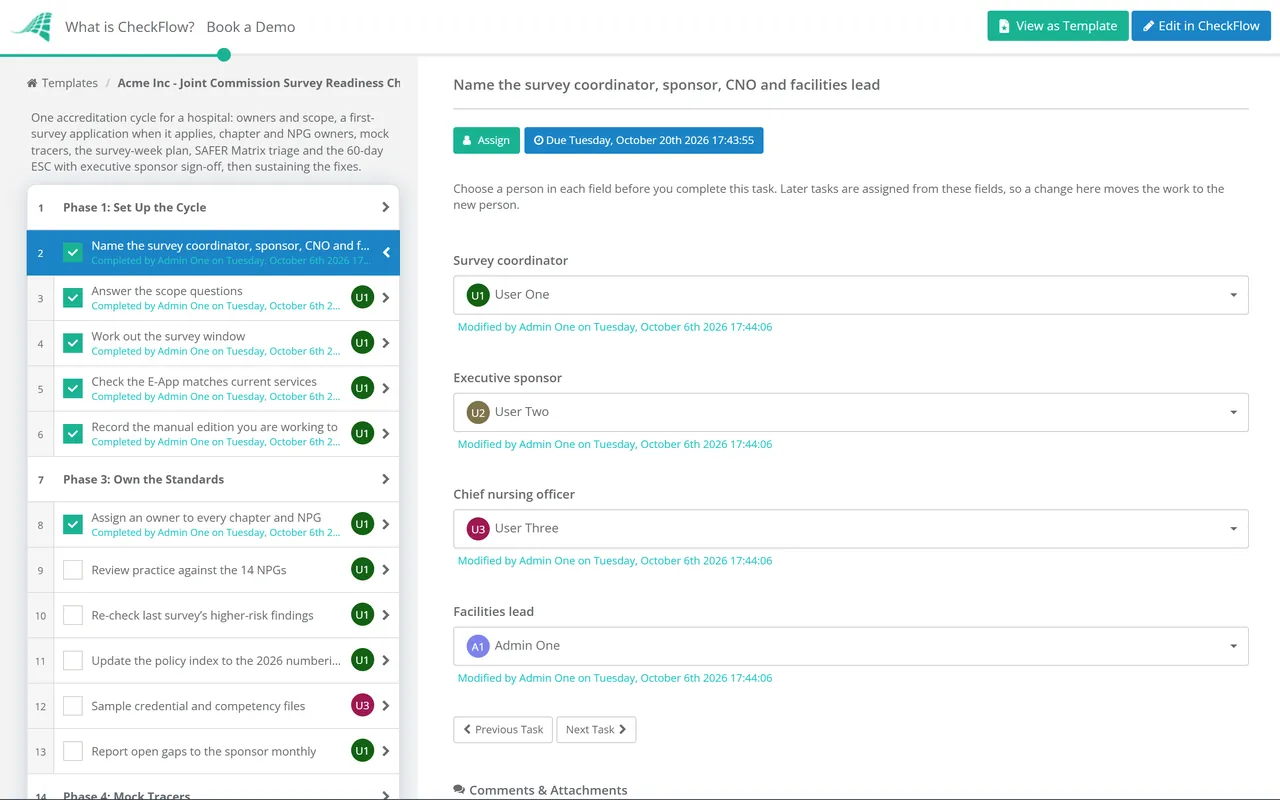
  • Name the survey coordinator, sponsor, CNO and facilities lead — later tasks are assigned from these four fields
  • Answer the scope questions — is this the hospital’s first Joint Commission survey, and is accreditation used for Medicare deemed status
  • Work out the survey window — from the last full survey date, so mock tracers and fixes are finished before it opens
  • Check the E-App matches current services — sites, services and volumes drive the survey length and the team sent
  • Record the manual edition you are working to — the January 2026 rewrite and any later E-dition updates, so owners read the same text
Initial

Phase 2: First Survey Application

Shown only when this is the hospital’s first Joint Commission survey.

  • Confirm you meet the eligibility requirements — including enough inpatients and open and closed records for surveyors to assess compliance
  • Submit the application for accreditation — with a description of services and volumes that is accurate on the day you send it
  • Agree the survey type and timing — with your Joint Commission contact, noting that deemed status surveys are unannounced
  • Run a full gap analysis against every chapter — there is no previous report to start from, so nothing can be skipped
Standards

Phase 3: Own the Standards

  • Assign an owner to every chapter and NPG — one named person per chapter and per National Performance Goal, with a deputy
  • Review practice against the 14 NPGs — each owner records gaps against current practice, not against last cycle’s binder
  • Re-check last survey’s higher-risk findings — surveyors may review them again, up to and including the next full survey
  • Update the policy index to the 2026 numbering — replace references to retired chapters such as Environment of Care and Life Safety
  • Sample credential and competency files — medical staff privileges and nursing competencies, against your bylaws and policy
  • Report open gaps to the sponsor monthly — owner, standard, risk and target date for each one
Tracers

Phase 4: Mock Tracers

  • Set the mock tracer schedule for the cycle — covering every inpatient unit and high-risk outpatient area at least once
  • Trace individual patients through their care — follow the record, observe care and ask staff to explain what they do and why
  • Cover infection control and medication management in tracers — surveyors assess both inside individual tracers, not in a meeting
  • Rehearse the OQPI session with real data — how you choose measures, what the data shows and what you changed
  • Walk the building with the facilities lead — against the Physical Environment chapter and Life Safety Code requirements
  • Log each finding with an owner and date — then re-trace the same area to confirm the fix has held
Survey week

Phase 5: Survey-Week Plan

  • Write the surveyor arrival procedure — who reception calls, who verifies identity and who opens the command room
  • Assign escorts and scribes for each surveyor — with cover for night, weekend and leave
  • Prepare the documents the Survey Process Guide lists — indexed and ready for the opening conference
  • Brief unit staff on tracer conversations — answer from their own practice and show where they would look things up
  • Debrief after each daily briefing — record observations, assign follow-up and tell units what is coming
  • Record findings and strengths at the exit conference — preliminary findings, their SAFER placement and any SAFEST strengths
ESC

Phase 6: Evidence of Standards Compliance

The executive sponsor sign-off halts the checklist. Nothing is submitted until it is given. The Medicare task appears only for deemed status.

  • Decide whether to request clarifications — within 10 business days of the report posting; ESC due dates do not move
  • Triage every RFI on the SAFER Matrix — by likelihood to harm and scope, so the highest-risk findings are fixed first
  • Write corrective actions with completion dates — what changed, when it was complete and how ongoing compliance is measured
  • Add leadership involvement and preventive analysis — required for higher-risk findings; name the leader and the underlying cause
  • Prepare for a Medicare deficiency follow-up survey — if the report scores any finding at Condition level
  • Executive sponsor sign-off of the ESC submission — the sponsor approves every corrective action and date before it is sent
  • Submit the ESC within 60 days — counted from when the Accreditation Survey Findings Report is posted
Sustain

Phase 7: Sustain and Restart

  • Audit each corrective action until it holds — on the schedule written into the ESC, with results attached
  • Prepare for a follow-up survey if required — an Accreditation with Follow-up Survey decision means a visit within six months
  • Share the SAFEST strengths and lessons — with unit leaders, the governing body and the medical staff
  • Start the next cycle’s checklist — carry open risks and new owners forward rather than starting from a blank page

The Hospital Survey Cycle at a Glance

The dates below are for the hospital accreditation programme as Joint Commission describes it in October 2026. Count forward from the last full survey, and leave slack at both ends of the window, because a survey can come on any day inside it.

Month 0

Last full survey and decision

Accreditation runs for about three years from the last day of the survey. Open this cycle’s checklist as soon as the previous ESC is accepted.

Months 1 to 29

Standards ownership and mock tracers

Chapter and NPG owners close gaps, mock tracers run on their schedule, and higher-risk findings from the last survey are re-audited.

Months 30 to 36

Survey window

The unannounced full survey can arrive on any weekday morning. The arrival procedure, escorts and document index should be ready before month 30.

Survey days

Opening conference to exit conference

Tracers, the OQPI session, the Life Safety Code building review, daily briefings and an exit conference with preliminary findings.

+10 business days

Clarification deadline

Ten business days from when the final report is posted, if you have evidence that you were compliant at the time of survey.

+60 days

ESC due

Every Requirement for Improvement is addressed in the Evidence of Standards Compliance, with extra detail for higher-risk findings.

Within 6 months

Follow-up survey, if required

Only after an Accreditation with Follow-up Survey decision, to confirm the fixes have held.

Other programmes run on different clocks. Joint Commission accredits laboratories on a two-year cycle. Hospitals and critical access hospitals were the first programmes moved to Accreditation 360 in 2026. If you run another programme, take its timing from that programme’s own survey guide rather than from this page.

Why Run Survey Readiness in CheckFlow?

1

A cycle that keeps its own dates

Every task carries a due date offset from the day the checklist starts, so mock tracers, the E-App check and the survey-week rehearsal land in order across the cycle. Teams that want a monthly mock tracer outside this checklist run one as a recurring checklist.

2

No ESC goes out unsigned

The ESC stops at an approval step until the executive sponsor answers. Corrective actions, attached evidence, comments and the sign-off stay in the checklist history, ready for the follow-up survey or the next cycle.

3

One template, any survey

Dropdown answers show the first-survey phase and the Medicare follow-up task only where they apply. Reports show which chapters still have open gaps, and the API and MCP server can feed findings into your own quality systems.

Surveyors trace real patients, so the same processes they follow need to run reliably every day. The New Nurse Onboarding Checklist leaves an evidenced competency record for each new hire, and the Patient Discharge Checklist covers the handover point many tracers end at. Running services in England as well? The CQC Inspection Readiness Checklist covers a different regulator with a different method.

Running accreditation, licensing and payer audits across several sites? CheckFlow’s healthcare checklist software puts every unit on the same readiness workflow, and compliance checklist software keeps owners, evidence and sign-offs in one place.

Frequently Asked Questions

How often does Joint Commission survey a hospital?

+

Hospital surveys are unannounced, and Joint Commission tells hospitals to expect the next full survey 30 to 36 months after the previous one. An accreditation decision is valid for about three years. Surveyors arrive no earlier than 7:45 a.m. on the first day. All deemed status surveys are unannounced too.

What changed in Joint Commission hospital accreditation in 2026?

+

From 1 January 2026, under Accreditation 360, Joint Commission removed 714 hospital requirements. It replaced the National Patient Safety Goals chapter with 14 National Performance Goals, which include staffing, and merged Environment of Care and Life Safety into a Physical Environment chapter. A Survey Process Guide replaced the Survey Activity Guide, and surveyors now record strengths in a SAFEST report. There is also an optional Continuous Engagement model. Joint Commission says no new concepts were added, but chapter references and policy cross-walks built before 2026 need updating.

What is a tracer in a Joint Commission survey?

+

A tracer is how surveyors test compliance in practice. In an individual tracer they pick a patient and follow that patient’s care through the hospital, reading the record, observing care and interviewing staff and, where appropriate, the patient. Since May 2024 infection prevention and medication management have been assessed within individual tracers in hospitals, and the data session became the OQPI session. Mock tracers are the closest rehearsal you can run.

How long do you have to submit Evidence of Standards Compliance?

+

60 days from when the Accreditation Survey Findings Report is posted. The ESC must address every Requirement for Improvement with a completion date and a description of how ongoing compliance will be maintained. Findings placed higher on the SAFER Matrix also need leadership involvement and a preventive analysis. You can ask for a clarification within 10 business days of the report posting, but that does not change the ESC due date.

What does deemed status mean for survey readiness?

+

CMS has determined that Joint Commission’s hospital standards and survey process meet or exceed its own, so a hospital accredited for deemed status is treated as meeting the Medicare Conditions of Participation. The survey then covers the CoP-based requirements as well as Joint Commission’s own, and the report shows a CMS score of Standard or Condition level for each finding. Findings at Condition level can lead to a Medicare deficiency follow-up survey. If CMS removes your deemed status after a complaint or validation survey, you must tell Joint Commission immediately.

Is CheckFlow free for this template?

+

14-day free trial, no card required. The Business plan is $10 per user per month after the trial. Full details at checkflow.io/pricing.

Be Ready on Any Morning in the Window

Free trial — no credit card required.