HIPAA Compliance Audit Checklist for Healthcare & Medical Organisations

2025 has broken records for HIPAA enforcement. 19 settlements. $8 million in fines. 186 million patient records breached. The organisations that escaped were the ones that ran a programme, not a checklist.

HIPAA compliance has never been more enforced. In 2025, the HHS Office for Civil Rights issued more resolution agreements than any previous year, with fines ranging from $10,000 to $1.5 million per violation. Covered entities — hospitals, clinics, pharmacies, dentists, and health plans — accounted for 82% of all breach reports. The proposed 2025 Security Rule updates elevate previously “addressable” implementation specifications to required status, removing the flexibility that smaller organisations relied on to argue proportionality. HIPAA compliance is no longer a matter of having a privacy notice and a locked filing cabinet — it requires documented policies, annual risk assessments, workforce training, Business Associate Agreements with all relevant vendors, technical safeguards for electronic PHI, and a tested breach notification procedure. This free HIPAA compliance audit checklist gives healthcare compliance officers, privacy officers, and practice administrators a structured framework for assessing and maintaining HIPAA compliance across all three Rules and all three safeguard categories.

Note: This checklist provides a framework for HIPAA compliance assessment. HIPAA requirements are complex and subject to change. Always consult a qualified healthcare compliance professional or legal counsel for advice specific to your organisation.
Use This Template Free See Live Example
No Credit Card Required

HIPAA’s Three Rules — What Each One Requires

The Privacy Rule

What it protects: All individually identifiable health information in any form — paper, electronic, or verbal — known as Protected Health Information (PHI).

What it requires: Policies governing how PHI may be used and disclosed; patient rights (access, amendment, accounting of disclosures); minimum necessary standard; Notice of Privacy Practices provided to patients.

Key compliance gap: Using or disclosing more PHI than the minimum necessary for the intended purpose.

The Security Rule

What it protects: Electronic Protected Health Information (ePHI) — PHI created, received, maintained, or transmitted electronically.

What it requires: Administrative safeguards (risk analysis, workforce training, access management), physical safeguards (facility access controls, workstation security), and technical safeguards (access controls, encryption, audit controls).

Key compliance gap: Failing to conduct a documented annual risk analysis — the most cited OCR finding in audit results.

The Breach Notification Rule

What it protects: Ensures patients and HHS are notified when PHI is breached.

What it requires: Individual notification within 60 days of discovery; HHS notification within 60 days for breaches affecting 500+ individuals (immediately); annual report to HHS for smaller breaches; media notification for large breaches.

Key compliance gap: Delays in breach identification and notification — many organisations do not discover breaches for months.

The HIPAA Compliance Audit Checklist for Healthcare Organisations

Seven phases covering the full HIPAA compliance programme — from administrative governance through Privacy Rule, Security Rule safeguards, breach notification, and business associate management.

Phase 1

Administrative Safeguards & Governance

The annual risk analysis is the most fundamental HIPAA requirement — and the most cited OCR finding when it is absent or inadequate. Everything else in the compliance programme should flow from the documented risk analysis.

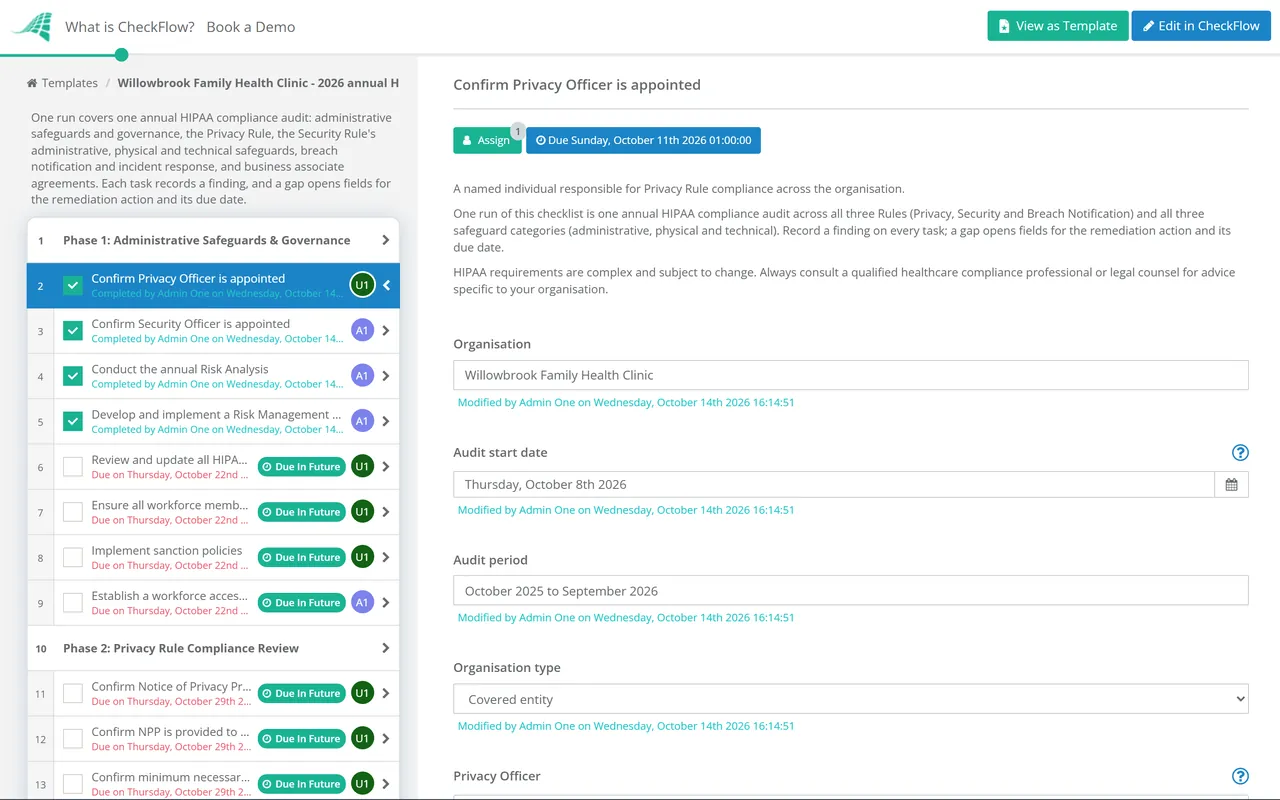
  • Confirm Privacy Officer is appointed — a named individual responsible for Privacy Rule compliance across the organisation
  • Confirm Security Officer is appointed — a named individual responsible for Security Rule compliance
  • Conduct the annual Risk Analysis — a thorough assessment of potential risks to the confidentiality, integrity, and availability of all ePHI created, received, maintained, or transmitted
  • Develop and implement a Risk Management Plan addressing the risks identified in the risk analysis with specific security measures
  • Review and update all HIPAA policies and procedures at least annually — document the review date and any changes made
  • Ensure all workforce members receive HIPAA training annually — covering Privacy Rule, Security Rule, and breach notification; document completion
  • Implement sanction policies — documented procedures for workforce members who fail to comply with HIPAA policies
  • Establish a workforce access management process — authorisation and/or supervision of workforce members who work with PHI; regular access reviews
Phase 2

Privacy Rule Compliance Review

  • Confirm Notice of Privacy Practices (NPP) is current — describes permitted uses and disclosures; patient rights; complaints process; effective date
  • Confirm NPP is provided to patients at first service delivery — acknowledgement of receipt obtained and documented
  • Confirm minimum necessary standard is applied — policies in place to limit PHI use to the minimum necessary for the intended purpose
  • Confirm patient rights procedures are in place — right of access (provide records within 30 days), right to amend, right to accounting of disclosures, right to restrict certain disclosures
  • Confirm Business Associate Agreements (BAAs) are in place with all vendors, contractors, and third parties who create, receive, maintain, or transmit PHI on behalf of the covered entity
  • Confirm authorisation procedures for uses and disclosures requiring patient authorisation — current authorisation forms meet HIPAA requirements
  • Audit PHI disclosure logs — accounting of disclosures is maintained; logs are accurate and up to date
Phase 3

Security Rule — Administrative Safeguards

  • Confirm the Risk Analysis is documented — scope, methodology, identified risks, and assigned risk levels; updated at least annually or when significant changes occur
  • Confirm the Risk Management Plan is implemented — specific measures addressing identified risks are in place and effective
  • Confirm a Contingency Plan exists — data backup plan, disaster recovery plan, emergency mode operations plan, testing procedures; tested at least annually
  • Confirm information access management policies — procedures for authorising access to ePHI; role-based access control implemented
  • Confirm workforce security procedures — authorisation, supervision, and termination of access for all workforce members
  • Confirm security awareness and training — periodic security updates and reminders; phishing awareness training
Phase 4

Security Rule — Physical Safeguards

  • Confirm facility access controls — documented policies controlling physical access to facilities containing ePHI; access logs maintained
  • Confirm workstation security policies — screens not visible to unauthorised individuals; automatic screen lock implemented; clean desk policy for PHI
  • Confirm device and media controls — policies for disposal, reuse, and accountability of hardware and electronic media containing ePHI
  • Confirm portable device policy — laptops, mobile phones, tablets, and USB drives used to access or store ePHI are encrypted and tracked
  • Confirm workstation access policies — only authorised users access clinical workstations; shared workstations have appropriate controls
Phase 5

Security Rule — Technical Safeguards

  • Confirm access controls are implemented — unique user identification for all users; role-based access to ePHI; automatic logoff for inactive sessions
  • Confirm encryption of ePHI at rest and in transit — particularly for portable devices, email containing PHI, and patient portal communications
  • Confirm audit controls are in place — hardware, software, and procedural mechanisms to record and examine activity in systems containing ePHI; audit logs reviewed regularly
  • Confirm integrity controls — ePHI is not altered or destroyed in an unauthorised manner; mechanisms to authenticate ePHI
  • Confirm transmission security — ePHI transmitted over electronic networks is protected against unauthorised access; encryption or equivalent alternative measures
Phase 6

Breach Notification & Incident Response

  • Confirm breach identification procedures — workforce knows what constitutes a HIPAA breach; any impermissible use or disclosure of PHI is presumed a breach unless assessed by the four-factor risk assessment
  • Confirm breach risk assessment procedure — the four-factor test (probability of PHI compromise, sensitivity, who accessed, extent of risk mitigation) is documented and followed
  • Confirm individual breach notification procedure — written notice to affected individuals within 60 days of breach discovery
  • Confirm HHS notification procedure — breaches of 500+ individuals reported to HHS within 60 days; breaches of fewer than 500 reported annually in March following the calendar year
  • Confirm incident response plan is documented and tested — including roles, escalation paths, evidence preservation, and containment procedures
Phase 7

Business Associate Agreement Management

  • Inventory all business associates — a complete list of all vendors, contractors, and third parties with access to PHI on behalf of the organisation
  • Confirm a current BAA exists for each business associate — signed, current (reflecting current HIPAA requirements), and meeting all required contract provisions
  • Include cloud service providers and IT vendors — any vendor who hosts, processes, or has access to ePHI is a business associate requiring a BAA
  • Review BAAs when business associate relationships change — new services, new vendors, or significant changes to existing arrangements
  • Confirm business associates have appropriate safeguards — BAAs require business associates to implement HIPAA-equivalent safeguards; periodic verification is a best practice

The Most Frequently Cited OCR Findings — and How to Prevent Each One

Inadequate risk analysis

Most cited finding in all OCR enforcement actions. The risk analysis must be comprehensive, documented, and regularly updated — not a one-time checkbox.

Delayed patient record access

Patients have the right to their records within 30 days. Delays beyond 60 days are a common enforcement target. A defined records access process with tracked deadlines prevents this.

Missing Business Associate Agreements

Many small practices have vendors with PHI access and no BAA in place. The vendor relationship inventory is the first step.

Insufficient workforce training

Training must be documented, role-specific, and conducted at least annually. “We told them about HIPAA at onboarding” is not sufficient documentation.

Inadequate technical safeguards

Unencrypted devices, no automatic logoff, shared passwords, and PHI transmitted via unencrypted email. Each is a readily discoverable technical gap.

No breach response procedures

Organisations that discover a breach without a documented response procedure consistently make avoidable notification timeline violations, compounding the original breach with a procedural violation.

Why Run Your HIPAA Audit in CheckFlow?

1

A structured, recurring annual compliance audit

HIPAA compliance is not a one-time project — it is an ongoing programme with annual requirements (risk analysis, workforce training, policy review) and continuous obligations (BAA management, access control auditing). CheckFlow’s recurring checklist feature schedules the annual HIPAA audit automatically, with all tasks assigned to Privacy Officer, Security Officer, and IT — ensuring the programme runs consistently every year.
2

Audit-ready documentation for OCR review

An OCR audit begins with a documentation request — policies, risk analysis, training records, BAA inventory, and breach logs. Every completed task in CheckFlow is timestamped and attributed to a named person. The full compliance audit record is always current and immediately accessible — not reconstructed in a panic when the OCR letter arrives.

3

Coordinated compliance across Privacy, Security, and IT

HIPAA compliance requires coordination between the Privacy Officer (policies, training, patient rights), the Security Officer (technical and physical safeguards), and the IT team (encryption, access controls, audit logs). CheckFlow assigns tasks to all three simultaneously, tracks their completion, and ensures no safeguard category is deferred while others advance.

HIPAA compliance intersects with broader compliance audit frameworks. For organisations managing multiple compliance frameworks, CheckFlow’s compliance template series includes HIPAA, ISO 27001, FedRAMP, and other standards. See the full HIPAA Compliance Audit Checklist →

Healthcare incidents involving PHI breaches trigger both incident reporting and HIPAA breach notification obligations. CheckFlow’s Healthcare Incident Reporting Checklist covers the incident management process that runs alongside the HIPAA breach response. See the Healthcare Incident Reporting Checklist →

Frequently Asked Questions

What is a HIPAA compliance audit and what does it cover?

+

A HIPAA compliance audit assesses whether a covered entity or business associate is meeting the requirements of the three HIPAA Rules: the Privacy Rule (governing how PHI may be used and disclosed, and patient rights), the Security Rule (governing administrative, physical, and technical safeguards for electronic PHI), and the Breach Notification Rule (governing notification to individuals, HHS, and the media when PHI is breached). An internal audit covers seven areas: administrative governance (officer appointments, risk analysis, policies, training), Privacy Rule compliance (NPP, patient rights, BAAs, minimum necessary), Security Rule administrative safeguards (risk management, contingency planning, access management), physical safeguards (facility access, workstation security), technical safeguards (access controls, encryption, audit logs), breach notification procedures, and Business Associate Agreement management.

Who needs to comply with HIPAA?

+

HIPAA applies to two categories of organisations. Covered entities are healthcare providers who transmit health information electronically (doctors, hospitals, clinics, pharmacies, dentists, psychologists), health plans (insurance companies, HMOs, Medicare, Medicaid), and healthcare clearinghouses. Covered entities represented 82% of all breach reports in the first three quarters of 2025. Business associates are third parties who create, receive, maintain, or transmit PHI on behalf of a covered entity — including EHR vendors, billing companies, cloud storage providers, IT service providers, and coding services. All business associates must have a signed Business Associate Agreement (BAA) and must implement HIPAA-equivalent safeguards.

What are Business Associate Agreements and when are they required?

+

A Business Associate Agreement (BAA) is a contract required by HIPAA between a covered entity and any third-party service provider who creates, receives, maintains, or transmits PHI on behalf of the covered entity. The BAA obligates the business associate to implement appropriate safeguards, report breaches, return or destroy PHI at the end of the relationship, and flow down HIPAA obligations to any subcontractors. Common business associates requiring BAAs include EHR software vendors, medical billing services, cloud storage providers that host PHI, IT support companies with access to clinical systems, transcription services, and accountants with access to patient billing records. BAAs must be in place before PHI is shared with the business associate.

What are the penalties for HIPAA violations?

+

HIPAA violations carry civil monetary penalties ranging from $100 to $50,000 per violation, with an annual cap per identical violation of $1.5 million. The penalty tier depends on culpability: unknowing violations carry lower penalties; wilful neglect not corrected carries the maximum. In 2025, the HHS Office for Civil Rights issued 19 resolution agreements totalling over $8 million in penalties — the highest number in a single year on record. Criminal charges can apply to wilful HIPAA violations, with penalties up to $250,000 and imprisonment for the most serious cases. Violations also appear on the HHS “Wall of Shame” breach portal, with significant reputational consequences.

Is CheckFlow free for this template?

+

You can start a free 14-day trial with no credit card required, giving you full access to all features including this template. The Business plan is $10 per user per month after the trial. Full details at checkflow.io/pricing.

Build a HIPAA Compliance Programme That Survives an OCR Audit

Free trial — no credit card required.