
Manufacturing Checklist Software
Your ERP tracks what you made. CheckFlow makes sure it was done right.
Many quality defects, safety incidents, and audit failures don’t happen because your team doesn’t know the procedure. They happen because the procedure wasn’t actually followed, step by step, and nobody can prove it either way. Paper checklists go missing. Spreadsheets get updated hours after the fact, or not at all. When an auditor asks for records, you’re scrambling.
CheckFlow gives every operator a structured digital checklist: assigned to the right person or shift team, completed in sequence, timestamped, and stored. Whether it’s a shift handover, a quality inspection, a preventive maintenance round, or a new operator sign-off, every step is documented. Every time.
14-day free trialNo credit cardUnlimited free guests

Last updated
Manufacturing checklist software puts the procedures that run a plant floor into checklists operators complete step by step. In CheckFlow, shift handovers, quality inspections, preventive maintenance rounds, OSHA safety checks and operator sign-offs become templates: schedules start them each shift, day or month, halt tasks stop steps being skipped, and every completion is recorded with a name and time as evidence for ISO 9001, OSHA and GMP audits.
Sound Familiar?
Manufacturing operations run on procedures. But when those procedures live in paper binders, printed forms, and shift managers’ heads, the results are inconsistent, and the consequences are real. A missed torque check becomes a defect. A skipped LOTO step becomes an injury. A handover note left on a whiteboard becomes the cause of the next shift’s incident. These aren’t edge cases. They’re what happens when there’s no system enforcing the procedure.
Steps skipped under deadline pressure
When a production target looms, operators take shortcuts. A missed torque check, a skipped QC step, a visual inspection rushed in two seconds instead of two minutes: these don’t show up until there’s a defect, a return, or a customer complaint.
Shift handovers go wrong
The outgoing shift leaves notes on a whiteboard. The incoming shift doesn’t read them. Critical process changes, equipment faults, and near-misses get lost in transition. The UK’s Health and Safety Executive treats shift handover as safety-critical communication and recommends written as well as face-to-face handover; information lost at a shift change was one of the factors behind the Piper Alpha disaster.
No audit trail for ISO, OSHA, or GMP
Paper forms get lost, damaged, or backdated. A signed form with no timestamp isn’t evidence of anything. Calibration records, competence records, and inspection logs need to be timestamped, named, and kept, and retrievable in seconds when an auditor asks. Free templates for an ISO 9001 internal audit and an ISO 45001 health and safety management system build that evidence as the work is done. In the US, the OSHA Recordkeeping Checklist keeps the Form 300 log, the 300A summary and the electronic submission on schedule.
Maintenance rounds fall behind schedule
Preventive maintenance due dates live in a spreadsheet nobody checks. Work gets done when someone remembers to ask, not on the scheduled cycle. Missed PM tasks become unplanned downtime, and unplanned downtime is an expensive oversight.
Who’s qualified on which machine?
Training happened, but was it documented? ISO 9001 clause 7.2 requires documented evidence of competence: for most plants, proof that each operator was trained, assessed, and signed off on each machine or process they operate. If you can’t prove it, it’s a nonconformance waiting to be found.
Different shifts follow different procedures
Day shift does it one way. Night shift does it another. The standard exists, but execution is inconsistent between teams, between supervisors, between sites. When something goes wrong, you can’t establish what was actually done, or by whom.
How CheckFlow Works for Manufacturing Teams
One checklist template per process. Runs automatically for every shift, every operator, every cycle.
Build your checklist templates once
Use CheckFlow’s template designer to map each manufacturing workflow: shift startup and handover, quality inspections, preventive maintenance rounds, OSHA safety walkthroughs, operator training sign-offs. Define every step, assign it to the right role (operator, supervisor, QC, maintenance tech), and set recurring schedules: a daily schedule for each shift start, or daily, weekly, or monthly.
Assign, schedule, and alert automatically
Schedules start the right checklist on time and CheckFlow assigns each task to the right person or group: no manual reminder emails, no relying on someone to remember. Every operator knows what they need to complete. Supervisors see real-time completion status across the floor. Overdue alerts go to the assignees before problems compound.
Get the audit trail automatically
Every completed step is timestamped with the operator’s name and stored. When ISO, OSHA, GMP, or a customer auditor asks for records, they’re already there. Filter the Reports Grid by template, status, assignee, or tag. Export to CSV, Excel, or PDF, or print any checklist. No last-minute scrambling before an inspection.
Built for How Manufacturing Operations Actually Work
Manufacturing doesn’t have the luxury of informal processes. Every procedure has a reason. Every deviation has a consequence. CheckFlow is designed for the operational reality of a plant floor, where the person completing the checklist may not have a desk, where procedures span multiple departments, and where the audit trail needs to be indisputable.
Handovers
Shift handover checklists
Give outgoing and incoming operators a structured handover form. Equipment status, active quality holds, safety incidents, process changes from the prior shift: all documented and signed off before the shift ends. Timestamped, named, and searchable. The next shift doesn’t fly blind.
- Required fields, so no part of the handover is left blank
- A halt task keeps the incoming shift’s steps locked until the handover is signed
Maintenance
Preventive maintenance rounds
Schedule recurring PM checklists by shift, day, week, or month. Each step is assigned to a named technician. Overdue tasks send alerts. Calibration records and PM completion logs are always current, and ready for ISO 9001 clause 7.1.5 audits without a manual search through maintenance logs. Start from the free Preventive Maintenance Checklist.
- Each schedule starts at a set time in its own time zone
- Every run is a new checklist with its own record
Corrective action
CAPA in the same checklist
Every production run needs quality checks at defined stages: incoming material inspection before components enter the process, in-process checks at the operations most critical to quality, and final inspection before products leave the facility. Each stage carries its own criteria, sample sizes and pass/fail thresholds.
When a check fails, the CAPA steps open in the same checklist: root cause, corrective action, preventive action, and effectiveness verification. The inspection, the failure and the fix sit in one record, with a name and a time on every step. The CAPA Process Checklist runs the same steps on its own when a problem is raised outside an inspection.
- A condition shows the CAPA phase only when the inspection result is Fail
- Required fields capture sample size, measurements and the disposition
Process changes
Template version history for process changes
When a production process changes (new material specification, revised work instruction, updated quality criteria), the previous version must be superseded and every operator retrained to the new standard. CheckFlow’s template version history records which version of each procedure was in use at each point in time, and every checklist keeps the version it was started from. If a customer or regulator asks what process was followed on a specific production date, the version history provides the answer.
The same goes for the standard operating procedures that run the plant and its facilities: operators follow the current version, training on each procedure is recorded for each person, and the SOP stays a followed document rather than an archived one.
In-process quality inspections
Run first-article, in-process, and final inspection checklists with enforced step sequence. Pass/fail criteria are documented at each control point. Multiple inspectors follow the same procedure every time. Every record is stored as evidence for ISO 9001 clause 8.5.1 (control of production), without any additional data entry.
Learn moreOSHA safety inspection checklists
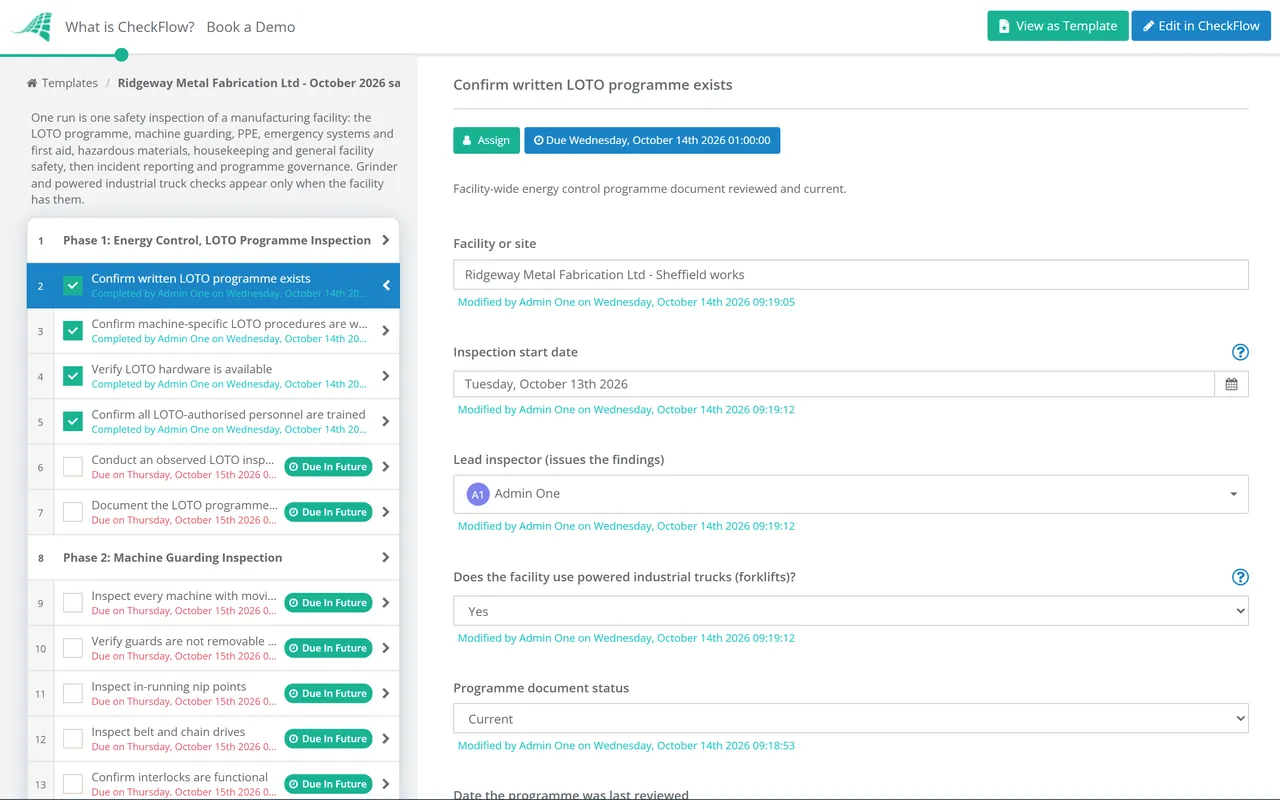
Run monthly facility walkthroughs, LOTO verification checks, PPE audits, and machine guarding inspections against your OSHA compliance checklist. Every item is signed off by a named employee with a timestamp: evidence you can produce in any OSHA investigation following an incident. Lockout/tagout is third on OSHA’s preliminary list of the most frequently cited standards for fiscal year 2026, so documented compliance matters.
Learn moreOperator training sign-offs
Create equipment-specific qualification checklists. Supervisors sign off each operator on each machine or process they’re certified to run. ISO 9001 clause 7.2 competence records are created as each sign-off is completed, and kept. When a customer audit or certification audit asks for training evidence, it’s already there. For new warehouse staff, the Warehouse Employee Onboarding Checklist adds PPE fit, manual handling and written forklift authorisation.
Learn moreAudit-ready records, always
Every checklist run produces a complete, timestamped record: who completed each step, when, and what the outcome was. Filter the Reports Grid by template, status, assignee, or tag, and export to CSV, Excel, or PDF, or print any checklist for the auditor. No more pre-audit scrambles to reconstruct records from paper forms and email threads.
Learn more
Ready-to-Use Manufacturing Templates
Don’t start from a blank page. Pick a proven manufacturing template, customise it to your production line, equipment, and quality standards, and run it in minutes. Each one is fully editable in the CheckFlow template designer.
Equipment Maintenance Workflow Checklist

Inventory Management for Manufacturing Environments Checklist

Manufacturing Change Order Process Checklist

Manufacturing Production Scheduling Checklist

Manufacturing Quality Control Checklist

Safety Inspection Process for a Manufacturing Facility
Safety and quality procedures have their own templates. The Lockout/Tagout (LOTO) Procedure Checklist runs an energy control procedure from shutdown to restart, with the annual periodic inspection, and the 5S Audit Checklist scores one area at a time. When a defect needs a permanent fix, the Root Cause Analysis (8D) Checklist runs the investigation and the CAPA Checklist carries it through to an effectiveness check.
What Your Manufacturing Checklists Should Cover
The four core manufacturing process categories that require structured checklists, and what gets missed when there’s no system enforcing them. Clause numbers are ISO 9001:2015’s; certificates to it stay valid during the transition to ISO 9001:2026.
01Quality & Inspection
- Shift startup: equipment status confirmed, quality holds reviewed, line clearance completed
- First article inspection: dimensional checks, visual inspection, test results documented
- In-process inspection: control point checks at defined intervals, pass/fail disposition recorded
- Final inspection: all quality characteristics verified before release, inspector name and timestamp on every record
- Calibration status verified before use (ISO 9001 clause 7.1.5)
- Incoming goods inspection: quantity, part number, certificate of conformance, visual damage check
- Shift handover: outgoing operator documents all active conditions; incoming operator signs acknowledgement
- Non-conformance identified: deviation recorded, hold tag placed, corrective action initiated
02Safety & OSHA
- Monthly facility safety walkthrough aligned to OSHA 29 CFR 1910 general industry standards
- Machine guarding inspection: guards in place, condition verified, no unauthorised modifications
- LOTO (lockout/tagout) verification per OSHA 29 CFR 1910.147: energy control procedures documented, devices available, trained operators verified, periodic inspection at least annually
- PPE availability and condition check: all required PPE present, serviceable, and correctly sized
- Chemical storage and HazCom: SDSs current and accessible, secondary containment intact, labelling compliant
- Emergency exits: unobstructed, signage visible, emergency lighting functional
- Forklift pre-use inspection (at least daily, and after each shift when used round the clock, per 29 CFR 1910.178(q)(7)): brakes, lights, forks, seatbelt, fluid levels
- Incident near-miss report initiated within 24 hours of any incident or near-miss
03Preventive Maintenance
- Daily visual walkaround: unusual noises, leaks, abnormal heat, warning indicators
- Weekly: lubrication points serviced, fluid levels checked and topped up, belt tension verified
- Monthly: filter replacement, calibration check, alignment verification, fastener torque check
- Calibration records updated per ISO 9001 clause 7.1.5: instrument ID, calibration date, next due date, technician name
- Corrective work order raised for any failed check item before next shift begins
- PM completion logged by named technician with timestamp
- Quarterly: critical spare inventory reviewed, supplier contacts confirmed, emergency procedures reviewed
04Operator Training
- Pre-equipment access: general safety induction completed, PPE requirements explained, emergency procedures reviewed
- Equipment-specific qualification: step-by-step operation demonstrated, operator performs independently, supervisor observes and signs off
- Competence record created per ISO 9001 clause 7.2: operator name, equipment or process, date of sign-off, supervisor name
- Restricted equipment list: operator is only authorised for equipment on their personal sign-off record
- 30-day review: supervisor confirms correct technique maintained, any additional coaching needed
- Annual refresher: competence re-verified, record updated, changes to procedure incorporated
- Probation sign-off: final assessment at end of probation confirming operational readiness
CheckFlow’s free manufacturing checklist templates cover quality, safety, maintenance, and training, ready to customise and run for your first shift in minutes.
Ask your AI assistant what the last shift left open.
CheckFlow works with any AI assistant. Connect it once and it reads and works your plant checklists with the same permissions as the person whose API key it holds.
Ask your AI assistant
Through the CheckFlow MCP server, Claude, ChatGPT, Gemini, Grok, Copilot or any other AI assistant can find last night’s handover checklist, list the steps still open, and check that every PM round on the schedule actually ran.
Read the MCP guideDraft the template from a sentence
Paste a work instruction or describe an inspection in a sentence and the free AI checklist generator drafts the template, with phases, fields and halt tasks in place.
Try the AI generatorConnect your other systems
Start a checklist from your ERP, MES or CMMS through Zapier or the REST API, and get a webhook when an inspection completes.
Developer overview
What did the night shift leave open on Line 3?
checklist: "Shift Handover – Line 3 · Night to Day"
status:    "Incomplete"
Four steps are open. “Record equipment status” is the one holding things up: it halts the incoming shift’s checks until Marco R. completes it. The other three belong to the day shift.
Used by great companies









If you need to create processes, with space for detailed instructions at each step, among other interesting features, this system will help you a lot.
Frequently Asked Questions
How is CheckFlow different from an inspection or audit app?
Inspection and audit apps are built primarily for auditors and EHS managers conducting inspections: scoring forms, photo capture, and corrective action management for periodic audit cycles. CheckFlow is built for day-to-day operational execution: the shift startup checklist that runs every morning, the daily PM round that starts on schedule, the operator training sign-off that creates an ISO 9001 clause 7.2 record. CheckFlow is $10 per user per month, or $9 billed annually, and people completing steps on a shared link are free. Some operations teams use both: CheckFlow for daily operations, an inspection app for scheduled audit programmes.
Can operators complete checklists without creating a login?
Yes. Share a checklist by link and operators complete their steps on it: no account creation, no app download, no password required. A supervisor starts the checklist and sends the link to the operator’s device. The operator completes it. Each completion is timestamped and stored, and shows as Anonymous User. To record each operator by name and assign them their own steps, add them as free Guests instead. Either way, this removes a common barrier to floor-level adoption: asking a machine operator to remember a password and log into a platform before every task.
Does CheckFlow create the audit trail that ISO 9001 auditors look for?
Yes. Every checklist run produces a timestamped, named completion record that supports the ISO 9001 clause 8.5.1 requirement for controlled production, the clause 7.2 requirement for evidence of competence, and the clause 7.1.5 requirement for calibration records (clause numbers from ISO 9001:2015). Records are stored, can be filtered by template, status, assignee or tag, and export to CSV, Excel or PDF, or print any checklist for the auditor on-site. Whether the evidence is enough is your auditor’s call; missing calibration and competence records are easy findings to avoid, and CheckFlow helps with both.
Can I run recurring checklists on a set schedule — per shift, daily, weekly?
Yes. CheckFlow supports fully recurring checklists. Give each shift a daily schedule that starts its startup checklist at the start of the shift, a daily PM walkround every morning, a monthly safety inspection on the first weekday of each month, and an annual calibration review every January. Each recurrence generates a new, independent completion record. Overdue tasks send alerts. The schedule keeps running even when personnel change.
How does CheckFlow handle multi-shift and multi-site manufacturing operations?
CheckFlow gives every operator, on every shift, at every facility the same structured process, so the procedure applied at 6am on the day shift is the procedure applied at 2am on the night shift. Each process run is attributed to the team member who completed it, with a timestamp, so shift-level quality and compliance performance is visible in the records and in the Reports Grid. For multi-site operations, different sites can run common templates (ensuring consistent standards across facilities) or site-specific variations (reflecting different equipment, processes, or local regulatory requirements), while each template’s version history records what each site was following at each point in time.
Does CheckFlow replace our ERP, MES, or CMMS system?
No, and it isn’t designed to. CheckFlow is the checklist execution layer: the system that makes sure your team actually follows your procedures and creates the documentation to prove it. Your ERP handles production orders and inventory; your MES handles production scheduling and performance data; your CMMS handles work order management and asset tracking. CheckFlow handles the process execution checklists that none of those tools do well: shift handovers, quality inspection records, operator sign-offs, and safety walkthroughs. It adds the execution layer without replacing anything.
Is CheckFlow a full QMS or does it complement an existing quality management system?
CheckFlow is a process management platform, not a full QMS. It handles the execution and documentation of human-operated processes: the structured checklists, work instructions, inspection records, and CAPA workflows that form the operational layer of a quality management system. It complements dedicated QMS platforms (which typically handle document control, non-conformance databases, and quality analytics) by providing the structured task execution and evidence creation that those systems often lack. Manufacturing teams can use CheckFlow for the operational workflows (inspections, maintenance, safety checks, training) while using a separate system for quality reporting and non-conformance management. The two categories are complementary.
How does CheckFlow help with GMP and FDA 21 CFR documentation requirements?
CheckFlow can be used to build structured batch production and quality control checklists that document each step, the operator who completed it, and the timestamp. This creates a per-run execution record that supports GMP documentation requirements under FDA 21 CFR Part 211. Note: CheckFlow is a general-purpose checklist execution tool, not validated GxP software under 21 CFR Part 11. For formally validated electronic batch records, you’ll need a purpose-built validated system. Food, pharma, and chemical manufacturers can use CheckFlow for SOPs, quality inspections, training records, and safety checks that fall outside formally validated workflows.
What does CheckFlow cost for a manufacturing team?
CheckFlow’s Business plan is $10 per user per month, or $9 billed annually, with no minimum seat count. You pay for the managers and supervisors using the platform, not the operators completing checklists: people who complete steps on a shared link are free, and so are Guests. A plant with 3 shift supervisors, a quality manager, and an EHS manager can run unlimited checklists for $50 per month, for cross-department checklist execution across quality, safety, maintenance, and training. See the full pricing page for details.
Your Next Audit Shouldn’t Be a Surprise
Free trial, no credit card required. Build the checklist that runs your plant the same way every shift, every day, and produces the documentation your ISO, OSHA, and GMP auditors expect to find.
14-day free trial, no credit cardFull refund in your first 30 daysUS or EU hosting