
Process Management Software for Law Firms
These are not failures of professional competence. They are failures of process infrastructure.
Law firms have extensive professional obligations (conflict checks, AML compliance, client care standards, supervision requirements), but these are frequently managed through personal habit, professional memory, and informal convention rather than structured, documented processes. The conflicts check that depends on the partner remembering to run it before confidential information is exchanged. The AML check that gets completed superficially because the client has been known to the firm for years. The file supervision review that happens when there’s time. The client who hasn’t received an update in three weeks because nobody tracked the communication rhythm.
CheckFlow gives law firms a way to make professional obligations operational: structured, sequenced, documented, and evidenced. Every new matter follows the same intake sequence: conflicts check first, KYC and AML before work commences, client care letter issued before advice is given. Every document review follows the same approval path. Every matter progresses against a documented deadline schedule. And every file review produces a supervision record that the COLP, the SRA, or a professional indemnity insurer can inspect.
14-day free trialNo credit cardUnlimited free guests

Last updated
Process management software for law firms turns professional obligations into checklists that run the same way on every matter. In CheckFlow, client intake and conflict checks, AML due diligence, document approval, file reviews and matter closing each get a template with a named fee earner and supervisor, due dates and steps that cannot be skipped. Every step is recorded with who did it and when, ready for the COLP, the SRA or your insurer.
Where Process Gaps Create Professional Risk in Law Firms
The professional risk in legal services does not usually arise from a lack of knowledge of the rules. It arises from a failure to apply them consistently. A conflict of interest check skipped because the partner was confident there was no conflict, only for one to emerge mid-matter. An AML check completed at a level that satisfied nobody actually investigating the source of funds. A client care letter issued after advice was already given. A supervision file review that was scheduled but never happened. Each of these represents a process that existed (was known, was required, was understood) but was not followed. The SRA’s increasing enforcement activity around AML compliance in particular reflects that documenting a process is not the same as following it. The firms that are most resilient to regulatory scrutiny are the ones that have made compliance procedural rather than discretionary.
The conflicts check cannot be discretionary
A conflicts check that depends on the fee-earner’s confidence that there is no conflict is a conflicts check that will eventually be skipped at exactly the wrong moment. CheckFlow makes the conflicts check a required first step of every new matter intake: it cannot be completed until its result and evidence are recorded, and it keeps the rest of the intake locked until it is done, so it happens before any confidential information is exchanged and before the engagement letter is issued.
AML compliance documented at the time it was done
The AML check that was “obviously fine” for a long-standing client, noted as completed without documented evidence of what was checked, is the AML check that creates exposure when the SRA asks for the contemporaneous record. CheckFlow requires the specific steps (identity verification, source of funds, PEP and sanctions screening) to be confirmed individually, creating the record that proves what was done, not just that something was done.
Matter processes that run on schedule, not on memory
Key dates in a matter (court deadlines, limitation periods, exchange dates, completion dates, filing deadlines) do not send their own reminders. CheckFlow structures the matter progression workflow, with each action due a set time before or after the key date and a reminder before it falls due: client update communications, WIP review checkpoints, supervisor file reviews, and escalation emails when a matter is approaching a critical date.
Why Law Firms Choose CheckFlow
Professional obligations met as a matter of process, not personal discipline
The most experienced partner in a firm can hold their own professional obligations in mind and apply them consistently. The newly qualified solicitor, the busy fee-earner covering three concurrent matters, and the team member who joined six weeks ago cannot be relied on to do the same through personal discipline alone. CheckFlow makes the professional obligation the process: the conflicts check is step one of every matter intake; the AML check has defined required steps; the client care letter has a required issue confirmation. The standard is applied through the workflow, not through individual memory.
A contemporaneous record for every professional obligation
The difference between a file that survives regulatory scrutiny and one that doesn’t is usually not whether the work was done. It is whether the record shows it was done, by whom, and when. CheckFlow creates a dated, attributed completion record for every process step automatically: every conflicts check, every AML verification, every supervision review. The SRA supervisor, the Legal Ombudsman, or the professional indemnity insurer who asks for evidence of compliance receives a documented record, not a recollection.
Scalable across practice groups and fee-earner levels
A process that the senior solicitor follows through experience should be the same process the trainee follows through a documented checklist. CheckFlow allows the firm’s methodology (the way matters should be handled, the checks that must be run, the quality gates that must be passed) to be deployed across every fee-earner and every practice group consistently. As the firm grows, lateral hires and new team members are onboarded to the firm’s processes rather than left to infer them from observation.
How Law Firms Use CheckFlow
From the first new client enquiry through to file closure, CheckFlow structures the operational and compliance processes that determine whether a law firm’s professional obligations are met consistently or only when someone remembers.
Matter opening
Client Intake & Matter Opening
Every new matter must follow the same sequence before work commences: conflict of interest check (before any confidential information is received), KYC and AML compliance checks, client care letter issued with terms of engagement, matter opened in the case management system, responsible fee-earner and supervisor assigned, key dates entered, and billing arrangement confirmed.
CheckFlow structures every step in the correct order, requires completion confirmation at each stage, and creates the intake record that demonstrates the firm followed its professional obligations from the start of the engagement, not as a reconstruction if something later goes wrong.
- A halt on the conflicts step keeps AML and the client care letter locked until the result is recorded
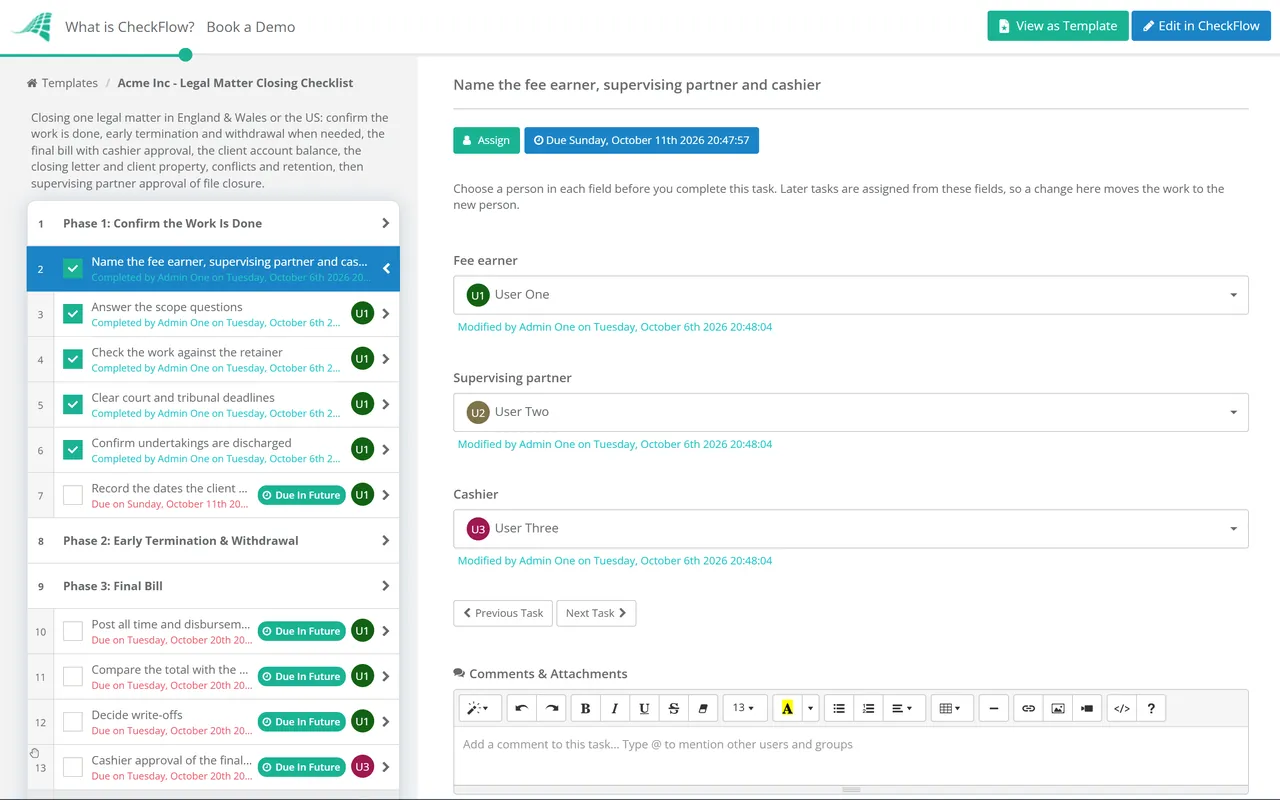
- Fee earner and supervisor are named once, and later steps are assigned to them
Supervision
File Review & Supervision
The SRA Code of Conduct for Firms requires an effective system for supervising clients’ matters, and the COLP must take all reasonable steps to ensure the firm complies with the SRA’s requirements. That calls for a documented record of supervision activity, not an assurance that supervision is happening. CheckFlow structures the periodic file review process: matter selection, fee-earner review of key documents and progress, supervisor assessment against quality and compliance criteria, findings and actions recorded, and sign-off dated.
File reviews that happen on schedule, produce documented records, and give the COLP the oversight evidence that a regulatory visit, a complaints investigation, or a professional indemnity claim may require. The same discipline applies when a matter ends: the legal matter closing checklist confirms deadlines and undertakings are dealt with, returns client money and original documents, and sets a destruction date before the file is archived.
- A schedule starts each month’s file review checklist on its own
- Every finding and sign-off is stamped with a name and a time
AML & Due Diligence Compliance
Law firms are high-risk entities for AML purposes, particularly in conveyancing, trust and company work, and matters involving the movement of significant funds through client account. SRA supervisory visits increasingly focus on whether AML procedures are being applied consistently and evidenced contemporaneously, not just documented in a policy. CheckFlow structures the AML and client due diligence workflow: identity verification method and evidence, business verification for corporate clients, source of funds and wealth assessment, PEP and sanctions screening, risk classification, and MLRO referral where required. Every step recorded at the time it was completed, by the person who completed it.
Customer Due Diligence ChecklistDocument Review & Approval Workflow
The contract that went to the client before the partner had reviewed the final version. The NDA where the latest redline wasn’t the one that was executed. The completion statement that contained a figure from the previous draft. Document review in law firms that relies on email chains, version confusion, and assumed approvals creates exactly these errors. CheckFlow structures the document review and approval workflow: drafting, internal review, client or counterparty circulation, comment consolidation, final version confirmation, approval routing, execution, and filing, with the agreed version attached at each stage and a named approver’s sign-off required before the next step opens.
Contract Review & Approval Checklist
Ready-to-Use Templates for Law Firms
Start from a template for the process that carries the most risk, adapt it to your practice areas and your firm’s procedures, and run it on the next matter. Each one is fully editable in the CheckFlow template designer.

Legal Case Intake Process Checklist

Customer Due Diligence Checklist

Contract Review & Approval Checklist

Legal Matter Closing Checklist

NDA Processing Workflow Checklist

Compliance Audit Checklist for a Legal Department
Relevant Template Libraries for Law Firms
CheckFlow’s template library covers the core operational and compliance processes that law firms run on every matter, every client relationship, and every compliance cycle, from initial intake and AML through to document management, file supervision, and professional development.
Legal & Contract Management Templates
Legal case intake, matter closing, contract review and approval, NDA processing, IP registration, contract renewal tracking, and compliance audits: the core legal workflow processes that govern every matter and every client relationship.
Browse legal templatesDue Diligence Templates
Customer due diligence, business partnership assessments, and counterparty reviews: the structured KYC, KYB, and AML workflows that must be applied consistently and documented contemporaneously for every new client and matter type.
Browse due diligence templatesCustomer Management Templates
Client onboarding, client success management, and account management workflows: the processes that determine the quality and consistency of every client engagement from first instruction through to matter close.
Browse customer templatesCompliance Templates
ISO 27001, data protection, and regulatory compliance frameworks: the recurring compliance workflows that keep the firm’s data security, GDPR obligations, and SRA regulatory requirements documented and evidenced.
Browse compliance templatesHuman Resources Templates
Solicitor recruitment, onboarding, CPD tracking, performance reviews, and capacity management: the people processes that ensure every fee-earner is qualified, supervised, and their professional development documented.
Browse HR templatesFinance & Accounting Templates
Invoice approval, expense management, and month-end close: the financial processes that support accurate billing, WIP management, and the client money handling that SRA Accounts Rules compliance requires.
Browse finance templates
Ask your AI assistant which matters are still waiting on a step.
CheckFlow works with any AI assistant. Connect it once and it reads and works your checklists with the same permissions as the person whose API key it holds.
Ask your AI assistant
Through the CheckFlow MCP server, Claude, ChatGPT, Gemini, Grok, Copilot or any other AI assistant can find an intake or matter closing checklist, list the steps still open and who owns them, and start the next intake for you.
Read the MCP guideDraft the template from a sentence
Describe your firm’s intake procedure or paste your file review policy and the free AI checklist generator drafts the template, with phases, fields and due dates in place.
Try the AI generatorConnect your other systems
Start an intake checklist when a matter is opened in your case management system, through Zapier or the REST API, and get a webhook when it completes.
Developer overview
Which matter closings are still waiting for the cashier?
template: "Legal Matter Closing"
status:   "InProgress"
Three matter closings are in progress. Two are waiting for the cashier’s approval of the final bill, which holds the client account steps. Shall I list the open steps and their owners?
Used by great companies









This is a great app for documenting and managing your processes. … It is particularly good for time sensitive processes as you can set up a sequence of task due reminder emails at whatever time frames you want.
Law Firm Process Management: Frequently Asked Questions
Why are conflict of interest checks such a critical process to structure?
A conflict of interest check is the one process in legal services that must be run before any other step: specifically, before any confidential information is received from a prospective client and before an engagement letter is issued. If a conflict is identified after confidential information has been received, the firm may be prevented from acting for either party and from disclosing what it knows to the affected party, a position that creates both professional and commercial damage. The SRA’s conflict rules (paragraphs 6.1 and 6.2) apply to individual solicitors under the Code of Conduct for Solicitors and to the firm under the Code of Conduct for Firms, which also requires the firm to have effective systems and controls for complying with them. A conflict check that depends on the fee-earner’s confidence that no conflict exists is not a conflict checking system. It is a gap in one. CheckFlow structures the conflicts check as a required, documented first step of every matter intake, with a completion record that demonstrates the check was performed before work commenced.
How does CheckFlow help with SRA AML compliance obligations?
The SRA’s supervision activity on AML compliance has increased substantially in recent years (its anti-money laundering report for 2024/25 records 151 enforcement outcomes, up from 78 the year before), with enforcement actions focusing specifically on whether firms can demonstrate that their AML procedures were applied consistently and documented contemporaneously, not just that they have a policy. CheckFlow supports SRA AML compliance through structured, evidenced execution of the AML workflow for every new client and matter: the specific verification steps taken (identity documentation obtained, business verification method, source of funds assessment), the risk classification applied, whether enhanced due diligence was triggered, and the fee-earner and date attributed to each step. The record created is contemporaneous: produced at the time the check was performed, not assembled retrospectively when the SRA requests the file. The government has decided that the FCA will take over AML supervision of legal services once legislation is passed; until then the SRA remains the supervisor, and the same records serve either. Note: CheckFlow structures processes and creates records; it is not a source of legal or regulatory advice. Always consult qualified compliance counsel for specific AML obligations.
How is CheckFlow different from a practice management system?
Practice management systems (Clio, LEAP, Osprey, Actionstep) manage matters, time recording, billing, document storage, and client communications. CheckFlow manages operational processes: the structured checklists and recurring workflows that run around and within the matter. The intake sequence that governs how every new matter is opened, the document review workflow that governs how every client document is reviewed and approved, the supervision process that governs how every matter is periodically reviewed by a supervisor. The two categories are complementary: practice management systems track the matter; CheckFlow ensures the processes around the matter are followed correctly and with a documented record of completion.
Can CheckFlow be used across different practice areas with different intake and compliance requirements?
Yes. CheckFlow supports multiple distinct process templates running simultaneously: a firm’s conveyancing practice can maintain an intake process that includes the specific source of funds requirements for property transactions, while the employment practice runs a simplified intake for employment tribunal matters, and the corporate team runs a more extensive due diligence workflow for M&A mandates. Each template is independently version-controlled, so regulatory updates or practice area changes can be applied without affecting other workflows. Templates can also be differentiated by seniority level, so a trainee follows a more comprehensive guided checklist while a senior associate follows a streamlined version of the same process.
Make Every Professional Obligation a Process, Not a Memory Test
Free 14-day trial, no credit card required. Pick the process that carries the most risk, start from a template, and run it on your next matter.
14-day free trial, no credit cardFull refund in your first 30 daysUS hosting, EU on request