CQC Inspection Readiness Checklist Template (England)

CQC judges what it can see, hear and read on the day. If the evidence of good care lives in one manager’s head, the report will not reflect it.

Most services that get a disappointing report were not giving poor care. What failed was the evidence: notifications nobody sent, audits that found problems and recorded no action, or a factual accuracy window that ran out while the manager was on leave. This free CQC inspection readiness checklist gives registered managers, nominated individuals and quality leads at CQC-registered providers in England one workflow: evidence organised by the five key questions, spot checks against the fundamental standards, notifications and the Provider Information Return, a plan for inspection day, and the 10-working-day factual accuracy check after the draft report arrives. Two questions at the start show the PIR task for adult social care services and a phase for closing breaches found at your last inspection.

Use This Template Free See Live Example
No Credit Card Required

Last reviewed: October 2026

How CQC Assesses Services in 2026, and What Is Changing

The Care Quality Commission regulates health and adult social care in England only. Scotland has the Care Inspectorate and Healthcare Improvement Scotland. Wales has Care Inspectorate Wales and Healthcare Inspectorate Wales, and Northern Ireland has the Regulation and Quality Improvement Authority. Every registered provider in England must meet the fundamental standards in the Health and Social Care Act 2008 (Regulated Activities) Regulations 2014, regulations 9 to 20A. These are the floor below which care must never fall, and the regulations CQC cites when it finds a breach.

As of October 2026, CQC still assesses services under its single assessment framework. That means five key questions (safe, effective, caring, responsive and well-led) and 34 quality statements, with evidence drawn from six categories: people’s experience, feedback from staff and leaders, feedback from partners, observation, processes and outcomes. Since 2 December 2024 CQC has scored only at quality statement level, on a scale of 1 to 4, and those scores feed the familiar ratings of outstanding, good, requires improvement and inadequate.

That framework is on its way out. Dr Penny Dash’s review, published on 15 October 2024, found serious failings in how CQC operated. CQC then consulted in late 2025 on its proposals. In March 2026 it published four draft sector-specific frameworks, for adult social care, mental health, primary care and community services, and hospitals. They bring back rating characteristics and key lines of enquiry, and they drop scoring in favour of holistic judgement by the inspection team. Pilots run from June to October 2026, with evaluation in November, alongside normal inspections. So prepare for the framework that applies on your assessment date, and organise your evidence by key question and regulation, because both survive the change.

A US hospital preparing for accreditation faces a different body with a different method. That is what the Joint Commission Survey Readiness Checklist covers.

Adult social care

Evidence from people’s daily lives

  • Residential services are usually inspected unannounced
  • Annual Provider Information Return, sent by the registered manager
  • Observation and people’s experience carry much of the weight
  • Care plans, safeguarding, staffing and DoLS records checked closely
Healthcare

Evidence from systems and outcomes

  • GP practices usually get notice of an assessment
  • Processes and outcomes data are a large part of the evidence
  • Clinical governance, learning from incidents and duty of candour
  • NHS acute trusts and independent hospitals check factual accuracy on a Word form

What the CQC Inspection Readiness Checklist Covers

Seven phases run from setting up to the published report. Phase 3 appears only when your last inspection found breaches of regulation, and the PIR task in Phase 5 appears only for adult social care services.

Setup

Phase 1: Set Up

Answer the two scope questions first. They decide whether the PIR task and the breaches phase appear.

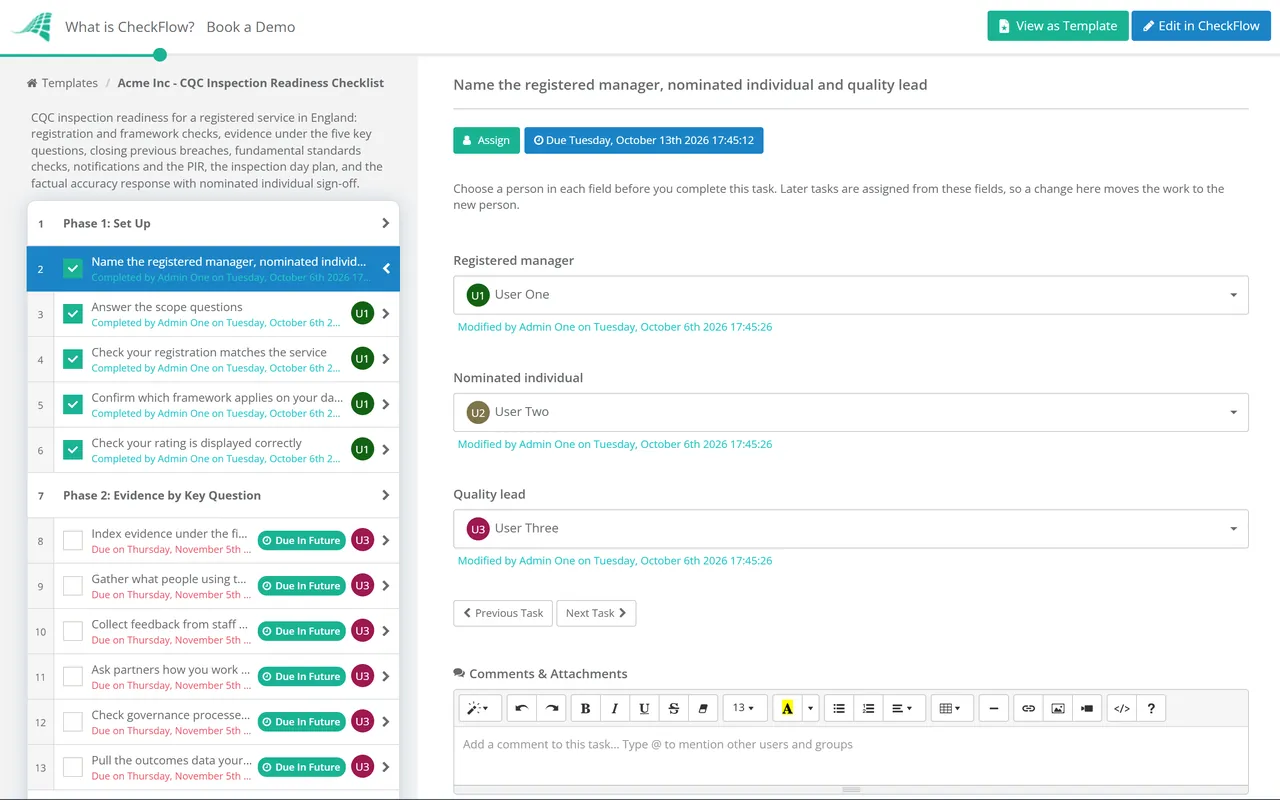
  • Name the registered manager, nominated individual and quality lead — later tasks are assigned from these three fields
  • Answer the scope questions — is this an adult social care service, and did the last inspection find breaches of regulation
  • Check your registration matches the service — regulated activities, locations and registered manager as they are today
  • Confirm which framework applies on your date — the single assessment framework or CQC’s new sector framework, from CQC’s current guidance
  • Check your rating is displayed correctly — at each location and on your website, with the date it was given
Evidence

Phase 2: Evidence by Key Question

  • Index evidence under the five key questions — safe, effective, caring, responsive and well-led, cross-referenced to regulations
  • Gather what people using the service say — surveys, compliments, complaints and feedback from families and advocates
  • Collect feedback from staff and leaders — staff surveys, supervision themes and what staff say about speaking up
  • Ask partners how you work with them — commissioners, local authority, GPs and other services you share people with
  • Check governance processes leave a trail — audits, findings, actions and re-audits, with dates and owners
  • Pull the outcomes data your sector uses — trends over time, with what you changed in response
Breaches

Phase 3: Close Previous Breaches

Shown only when the last inspection found breaches of regulation.

  • List each regulation breached and what CQC found — taken word for word from the published report
  • Evidence every action in your improvement plan — what changed, when, and the record that proves it
  • Re-audit each area that failed — at least twice, so the fix is shown to hold
  • Brief the nominated individual on progress — open actions, risks and the dates you are working to
Standards

Phase 4: Fundamental Standards Checks

  • Sample care plans for personalisation and consent — regulations 9 and 11, against what people and staff tell you
  • Review safeguarding referrals and follow-up — regulation 13, including whether CQC was notified
  • Check staffing levels and recruitment files — regulations 18 and 19, including pre-employment checks and training
  • Review complaints and their outcomes — regulation 16, from receipt to response and learning
  • Check duty of candour records — regulation 20, for each notifiable safety incident
  • Inspect premises and equipment records — regulation 15, servicing, cleaning and maintenance logs
  • Test the governance cycle end to end — regulation 17, from audit finding to action closed
Notify

Phase 5: Notifications & Returns

The PIR task appears only for adult social care services.

  • Reconcile incidents against statutory notifications — deaths, abuse allegations, serious injuries and police incidents sent without delay
  • Check DoLS outcomes were notified — once the outcome of each request or application is known
  • Confirm provider portal access for registered roles — accounts made before February 2024 no longer work
  • Complete the annual Provider Information Return — within the deadline in CQC’s email, signed off before it is sent
  • Keep a notifications log — date of event, date sent and reference, for inspectors to check
On site

Phase 6: Inspection Day Plan

  • Agree who greets inspectors on any shift — including nights and weekends, with the registered manager’s contact details
  • Prepare the evidence index for requests — where each document lives and who can produce it quickly
  • Brief staff on talking to inspectors — answer from their own practice; no scripts
  • Tell people using the service and families — that inspectors may ask to speak to them, and that it is their choice
  • Record the feedback given at the end — while it is fresh, with any evidence inspectors asked for afterwards
Report

Phase 7: Factual Accuracy & Report

The nominated individual sign-off halts the checklist. Nothing is submitted until it is given.

  • Log the date the draft report arrived — you have 10 working days from CQC’s email
  • Check the draft against your evidence — for accuracy and completeness, not to argue judgements
  • Draft factual accuracy comments with evidence — one comment per point, each with the document that supports it
  • Nominated individual sign-off of the factual accuracy response — the nominated individual approves the comments before they are sent
  • Submit comments before the deadline — online, or on the Word form for NHS acute trusts and independent hospitals
  • Decide whether to request a rating review — within 15 working days of publication, on process grounds only
  • Display the new rating within 21 days — at each location and on your website, then update your improvement plan

The Fundamental Standards: What to Have Ready

Regulations 9 to 20A of the 2014 Regulations set the fundamental standards. Whatever framework CQC is using on the day, a breach is cited against one of these. The right-hand column is a starting point for each evidence pack, not a complete list.

RegStandardEvidence to have ready
9Person-centred careCare plans written with the person, and reviews
10Dignity and respectFeedback, observation notes, privacy arrangements
11Need for consentConsent records, capacity assessments where needed
12Safe care and treatmentRisk assessments, medicines audits, incident learning
13Safeguarding from abuse and improper treatmentReferrals, training, DoLS records
14Nutritional and hydration needsAssessments, monitoring, follow-up of concerns
15Premises and equipmentServicing, cleaning and maintenance logs
16Receiving and acting on complaintsComplaints log, responses, learning
17Good governanceAudit cycle, action plans, board or owner oversight
18StaffingRotas, dependency tools, training and supervision
19Fit and proper persons employedRecruitment files and pre-employment checks
20Duty of candourNotifiable incidents, letters, apologies
20ADisplay of performance assessmentsRating at each location and on the website

Two time limits worth knowing. Under regulation 17(3), when CQC asks for a written report on how you meet the governance requirements, you have 28 days to send it. That request is how the adult social care PIR is made. Under regulation 16(3), a summary of complaints asked for by CQC is also due within 28 days. CQC can prosecute a failure on either without first issuing a warning notice.

Why Run CQC Readiness in CheckFlow?

1

Deadlines that count themselves

Tasks carry due dates offset from the day the checklist starts, so the factual accuracy check, the rating review window and the 21-day display deadline are dated the moment the draft report arrives. Run the evidence and notification checks as a quarterly recurring checklist so readiness is continuous.

2

No response goes unsigned

The factual accuracy response stops at an approval step until the nominated individual answers. Comments, attached evidence and the sign-off stay in the checklist history, which is itself governance evidence under regulation 17.

3

One template, any service

Dropdown answers show the PIR task and the breaches phase only where they apply. Reports show which locations have overdue audits or open actions, and the API and MCP server can start a readiness checklist from your own systems.

Readiness rests on everyday processes inspectors will sample. The Healthcare Incident Reporting Checklist keeps incident learning on record. The Healthcare Staff Credentialing Checklist and the New Nurse Onboarding Checklist leave recruitment and induction records ready for regulations 18 and 19. The Patient Discharge Checklist covers transfers between services.

Running several registered locations? CheckFlow’s healthcare checklist software runs the same readiness checks at every site, and compliance checklist software keeps owners, evidence and sign-offs in one place.

Frequently Asked Questions

Is CQC still using the single assessment framework in 2026?

+

Yes, as of October 2026. CQC assesses services against five key questions and 34 quality statements, with scores at quality statement level that feed the ratings. It has published four draft sector-specific frameworks, which drop scoring and bring back key lines of enquiry and rating characteristics. It is piloting them from June to October 2026, alongside normal inspections, and evaluating in November. Check CQC’s guidance for which framework applies on your assessment date.

How long do you have to respond to a CQC draft report?

+

10 working days from the date of CQC’s email with the draft report. CQC will not extend that except in exceptional circumstances. Use it to correct factual errors and gaps in the evidence, attaching proof for each point. If you think CQC did not follow its own process for making a rating, you can request a review within 15 working days of the report being published. Disagreeing with the judgement is not grounds for a review.

What are the CQC fundamental standards?

+

They are regulations 9 to 20A of the Health and Social Care Act 2008 (Regulated Activities) Regulations 2014: person-centred care, dignity and respect, need for consent, safe care and treatment, safeguarding, nutrition and hydration, premises and equipment, complaints, good governance, staffing, fit and proper persons employed, duty of candour, and display of ratings. They are the standards below which care must never fall.

What must be notified to CQC?

+

Under the Care Quality Commission (Registration) Regulations 2009, deaths of people using the service are notified under regulation 16. Regulation 18 covers other incidents: abuse or allegations of abuse, serious injuries, incidents reported to or investigated by the police, events that threaten your ability to keep running the service safely, and the outcome of applications to deprive someone of their liberty. Most must be sent without delay, and many can be sent through the CQC provider portal.

Does CQC inspect services in Scotland, Wales or Northern Ireland?

+

No. CQC regulates health and adult social care in England. In Scotland the regulators are the Care Inspectorate and Healthcare Improvement Scotland. In Wales they are Care Inspectorate Wales and Healthcare Inspectorate Wales, and in Northern Ireland it is the Regulation and Quality Improvement Authority. Each has its own standards and process, so adapt this checklist rather than use it as it stands.

Is CheckFlow free for this template?

+

14-day free trial, no card required. The Business plan is $10 per user per month after the trial. Full details at checkflow.io/pricing.

Show Inspectors the Care You Already Give

Free trial — no credit card required.