
Process Management Software for Fintech Companies
Fintech companies are built to move fast.
The regulatory environments fintech companies operate in (the FCA, FinCEN, MAS, PSD2, AMLD6, DORA) require documented, consistent, auditable processes. The tension between these two realities is where most growing fintechs encounter operational risk. Not from bad intentions, but from processes that worked at twenty people and broke at two hundred. The onboarding flow applied differently by different teams. The incident response that nobody practised. The vendor due diligence that was thorough for the first supplier and skipped for the tenth.
CheckFlow gives every operational process in a fintech company a consistent, documented structure that scales with the business (customer KYC onboarding, product compliance sign-off, vendor risk management, incident response, and regulatory change management) without adding the administrative overhead that slows a growing team down.
14-day free trialNo credit cardUnlimited free guests
Last updated
Process management software for fintech companies turns KYC onboarding, product compliance sign-off, vendor risk reviews and incident response into checklists that run the same way at twenty people or two hundred. In CheckFlow, each process gets a template with named owners, due dates and steps that cannot be skipped, and every completed step is recorded with who did it and when, ready when an auditor, a partner bank or a regulator asks.
The Operational Reality for Growing Fintech Companies
The compliance framework most fintechs build at founding is designed for the size and complexity of the company at that moment. Six months later, the team is larger, the product has new features operating in new jurisdictions, and the KYC process that the founding compliance officer could oversee personally is now being applied by twelve people across three locations. The process hasn’t changed, but it’s no longer being applied consistently. Regulators assess compliance based on evidence, not intent. The question is never “did you try to follow the process?” It is “can you show that it was followed, by whom, and when?”
Consistency doesn’t scale by accident
Onboarding processes applied differently depending on workload, team, or region are a compliance failure in waiting. CheckFlow deploys the same structured workflow to every team member, so the verification steps that apply to a customer in London apply identically to a customer onboarded by a different team in Singapore.
The documentation must tell the full story
When a regulator or auditor requests evidence, “we have policies” is not the same as “here is a dated record showing who completed each step, when, and what the outcome was.” CheckFlow creates that record automatically for every process run, without the team needing to remember to do it.
Recurring obligations can’t rely on memory
KYC refresh cycles, periodic compliance reviews, vendor performance assessments, and security audit schedules all have defined frequencies. A CheckFlow schedule starts each recurring checklist automatically at the interval you set, so no deadline is missed because it wasn’t manually scheduled.
Why Fintech Companies Choose CheckFlow
Scales with the company, not against it
A compliance process that depends on one person’s oversight works when there are twenty people and breaks when there are two hundred. CheckFlow deploys the same structured workflow to every team member, in every location, on every shift, so the compliance standard applied at twenty people is the compliance standard applied at two hundred. Growth doesn’t dilute the process.
Template version history for a changing regulatory landscape
PSD2 being replaced by PSD3 and the Payment Services Regulation, AMLD6 enacted, DORA applying since January 2025: the regulatory requirements fintech companies operate under change regularly, and the processes must change with them. When a compliance workflow is updated, CheckFlow’s template version history records each version with who saved it and when, and checklists stay on the version they were started from unless you choose to upgrade them. When a regulator asks what procedure was followed on a specific date six months ago, the answer is in the version history, not in someone’s memory.
Accessible for seed-to-Series B and beyond
Enterprise compliance software carries enterprise pricing, enterprise implementation timelines, and enterprise sales cycles. CheckFlow is operational within hours: no IT implementation, no professional services, no minimum contract. At $10 per user per month with a 14-day free trial, it is accessible from a company’s first compliance hire to a scaled operations team running hundreds of recurring processes each month.
How Fintech Teams Use CheckFlow
From regulated customer onboarding to product compliance and vendor risk, CheckFlow structures the operational workflows that keep fintech companies compliant as they grow.
Verification
Customer Onboarding & KYC/AML
Every customer onboarded through a fintech platform must pass the same verification standards, regardless of volume, channel, or which team member is handling the case. CheckFlow’s customer onboarding workflow structures the full KYC process: identity verification, sanctions and PEP screening, source of funds assessment, risk classification, and account approval, with a dated, attributed record of every step. When onboarding volume doubles, the process doesn’t degrade.
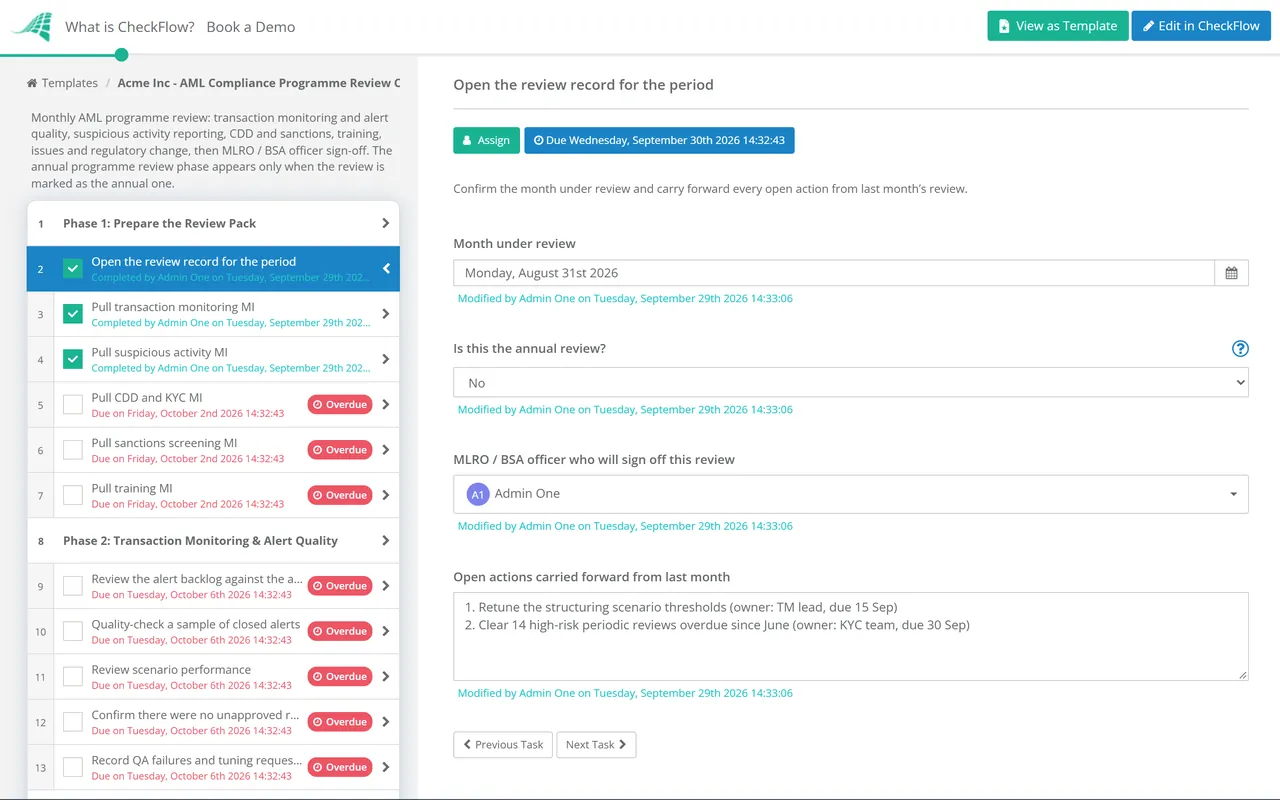
Once customers are on board, the KYC periodic review checklist refreshes their due diligence by risk tier, and the AML compliance programme review gives the MLRO a monthly review of the whole programme.
- Halt tasks keep account approval locked until screening and the source of funds check are complete
- A condition adds enhanced due diligence when screening returns a PEP match
Incidents and breaches
Incident & Breach Response
Under the GDPR (and the UK GDPR), a personal data breach must be reported to the supervisory authority without undue delay and, where feasible, within 72 hours of becoming aware of it, unless it is unlikely to result in a risk to people’s rights and freedoms. Under DORA, major ICT-related incidents have their own timeline: an initial notification within four hours of classifying the incident as major and no later than 24 hours after becoming aware of it, an intermediate report within 72 hours of that, and a final report within a month.
CheckFlow’s incident response workflow provides a structured, time-stamped process: detect and classify, initiate the response plan, make the notification decision, meet the filing deadline, and document the full incident timeline. Each deadline is due a set number of hours after the time you enter when the incident is discovered. The workflow runs the clock; the team manages the response.
Product & Feature Compliance Sign-Off
Launching a new product feature, entering a new market, or changing the terms of a regulated service all carry compliance obligations: regulatory notification, disclosure updates, customer communication, support team briefing, and internal sign-off. CheckFlow’s product compliance workflow structures every pre-launch gate, assigns each step to the responsible owner across compliance, operations and engineering, and keeps the launch step locked until the gates before it are complete. Speed is preserved; the compliance steps don’t get skipped.
Product Launch TemplatesVendor & Third-Party Risk Management
BaaS providers, identity verification vendors, cloud infrastructure, card processors: every third-party relationship in a fintech’s stack represents a risk that must be assessed at onboarding and monitored on an ongoing schedule. Regulators treat third-party risk as the firm’s own risk: under the FCA’s outsourcing rules and DORA, the firm stays fully responsible for its obligations when a provider does the work. CheckFlow structures vendor due diligence at onboarding (financial stability, security certifications, incident response and notification commitments, contractual protections) and starts scheduled performance reviews automatically, so vendor risk is managed as a programme, not as a reaction to incidents.
Vendor Management Templates
Ready-to-Use Templates for Fintech Teams
Start from a template for the process causing the most risk, adapt it to your products and jurisdictions, and run it today. Each one is fully editable in the CheckFlow template designer and has a live demo.

AML Compliance Programme Review Checklist
Customer Due Diligence Checklist
DORA ICT Risk Management Checklist
Vendor Risk Assessment Checklist
Data Breach Response Checklist

Feature Release Process Checklist
Relevant Template Libraries for Fintech Teams
CheckFlow’s template library covers the operational processes that fintech companies run repeatedly, from customer onboarding and KYC through to product compliance, vendor risk, incident management, and HR in a regulated environment.
Customer Management Templates
SaaS customer onboarding, customer success, and client management workflows: structured processes for onboarding customers at scale while maintaining consistent verification and documentation standards.
Browse customer templatesCompliance Templates
ISO 27001, HIPAA, FISMA, FedRAMP, and other compliance frameworks: recurring compliance workflows that start automatically on a schedule, maintain evidence records, and stand up to regulatory inspection.
Browse compliance templatesInformation Technology Templates
IT change management, incident management, disaster recovery audit, and support ticket workflows: the operational IT processes that DORA and cybersecurity requirements increasingly expect to be structured and evidenced.
Browse IT templatesProduct Development & Launch Templates
Feature release, MVP development, product launch, and bug tracking workflows: structured pre-launch compliance gates that ensure regulated product features are approved and documented before deployment.
Browse product templatesDue Diligence Templates
Customer due diligence, vendor due diligence, and business partnership assessments: the documented workflows for every counterparty and supplier relationship that carries regulatory or commercial risk.
Browse due diligence templatesHuman Resources Templates
Recruitment, onboarding, and performance management for regulated environments, including competency frameworks, SM&CR documentation, and training completion records.
Browse HR templates
Ask your AI assistant which compliance steps are overdue.
CheckFlow works with any AI assistant. Connect it once and it reads and works your checklists with the same permissions as the person whose API key it holds.
Ask your AI assistant
Through the CheckFlow MCP server, Claude, ChatGPT, Gemini, Grok, Copilot or any other AI assistant can list the overdue steps across your KYC, vendor and launch checklists, say who owns each one, and start the next checklist for you.
Read the MCP guideDraft the template from a sentence
Describe your onboarding flow or paste your incident response plan and the free AI checklist generator drafts the template, with phases, fields and due dates in place.
Try the AI generatorConnect your other systems
Start a KYC checklist when a sign-up clears your identity verification provider, or an incident checklist from your alerting tool, through Zapier or the REST API, and get a webhook when it completes.
Developer overview
Which compliance steps are overdue across our checklists?
assignee: "all"
status:   "Overdue"
Four tasks are overdue: two source of funds checks on KYC onboarding checklists, the annual review in “Vendor Risk Assessment – Acme Logistics”, and the disclosure update on the Instant Transfers launch sign-off. Shall I list the owners and due dates?
Used by great companies









There is a great API that gives you the ability to integrate it in your existing software landscape.
Fintech Process Management: Frequently Asked Questions
What operational processes create the most compliance risk in a growing fintech company?
The highest-risk processes are those that are applied inconsistently as the company grows: most commonly customer onboarding and KYC (where verification standards vary between teams, regions, or volume levels), incident response (where the 72-hour GDPR notification window and DORA ICT incident timelines require a structured, time-stamped response from the moment of detection), and vendor risk management (where due diligence that was thorough for early suppliers becomes cursory as the vendor list grows). The common thread is not bad intent. It is processes that relied on individual oversight rather than structured workflows, and broke when volume or headcount exceeded the capacity of that oversight.
How does CheckFlow help with GDPR and DORA compliance?
CheckFlow supports compliance with both frameworks through structured, evidenced processes rather than point-in-time documentation. For GDPR: the personal data breach response workflow provides a structured, time-stamped process for assessing, classifying, and notifying a breach within the 72-hour window, with a complete incident record created as the response runs. Vendor onboarding and data processing agreement workflows ensure supplier data protection obligations are documented and reviewed on a defined schedule. For DORA, which has applied since 17 January 2025: the ICT incident management workflow structures the detection, classification, escalation, and notification process for major ICT-related incidents, with the timeline documentation that DORA’s reporting requirements demand. ICT third-party risk management workflows structure due diligence and ongoing monitoring for the ICT third-party service providers that support critical or important functions; the DORA ICT risk management checklist is a starting point. Whether you comply is for your DPO, your auditors and your regulator to judge; CheckFlow makes the work consistent and keeps the record.
How is CheckFlow different from dedicated RegTech compliance software?
RegTech compliance platforms (transaction monitoring systems, automated sanctions screening tools, regulatory reporting platforms) handle system-generated compliance activities: they run automatically based on data triggers. CheckFlow handles the human-executed operational procedures that surround those activities: the structured onboarding checklist that a compliance analyst follows, the pre-launch sign-off process that governs new product features, the vendor due diligence workflow that runs every time a new third party is onboarded. The two categories are complementary: RegTech handles the automated controls; CheckFlow handles the human procedures that form the surrounding compliance programme. CheckFlow is not an alternative to KYC/AML screening tools; it is the structured operational wrapper around them.
Is CheckFlow suitable for early-stage fintechs as well as established ones?
Yes. CheckFlow is designed to be operational within hours: no implementation project, no professional services requirement, no minimum contract. The 14-day free trial requires no credit card and gives full access to every feature. At $10 per user per month, it is financially accessible from a company’s first compliance hire. The template library provides a starting point for any regulatory environment, and every template is fully customisable. Early-stage fintechs benefit particularly from implementing structured processes before growth makes inconsistency inevitable: it is significantly easier to build the compliance infrastructure while the team is small than to retrofit it after the regulator has asked questions.
Give Every Fintech Process a Documented, Consistent Workflow From Day One
Free 14-day trial, no credit card required. Pick the process causing the most risk, start from a template, and run it with your team today.
14-day free trial, no credit cardFull refund in your first 30 daysUS hosting, EU on request