
Healthcare & Medical Staff Credentialing Checklist Template

A structured credentialing process — from application receipt to privileging approval — with primary source verification documented at every step and full audit trails maintained.

Medical staff credentialing is not a formality — it is the primary mechanism by which healthcare organisations verify that the people providing patient care are qualified, licensed, and competent to do so. An incomplete credentialing file, a missed licence expiry, or a sanction check that was never run represents not just a compliance failure but a patient safety risk. The NCQA’s 2025 credentialing standards — effective July 2025 — raised the bar significantly: primary source verification must be completed within tighter timeframes, full audit trails are required for all data changes, and monthly monitoring of sanctions and exclusions is now mandatory. More than half of credentialing applications contain errors or missing information, making incomplete applications the primary cause of onboarding bottlenecks in healthcare organisations. A structured credentialing checklist ensures every required element is collected, every verification is completed and documented, and every deadline is met — reducing the time from application to authorised practice while maintaining the rigour that patient safety demands. This free checklist gives medical staff services professionals, credentialing coordinators, and healthcare administrators a structured framework for the full credentialing cycle.

Note: This checklist describes the administrative credentialing process framework. Specific verification requirements, timelines, and standards are set by applicable accreditation bodies (NCQA, The Joint Commission), CMS Conditions of Participation, and state regulations. Always verify current requirements with applicable standards.
Use This Template Free See Live Example
No Credit Card Required

What Happens When Credentialing Processes Are Not Structured

Patient safety risk

An unverified clinician with a lapsed licence, undisclosed malpractice history, or active sanctions provides patient care the organisation believes is credentialed. The harm is not only to the patient — it is to the organisation’s accreditation, liability exposure, and reputation.

Root cause: No systematic process for verifying each required element at initial credentialing and at reappointment.

Accreditation and payer compliance failures

The Joint Commission, NCQA, and CMS all have specific credentialing requirements. An incomplete or poorly documented credentialing file discovered during an accreditation survey or payer audit produces findings that can threaten accreditation status or payer network participation.

Root cause: No audit trail showing who verified what, from which primary source, and when.

Revenue cycle delays

A provider who cannot see patients until credentialing is complete — or who cannot bill because payer credentialing has not been completed — represents a direct revenue impact. The average credentialing timeline with commercial payers runs 90–150 days. Incomplete applications extend this further.

Root cause: No structured process for collecting all required application elements before submission.

The Healthcare Staff Credentialing Checklist

Six phases covering the full credentialing cycle — from application receipt through primary source verification, privileging, committee approval, and ongoing reappointment monitoring.

Phase 1

Credentialing Application Collection

More than 50% of credentialing applications contain errors or missing information. Completeness review before submission is the single most effective step for reducing credentialing cycle time.

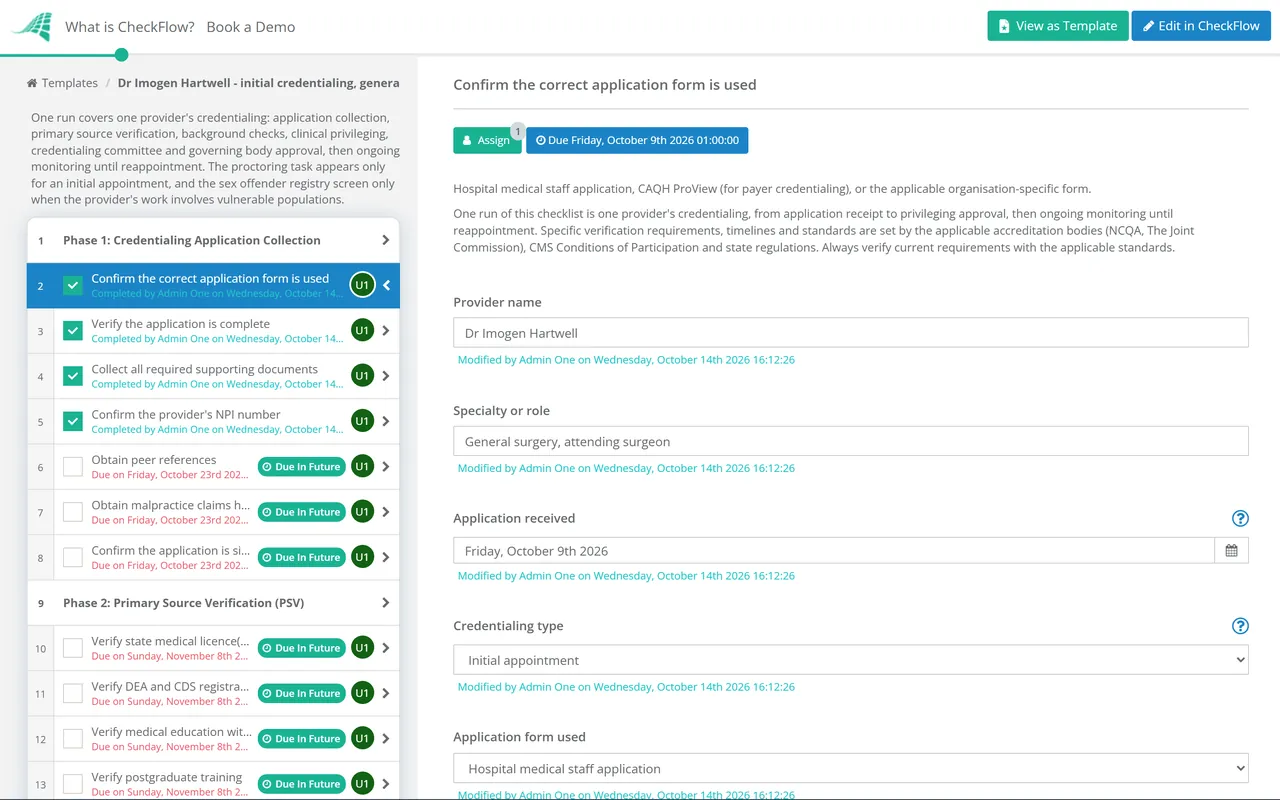
  • Confirm the correct application form is used — hospital medical staff application, CAQH ProView (for payer credentialing), or the applicable organisation-specific form
  • Verify the application is complete — all sections completed, all dates in required format (MM/YYYY), no unexplained gaps in work history
  • Collect all required supporting documents — government-issued photo ID, current curriculum vitae, medical degree and training certificates, board certification certificates, current state licences, DEA registration, and malpractice insurance certificate
  • Confirm the provider’s NPI number — National Provider Identifier confirmed and active in the NPPES database
  • Obtain peer references — minimum three professional references who can attest to the applicant’s clinical competence; confirm references are not relatives and meet the applicable standards
  • Obtain malpractice claims history — self-reported history covering the preceding 10 years; narrative explanation for any claims received
  • Confirm the application is signed and dated by the applicant — attestation of accuracy and completeness required
Phase 2

Primary Source Verification (PSV)

Primary Source Verification means confirming credentials directly with the issuing source — not accepting copies provided by the applicant. NCQA 2025 standards require PSV to be completed within 120 days (accreditation) or 90 days (certification), with full audit trails for every verification.

  • Verify state medical licence(s) directly with the state medical licensing board — confirm licence is active, unrestricted, and not subject to disciplinary action
  • Verify DEA and CDS registration directly with the DEA or state controlled substance agency — confirm active status and schedule(s) covered
  • Verify medical education directly with the issuing medical school or through an NCQA-approved source
  • Verify postgraduate training — residency and fellowship programmes verified directly with the training institution
  • Verify board certification directly with ABMS, AOA, or the applicable certifying board
  • Verify work history — employment and hospital affiliation history confirmed with each listed employer; unexplained gaps must be addressed
  • Query the National Practitioner Data Bank (NPDB) — mandatory for hospital credentialing; confirms malpractice payments and adverse actions; query result retained in the file
  • Check the OIG List of Excluded Individuals/Entities (LEIE) — confirms the provider has not been excluded from Medicare/Medicaid participation
  • Check SAM.gov (System for Award Management) — confirms no federal debarment or suspension
  • Check state disciplinary board records for all states where the provider is or has been licensed — confirm no active disciplinary actions
  • Document all PSV outcomes — date verified, source contacted, verification method, and result for every element; full audit trail required
Phase 3

Background Checks & Additional Screening

  • Conduct a criminal background check — federal and state; consistent with the organisation’s background check policy and applicable state law
  • Confirm malpractice insurance coverage — current certificate of insurance on file; confirm coverage type (occurrence vs claims-made), limits, and any prior acts coverage
  • Verify DEA sanction history — any prior DEA action or voluntary surrender reviewed
  • Check hospital privilege history — confirm privilege history at prior institutions; any restrictions, surrenders, or investigations reviewed
  • Confirm professional liability claims history independently against the malpractice carrier — cross-reference with self-reported history
  • Screen against applicable sex offender registries for providers whose work involves vulnerable populations — confirm consistent with state requirements
Phase 4

Clinical Privileging

  • Define the privileges requested — specific clinical activities, procedures, or services the provider is requesting authorisation to perform at the facility
  • Verify competency evidence — training, experience, and documented competency supporting each requested privilege; case logs or procedure volumes where applicable
  • Confirm privileges are within the scope of licensure — the requested privileges do not exceed what the provider is licensed to perform
  • Assign a department chair or designee review — clinical review of the privilege application by the applicable department; recommendation documented
  • For initial privileges — confirm whether proctoring or supervised practice period is required before full privileges are granted
  • Document the privileging decision — privileges granted, denied, or modified; with rationale documented for any denial or modification
Phase 5

Credentialing Committee Review & Approval

  • Present the complete credentialing file to the credentialing committee — all PSV outcomes, background check results, references, NPDB query, and peer/department recommendations
  • Confirm the committee quorum and meeting requirements are met — consistent with medical staff bylaws
  • Document the committee review and vote — minutes recording the committee’s decision and any conditions or exceptions
  • Obtain governing body approval — final appointment to the medical staff and privilege granting requires governing board approval in most accreditation frameworks
  • Notify the provider of the credentialing decision in writing — confirming the scope of privileges granted and the effective date
  • Notify relevant departments and the revenue cycle team — the provider is credentialed and the scope of authorised services; relevant for scheduling and billing
Phase 6

Ongoing Monitoring & Reappointment

NCQA 2025 standards require monthly monitoring of sanctions, exclusions, and licence status. Annual monitoring of licence expiry dates is no longer sufficient — real-time monitoring is the emerging standard.

  • Monitor licence expiry dates — all state licences, DEA registrations, and board certifications; renewal reminders sent well in advance of expiry
  • Conduct monthly exclusion monitoring — OIG LEIE and SAM.gov monthly checks for all credentialed providers; document results
  • Monitor for adverse actions and sanctions — NPDB continuous query (where applicable) or periodic query; state board disciplinary action monitoring
  • Collect and review quality and performance data — ongoing professional practice evaluation (OPPE) data for use in reappointment decisions
  • Process reappointment every two years — full re-verification of credentials (updated PSV), review of OPPE data, and updated privilege review; credentialing cycle repeats

Primary Source Verification — What Must Be Verified and Where

Credential Element Primary Source NCQA Required
Medical DegreeMedical school directlyYes
Postgraduate TrainingTraining institution directlyYes
State LicensureState medical licensing boardYes
DEA RegistrationDEA or state controlled substance agencyYes
Board CertificationABMS, AOA, or the applicable certifying boardYes
Work HistoryEach previous employer directlyYes
Malpractice HistoryNational Practitioner Data Bank (NPDB)Yes
Sanctions / ExclusionsOIG LEIE, SAM.gov — monthly monitoringMonthly

NCQA 2025 standards (effective July 1, 2025) require PSV to be completed within 120 days for accreditation or 90 days for certification, with full audit trails — who verified, what source, what date, what outcome — for every element.

Why Run Your Credentialing Process in CheckFlow?

1

Track every provider through the credentialing cycle simultaneously

A credentialing coordinator managing 20 providers through initial credentialing and reappointment simultaneously needs a single view showing which providers have outstanding PSV elements, which are pending committee review, and which licences are approaching expiry. CheckFlow’s grid shows every provider’s status across every credentialing phase — without managing the process across spreadsheets, email threads, and shared drives.


2

Enforce the PSV sequence before approval

Credentialing committee review should not begin until PSV is complete. Privileges should not be granted until committee approval is obtained. CheckFlow’s enforced task sequence prevents later phases from advancing while earlier phases have outstanding items — ensuring no provider is granted privileges on an incomplete file.

3

A complete, audit-ready credentialing record

NCQA 2025 requires full audit trails — who verified, what, when, and from which source. Every task in CheckFlow is timestamped and attributed to the named person who completed it. The complete credentialing record for every provider — PSV outcomes, NPDB results, committee decisions, and reappointment history — is archived and immediately accessible for accreditation surveys and audits.

Healthcare staff credentialing and HIPAA compliance both require structured, documented processes with full audit trails. CheckFlow’s HIPAA Compliance Audit Checklist covers the privacy and security compliance framework that runs alongside the credentialing process. See the HIPAA Compliance Audit Checklist →

Credentialing is a recurring cycle — initial credentialing followed by reappointment every two years, with ongoing monthly monitoring between cycles. CheckFlow’s recurring checklist feature schedules reappointment cycles automatically for every credentialed provider. Learn more about recurring checklists →

Frequently Asked Questions

What is healthcare staff credentialing?

+

Healthcare staff credentialing is the formal process by which healthcare organisations verify that clinicians are qualified, licensed, and competent to provide safe patient care. It involves collecting the provider’s application and supporting documents, then conducting Primary Source Verification (PSV) — confirming each credential directly with the issuing source rather than accepting copies provided by the applicant. Key elements verified include state medical licensure, DEA registration, medical education and training, board certification, work history, malpractice history, and sanctions checks through the NPDB, OIG LEIE, and SAM.gov. The process culminates in a credentialing committee review, governing body approval, and the granting of clinical privileges.

What is Primary Source Verification and why is it required?

+

Primary Source Verification (PSV) means confirming a healthcare provider’s credentials directly with the organisation that issued them — the state licensing board, the medical school, the certifying board — rather than accepting copies provided by the applicant. PSV is required by The Joint Commission, NCQA, CMS Conditions of Participation, and most payer credentialing standards because it provides the most reliable confirmation that a credential is genuine and current. NCQA’s 2025 standards (effective July 1, 2025) require PSV to be completed within 120 days for accreditation or 90 days for certification, with full audit trails documenting who verified each element, from which source, on which date, and with what outcome.

What is the NPDB and why must it be queried?

+

The National Practitioner Data Bank (NPDB) is a federal repository maintained by the U.S. Department of Health and Human Services that contains information on malpractice payments and adverse actions against healthcare practitioners. Hospital credentialing is legally required to query the NPDB when initially granting clinical privileges and at reappointment. The NPDB reports on medical malpractice payment information, adverse clinical privilege actions, adverse professional society membership actions, federal and state licensure and certification actions, exclusions from federal or state health care programmes, and negative actions taken by private accreditation organisations. NPDB queries must be documented in the credentialing file.

How often must credentialing be renewed?

+

Medical staff credentialing is typically renewed every two years — a process known as reappointment. At reappointment, the organisation must re-verify current credentials through updated PSV, review ongoing professional practice evaluation (OPPE) data, and confirm the provider’s privileges remain appropriate. In addition to the two-year reappointment cycle, NCQA 2025 standards require monthly monitoring of exclusion lists (OIG LEIE and SAM.gov) and real-time or regular monitoring of licence expiry dates and disciplinary actions between reappointment cycles.

Is CheckFlow free for this template?

+

You can start a free 14-day trial with no credit card required, giving you full access to all features including this template. The Business plan is $10 per user per month after the trial. Full details at checkflow.io/pricing.

Credential Every Provider With the Same Structured, Audit-Ready Process

Free trial — no credit card required.