A failed new hire costs between $25,000 and $50,000 — in recruitment, training time, lost productivity, and the cost of starting over. The research on what prevents that outcome is unambiguous: structured onboarding, extended across the full first 90 days, consistently outperforms the alternative on every measure that matters — retention, time-to-productivity, engagement, and cultural integration. Yet only 29% of companies run a structured 90-day programme, and 52% of new hires say administrative tasks dominated their onboarding experience. The gap between what onboarding could be and what it usually is, is not a shortage of good intentions — it is a shortage of structure. This free employee onboarding checklist gives HR teams, managers, and growing businesses a structured, 30-60-90 day framework that coordinates preboarding, day one, the first week, and the critical milestones beyond — with every task assigned to the right person, nothing left to memory or informal handoff.
Why the First 90 Days Determine Whether a New Hire Stays
New employees make the decision to stay or leave earlier than most organisations assume. Research consistently shows that the quality of the onboarding experience — whether the new hire felt welcomed, prepared, supported, and connected to the team — is one of the strongest early predictors of 12-month retention. Organisations that extend onboarding beyond the first week and through the 90-day mark see new hire productivity accelerate by 31% compared to those with shorter programmes. Yet most onboarding experiences are dominated by paperwork, fragmented handoffs between HR and the hiring manager, and an absence of structured check-ins after week one.
The problem is not that organisations do not understand the value of good onboarding. It is that good onboarding is genuinely hard to deliver consistently when it depends on multiple people — HR, IT, the manager, and the team — each doing their part at the right moment, without a shared system that makes those responsibilities explicit and tracks whether they were fulfilled. A structured checklist does not make onboarding warmer or more human — the people in the process do that. It makes sure the operational foundation is in place so that the human interactions can happen at their best.
What the Employee Onboarding Checklist Covers
This checklist covers six phases of the employee onboarding cycle — from preboarding through to the 90-day review. Each phase builds on the last, with tasks distributed across HR, IT, the hiring manager, and the new hire’s team.
- 1
Preboarding
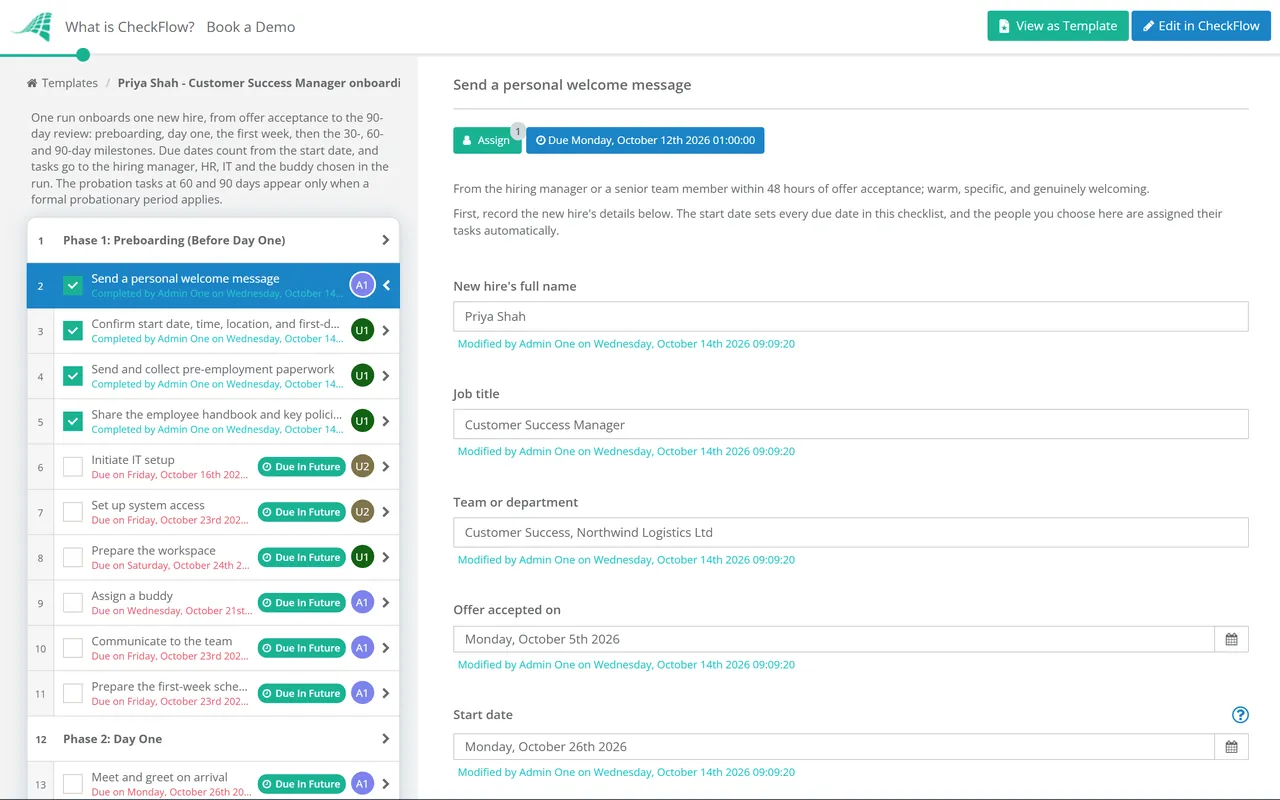
Phase 1: Preboarding (Before Day One)
10 tasksPreboarding is the period between offer acceptance and the first day. Done well, it builds anticipation, reduces first-day anxiety, and eliminates the administrative delays that make day one feel like a paperwork exercise rather than a beginning.
- Send a personal welcome message — from the hiring manager or a senior team member within 48 hours of offer acceptance; warm, specific, and genuinely welcoming
- Confirm start date, time, location, and first-day logistics — parking, building access, dress code, and who to ask for on arrival
- Send and collect pre-employment paperwork — contract, tax forms, payroll setup, bank details, right to work verification, and emergency contact information; do this before day one so day one is not dominated by administration
- Share the employee handbook and key policies — code of conduct, data protection, expenses, leave, and any other policies the new hire needs to have read before starting
- Initiate IT setup — laptop or device ordered and configured, email account created, software licences assigned, and access credentials ready for day one
- Set up system access — HRIS, project management tools, communication platforms (Slack, Teams), and any role-specific software; confirm all accounts are active before day one
- Prepare the workspace — desk, chair, equipment, and any welcome materials ready; for remote hires, confirm equipment delivery and home office setup requirements
- Assign a buddy — a peer-level colleague (not the manager) who will be the new hire’s informal guide for the first month; brief the buddy on their role before day one
- Communicate to the team — inform the existing team who is joining, when, in what role, and invite them to make the new hire feel welcome
- Prepare the first-week schedule — a clear, structured agenda for the first five days; share with the new hire before they arrive
- 2
Day One
Phase 2: Day One
10 tasksDay one sets the tone for everything that follows. The goal is simple: the new hire should leave at the end of day one feeling welcomed, confident that they made the right decision, and clear on what happens next.
- Meet and greet on arrival — the buddy or hiring manager should be available to welcome the new hire when they arrive; do not leave them waiting in reception
- Conduct a building or workspace orientation — desk location, key facilities, fire exits, kitchen, meeting rooms, and any other practical information they need to navigate the workplace
- Make team introductions — structured introductions to direct team members; a brief introduction to key stakeholders and cross-functional colleagues they will work with
- Set up and test all technology — confirm the new hire can log into every required system; resolve any access issues on day one, not day three
- Conduct an HR welcome session — overview of benefits, key policies, payroll schedule, leave entitlement, and who to contact in HR
- Brief on company culture and values — not the mission statement on the wall but what the values mean in practice and how they shape day-to-day decisions
- Manager one-to-one — the hiring manager meets with the new hire individually on day one; covers the role, immediate priorities, how they like to work, and the 90-day plan overview
- Complete any mandatory first-day training — health and safety, data protection awareness, or any other compliance training required before the employee can work independently
- Lunch with the team — an informal team lunch or coffee; social connection on day one significantly affects first-day experience
- End-of-day check-in — a brief conversation with the buddy or manager; how was the day? Any questions? What happens tomorrow?
- 3
First Week
Phase 3: The First Week (Days 2–5)
10 tasks
- Complete all outstanding HR administration — confirm all pre-employment paperwork is received, right to work is verified, and payroll is set up correctly
- Conduct role-specific orientation — the hiring manager walks through the team’s responsibilities, current projects, processes, and tools; the new hire understands what they are joining in practice
- Set 30-day goals — a clear, written agreement between the new hire and their manager on what success looks like in the first 30 days
- Introduce key stakeholders — meetings or introductions with cross-functional colleagues, key internal customers, and anyone the new hire will work with regularly
- Complete required compliance training — any mandatory training modules (GDPR, anti-bribery, health and safety, diversity and inclusion, or sector-specific compliance requirements)
- Assign first real work — a meaningful piece of work the new hire can contribute to by the end of week one; early contribution builds confidence and connection
- Set up recurring one-to-ones with the manager — weekly cadence in the first 90 days; calendar invites sent in the first week
- Conduct end-of-week review — manager checks in on how the week went, what questions arose, and whether anything needs adjusting in the onboarding plan
- Confirm buddy relationship is active — the new hire has connected with their buddy and knows how to use the relationship
- Note any onboarding experience feedback from the first week — what worked well, what was confusing or missing; use this to improve future onboarding cycles
- 4
30 Days
Phase 4: The 30-Day Milestone
10 tasks
- Conduct the 30-day check-in — a structured one-to-one with the manager reviewing progress against the 30-day goals, how the new hire is feeling, and what support is needed
- Collect 30-day feedback from the new hire — a brief survey or conversation covering the onboarding experience, clarity of role, quality of team integration, and anything that should be improved
- Review and confirm 30-day goal progress — what has been achieved, what is in progress, and what needs adjustment
- Set 60-day goals — agree on what the next 30 days look like; objectives should increase in scope and independence compared to the first 30 days
- Assess training and development needs — what skills or knowledge gaps have emerged in the first month? Agree on a plan to address them
- Introduce performance expectations — confirm the new hire understands how their performance will be assessed; introduce the performance review cycle and any probationary review process
- Confirm cultural integration — is the new hire connecting with the team? Do they feel they belong? Address any concerns proactively
- Confirm all required access and tools are in place — any systems, permissions, or resources outstanding from the first week should be resolved by 30 days
- Brief on career development opportunities — training budget, learning and development resources, internal mobility, and any mentoring or coaching available
- Document the 30-day review — written summary of feedback, goals agreed, and any actions from the check-in
- 5
60 Days
Phase 5: The 60-Day Milestone
10 tasks
- Conduct the 60-day check-in — a structured review of progress against 60-day goals; greater focus on independent contribution and team integration than at 30 days
- Assess confidence and capability — is the new hire operating with appropriate independence? Where do they still need support?
- Review and confirm 60-day goal progress — what has been delivered, what is in progress, and any adjustments required
- Set 90-day goals — the final phase of the structured onboarding period; goals should reflect the new hire’s growing ownership of their role
- Assess team and stakeholder relationships — are the key working relationships established? Are there any relationship or collaboration challenges to address?
- Confirm probationary period status — where a formal probationary period applies, assess progress and communicate clearly; address any performance concerns at 60 days, not 89 days
- Gather feedback from the new hire’s colleagues and stakeholders — informal 360 feedback from key team members or stakeholders the new hire works with
- Identify any role or scope adjustments — at 60 days, the picture of what the role actually requires is clearer; address any misalignments with the original job description
- Confirm any outstanding training is completed or scheduled — particularly any compliance training with a defined deadline
- Document the 60-day review — written summary of feedback, goals agreed, and any actions from the check-in
- 6
90 Days
Phase 6: The 90-Day Review & Full Integration
10 tasksThe 90-day review marks the formal end of the structured onboarding period — but it is the beginning of the ongoing relationship, not a finish line. Organisations that extend structured support beyond 90 days see productivity acceleration continue through the first year.
- Conduct the 90-day formal review — a structured assessment of progress across all three phases; review the full goal set from the first week and assess overall performance and integration
- Confirm probationary period outcome — where applicable; communicate the decision clearly, in writing, with specific feedback whether the outcome is positive or extended
- Collect and document formal onboarding feedback — a structured survey covering every phase of the onboarding experience; use this data to improve future onboarding
- Set the ongoing performance and development plan — the transition from onboarding goals to business-as-usual performance objectives; confirm the new hire’s development plan for the next 6–12 months
- Confirm full system and access setup is complete — any remaining access requests, software licences, or system permissions outstanding from the preboarding phase
- Confirm the buddy relationship is reviewed — has the buddy arrangement served its purpose? Does it continue, transition, or end at 90 days?
- Assess cultural belonging at 90 days — does the new hire feel they belong and understand the culture? This is the moment to address any concerns before they become attrition risk
- Review the manager’s assessment of the onboarding process — what worked, what was missing, and what should change for the next hire
- Update the HR record — all onboarding documentation, review records, and probationary outcome filed and compliant with data protection requirements
- Archive the onboarding record — complete record of the onboarding process for this hire retained; available for HR audit, employment tribunal defence, and future reference
This checklist is available as a free, runnable template in CheckFlow — with tasks assigned automatically to HR, IT, the hiring manager, and the buddy, every milestone scheduled from day one, and a complete documented record for every new hire.
Use this template freeOnboarding Is a Team Process — Here Is Who Owns Each Phase
The most common onboarding failure is not a missing task — it is a task without a named owner. Every item in the checklist above belongs to a specific person or team.
Owner
HR Team
Pre-employment documentation, right to work verification, payroll setup, benefits enrolment, compliance training administration, policy acknowledgements, HRIS record creation, and 30/60/90-day review documentation.
Preboarding through 90 days.
Owner
IT Team
Device procurement and configuration, email account creation, system access provisioning, software licence assignment, and technical support for access issues in the first week.
Preboarding through first week; ongoing for any outstanding access.
Owner
Hiring Manager
Welcome message, role orientation, 30-60-90 day goal-setting, weekly one-to-ones, performance feedback, probationary review, and cultural integration assessment.
Preboarding through 90 days and beyond.
Owner
Buddy
Day-one welcome, informal cultural guide, answering day-to-day questions, social introductions, and being a low-pressure point of contact for the new hire’s first month.
Day one through 30 days; reviewed at 30-day milestone.
CheckFlow assigns each task to the right owner automatically when a new hire is added to the checklist — HR receives their tasks, IT receives theirs, and the manager receives theirs. Nobody needs to coordinate; the system does it.
Why Run Employee Onboarding in CheckFlow?
1Every new hire gets the same quality of start
Without a structured system, onboarding quality varies with hiring volume, HR capacity, and which manager is involved. A new hire who joins during a busy period gets less attention than one who joins when things are quiet. CheckFlow runs the same structured checklist for every hire — the same preboarding tasks, the same day-one experience, the same 90-day milestone reviews — regardless of how many people are joining and how busy the team is.
Nothing falls between HR and the manager
The most common onboarding failures happen in the handoff — HR assumes the manager handled the role orientation; the manager assumed HR covered the policy briefing; nobody scheduled the 30-day check-in. CheckFlow assigns every task to a named person with a due date, sends reminders before deadlines, and flags overdue items. The question “did that happen?” is answered by the system, not by chasing people.
A documented record for every hire from day one
Every completed task is logged with a timestamp and the name of the responsible person. The full onboarding record — documents received, training completed, milestones reviewed, and probationary outcomes — is archived in CheckFlow. When an employment dispute, compliance audit, or management review requires evidence of how a hire was onboarded, the record is complete and immediately accessible.
Employee onboarding covers the people and role integration side. The IT access and systems setup element has its own dedicated checklist that runs in parallel. CheckFlow’s IT Onboarding Checklist covers every technical setup task — device, access, accounts, and software — as a structured process for the IT team. See the IT Onboarding Checklist →
For businesses hiring multiple new employees each month, CheckFlow’s recurring checklist feature means each new hire’s onboarding process starts automatically — the same structured experience, running for every new joiner, without manual setup for each person. Learn more about recurring checklists in CheckFlow →