Medical Equipment Sterilization Checklist Template
A structured instrument reprocessing checklist — from point-of-use treatment to verified sterile storage — that ensures no step in the sterilization cycle is skipped under time pressure.
Healthcare-associated infections (HAIs) linked to inadequate instrument reprocessing are among the most preventable causes of patient harm in clinical settings. A contaminated instrument that reaches a patient represents a failure somewhere in the reprocessing cycle — a step that was skipped, a biological indicator that was not checked, a packaging integrity that was not verified, or cleaning that was not allowed to complete. Research consistently shows that sterilization failures occur most often when processes are not standardised, when staffing shortages lead to rushed procedures, or when instrument reprocessing is treated as a mechanical routine rather than a safety-critical clinical process. A structured reprocessing checklist transforms the process from a series of remembered steps to a documented, verifiable sequence where every step is confirmed before the next begins. This free medical equipment sterilization checklist gives sterile processing department teams, infection control practitioners, and clinical facility managers a structured framework for consistent, documented, and verifiable instrument reprocessing.
Note: This checklist provides a general administrative framework for the sterilization reprocessing cycle. Actual sterilization practices for specific instruments must follow the device manufacturer’s Instructions For Use (IFU), applicable AAMI/AORN guidelines, and the facility’s infection control committee protocols. This content does not constitute clinical guidance.
Note: Cleaning alone may be adequate for some noncritical items. Follow facility policy and IFU.
Misclassification — treating a critical or semicritical instrument as noncritical — is a common source of reprocessing failure with direct patient safety consequences.
The Medical Equipment Sterilization Checklist
Six phases covering the complete instrument reprocessing cycle — from point-of-use treatment through decontamination, inspection, packaging, sterilization verification, and sterile storage.
Phase 1
Point-of-Use Treatment (At the Clinical Site)
Point-of-use treatment — removing gross contamination immediately at the clinical site before the instrument is returned to the sterile processing department — is the first step that directly affects every subsequent step. Dried bioburden is significantly harder to remove during cleaning.
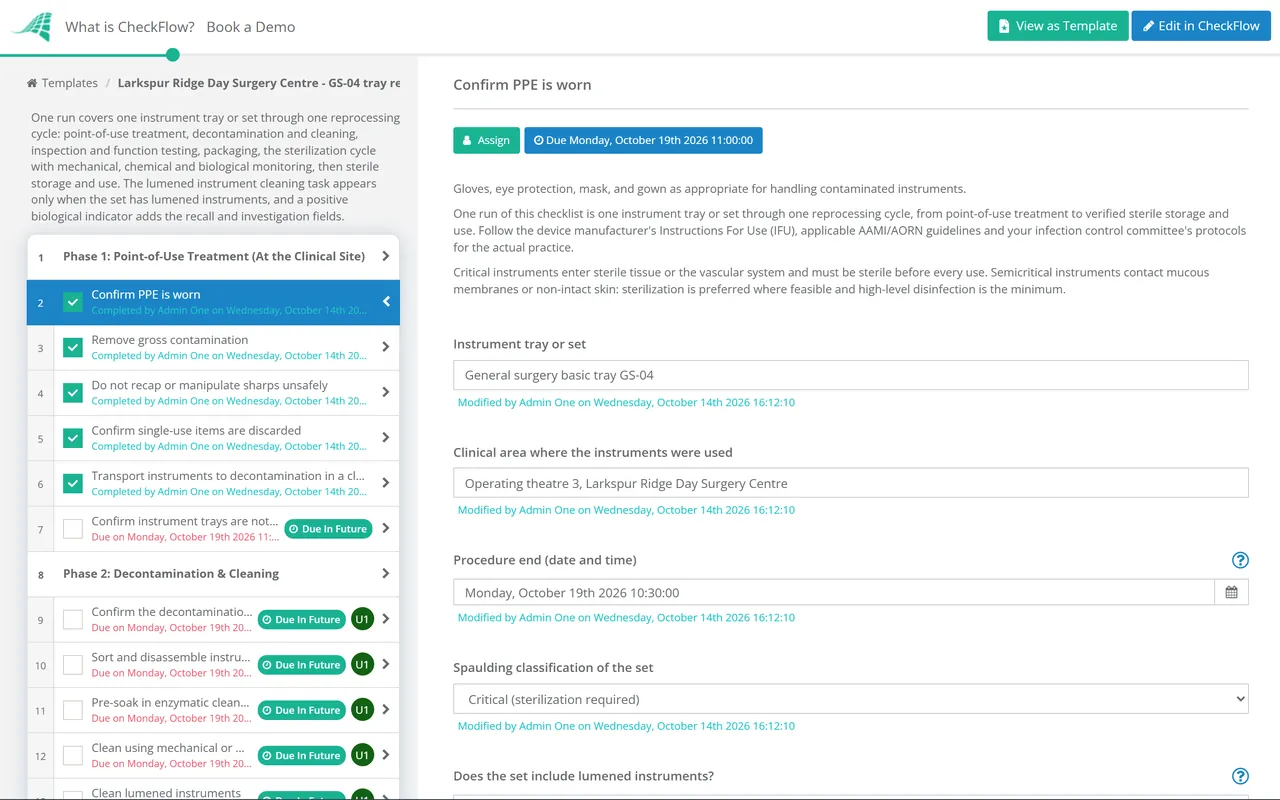
Confirm PPE is worn — gloves, eye protection, mask, and gown as appropriate for handling contaminated instruments
Remove gross contamination — wipe or rinse visible soil from instruments at the point of use; before instruments dry
Do not recap or manipulate sharps unsafely — follow sharps safety protocols; one-handed technique or mechanical recapping device
Confirm single-use items are discarded — single-use devices (SUDs) must not be reprocessed unless through an FDA-cleared third-party reprocessor
Transport contaminated instruments to the decontamination area in a closed, puncture-resistant container — clearly labelled as contaminated/biohazard
Confirm instrument trays are not overfilled — adequate space for effective cleaning and sterilization
Phase 2
Decontamination & Cleaning
Confirm the decontamination area is separate from the clean/sterile area — unidirectional workflow from dirty to clean; no cross-contamination between soiled and processed instruments
Sort and disassemble instruments — disassemble multi-part instruments according to IFU; sort by material and cleaning method
Pre-soak in enzymatic cleaner as indicated by IFU — enzymatic cleaners break down organic material; confirm correct dilution and contact time
Clean using mechanical or manual method — ultrasonic washer, automated washer-disinfector, or manual scrubbing; following the instrument manufacturer’s IFU
Clean lumened instruments — flush all channels with enzymatic cleaner then rinse water; use appropriate brushes for internal channels
Rinse thoroughly to remove all cleaning agent residue — inadequate rinsing can compromise sterilization
Dry completely — moisture remaining on instruments can compromise sterilization efficacy and promote corrosion
Phase 3
Inspection & Functionality Testing
Inspect each instrument under magnification — for cleanliness; any visible soil must return to the cleaning phase before proceeding
Inspect for damage — cracks, corrosion, bent tips, damaged insulation, or any compromise that could affect function or sterilization efficacy
Test instrument function — hinges open and close smoothly; box locks function; cutting edges are sharp; ratchets hold
Check for pitting or corrosion — pitted instruments harbour microorganisms and cannot be adequately cleaned; remove from service if found
Confirm instruments are returned to the correct tray configuration matching the tray count sheet
Phase 4
Packaging for Sterilization
Select the correct packaging — woven or non-woven wrap, peel pouches, or rigid containers; appropriate for the sterilization method to be used
Confirm packaging is intact — no holes, tears, or compromised seals in packaging materials before use
Package instruments according to IFU and facility protocol — instruments positioned to allow sterilant penetration; hinged instruments open or unlocked
Include chemical indicator (CI) inside each package — Class 5 or Class 6 integrating/emulating indicators provide the most reliable information about sterilization process parameters
Apply external chemical indicator on the outside of the package — distinguishes processed from unprocessed packages
Label each package — load control number, sterilizer number, cycle number, date of sterilization, and expiry date (event-related or date-related per facility policy)
Phase 5
Sterilization Cycle & Monitoring
Three types of monitoring must be used: mechanical (cycle parameters), chemical (indicators), and biological (spore testing). Biological indicators are the only direct measure of sterilization efficacy. All three must be documented for every load.
Confirm the correct sterilization method — steam (most common), EtO (ethylene oxide), hydrogen peroxide plasma, or dry heat; consistent with IFU for all instruments in the load
Load the sterilizer correctly per the sterilizer manufacturer’s instructions — adequate space between packages for sterilant penetration; no overloading
Include a biological indicator (BI) in each load (or per facility protocol) — BI contains resistant bacterial spores
Review the mechanical printout or cycle log — temperature, pressure, and time parameters met throughout the cycle
Interpret the chemical indicators — internal CIs confirm cycle parameters were met at the package level
Incubate and read the biological indicator — positive BI result requires recall of all items in the load and investigation
Document the sterilization cycle — load number, sterilizer ID, cycle parameters, BI result, operator ID, and any exceptions
Phase 6
Sterile Storage & Handling
Allow packaged instruments to cool before storage — condensation on hot packages in cold storage compromises the sterile barrier
Store sterile packages in designated sterile storage — closed, dust-free, temperature and humidity-controlled storage area
Handle sterile packages with care — compression, bending, or puncture of packaging compromises sterility; handle from the edges
Inspect packaging integrity before use — immediately before the instrument is opened at the point of use; any compromised package must not be used
Apply first-in, first-out (FIFO) rotation — items with earlier sterilization or expiry dates used before later ones
Document the use of each sterilized instrument tray — linked to the patient record and the sterilization load; enables traceability for product recall
Sterilization Monitoring — Three Levels, All Three Required
Mechanical Monitoring
What: Continuous monitoring of sterilizer parameters — temperature, pressure, time, and humidity — via the sterilizer’s digital display, printout, or automated recording system.
What it confirms: The sterilizer ran a complete cycle within specified parameters.
Limitation: Confirms the machine ran correctly — not that sterilization was achieved at the package level.
Chemical Indicators (CI)
What: Chemical test strips or devices placed inside (internal CI) or outside (external CI) each package. Change colour or appearance in response to sterilization cycle parameters.
What it confirms: That specified conditions were present at the package level.
Best practice: Class 5 (integrating indicators) and Class 6 (emulating indicators) provide the most reliable chemical monitoring.
Biological Indicators (BI)
What: Preparations containing a known population of resistant bacterial spores. If the BI shows no growth after incubation, sterilization conditions were sufficient to kill the spores.
What it confirms: The only direct measure of sterilization efficacy — that conditions sufficient to kill resistant spores were achieved.
Required for: Every sterilization load (or per facility policy); sterilizer qualification; and after any sterilizer failure, repair, or major change.
Why Run Your Sterilization Process in CheckFlow?
1
A documented record for every sterilization cycle
Regulatory accreditation (The Joint Commission, DNV) requires documented evidence of sterilization monitoring for every load. CheckFlow’s sterilization checklist creates a timestamped, attributed record for each cycle — mechanical parameters reviewed, BI placed and result recorded, packaging inspection confirmed — providing the documented audit trail that accreditation surveyors require.

2
Consistent process regardless of staffing pressures
Sterile processing departments are frequently understaffed and under time pressure. The steps most likely to be skipped under pressure — inspection, biological indicator documentation, and sterility storage confirmation — are exactly the steps with the most patient safety consequence. CheckFlow’s enforced checklist sequence makes skipping steps visible and accountable.
3
Instrument traceability for recall management
When a sterilization failure is identified — a positive biological indicator or a sterilizer malfunction — every instrument processed in the affected load must be recalled. CheckFlow’s load documentation links each tray to its sterilization cycle number, enabling rapid identification of all affected items and the patients on whom they were used.
Sterilization failures are clinical incidents that require formal reporting and investigation. CheckFlow’s Healthcare Incident Reporting Checklist covers the full incident management process that follows a sterilization cycle failure. See the Incident Reporting Checklist →
Medical equipment sterilization is a standard operating procedure that must be documented, followed consistently, and updated when standards or equipment change. CheckFlow’s SOP software page covers the platform capability for clinical SOPs. See CheckFlow for SOPs →
What is the sterilization process for medical instruments?
+
Medical instrument sterilization follows a defined reprocessing cycle covering six phases: point-of-use treatment (removing gross contamination immediately at the clinical site before the instrument is returned to the sterile processing department); decontamination and cleaning (enzymatic cleaning, mechanical or manual cleaning, rinsing, and drying); inspection and functionality testing (visual inspection under magnification, damage assessment, and function testing); packaging (selecting appropriate packaging, including chemical indicators, and labelling with load control information); sterilization cycle with three-level monitoring (mechanical, chemical, and biological); and sterile storage and handling (designated storage area, FIFO rotation, pre-use integrity inspection and use and traceability documentation). Every step must follow the manufacturer’s Instructions For Use (IFU) for each specific instrument.
What is the Spaulding Classification?
+
The Spaulding Classification is a widely accepted framework for determining the appropriate level of reprocessing for medical instruments based on their intended use. Critical instruments enter sterile tissue or the vascular system and must be sterile — they require sterilization (destruction of all microbial life including spores). Semicritical instruments contact mucous membranes or non-intact skin and require high-level disinfection at minimum (sterilization is preferred where feasible). Noncritical instruments contact only intact skin and require low-level disinfection. Correct classification of every instrument is the first step in determining the appropriate reprocessing level.
What is a biological indicator and why must it be used?
+
A biological indicator (BI) is a sterilization monitoring device containing a known population of resistant bacterial spores — typically Geobacillus stearothermophilus for steam sterilization. After sterilization, the BI is incubated and observed for spore growth. No growth indicates that conditions sufficient to kill the resistant spore population were achieved — making the BI the only direct measure of sterilization efficacy. Mechanical monitoring (cycle parameters) and chemical indicators confirm the cycle ran correctly, but only the BI confirms sterilization was achieved at the biological level. A positive BI result requires recall of all items in the load and a formal investigation of the sterilizer and process.
What documentation is required for each sterilization cycle?
+
Documentation for each sterilization cycle should include: sterilizer identification number; load control number; date and time of cycle; sterilization method and parameters (temperature, pressure, time); names or IDs of instruments in the load; mechanical monitoring outcome (cycle printout or log); chemical indicator interpretation; biological indicator placement and result; operator ID; and any exceptions or discrepancies. This documentation enables traceability (linking every sterilized instrument to its cycle record), supports recall management if a sterilization failure is identified, and provides evidence of process compliance for accreditation surveys.
Is CheckFlow free for this template?
+
You can start a free 14-day trial with no credit card required, giving you full access to all features including this template. The Business plan is $10 per user per month after the trial. Full details at checkflow.io/pricing.
Document Every Sterilization Cycle. Verify Every Step. Never Skip Under Pressure.
Free trial — no credit card required.
Do you like cookies? 🍪 We use cookies to ensure you get the best experience on our website. Learn more