
Vendor Onboarding Software
Every new vendor, the same secure process. NDA first, access last.
Verizon’s 2025 Data Breach Investigations Report, covering breaches from November 2023 to October 2024, found a third party involved in 30% of them, double the previous year. A familiar pattern sits behind breaches like these: the vendor was given access before the proper checks were done. NDA not signed. Security assessment skipped. DPA never sent. The risk was taken on without anyone consciously deciding to take it.
CheckFlow gives procurement, legal, IT security, and finance teams a single structured process for every new vendor: legal agreements before anything starts, security review before any system access is provisioned, financial verification before any payment goes out. Executed by the right person at each step, documented with timestamps, and auditable for GDPR, SOC 2, ISO 27001, and DORA requirements.
14-day free trialNo credit cardUnlimited free guests
Last updated
Vendor onboarding software makes every new supplier pass the same checks in the same order. In CheckFlow one template gives Legal, IT Security, Finance and Procurement their own steps: NDA and DPA before access, security questionnaire and risk rating before provisioning, bank details verified before the first payment. Halt tasks keep later steps locked, and every step is recorded with who did it and when.
Sound Familiar?
Vendor onboarding fails when it’s an informal process: a series of emails between departments, each one assuming someone else has handled the steps they haven’t heard about. Legal assumes IT has done the security assessment. IT assumes Legal has the NDA. Finance sets up the payment before anyone’s confirmed the bank details are legitimate. Everyone assumes someone else has dealt with the DPA. Nobody has. And by the time the vendor is operational, the risk is already live.
Vendor gets access before the security check
The project needs the vendor onboarded this week. The security questionnaire is still being chased. Someone provisioned the access to move things along. This is the kind of exposure behind the 30% of breaches in Verizon’s 2025 report that involved a third party: a vendor with access to systems or data before the risk was properly assessed.
NDA not signed at project kickoff
The project starts on Monday. The NDA gets sent on Tuesday. Everyone’s already shared the product roadmap in the Friday call. Without a system that enforces “NDA signed” as a gate before any other step, legal protection is theoretical rather than operational.
DPAs missing across your vendor base
GDPR Article 28 requires a Data Processing Agreement with every processor that handles personal data on your behalf, and Article 28(4) requires the same obligations to flow down to their sub-processors. Breaching the processor rules can cost up to €10 million or 2% of worldwide annual turnover under Article 83(4). Companies with a long vendor list often have DPAs with only some of them. CheckFlow makes the DPA a mandatory step, not an optional one.
Different standards applied to different vendors
High-value new vendors get thorough onboarding. Smaller or faster-moving ones get whatever the project manager remembers to do. The inconsistency is the problem: a breach doesn’t care that you had 12 good onboardings. It happens through the one that was rushed.
Bank details not verified before first payment
Business Email Compromise (BEC) attacks specifically target vendor payment setup: a fraudulent email updating banking details before the vendor relationship is formally confirmed. Without a structured verification step, finance has no way to distinguish a legitimate bank detail update from a social engineering attack. After onboarding, the Vendor Bank Detail Change Verification Checklist applies the same control to every change request.
No audit trail when regulators ask
Your GDPR data map lists the vendor. But can you prove they were assessed before being given access to personal data? Can you show DORA examiners your ICT vendor risk register with evidence of due diligence? Without a documented, timestamped onboarding record per vendor, your risk management programme is a policy document, not a practice. The free Vendor Risk Assessment Checklist creates that record: criticality tier, evidence review, residual risk sign-off and the annual reassessment. Before a new SaaS tool is bought, the SaaS Procurement Security Review Checklist checks its security evidence and contract terms, and once vendors are connected, the quarterly Third-Party Remote Access Review Checklist checks every route they can use to get in.
How CheckFlow Works for Vendor Onboarding
One checklist template per vendor type. Every department gets their steps. Nothing proceeds to the next stage without the prior stage complete.
Build your vendor onboarding checklist template
Define every step required before a vendor is operational: NDA and MSA execution, DPA sign-off for data processors, security questionnaire and certificate review, sanctions and insurance verification, ERP system setup, bank detail verification. Assign each step to the right department: Legal handles contracts, IT Security handles risk assessment, Finance handles bank and payment setup, Procurement handles system registration.
Start it for each new vendor in seconds
When a new vendor engagement begins, start the checklist. Legal gets their contracting tasks immediately. IT Security gets the security review tasks. Finance gets the payment setup steps. Each team sees their own steps and receives automatic reminders as deadlines approach. The access provisioning step stays locked until IT Security’s steps are complete, and the payment setup step stays locked until Finance has verified the bank details.
Build the compliance evidence trail automatically
Every completed step creates a timestamped record: who completed it, when, and any attached documents. The full onboarding record per vendor is stored and exportable. When a GDPR audit asks for evidence of due diligence on a specific processor, or a SOC 2 auditor reviews your CC9.2 vendor management controls, the evidence is already there.
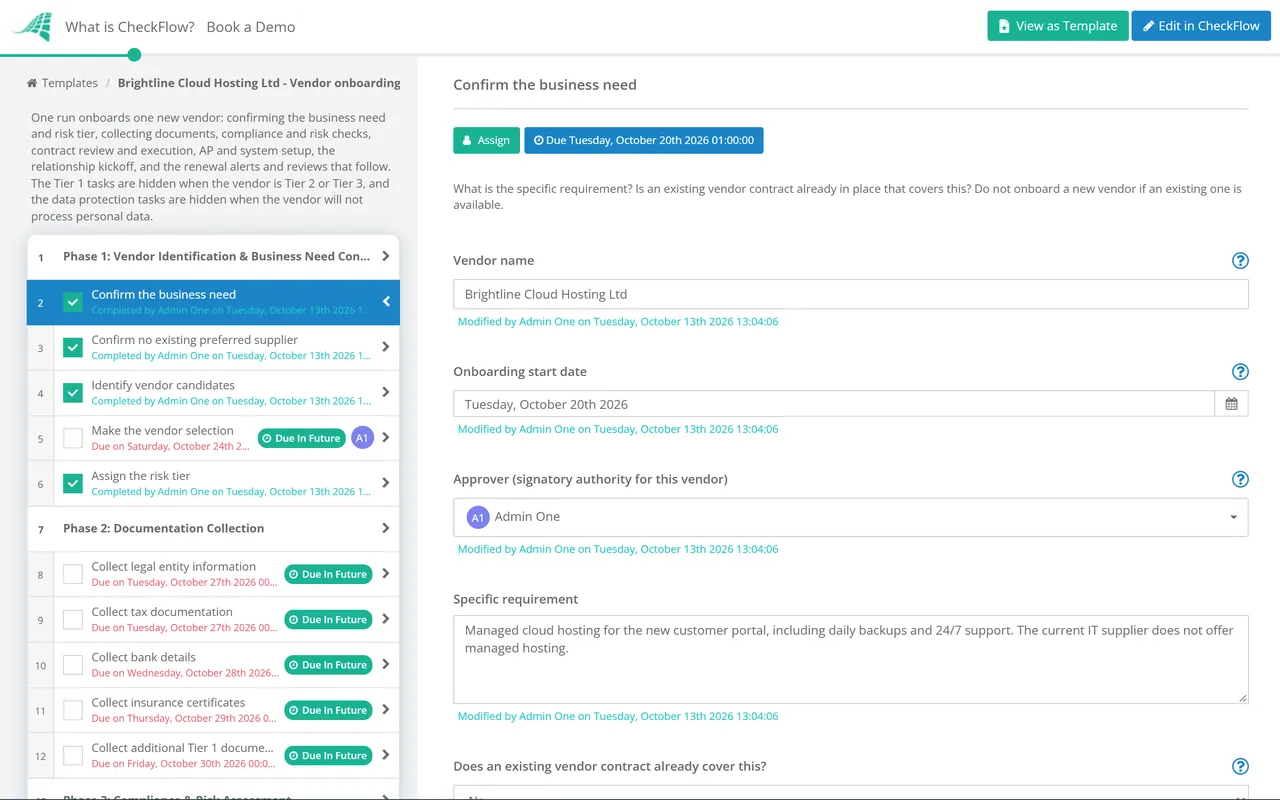
Built for How Vendor Onboarding Actually Works Across Departments
Vendor onboarding isn’t a single-team process. Legal executes the contracts. IT Security runs the risk assessment. Finance sets up the payment. Procurement registers the supplier. HR or Compliance may run background checks. When these teams operate in separate systems with no shared checklist, steps fall between the cracks, and the gap between “vendor selected” and “vendor operational and compliant” is where most vendor risk originates.
Gates
Legal and contract execution gates
NDA, MSA, and DPA steps are sequenced as gates before any other onboarding step can proceed. Legal completes and files the documents; CheckFlow records completion with a timestamp. The access and project steps stay locked until the legal gates are cleared. The NDA is not a courtesy. It’s a prerequisite.
- Halt tasks lock every later step until the gate is complete
- Required fields capture the signed date and document reference
Coordination
Cross-department coordination without email chains
Each department sees their own tasks and deadlines: Legal, IT Security, Finance, Procurement. Mark steps exclusive and only their assignees can open or complete them; everyone else on the checklist sees them greyed out. Reminders go to the right person automatically. The requesting manager sees real-time progress across all departments. No “has Legal signed off yet?” emails. No vendor going live with tasks outstanding.
Security assessment workflow
IT Security runs a structured vendor security assessment for every new vendor who will access your systems or data: security questionnaire sent and responses reviewed, SOC 2 Type 2 report or ISO 27001 certificate reviewed and filed, risk rating assigned. All documented. The assessment record includes the reviewer, the date, the risk rating, and any conditions attached to the approval.
Learn moreGDPR and data protection compliance
Data Processing Agreement execution is a mandatory, sequenced step for any vendor processing personal data. Fields on the step record which DPA version was signed, by whom, and when. The completed DPA step supports your GDPR Article 28 obligations. For all vendors, the full onboarding record supports your data map and your ability to demonstrate due diligence to a supervisory authority.
Learn moreFinancial verification and ERP setup
Finance completes structured vendor financial setup steps: bank detail verification against official confirmation (not email), currency and payment terms confirmed, supplier registered in ERP, purchase order process confirmed. Structured verification is a key defence against Business Email Compromise at vendor onboarding, a fraud that exploits unstructured vendor payment setup processes.
Learn moreAudit-ready vendor records for every compliance framework
Every completed vendor onboarding produces a timestamped record that directly supports: SOC 2 CC9.2 (vendor management evidence), GDPR Article 28 (processor due diligence), ISO 27001 A.5.19–5.22 (supplier relationship controls), DORA Article 28 (ICT third-party risk and register of information), and FCA SYSC 8 (outsourcing risk management). One checklist, evidence for multiple frameworks.
Learn more
Ready-to-Use Procurement & Vendor Templates
Don’t start from a blank page. Pick a proven procurement and supplier template, customise it to your vendor tiers, due diligence, and approval process, and run it for your next vendor in minutes. Each one is fully editable in the CheckFlow template designer.

Vendor Onboarding Process Checklist

Supplier Onboarding Checklist
Vendor Risk Assessment Checklist

Procurement Compliance Review Checklist

Supplier Performance Evaluation Checklist
Purchase Order Approval Checklist
Onboarding starts once a supplier has been chosen. For a competitive choice, the Supplier Sourcing & Tender Checklist runs the buyer side of an RFI and RFP, from the business case and weighted criteria to an approved award, and hands the winner straight to onboarding.
What Your Vendor Onboarding Checklist Should Cover
The four stages of compliant vendor onboarding, and the steps that most organisations skip, deprioritise, or forget to document until there’s an incident.
01Legal & Contractual
- NDA (Non-Disclosure Agreement) executed and filed before any confidential information is shared: this is a gate step, not a parallel task
- MSA (Master Services Agreement) or contract signed and filed before any work begins
- Data Processing Agreement (DPA) executed for any vendor who will process personal data under GDPR Article 28: mandatory for all data processors
- Sub-processor list reviewed and approved if the vendor uses sub-processors to deliver their service
- Contract terms reviewed: liability caps, indemnity, IP ownership, data breach notification obligations (fast enough for you to meet the GDPR 72-hour deadline for reporting to the supervisory authority)
- Governing law and jurisdiction confirmed
- Legal sign-off on non-standard or high-value contracts before execution
02Compliance & Risk
- Sanctions screening completed: vendor entity and principals checked against the OFAC SDN list, the EU consolidated list and the UK Sanctions List
- Insurance certificates verified: professional indemnity, public liability, and cyber insurance minimum thresholds confirmed
- Business continuity plan reviewed for critical and high-dependency vendors
- Regulatory status confirmed for regulated industries: FCA authorisation, ISO certification
- Background checks completed for vendors with individual access to your premises or sensitive data
- GDPR/privacy compliance confirmed: vendor’s own privacy policy reviewed, appointed DPO confirmed if required
- Risk rating assigned (high / medium / low) and recorded with justification
- Escalation to senior management for high-risk vendor approvals
03Security Assessment
- Security questionnaire sent, completed, and reviewed (SIG Lite, CAIQ, or bespoke questionnaire as appropriate to vendor tier)
- SOC 2 Type 2 report or ISO 27001 certificate reviewed and confirmed current for vendors with system or data access
- Evidence of penetration testing reviewed for high-risk vendors
- Access scope defined: exactly which systems, data, and environments the vendor will have access to
- Access provisioning completed: accounts created, MFA enforced, least-privilege principle applied
- Vendor access limited to what’s required for the engagement: no standing access for project-based engagements
- Vendor security incident notification process confirmed
- Vendor added to IT asset register and security monitoring scope
04Financial & Operational
- Vendor registered in ERP or Accounts Payable system with correct entity details
- Bank details verified via direct confirmation on vendor letterhead or phone call, not via email
- Currency, payment terms, and purchase order process confirmed in writing
- VAT / tax number verified and recorded
- Credit check completed for vendors in strategic supply chain roles
- SLA and service delivery metrics agreed and documented
- Escalation contacts and account manager details recorded
- First purchase order raised and confirmed with vendor
- Vendor onboarding confirmed complete: all steps across all departments signed off
CheckFlow’s free vendor onboarding templates cover all four stages: customise them for your vendor tier, risk level, and compliance requirements, and onboard your next vendor today.
Ask your AI assistant where a vendor is stuck.
CheckFlow works with any AI assistant. Connect it once and it reads and works your vendor checklists with the same permissions as the person whose API key it holds.
Ask your AI assistant
Through the CheckFlow MCP server, Claude, ChatGPT, Gemini, Grok, Copilot or any other AI assistant can find a vendor’s onboarding checklist by what was filled in on it, list the steps still open, and share it with the vendor with a password and an expiry.
Read the MCP guideDraft the template from a sentence
Paste your vendor policy or describe it in a sentence and the free AI checklist generator drafts the template, with phases, fields and due dates in place.
Try the AI generatorConnect your other systems
Start a vendor onboarding checklist when a supplier request is approved, through Zapier or the REST API, and get a webhook when it completes.
Developer overview
Where is the Acme Logistics onboarding up to?
template:    "Vendor Onboarding"
Vendor name: "Acme Logistics"
status:      "InProgress"
There is one in progress: “Vendor Onboarding – Acme Logistics”. Shall I list its open steps? The DPA step is the one holding the security review.
Used by great companies









If you need to create processes, with space for detailed instructions at each step, among other interesting features, this system will help you a lot.
Frequently asked questions
How is CheckFlow different from Coupa, SAP Ariba, or a Vendor Management System?
Coupa, SAP Ariba, and enterprise VMS platforms manage vendor relationships at scale: procurement workflows, catalogue purchasing, contract management, and spend analytics. They’re built for procurement departments with significant budgets and IT support. CheckFlow solves a different, more immediate problem: the structured cross-department checklist that ensures every new vendor goes through NDA execution, security assessment, GDPR compliance review, and financial setup in the right order, with every step documented. It suits companies that don’t have a VMS, and procurement, legal, and IT Security teams within larger companies that need a simple, lightweight checklist layer alongside their enterprise tools.
Does the vendor need to create a CheckFlow account to be onboarded?
No. The vendor onboarding process is executed by your internal team. Legal handles the contract steps, IT Security handles the risk assessment, Finance handles the financial setup, all using CheckFlow. The vendor can receive documents to sign (NDA, DPA, security questionnaire) through your existing channels: DocuSign, email, or whatever you use. CheckFlow tracks that each step has been completed by the appropriate internal owner. If you want the vendor to supply company details and documents directly, share the checklist with them by link: no account is needed, and tasks assigned exclusively to your team stay off their page.
How does CheckFlow help with GDPR Article 28 requirements?
GDPR Article 28 requires that processing by a processor is governed by a contract, the Data Processing Agreement (DPA), so it needs to be in place before the processor handles personal data. CheckFlow includes the DPA execution as a mandatory, sequenced step in the vendor onboarding checklist for any vendor processing personal data, so the data access step stays locked until the DPA step is complete. The completed record includes who confirmed the DPA was executed, when, and any reference to the document. This creates the documented due diligence record that supervisory authorities look for in a GDPR investigation.
Can I build different checklists for different vendor tiers?
Yes. Many organisations classify vendors by risk level (high, medium, and low) and apply proportionate due diligence. A high-risk vendor with access to production systems and personal data gets the full checklist: SOC 2 review, SIG Lite questionnaire, DPA, background checks, senior sign-off. A low-risk vendor supplying office stationery gets a shorter version with basic contract and payment setup steps. CheckFlow lets you build a template per vendor tier and apply the appropriate one at onboarding, or keep one template and use conditional logic to show the extra steps when the tier is High.
What compliance frameworks does CheckFlow support for vendor onboarding?
The vendor onboarding checklist and its documented completion records directly support: GDPR Article 28 (Data Processing Agreement execution and processor due diligence), SOC 2 CC9.2 (vendor risk management evidence for Type 2 audits), ISO 27001 Annex A controls A.5.19–5.22 (supplier relationships and ICT supply chain security), DORA Article 28 (ICT third-party risk, including the register of information, for EU financial entities), and FCA SYSC 8 (outsourcing risk management). One checklist, evidence for multiple regulatory requirements.
How long does it take to set up a vendor onboarding checklist in CheckFlow?
You can have your first vendor onboarding checklist template running in a single afternoon. Start with the free CheckFlow template, customise the steps for your legal, security, and financial requirements, assign each step to the appropriate department or role, and you’re ready to run it for your next vendor. There’s no IT implementation, no integration project, and no vendor to train. The internal team who will complete the checklist steps can be up and running within hours, not weeks.
What does CheckFlow cost for a vendor onboarding process?
CheckFlow’s Business plan is $10 per user per month, or $9 billed annually, with no minimum seat count. Seats are counted for the people who work in CheckFlow to manage and complete checklist steps, typically Procurement, Legal, IT Security, and Finance team members. For a team of 5 people managing vendor onboarding across these departments, the cost is $50 per month on monthly billing. Vendors themselves require no account and are not counted as users. See the full pricing page for details.
Your next vendor shouldn’t be onboarded with a chain of emails
Free trial, no credit card required. Build the cross-department vendor onboarding checklist that ensures every new supplier goes through the right legal, security, compliance, and financial steps, in the right order, by the right person, with documented proof for every audit.
14-day free trial, no credit cardFull refund in your first 30 daysUS or EU hosting