
Process Management Software for Tech Companies
These aren’t talent failures. They’re process gaps.
Tech companies build software to help everyone else run better processes. The irony is that the same companies are often the ones managing their own operations through Slack messages, informal agreements, and shared documents nobody updates. This works at fifteen people. At fifty, the new engineer who joins on Monday is still waiting for GitHub access on Wednesday. The developer who leaves on Friday still has production access the following Monday. The customer who signed up last month hasn’t heard from anyone since the welcome email. The release that shipped last week bypassed staging verification because the sprint end was approaching.
CheckFlow gives tech teams lightweight, structured workflows for the operational processes that matter most: IT onboarding and offboarding, product release gates, security and compliance cycles, customer activation, and the recurring operational checks that keep a growing tech company running securely and consistently as the team scales.
14-day free trialNo credit cardUnlimited free guests
Last updated
Process management software for tech companies turns the operational work around the product into checklists that run the same way every time. In CheckFlow, IT onboarding and offboarding, release gates, SaaS customer onboarding and security reviews each get a template with named owners, due dates and steps that cannot be skipped. Every completed step is recorded with who did it and when, ready when a SOC 2 auditor or an enterprise buyer asks.
The Process Gap in Fast-Moving Tech Companies
The operational failures that cost tech companies most are rarely dramatic. They are accumulative: a new hire who spends their first two days chasing IT access forms an impression of organisational competence that takes weeks to revise. A departing employee whose system access is revoked two weeks after their last day is two weeks of potential security exposure. A customer who reaches 60 days without a structured check-in is a customer already exploring alternatives. A product release that shipped without staging verification because “we were confident in this one” is the release that triggers the 2am incident call. None of these failures require bad intentions. They require only that process was treated as optional when speed was the priority, which, in a tech company, is always.
The processes that matter can’t be improvised
IT offboarding, release gates, security access reviews, and customer onboarding milestones benefit from consistency, not creativity. CheckFlow structures each as a required sequence of steps with assigned owners, so the process runs correctly every time, regardless of which team member is responsible and how busy the week is.
Structure doesn’t have to mean slow
The objection to documented processes in tech is that they add friction. A CheckFlow process step takes seconds to complete and minutes to run end-to-end. What it prevents (the security gap, the churning customer, the production incident) takes days or weeks to remediate. Lightweight structured processes are not the opposite of moving fast; they are what makes moving fast sustainable.
Operational maturity is what enterprise buyers evaluate
For any tech company selling to enterprises, procurement and security teams will ask about SOC 2, GDPR, incident response procedures, and access control processes. The company that can demonstrate documented, auditable processes for these areas is better placed to close enterprise deals than the company managing them informally. Operational maturity is not just internal discipline. It is a commercial capability.
Why Tech Companies Choose CheckFlow
Built for the way tech teams actually work
CheckFlow is designed for teams that value lightweight process over bureaucratic overhead. There is no implementation project, no dedicated admin required, no enterprise sales cycle. A team can sign up, select a template, customise it to their specific tools and workflow, and run their first structured process within hours. Recurring processes (weekly security checks, monthly access reviews, quarterly SOC 2 evidence collection) start automatically on a schedule at the configured interval. The process infrastructure runs in the background; the team focuses on the work.
The same operational standard as the team scales
The operational processes that work at 15 people through personal responsibility and direct communication break at 50 because the team is too large and too distributed for everyone to know what everyone else is doing. CheckFlow gives every process the same structured execution regardless of team size: new hire IT onboarding is the same whether the company is 10 or 200 people, SaaS customer onboarding is the same whether the CSM team has 1 person or 20. Scale doesn’t degrade the standard.
The audit trail that enterprise procurement requires
Selling to enterprise customers means passing their security reviews, which means demonstrating documented, auditable processes for access management, incident response, and change control. CheckFlow creates that documentation as the work is done: every access grant, every release gate, every security review is a dated, attributed record. The evidence that took weeks to assemble for the last audit exists by the time the next one is requested.
How Tech Teams Use CheckFlow
From engineering to HR to customer success, CheckFlow structures the operational processes that growing tech companies most commonly manage through Slack, spreadsheets, and optimism.
Access lifecycle
IT Onboarding & Offboarding
New hire starts Monday. By 9am they should have laptop configured, all required system access provisioned, tools installed, and security policies confirmed. Without a structured process, it takes until Wednesday. When someone leaves, every system access (GitHub, AWS, Slack, Salesforce, internal tools) should be revoked on their last day, not when IT gets around to it.
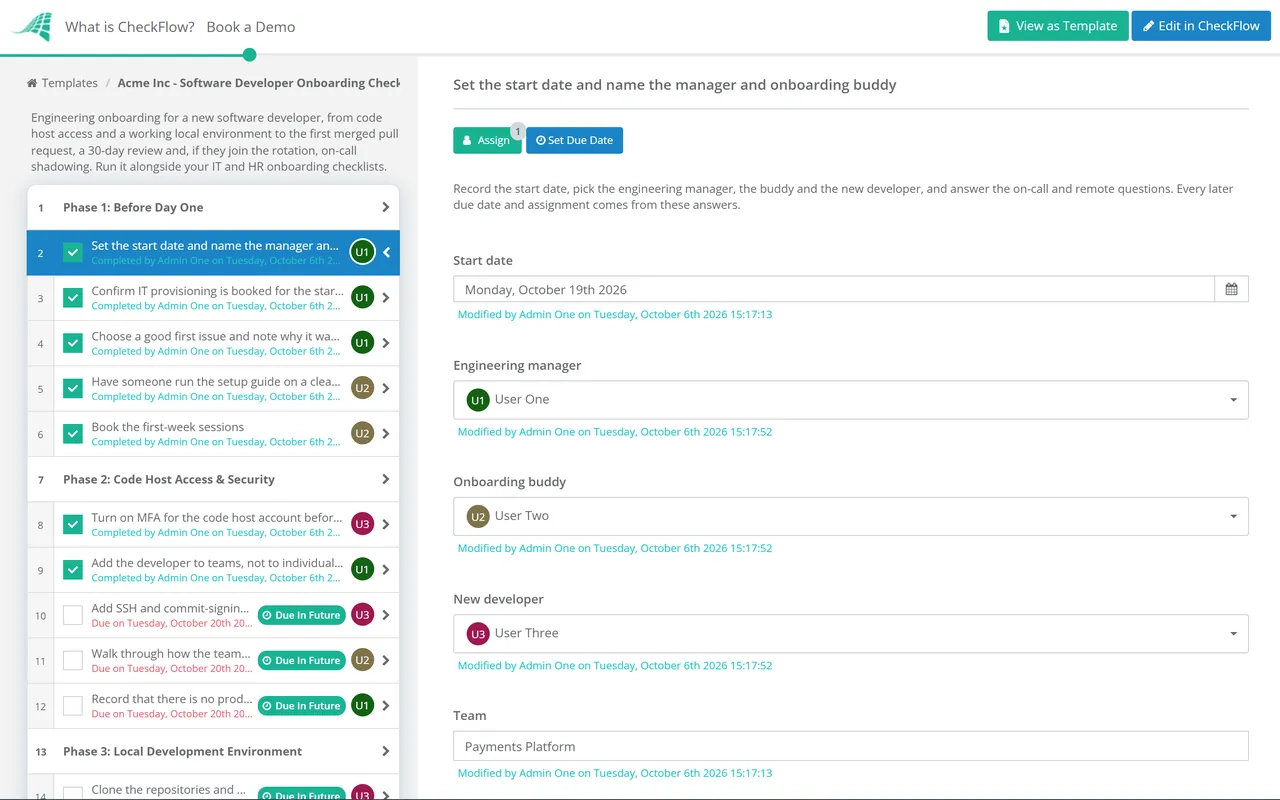
CheckFlow structures both sides of the access lifecycle: onboarding with every provisioning step due before day one, and offboarding with every revocation step due on the last day and a halt that keeps the sign-off locked until they are all done. The security audit trail is built as each step is completed. Engineering hires have their own Software Developer Onboarding Checklist, from code host access to the first merged pull request.
Release gates
Product Release & Feature Launch
The release that ships without QA sign-off because the sprint was ending, without staging verification because “it was fine last time,” and without monitoring configured because the engineer moved on to the next ticket: that release is the one that triggers the 2am incident call.
CheckFlow’s feature release workflow structures every gate between “development complete” and “shipped to production”: QA sign-off, staging verification, security review for sensitive changes, release notes prepared, monitoring configured, rollback plan confirmed. Gates that cannot be skipped under schedule pressure, because the checklist is the gatekeeper, not the person under pressure to ship.
- Halt tasks keep the deploy step locked until QA and staging are signed off
- A condition adds the security review only when the change is marked sensitive
SaaS Customer Onboarding
The SaaS customer who doesn’t reach activation within their first 30 days (product not configured, integrations not set up, team not trained) is the customer who churns at renewal and blames the product when the real cause was the onboarding. CheckFlow structures the full activation journey: account setup and configuration, integration and data migration, user training, success metrics defined and agreed, and 30/60/90-day check-ins due from the subscription start date. Every customer goes through the same activation process, regardless of which CSM is responsible, how many other accounts they’re managing, or how confident everyone was at the point of signature.
SaaS Customer Onboarding ChecklistSecurity & Compliance Operations
SOC 2 audit preparation doesn’t start two weeks before the audit. It starts with the daily operational practices that the audit will assess: access review cycles, security incident response procedures, vendor risk assessments, change management documentation, and evidence that security controls were applied consistently. CheckFlow structures each recurring security process (quarterly access reviews, annual penetration test scheduling, incident response playbooks) and builds the audit evidence trail as each cycle runs. The SOC 2 report, the ISO 27001 audit, and the enterprise customer’s security questionnaire all become easier to answer when the evidence already exists.
Security & Compliance Templates
Ready-to-Use Templates for Tech Teams
Start from a proven template for the process causing the most pain, customise it to your stack and team, and run it today. Each one is fully editable in the CheckFlow template designer.

Software Developer Onboarding Checklist
SaaS Access Offboarding Checklist

Feature Release Process Checklist
SaaS Customer Onboarding Checklist
IT Incident Management Process Checklist
User Access Review Checklist
Relevant Template Libraries for Tech Teams
CheckFlow’s template library covers the operational processes that tech companies most commonly manage informally, from IT access management and product releases through to customer onboarding, security compliance, and remote team operations.
Information Technology Templates
IT support, change management, incident management, disaster recovery audits, and support ticket response: the core IT operations processes that keep a tech company’s infrastructure secure and its response to incidents structured.
Browse IT templatesProduct Development & Launch Templates
Bug tracking, feature release, MVP development, product ideation, product launch, and user feedback collection: every stage of the product development lifecycle with the quality gates that prevent production incidents and ensure every launch is coordinated across engineering, marketing, and support.
Browse product templatesCustomer Management Templates
SaaS customer onboarding, customer success, and account management: the workflows that drive product activation, reduce time-to-value, and create the structured check-in rhythm that prevents churn before it shows up in the numbers.
Browse customer templatesRemote Work & Hybrid Teams Templates
Home office setup, IT equipment provisioning, remote employee onboarding, performance reviews, team engagement, and virtual meeting best practices: the distributed team processes that most tech companies rely on but few have systematised.
Browse remote work templatesEmployee Onboarding Templates
New hire onboarding, offboarding, expectations setting, and development planning: structured people processes for a fast-hiring tech team where every new starter should have the same quality of first-week experience regardless of who their manager is. Engineering hires have their own Software Developer Onboarding Checklist, from code host access to the first merged pull request.
Browse onboarding templatesCompliance Templates
ISO 27001, FedRAMP, FISMA, and HIPAA compliance frameworks: the recurring security and compliance workflows that generate the audit evidence enterprise sales cycles and certification bodies require.
Browse compliance templates
Ask your AI assistant what is still open before the release.
CheckFlow works with any AI assistant. Connect it once and it reads and works your checklists with the same permissions as the person whose API key it holds.
Ask your AI assistant
Through the CheckFlow MCP server, Claude, ChatGPT, Gemini, Grok, Copilot or any other AI assistant can find a release or onboarding checklist, list the steps still open and who owns them, and start the next checklist for you.
Read the MCP guideDraft the template from a sentence
Describe your release process or paste your onboarding runbook and the free AI checklist generator drafts the template, with phases, fields and due dates in place.
Try the AI generatorConnect your other systems
Start an onboarding checklist when a hire is added to your HR system, or a release checklist from your CI pipeline, through Zapier or the REST API, and get a webhook when it completes.
Developer overview
What is still open on the Bulk export v2 release?
template: "Feature Release"
status:   "InProgress"
One release is in progress: “Feature Release – Bulk export v2”. Staging verification is open and holds the security review and the deploy. Shall I list the remaining steps and their owners?
Used by great companies









There is a great API that gives you the ability to integrate it in your existing software landscape.
Tech Company Process Management: Frequently Asked Questions
What are the highest-risk process gaps in a growing tech company?
Three operational gaps stand out in growing tech companies: IT offboarding (departed employees retaining system access because the offboarding checklist was incomplete or not followed, a direct security exposure and one that SOC 2 auditors test for), product release processes (releases that reach production without completing QA, staging verification, or monitoring configuration, a failure usually caused by schedule pressure overriding process), and SaaS customer onboarding (new customers who don’t reach activation within 30 days because the onboarding process is inconsistently applied or depends on the CSM remembering to schedule the right touchpoints). All three share the same root cause: a process that exists informally breaks down under volume and time pressure.
How does CheckFlow help with SOC 2 and ISO 27001 compliance?
SOC 2 and ISO 27001 both require evidence that security controls are applied consistently, not just that policies exist. CheckFlow supports this through structured, evidenced execution of the operational processes that auditors assess: access management (provisioning on hire, revocation on departure, periodic access review, all documented with named owners and timestamps), change management (the structured review and approval process for production changes, with a dated record of each change assessed and authorised), incident response (the structured workflow that runs from detection to resolution, generating the incident timeline that both internal post-mortems and external auditors require), and vendor risk management (due diligence at onboarding and scheduled performance reviews for critical vendors). Each process run creates the evidence record that auditors request, built as operations run, not assembled retrospectively before the audit window. Your auditor decides what evidence is sufficient; CheckFlow makes the work and its record consistent. See SOC 2 compliance software for more.
How is CheckFlow different from Jira, Linear, or other engineering project tools?
Jira, Linear, and similar tools manage product development work: tickets, sprints, backlogs, and releases. CheckFlow manages operational processes: the structured checklists and recurring workflows that sit around and between the product work. The IT onboarding process that runs every time a new person joins, the feature release gate that runs before every deployment, the customer onboarding workflow that runs for every new subscription, the quarterly access review that runs on a calendar schedule. These are different categories: project management tools track the work to be done; CheckFlow ensures the processes around the work are followed consistently and with a documented record.
Is CheckFlow suitable for early-stage tech companies or just established teams?
CheckFlow works at any stage. Early-stage companies benefit from building the process infrastructure before they need it: it is much easier to implement a structured IT onboarding workflow at 15 people than to retrofit one at 80 when access management has already become inconsistent. The 14-day free trial requires no credit card, and at $10 per user per month there is no minimum spend threshold. The template library provides ready-to-use starting points for every process type; every template is fully customisable to the company’s specific tools, stack, and workflow. Growing teams often start with the one process causing the most pain (usually IT onboarding or product release gates) and expand from there as the operational value becomes clear.
Run the Processes That Matter, Consistently, From Day One
Free 14-day trial, no credit card required. Pick the process causing the most pain, start from a template, and run it with your team today.
14-day free trial, no credit cardFull refund in your first 30 daysUS hosting, EU on request