Patient Discharge Checklist Template

Most discharges that go wrong were decided on the day. The planning that should have started at admission happened in the last few hours, and the gaps showed up at home.

A safe discharge depends on a dozen people finishing their part in the right order: the screening, the referral, the medicines, the appointment, the transport and the summary the next provider reads. This free patient discharge checklist gives hospital case managers, discharge coordinators and ward nurses one coordination workflow per patient, from discharge planning at admission to the follow-up call afterwards. It tracks who did what and when; the clinical decisions stay with the clinicians and your policies. Three questions at the start add a post-acute placement and referral phase, the follow-up Important Message from Medicare for US Medicare inpatients, and an equipment task for patients going home with new equipment or oxygen.

Use This Template Free See Live Example
No Credit Card Required

Last reviewed: October 2026

Discharge Planning Starts at Admission, Not on Discharge Day

In the US, the Medicare Conditions of Participation for hospitals set out discharge planning at 42 CFR 482.43. The hospital needs an effective process that focuses on the patient’s goals and treatment preferences and treats the patient and their caregivers as active partners. It must identify, at an early stage of the stay, patients likely to suffer adverse consequences without adequate discharge planning, and evaluate them in time for arrangements to be made before discharge. At discharge it must send the necessary medical information to the post-acute providers and practitioners responsible for follow-up care. The patient-choice rules (the list of available post-acute providers, the freedom to choose and disclosure of the hospital’s financial interests) have sat in paragraph (d) since 1 July 2025, when a new paragraph (c) on transfer protocols was added. CMS issued revised interpretive guidance for surveyors in QSO-25-24-Hospitals, first released in September 2025.

In England, the Department of Health and Social Care’s Hospital discharge and community support guidance, last updated in January 2024, sets out the discharge to assess model and its four pathways. NICE guideline NG27, which covers adults with social care needs, asks for discharge planning to start on admission for people with complex needs, a single named discharge coordinator, and a discharge summary available to the GP within 24 hours, with a copy given to the person on the day they leave.

The practical methods are well documented. AHRQ’s Re-Engineered Discharge (RED) toolkit sets out mutually reinforcing actions, among them booking follow-up appointments before discharge, planning for test results still pending, organising services and equipment, teaching a written plan, sending the discharge summary, and a follow-up phone call. AHRQ’s IDEAL discharge planning (Include, Discuss, Educate, Assess, Listen) adds the habit of checking understanding with teach-back. The intake side of the stay is covered by the Patient Intake Checklist; this page is the other end.

United States

CMS hospital discharge planning (§ 482.43)

  • Early identification and a timely discharge planning evaluation (§ 482.43(a))
  • A list of available Medicare-participating HHAs, SNFs, IRFs or LTCHs (§ 482.43(d)), with quality and resource-use data relevant to the patient’s goals (§ 482.43(a)(8))
  • The patient’s freedom to choose, and disclosure of the hospital’s financial interests (§ 482.43(d))
  • Necessary medical information sent to the next providers at discharge
England

DHSC guidance and NICE NG27

  • Discharge to assess, with four pathways by destination and need
  • Unpaid carers and family involved in discharge decisions where appropriate
  • A single named discharge coordinator for people with complex needs
  • Discharge summary to the GP within 24 hours, copy to the person on the day

What the Patient Discharge Checklist Covers

Seven phases run from admission to the call after discharge. Phase 3 appears only when the patient needs post-acute care or new services; the equipment task in Phase 4 and the follow-up Medicare notice in Phase 6 appear only when they apply.

Admission

Phase 1: Plan From Admission

Start the checklist when the patient is admitted, and answer the three scope questions as soon as the picture is clear.

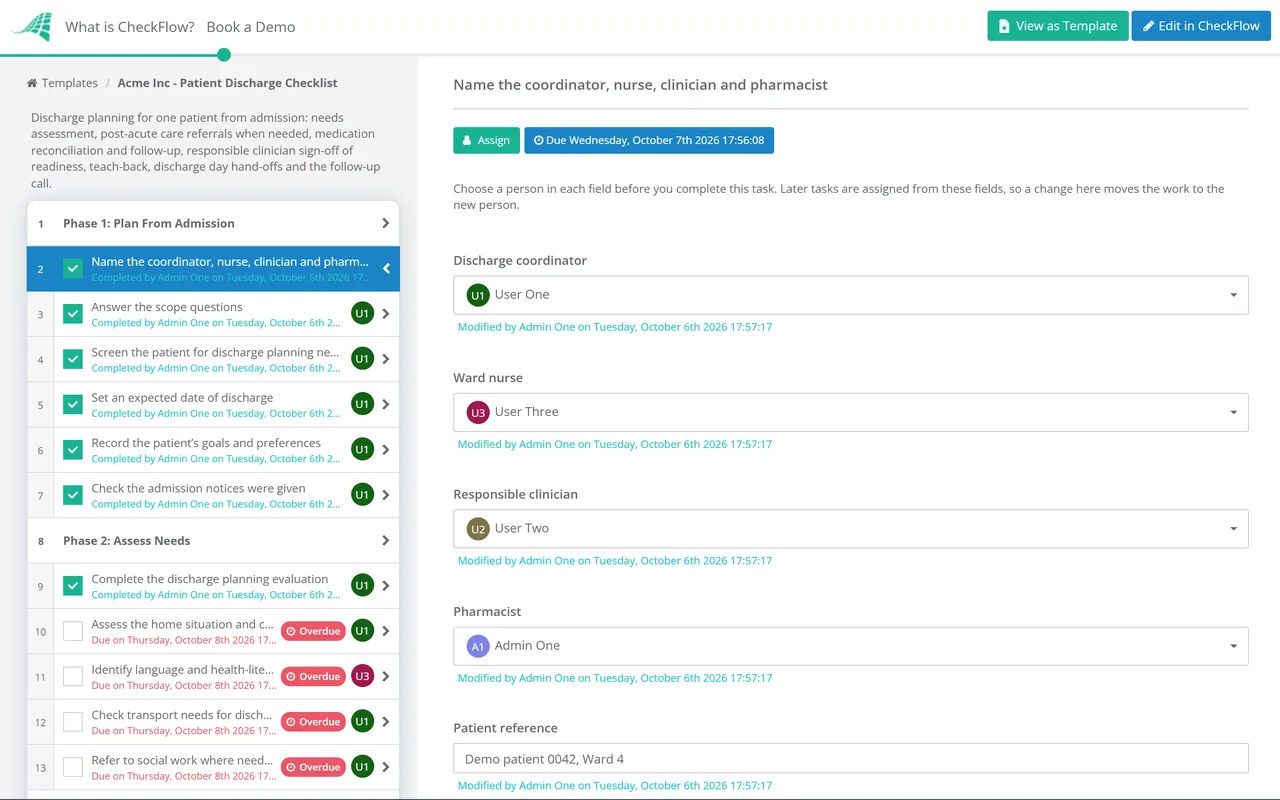
  • Name the coordinator, nurse, clinician and pharmacist — later tasks are assigned from these four fields
  • Answer the scope questions — post-acute care or new services, Medicare inpatient, new equipment or oxygen
  • Screen the patient for discharge planning needs — early in the stay, against your hospital’s screening criteria
  • Set an expected date of discharge — agreed with the clinical team and reviewed as the stay goes on
  • Record the patient’s goals and preferences — and who their caregiver or support person is
  • Check the admission notices were given — such as the Important Message from Medicare for US Medicare inpatients
Evaluation

Phase 2: Assess Needs

  • Complete the discharge planning evaluation — likely needs after discharge, and whether services are available
  • Assess the home situation and caregiver capacity — who will help, with what, and whether they are able to
  • Identify language and health-literacy needs — interpreter booked for teaching sessions where needed
  • Check transport needs for discharge day — family, own transport or transport your policy provides
  • Refer to social work where needed — housing, finances, safeguarding or a complex family situation
Placement

Phase 3: Arrange Post-Acute Care

Shown only when the patient is going to a care facility or starting new services at home.

  • Give the patient a list of available providers — US: with quality and resource-use data relevant to their goals
  • Record the patient’s choice of provider — their choice, not steered; disclose any hospital financial interest
  • Send referrals and confirm acceptance — with the information each provider needs to decide
  • Confirm funding or authorisation — insurer authorisation or the local funding route your process uses
  • Agree the discharge pathway with the transfer hub — England: pathway 1, 2 or 3 under discharge to assess
  • Confirm the start date for services — first home visit or admission date confirmed in writing
Readiness

Phase 4: Prepare for Discharge

The equipment task appears only when new equipment or oxygen is needed. The clinician’s sign-off at the end halts the checklist.

  • Reconcile medications as your policy requires — by the pharmacist or prescriber; changes recorded
  • Arrange medicines to take home — supply ready before the planned discharge time
  • Order equipment and confirm delivery — per the prescriber’s order; delivered and demonstrated before discharge
  • Book follow-up appointments before discharge — date, time and place written into the discharge plan
  • List tests pending at discharge — and name who will follow up each result
  • Confirm discharge-day transport — booked for a time that fits medicines and paperwork
  • Responsible clinician sign-off of readiness for discharge — the discharge decision or order recorded before the patient leaves
Education

Phase 5: Teach the Plan

  • Write the discharge plan in plain language — medicines, appointments, services and who to contact
  • Teach the plan using teach-back — the patient explains it back in their own words
  • Explain medication changes as prescribed — what is new, changed or stopped, per the prescriber
  • Explain who to call and when — the warning signs and contacts the clinical team has set out
  • Give copies to the patient and carer — the carer’s copy with the patient’s agreement
Discharge

Phase 6: Discharge Day

The follow-up Medicare notice appears only for US Medicare inpatients.

  • Give the follow-up Important Message from Medicare — a copy of the signed notice, no more than 2 calendar days before discharge
  • Send the discharge summary to the next provider — primary care and any post-acute provider, at the time of discharge
  • Hand over verbally to a receiving facility — a nurse-to-nurse call, logged with the name and time
  • Return belongings and own medicines — as your property and medicines policies require
  • Record the discharge time and destination — on the patient record and on this checklist
Follow-up

Phase 7: Follow Up After Discharge

  • Call the patient after discharge — within the days your programme sets; medicines, appointments and services
  • Escalate any problems found — to the responsible team, as your policy sets out
  • Confirm services started as planned — first home visit made or facility admission completed
  • Confirm the discharge summary was received — by the primary care team and any post-acute provider
  • Close the checklist and log lessons — delays, readmission or gaps noted for review

Where the Patient Is Going Changes the Checklist

Most patients go home with nothing new to arrange, and the checklist stays short. The more support a patient needs after leaving, the more of it runs. The England pathway numbers come from the discharge to assess model; US hospitals will recognise the same split between home, home health and a facility.

DestinationEngland pathwayWhat the checklist adds
Home, no new needsPathway 0Core phases only; Phase 3 stays hidden
Home with new care or servicesPathway 1Phase 3 referrals, start date and funding; equipment task if needed
Community bed for recoveryPathway 2Phase 3, plus a verbal handover to the receiving unit
New residential or nursing homePathway 3Phase 3 with provider choice, funding and handover

Pathway 3 is meant to be the exception. The DHSC guidance says it should be used only in exceptional circumstances, and NICE NG27 warns against asking people to decide on long-term residential or nursing care while they are in crisis. Where your process allows it, record the reason a care home placement is being arranged directly from hospital.

Keep clinical detail where it belongs. The checklist records that each step happened, who did it and when. The medication list, the discharge summary and the clinical notes stay in your patient record system, and a task links to them rather than copying them.

Why Coordinate Discharges in CheckFlow?

1

Planning that starts on day one

Start a checklist at admission and the screening, evaluation and referral tasks fall due in the first days of the stay, offset from that start. Tasks are assigned from the coordinator, nurse, clinician and pharmacist fields, so each patient’s discharge has named owners from the outset.

2

No discharge without the clinician

The responsible clinician’s readiness decision is an approval step: the discharge-day tasks do not open until the clinician answers. Referral acceptances, comments and attachments stay in the checklist history, so you can see what was done and when.

3

See where patients are stuck

Dropdown answers show the placement phase, the equipment task and the Medicare notice only for the patients who need them. Reports show which discharges are waiting on a referral or a sign-off, and the API and MCP server can start a checklist from your own systems.

The Patient Intake Checklist covers the front of the stay. When a discharge goes wrong, the Healthcare Incident Reporting Process Checklist records and reviews it. Discharge planning records are a common subject of survey and inspection, so the Joint Commission Survey Readiness Checklist and the CQC Inspection Readiness Checklist are useful companions, and new ward nurses can learn the process through the New Nurse Onboarding Checklist.

Running discharge coordination across several wards? CheckFlow for healthcare teams gives every unit the same process, with one view of the patients still waiting to go home.

Frequently Asked Questions

What should a patient discharge checklist include?

+

The coordination steps from admission to after discharge: early screening for discharge planning needs, an evaluation of what the patient will need and whether it is available, referrals to post-acute providers with the patient’s choice recorded, medication reconciliation and medicines to take home, follow-up appointments booked before discharge, tests pending at discharge, transport, a plain-language plan taught with teach-back, the discharge summary sent to the next provider, and a follow-up call. The clinical content of each step comes from your policies and the prescriber.

Who should coordinate a hospital discharge?

+

One named person, usually a case manager, discharge coordinator or the patient’s ward nurse, depending on how complex the discharge is. NICE NG27 recommends a single health or social care practitioner as the coordinator for people with social care needs, with a named replacement when they are away. The coordinator does not do every task. They make sure the clinician, pharmacist, therapists, social work and receiving providers each finish their part, and that the patient and family know who to ask.

When should discharge planning start?

+

On admission, or before it for a planned admission. In the US, 42 CFR 482.43 requires hospitals to identify, at an early stage of the stay, the patients likely to suffer adverse consequences without discharge planning and to evaluate them in time to make arrangements before discharge. In England, NICE NG27 asks for discharge planning to start as soon as a person with complex needs is admitted.

When is the Important Message from Medicare given?

+

Hospitals give the Important Message from Medicare to Medicare inpatients, including Medicare Advantage enrollees, within 2 calendar days of admission, and ask the patient or their representative to sign it. A copy of the signed notice is given again before discharge, no more than 2 calendar days before it. If the first notice was given within 2 calendar days of discharge, the second is not needed. The notice explains the patient’s right to appeal the discharge.

What are the discharge to assess pathways?

+

They are the four routes out of hospital in England’s discharge to assess model. Pathway 0 is home with no new care needs. Pathway 1 is home with new or extra health or social care support. Pathway 2 is a community bed with recovery support. Pathway 3 is a new residential or nursing home placement for people likely to need long-term care, which the guidance says should be used only in exceptional circumstances.

What is teach-back and why use it at discharge?

+

Teach-back means asking the patient, or their carer, to explain the plan in their own words, then re-teaching anything they missed. It checks the explanation rather than the patient’s memory. AHRQ includes it in its Health Literacy Universal Precautions Toolkit and in the Assess step of its IDEAL discharge planning approach, and the RED toolkit uses it when teaching the written discharge plan.

Is CheckFlow free for this template?

+

14-day free trial, no card required. The Business plan is $10 per user per month after the trial. Full details at checkflow.io/pricing.

Plan Every Discharge From the Day of Admission

Free trial — no credit card required.