
Process Management Software for Financial Services Firms
The challenge is not the absence of a framework.
Financial services firms generally have extensive compliance frameworks: policies, procedures, and controls that have been approved by boards, reviewed by legal, and signed off by the compliance function. The challenge is the gap between the procedure documented in the policy manual and what happens in practice at 9am in a branch, on a customer service call, in an adviser’s meeting with a new client. Consumer Duty makes this gap a regulatory liability: firms must now demonstrate that they are delivering good outcomes for customers, not simply that their processes are designed to. The evidence that holds up is contemporaneous, attributed, and consistent across every channel and every team member.
CheckFlow gives financial services firms a way to close that gap, deploying structured, evidenced workflows to every team member, at every location, for every regulated process. Customer onboarding that follows the same steps regardless of which adviser is handling it. Complaints that are acknowledged, investigated, and resolved within the regulatory timetable every time. Staff whose competency is assessed, documented, and up to date before they give regulated advice. And regulatory changes that are embedded in the operational process, not just added to the policy manual.
14-day free trialNo credit cardUnlimited free guests

Last updated
Process management software for financial services firms turns regulated procedures into checklists that every adviser, branch and channel runs the same way. In CheckFlow, customer onboarding and KYC reviews, complaint handling, SM&CR certification and staff competency, and regulatory change each get a template with named owners, due dates and steps that cannot be skipped. Every completed step is recorded with who did it and when, ready when compliance, an auditor or a supervisor asks.
The Execution Gap in Financial Services Compliance
Consumer Duty’s core requirement, that firms deliver good customer outcomes and not just document that their processes are designed to, places the burden of proof on execution, not intention. The KYC process that varies between advisers because each one has their own interpretation of the standard is not a compliant KYC process. The complaint handling workflow that meets the regulatory timetable when the dedicated complaints team is handling it but falls behind when it lands with a branch team is not a compliant complaints process. The staff competency record that is up to date for the advisers who are diligent about their T&C file and missing for those who aren’t is not a compliant competency framework. Regulators assess compliance based on evidence of consistent execution, not the existence of a well-written procedure.
The standard applied, not just documented
A compliance framework is only as strong as the consistency with which it is applied across every team member, every branch, and every customer interaction. CheckFlow deploys the same structured workflow to every person handling a given process, so the customer onboarding standard is applied in Glasgow on a Monday afternoon exactly as it is in London on a Friday morning, regardless of which adviser is present.
Evidence of outcomes, not just processes
Consumer Duty reflects a regulatory direction of travel: firms must produce evidence that their processes produced good outcomes, not just demonstrate that their documented procedures were designed to. SM&CR adds the question of who was accountable for each step. CheckFlow creates a contemporaneous, attributed record of every process step completed: the dated evidence trail that regulators, auditors, and the Financial Ombudsman Service ask for when they want to know “what actually happened?”
Regulatory change embedded in operations, not just in policy
When a regulatory change comes into force, the response cannot be limited to updating the policy manual. The operational process must be updated, the new process deployed to every affected team member, training completion recorded, and the change documented with an effective date. CheckFlow’s template version history records each version with who saved it and when, checklists stay on the version they were started from unless you choose to upgrade them, and the retraining workflow makes sure the updated standard is actually applied.
Why Financial Services Firms Choose CheckFlow
Consumer Duty evidence built as processes run
Consumer Duty requires firms to demonstrate that they are delivering good outcomes, not just that their processes are designed to. CheckFlow creates the contemporaneous evidence trail that this demonstration requires: every customer onboarding step completed in sequence, every complaint handled to the documented timetable, every advice review conducted and recorded. The evidence that previously had to be assembled retrospectively when a regulator enquired is available immediately, attributed to named individuals, and dated to the moment it was completed. Your compliance function, auditors and supervisors decide whether it meets the standard; CheckFlow makes sure the record exists.
Template version history for an evolving regulatory landscape
Financial services regulation does not stand still. Consumer Duty evolves, SM&CR reforms are implemented, product governance rules change. When a CheckFlow process is updated to reflect a new regulatory requirement, the version history records each version with who saved it and when, and checklists stay on the version they were started from unless you choose to upgrade them. When a regulator or the Financial Ombudsman Service asks what procedure was being followed on a specific date, the answer is in the template version history, not reconstructed from the collective memory of the compliance team.
Consistent execution without management overhead
The alternative to documented, structured processes in financial services is supervision: senior compliance staff observing, checking, and correcting to ensure the standard is applied. This scales to a team of twenty and breaks at two hundred. CheckFlow allows the compliance standard to be applied through the process rather than through oversight: every team member follows the same structured workflow, at every location, without a supervisor needing to be present to ensure it.
How Financial Services Teams Use CheckFlow
From the first customer interaction through to ongoing compliance management, CheckFlow structures the processes that determine whether a financial services firm’s compliance framework delivers on paper or in practice.
Onboarding and KYC
Customer & Account Onboarding
The account opening or advice process that varies between advisers, branches, or channels is the process most likely to produce a Consumer Duty finding, a misselling complaint, or an AML gap. CheckFlow structures every step of the customer onboarding and account opening process (identity verification, KYC checks, suitability assessment, risk disclosure, product explanation, advice documentation, and customer consent) as a required sequence that cannot be abbreviated or reordered.
Every completed onboarding creates a contemporaneous record of what was done, by whom, and when: the evidence of good customer outcomes that Consumer Duty demands. After onboarding, the KYC periodic review checklist keeps each customer’s due diligence current on a cycle set by risk tier.
- A condition adds enhanced due diligence when the customer is rated high risk or is a PEP
- Halt tasks keep account approval locked until screening and sign-off are complete
SM&CR and T&C
Staff Competency & Licensing
Under SM&CR, a firm may only certify someone it has assessed as fit and proper, competence included, and a certificate lasts no more than 12 months. Under the FCA’s Training and Competence sourcebook, firms must keep the staff who carry on TC activities competent, and retail investment advisers must complete at least 35 hours of CPD a year and confirm it in writing annually. Firms must keep documented evidence that this has been assessed and remains current. Competency that relies on each adviser maintaining their own T&C file produces the gaps that supervision visits find.
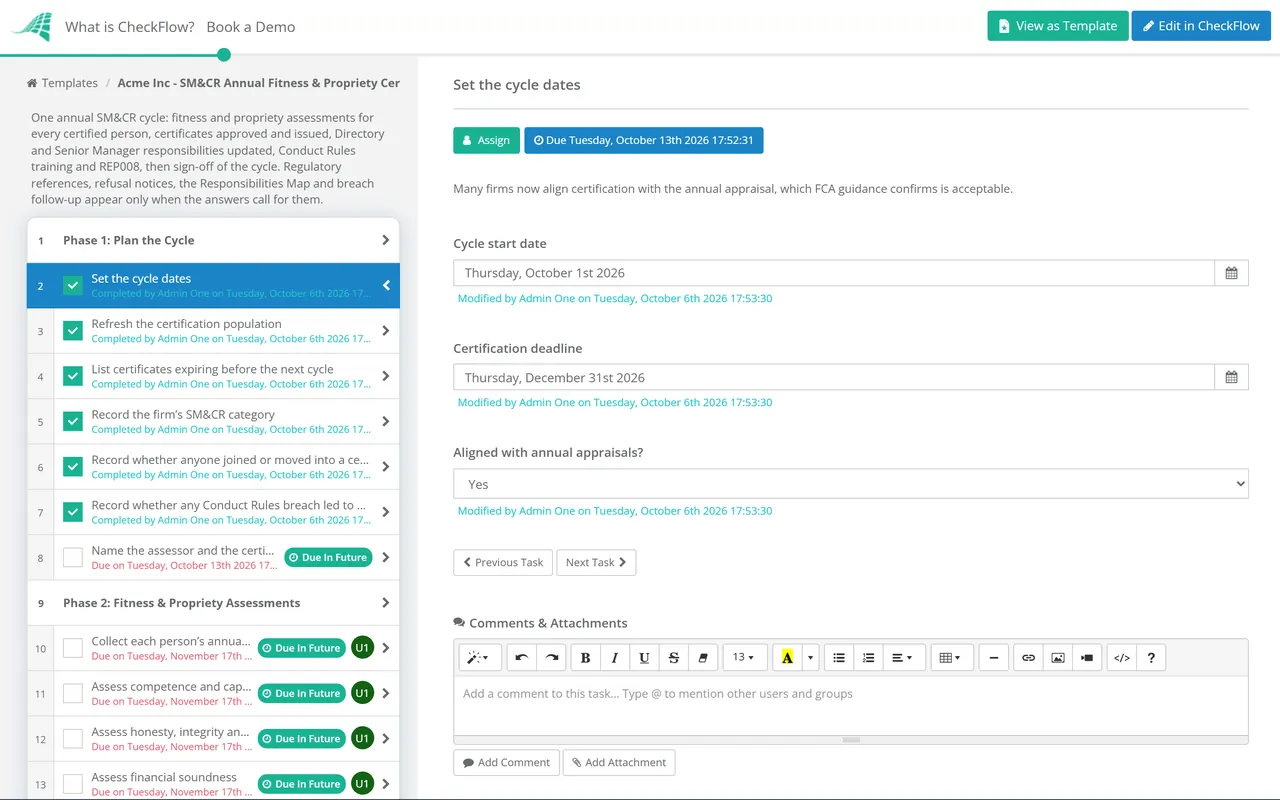
CheckFlow structures the full competency management cycle: initial assessment at appointment, ongoing CPD records, periodic competency review, supervisor sign-off, and annual attestation, with a dated record for every certified person that the compliance function can access and auditors can inspect. The employee compliance certification tracking checklist runs that cycle for licences, continuing education and annual attestations, and the SM&CR annual certification checklist covers the UK fitness and propriety cycle. CheckFlow keeps the record; it does not total CPD hours or report anything to the FCA for you.
- A schedule starts the certification cycle every year, before certificates lapse
- File upload fields hold CPD certificates and the signed fitness and propriety assessment
Complaint Handling & Resolution
Financial services regulators set specific timescales for complaint handling: acknowledge promptly, investigate thoroughly, resolve or refer to the ombudsman within the regulatory window. In the UK, DISP requires a final response within eight weeks, or 15 business days for most payment services and e-money complaints, and the customer then has six months to take it to the Financial Ombudsman Service. The complaint that misses the timetable (because it was logged in the wrong system, because the investigation step wasn’t tracked, because the resolution letter wasn’t sent within the deadline) creates regulatory exposure on top of the underlying complaint. CheckFlow structures the full complaint lifecycle: receipt and acknowledgement, triage and classification, investigation, resolution or upheld decision, final response due a set time after the date the complaint was received, and ombudsman referral where required. Every complaint has a documented timeline.
Complaints Handling TemplateRegulatory Change Management
When Consumer Duty introduced new requirements, when SM&CR reforms change accountability structures, when a product governance rule changes, the compliance response must go beyond updating the policy manual. Affected processes must be identified, updated, redeployed to all relevant staff, and training completion recorded before the effective date. CheckFlow structures the regulatory change workflow: change assessment, impacted process identification, SOP update with version control, staff communication, training completion tracking, and management sign-off that the change has been embedded. The regulator who asks “how did you implement this requirement operationally?” receives a documented workflow, not a verbal summary.
Compliance Management Templates
Ready-to-Use Templates for Financial Services Teams
Start from a template for the regulated process causing the most work, adapt it to your own policies and products, and run it today. Each one is fully editable in the CheckFlow template designer and has a live demo.

KYC Periodic Review Checklist

Customer Complaints Handling Checklist

SM&CR Annual Fitness & Propriety Certification Checklist

Employee Compliance Certification Tracking Checklist

FCA Consumer Duty Annual Review Checklist

Regulatory Examination Preparation Checklist
Relevant Template Libraries for Financial Services Teams
CheckFlow’s template library covers the core operational and compliance processes that financial services firms run repeatedly, from customer onboarding and complaint handling through to staff competency, regulatory audit, and due diligence. The dedicated financial services templates add regulation-specific reviews, including the DORA ICT risk management checklist, the GLBA Safeguards Rule checklist and a regulatory examination preparation checklist. Conduct, financial crime and lending teams can start from the Consumer Duty annual review, sanctions screening, loan origination and mortgage application processing checklists.
Customer Management Templates
Customer onboarding, account management, and client success: structured workflows for every customer interaction that must produce demonstrable good outcomes under Consumer Duty and equivalent consumer protection frameworks.
Browse customer templatesCompliance Templates
ISO 27001, HIPAA, FISMA, and other compliance frameworks: recurring compliance workflows with built-in audit trails for certification maintenance, regulatory inspection, and internal governance.
Browse compliance templatesAudit Templates
Internal audit, operational audit, compliance audit, and corrective action tracking: the structured audit processes that give the board and compliance function documented assurance that operational standards are being applied as intended.
Browse audit templatesHuman Resources Templates
Recruitment, onboarding, competency frameworks, performance reviews, and capacity management: the people management processes that underpin SM&CR compliance and the ongoing demonstration that certified persons are fit and proper.
Browse HR templatesDue Diligence Templates
Customer due diligence, business partnership assessments, and counterparty reviews: the structured KYC and AML workflows that must be consistent, documented, and defensible across every customer type and risk category.
Browse due diligence templatesLegal & Contract Management Templates
Contract review and approval, NDA processing, and legal case intake: the legal workflows that govern customer agreements, supplier contracts, and any formal regulatory or legal proceedings.
Browse legal templates
Ask your AI assistant which KYC reviews are still open.
CheckFlow works with any AI assistant. Connect it once and it reads and works your checklists with the same permissions as the person whose API key it holds.
Ask your AI assistant
Through the CheckFlow MCP server, Claude, ChatGPT, Gemini, Grok, Copilot or any other AI assistant can find the KYC reviews or complaints still in progress, list the open steps and who owns them, and start the next checklist for you.
Read the MCP guideDraft the template from a sentence
Describe your complaints procedure or paste your T&C scheme and the free AI checklist generator drafts the template, with phases, fields and due dates in place.
Try the AI generatorConnect your other systems
Start a KYC review when your CRM flags a trigger event, or a complaint checklist when a complaint is logged, through Zapier or the REST API, and get a webhook when it completes.
Developer overview
Which high-risk KYC reviews are still open?
template:  "KYC Periodic Review"
Risk tier: "High"
status:    "InProgress"
Three high-risk reviews are in progress. “KYC Review – Fabrikam Holdings” is waiting on senior management approval to continue the relationship; the other two are at re-screening. Shall I list the open steps and their owners?
Used by great companies









It has changed the way our team works. We work more efficiently and our work is more consistent since using CheckFlow.
Financial Services Process Management: Frequently Asked Questions
How does Consumer Duty change the process management requirements for financial services firms?
Consumer Duty, which came into force on 31 July 2023 for products open to sale or renewal (and on 31 July 2024 for closed products) and has been actively scrutinised by the FCA since, requires firms to deliver good outcomes for retail customers and to be able to show it, not just that their processes are designed to produce them. This shifts the compliance burden from documentation to evidence. A firm that has well-written customer onboarding procedures but cannot show contemporaneous evidence that those procedures were consistently followed, across all advisers and channels, has a Consumer Duty gap regardless of the quality of its policy documents. CheckFlow addresses this by creating a dated, attributed completion record for every customer-facing process step: the contemporaneous evidence that demonstrates outcomes rather than asserting intentions. The FCA’s Consumer Duty focus areas for 2025 to 2026 include reviews of outcomes monitoring and of how firms design products and services, both of which call for the kind of operational evidence trail that structured process management produces.
How does CheckFlow support SM&CR compliance?
The Senior Managers and Certification Regime requires firms to make clear what each senior manager is responsible for, to assess certified persons as fit and proper before issuing a certificate that lasts no more than 12 months, and to keep the evidence behind those assessments. The regime is being reformed: the first phase of FCA and PRA changes took effect on 24 April 2026 (FCA PS26/6), and the Financial Services and Markets Bill, which completed its House of Lords stages in September 2026, would remove the Certification Regime from FSMA and leave the regulators to decide what replaces it. Until that happens, the annual certification cycle still applies. CheckFlow supports SM&CR compliance by structuring the operational processes that generate this evidence: the certified person’s competency assessment cycle (initial assessment, CPD records, periodic review, supervisor attestation), the onboarding process for new certified staff (including regulatory reference requests and fit and proper assessments), and the governance processes that demonstrate senior manager accountability. Every process run creates a dated record that the compliance function can produce when supervisory scrutiny arrives. The SM&CR annual certification checklist is a ready-made starting point.
What is the difference between CheckFlow and a dedicated compliance management system?
Dedicated compliance management systems for financial services (regulatory reporting platforms, surveillance tools, automated transaction monitoring) handle system-generated compliance activities: they run automatically based on data and rule triggers. CheckFlow handles the human-executed operational procedures that form the surrounding compliance programme: the structured checklist a relationship manager follows when onboarding a customer, the complaint handling workflow that tracks a complaint from receipt to resolution, the competency assessment process that produces the T&C file evidence, the regulatory change workflow that embeds a new requirement into operational practice. The two categories are complementary: compliance systems handle automated controls; CheckFlow handles the human procedures that constitute the operational compliance programme. CheckFlow does not file regulatory returns; the Reports Grid and its exports give the compliance function the management information on those procedures.
Can CheckFlow be used across multiple business lines and regulatory contexts within a financial services firm?
Yes. CheckFlow supports multiple distinct process templates running simultaneously: a retail bank can maintain separate onboarding processes for personal accounts, business accounts, and mortgage applications; an insurance firm can maintain separate complaint workflows for general insurance and protection products; a wealth manager can differentiate between advisory and discretionary client processes. Each template is independently version-controlled, so regulatory updates affecting one product line or business area can be applied without affecting others. Templates can be differentiated by jurisdiction, allowing global firms to maintain market-specific process variants while sharing the common structural framework.
Close the Gap Between Your Compliance Framework and What Happens in Practice
Free 14-day trial, no credit card required. Pick the regulated process causing the most work, start from a template, and run it with your team today.
14-day free trial, no credit cardFull refund in your first 30 daysUS hosting, EU on request