Healthcare Incident Reporting Process Checklist Template

A structured incident reporting process — from the moment an event occurs to root cause analysis and corrective action — that treats every incident as an opportunity to prevent the next one.

Every healthcare incident — from a near-miss medication error caught before reaching the patient to a sentinel event requiring immediate response — represents information about where the system has a vulnerability. Organisations that capture that information systematically, investigate thoroughly, and act on findings prevent future harm. Those that handle incidents reactively, incompletely, or punitively miss the opportunity — and in many cases, see the same event recur. Research consistently shows that the organisations with the best patient safety outcomes are those with the highest incident reporting rates — not because more incidents occur, but because a culture that makes reporting safe and easy generates the data that drives improvement. This free healthcare incident reporting process checklist gives quality managers, risk managers, clinical leaders, and patient safety teams a structured framework for the full incident management cycle — from immediate response through to learning and continuous improvement.

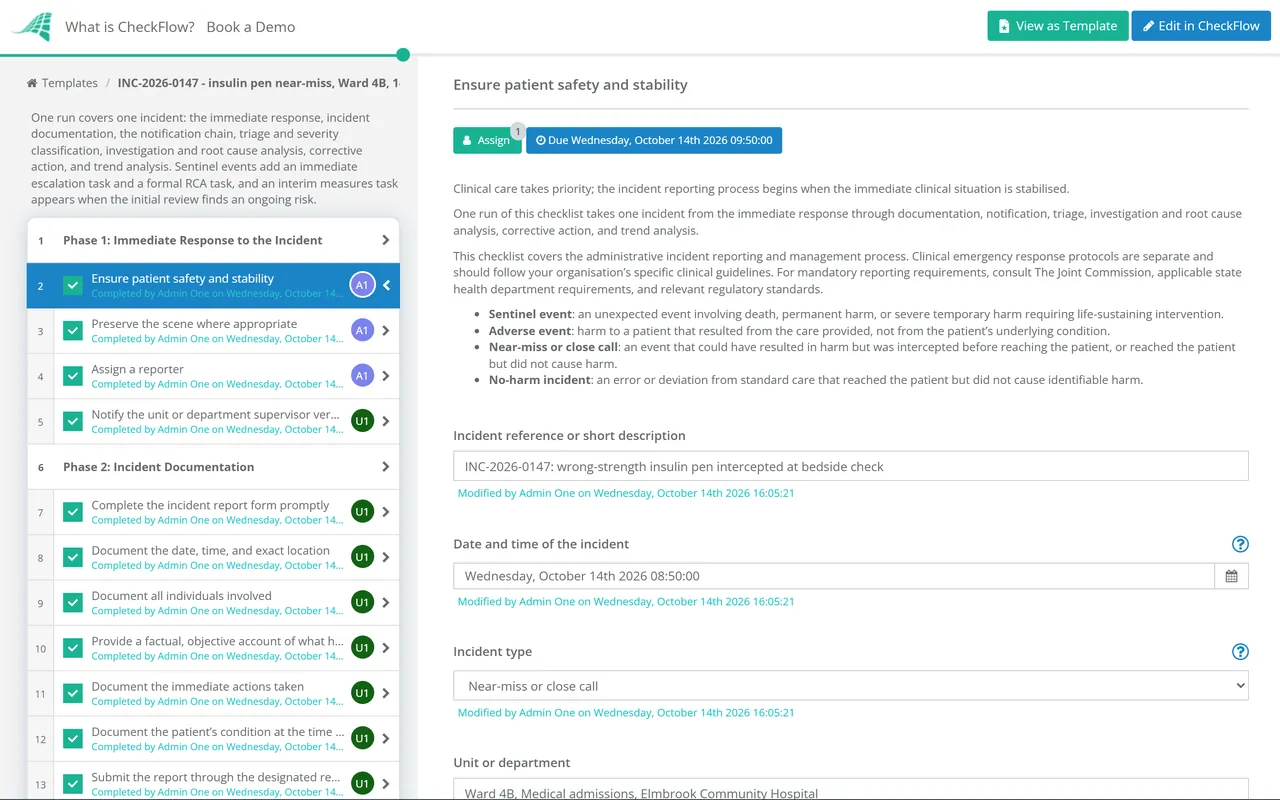
Note: This checklist covers the administrative incident reporting and management process. Clinical emergency response protocols are separate and should follow your organisation’s specific clinical guidelines. For mandatory reporting requirements, consult The Joint Commission, applicable state health department requirements, and relevant regulatory standards.
Use This Template Free See Live Example
No Credit Card Required

The Four Healthcare Incident Types — and Why Near-Miss Reporting Is the Most Valuable

Sentinel Events

Definition: Unexpected events involving death, permanent harm, or severe temporary harm requiring life-sustaining intervention.

Reporting: The Joint Commission requires review of all sentinel events; many states require mandatory external reporting.

Response required: Immediate stabilisation, leadership notification, formal root cause analysis, and corrective action plan.

Adverse Events

Definition: Events resulting in harm to a patient that was not the result of the patient’s underlying condition — harm that resulted from the care provided.

Reporting: Varies by state and event type; some are subject to mandatory reporting requirements.

Response required: Full documentation, patient and family communication, investigation, and risk management review.

Near-Miss / Close-Call Events

Definition: Events that could have resulted in harm but were intercepted before reaching the patient — or reached the patient but did not cause harm.

Reporting: Not typically subject to external mandatory reporting, but critically important for internal safety learning.

Response required: The same structured internal reporting and investigation as adverse events — because a near-miss is a warning about a vulnerability that will produce a harm event if not corrected.

No-Harm Incidents

Definition: Events involving errors or deviations from standard care that reached the patient but did not cause identifiable harm.

Reporting: Internal reporting and tracking; may not require external notification.

Response required: Documentation and trend analysis. Repeated no-harm incidents of the same type often precede harm events.

The organisations with the safest outcomes are those with the highest near-miss reporting rates. Near-miss reports cost nothing and prevent everything. A blame-free reporting culture that makes near-miss reporting easy is the foundation of patient safety improvement.

The Healthcare Incident Reporting Process Checklist

Seven phases covering the full incident management cycle — from immediate response through documentation, investigation, corrective action, and continuous improvement.

Phase 1

Immediate Response to the Incident

This phase covers the immediate administrative steps following an incident. Clinical emergency response protocols are separate and take priority over administrative steps.

  • Ensure patient safety and stability — clinical care takes priority; the incident reporting process begins when the immediate clinical situation is stabilised
  • Preserve the scene where appropriate — for equipment-related incidents, do not discard or clean equipment until it has been assessed; preserve any relevant materials
  • Assign a reporter — the clinician or staff member who witnessed or discovered the incident is responsible for initiating the report; this should happen on the same shift
  • Notify the unit or department supervisor verbally within the shift in which the incident occurred
  • For suspected sentinel events — notify the charge nurse or supervisor immediately; escalate to the medical director or administrator on call
Phase 2

Incident Documentation

Incident reports are confidential quality improvement documents and should NOT be referenced in the patient’s medical record. The medical record should contain objective clinical observations only. This distinction is important for legal and privilege purposes.

  • Complete the incident report form promptly — ideally within one hour of the incident; memory details fade quickly
  • Document the date, time, and exact location — precise details support pattern identification
  • Document all individuals involved — patient (name and medical record number), staff involved, any witnesses
  • Provide a factual, objective account of what happened — what was observed, not interpretation or blame; stick to facts and observations
  • Document the immediate actions taken — clinical response, who was notified, and any changes made to the care plan
  • Document the patient’s condition at the time of the incident and following it
  • Submit the report through the designated reporting system — paper-based, EHR-based, or dedicated incident reporting software
Phase 3

Notification Chain & Escalation

  • Notify the department manager within the same business day for all incidents — immediately for sentinel events and serious adverse events
  • Notify risk management and/or the quality team according to the organisation’s incident severity classification — risk management review for all adverse events and sentinel events
  • Notify the attending physician for patient care incidents where the physician is not already aware
  • Determine whether patient/family notification is required — most accreditation standards and ethical guidelines require disclosure of unanticipated outcomes; consult risk management and legal on timing and approach
  • Determine external reporting obligations — state mandatory reporting requirements vary; sentinel events may require reporting to The Joint Commission; certain incidents trigger CMS reporting obligations
  • Document all notifications — who was notified, when, by whom, and the response received
Phase 4

Initial Triage & Severity Classification

  • Classify the incident severity using the organisation’s severity classification system — determines the depth of investigation required
  • Assign the investigation to an appropriate owner — quality/safety team for routine incidents; cross-functional team for serious adverse events; formal RCA team for sentinel events
  • Secure all relevant documentation — medical records, equipment maintenance logs, policy documents, training records, and any other materials relevant to the investigation
  • Conduct an initial review within 24–48 hours — is the incident adequately documented? Is the severity classification correct? Is there a need for immediate interim corrective action?
  • Implement any immediate interim measures — if the investigation reveals an immediate ongoing risk (faulty equipment, unsafe process), address it before the full investigation is complete
Phase 5

Investigation & Root Cause Analysis

  • Conduct the investigation interview(s) with involved staff and witnesses — in a non-punitive environment; focused on system and process factors, not individual blame
  • Reconstruct the event timeline — a factual, chronological account of what happened, in what sequence, and what barriers failed
  • Identify contributing factors using a structured framework (fishbone/Ishikawa diagram, 5 Whys, or the organisation’s RCA methodology) — what systems, processes, equipment, environment, or training factors contributed?
  • Distinguish root causes from contributing factors — root causes are the fundamental systemic factors that, if corrected, would prevent recurrence
  • For sentinel events — conduct a formal RCA with a multidisciplinary team within The Joint Commission’s required timeframe (typically 45 days)
  • Document the RCA findings — structured report of contributing factors, root causes, and recommendations; confidential quality improvement document
Phase 6

Corrective Action Planning & Implementation

  • Develop a corrective action plan — specific, measurable actions addressing each identified root cause; named owner for each action; target completion date
  • Prioritise corrective actions by risk level — actions addressing high-risk vulnerabilities are implemented immediately; lower-priority improvements scheduled
  • Implement the corrective actions — policy updates, process changes, equipment modifications, training interventions, or environmental changes as required
  • Communicate relevant learnings to staff without identifying individuals — de-identified learning shared broadly supports safety culture
  • Monitor the corrective actions — confirm the changes are sustained; the first implementation does not guarantee lasting change
  • Verify effectiveness — has the corrective action reduced the incidence of the contributing factors identified? Measurement confirms improvement, not just action completion
Phase 7

Trend Analysis & Continuous Improvement

  • Aggregate incident data regularly — monthly or quarterly analysis of all reported incidents by type, location, severity, and contributing factors
  • Identify recurring patterns — are the same incident types recurring? Same department? Same time of day or shift? Patterns indicate systemic issues not yet resolved
  • Review near-miss data specifically — near-miss patterns are predictive of future adverse events; prioritise near-miss trends for preventive action
  • Report to the patient safety committee — aggregate findings, identified trends, corrective action status, and improvement metrics
  • Update safety training based on findings — recurring incident types that involve training gaps should trigger training updates
  • Report annually to governance — patient safety performance, significant incidents, and improvement programme outcomes reported to the governing body

Just Culture — Why a Blame-Free Reporting Environment Produces Safer Outcomes

Just culture is the principle that healthcare organisations distinguish between human error (unintentional mistakes), at-risk behaviour (choosing behaviours that increase risk), and reckless behaviour (consciously disregarding substantial risk). The principle does not mean there are no consequences — it means consequences are proportionate and focused on system improvement rather than individual punishment for unintentional errors. Organisations where staff fear punitive consequences for reporting near-misses have lower reporting rates — and critically, miss the information that would have prevented the next adverse event.

Research from The Joint Commission and AHRQ consistently shows that the safest healthcare organisations have higher-than-average reporting rates — not because more incidents occur, but because staff feel safe reporting. A structured incident reporting process that is non-punitive, promptly investigated, and consistently followed up with visible system-level improvements builds the trust that produces high reporting rates and, over time, measurably safer patient care.

Why Run Your Incident Management Process in CheckFlow?

1

A consistent reporting and investigation workflow

Incident management quality should not vary with the experience of the quality officer managing the case. CheckFlow’s incident reporting checklist ensures every incident — regardless of type or severity — goes through the same structured sequence: documentation, notification, triage, investigation, corrective action, and follow-through. No investigation phase is skipped. No corrective action is left without a named owner and deadline.
2

Transparent tracking of every open investigation

Quality managers overseeing multiple concurrent incidents need to know at any moment which incidents are fully documented, which are in investigation, and which corrective actions are overdue. CheckFlow’s dashboard shows every open incident’s status simultaneously — giving quality leadership real-time visibility without status meeting overhead.

3

An archived record for accreditation and legal purposes

The Joint Commission requires evidence of RCA completion and corrective action plans for sentinel events. State regulators require documentation of mandatory-report incidents. Legal discovery may require evidence of how incidents are managed. Every step in CheckFlow’s incident management process is timestamped and archived — the complete record is there when it is needed.

Healthcare incident reporting often intersects with HIPAA breach notification — incidents involving unauthorised access to patient data trigger specific reporting obligations. CheckFlow’s HIPAA Compliance Audit Checklist covers breach identification and notification processes. See the HIPAA Compliance Audit Checklist →

For standard operating procedure documentation in healthcare — including incident reporting protocols, investigation procedures, and corrective action frameworks — CheckFlow’s SOP software capability provides a structured platform. See CheckFlow for SOPs →

Frequently Asked Questions

What should a healthcare incident report include?

+

A healthcare incident report should include: the date, time, and exact location of the incident; all individuals involved (patient, staff, witnesses) with appropriate identifiers; a factual, objective account of what occurred (observations, not interpretation or blame); the patient’s condition at the time and following the incident; immediate actions taken and who was notified; and the name and role of the reporting individual. The report should be factual and objective — it is not the place for conclusions, blame, or opinions about what should have happened. Incident reports are typically confidential quality improvement documents and should NOT be referenced in the patient’s clinical record.

What is the difference between a sentinel event, adverse event, and near-miss in healthcare?

+

A sentinel event is an unexpected occurrence involving death, permanent harm, or severe temporary harm requiring life-sustaining intervention — the most serious category, requiring formal RCA and often mandatory external reporting. An adverse event is harm to a patient that results from healthcare management rather than the underlying condition — it reached the patient and caused harm. A near-miss (or close call) is an event that could have resulted in harm but was intercepted before reaching the patient, or reached the patient without causing harm. Near-misses are the most valuable category for learning because they reveal system vulnerabilities before harm occurs — and they carry no external mandatory reporting burden, making them safer to report when a just culture is in place.

Are healthcare organisations required to report incidents externally?

+

External reporting requirements depend on the type of incident, the type of organisation, and state law. The Joint Commission requires review of all sentinel events and may require reporting of some to accreditation reviewers. Many states have mandatory reportable adverse event lists for hospitals and other licensed facilities — events that must be reported to the state health department within defined timeframes. CMS has reporting requirements for certain quality events in Medicare-participating facilities. Incidents involving HIPAA breaches trigger separate notification requirements under the HIPAA Breach Notification Rule. Healthcare organisations should maintain a current understanding of the mandatory reporting requirements applicable to their specific facility type, accreditation status, and state.

What is root cause analysis (RCA) in healthcare?

+

Root cause analysis (RCA) is a structured investigation methodology used to identify the fundamental systemic factors that contributed to an incident — the root causes whose correction would prevent recurrence — rather than attributing the event to individual error. Common RCA methodologies in healthcare include the fishbone (Ishikawa) diagram, the Five Whys approach, and HFMEA (Healthcare Failure Mode and Effects Analysis). The Joint Commission requires a formal RCA for sentinel events, with a completed corrective action plan, typically within 45 days of the event being identified. RCA findings are confidential quality improvement documents and should be protected from discovery to the maximum extent permitted by applicable state peer review protection laws.

Is CheckFlow free for this template?

+

You can start a free 14-day trial with no credit card required, giving you full access to all features including this template. The Business plan is $10 per user per month after the trial. Full details at checkflow.io/pricing.

Turn Every Incident Into a Learning That Prevents the Next One

Free trial — no credit card required.