Production Line Start-Up & First-Off Approval Checklist

A start-up goes wrong in small ways: a reel of the last job’s labels left on the labeller, a guard not refitted after the tool change, a setting carried over from the last product. Find them before the first good product is released.

Last reviewed: November 2026

Printed from checkflow.io/templates/manufacturing-production/production-line-start-up-first-off-approval-checklist

This free production line start-up checklist is for line supervisors, setters, team leaders and quality inspectors in plants that make, fill or pack product on lines. One run is one start of one line: a new job on a clear line, a changeover from another product, or a restart after a stop or shutdown. It plans the start-up and briefs the team, clears the line of the last product with its labels, packaging and paperwork, fits the change parts, puts every guard back and tests the interlocks and emergency stops, brings in the new job’s materials at the right revision, sets the line from the set-up sheet and has a second person check it. Quality then checks the first-off samples against the acceptance criteria. A failed first-off adds the steps to contain, adjust and check again. Production signs the line ready and quality releases it; nothing after the release can be completed until quality gives it. The first hour is watched closely, and the record is filed with the job. Medicines and food lines get extra checks and notes on the rules that apply to them.

Start-Up, First Article or Quality Control?

Every start of a line is a chance to run the wrong label, the wrong material or the wrong setting, or to start a machine with a guard still off. A start-up check catches those before the run: clear the last job, make the line safe, set it up for the new one, and let quality approve the first-off before anyone ships what the line makes. Line clearance and a changeover checklist are parts of this one record, not separate jobs.

It sits between other processes without replacing them. Planning which job runs when, and grouping similar set-ups, belongs to the Manufacturing Production Scheduling Checklist; what one shift hands to the next belongs to the Shift Handover Checklist; an engineering change to a product or process goes through the Manufacturing Change Order Checklist; and isolating a machine for work is done with the Lockout/Tagout (LOTO) Procedure Checklist.

This checklist

Line start-up and first-off approval

Asks: is this line clear of the last job, safe, set up to the right revision and making good product before the run begins?

When: every time a line starts a new job, changes over or restarts after a stop or shutdown.

Output: the clearance record, the safety and set-up checks, the first-off result and the release signed by production and quality.
Once per part

First article inspection

Asks: does the first production part meet every requirement on the drawing and the customer’s order?

When: once for a new part or after a change to it, in the First Article Inspection Checklist.

Output: an inspection report and the customer’s approval. A first-off check repeats at every start, against the job’s acceptance criteria.

Through the run

Quality control

Asks: is the output staying in specification while the line runs?

When: through the run, in the Manufacturing Quality Control Checklist.

Output: inspection records, non-conformances and corrective actions. This checklist stops after the first hour’s checks.

What the Production Line Start-Up Checklist Covers

Nine phases follow one start of one line. The first task records the line, the job, the start type, the product rules, the time the start-up begins and who sets up, checks and releases the line. A new job adds a check of the line’s last clearance record; a changeover adds the clean-down and the change parts; a restart after a stop or shutdown adds the maintenance hand-back and a task for product held during the stop. Medicines lines add a batch record task for labelling materials and human food lines an allergen clean-down check, each with notes on the US, EU and UK rules. A failed first-off adds the steps to contain, adjust and check again. Nothing after the quality release can be completed until it is given. Released with conditions adds a task to meet the conditions; Not released adds a task to fix the line and hides the first-hour checks and the running-line tasks.

  1. Phase 1

    Phase 1: Plan the Start-Up

    5 tasks

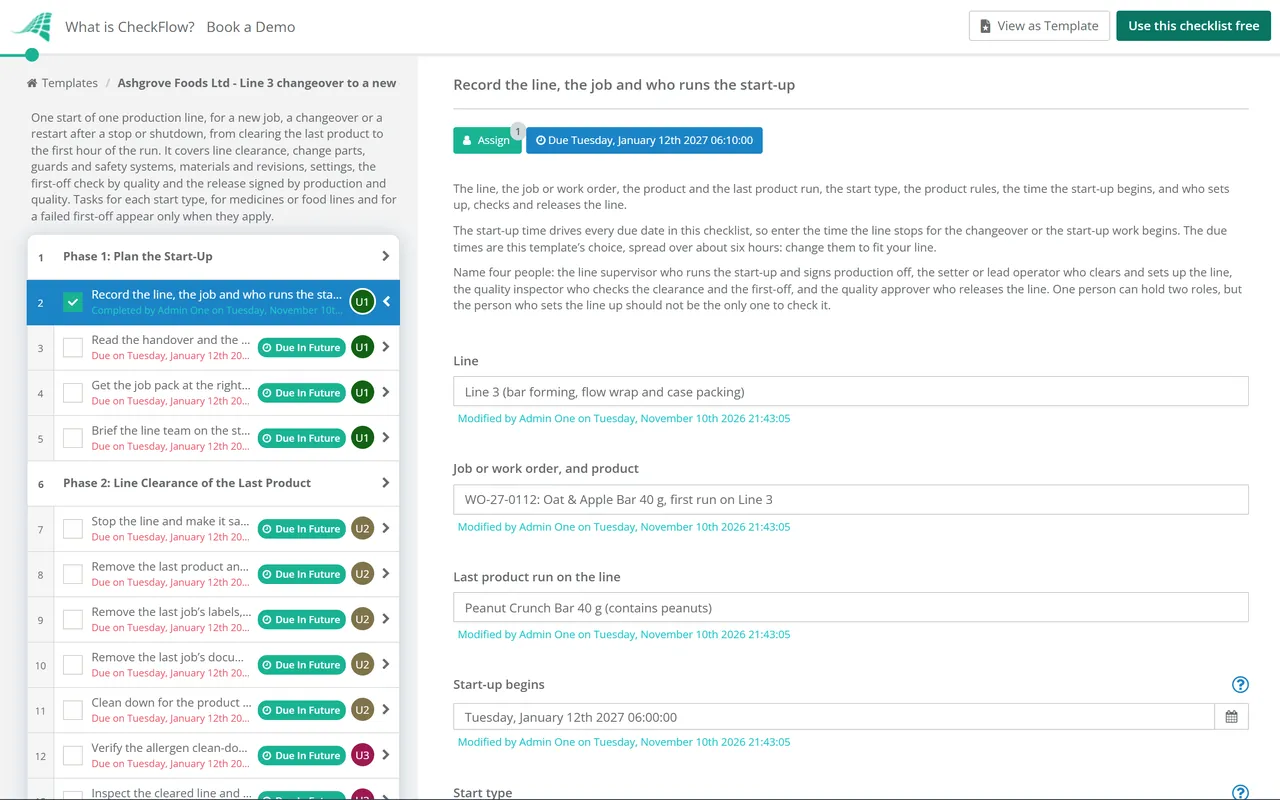
    Enter the time the start-up begins first: every task falls due a set time after it. The start type and the product rules on the first task add the tasks this start needs.

    • Record the line, the job and who runs the start-up — the line, the job or work order, the product and the last product run, the start type, the product rules, the time the start-up begins, and who sets up, checks and releases the line
    • Read the handover and the line’s open issues — open faults, quality holds, permits and isolations on the line, and anything the last shift left unfinished
    • Get the job pack at the right revision — the work order, the set-up sheet or recipe, the product specification and the first-off acceptance criteria, each at its current approved revision
    • Get the maintenance hand-back after the stop — the work done during the stop or shutdown finished, its work orders closed or handed back, tools and parts removed from the machine, and maintenance’s own isolations removed by the people who applied them
    • Brief the line team on the start-up — who does what, the safety points, what changes from the last job and what quality will check at the first-off
  2. Phase 2

    Phase 2: Line Clearance of the Last Product

    9 tasks

    Clear the line of everything from the last job before anything for the new job arrives: product, part-finished work, labels, packaging and paperwork. A second person checks the cleared line.

    • Stop the line and make it safe to clear — the line stopped and, where anyone reaches into a machine or removes a guard, isolated under the site’s lockout/tagout procedure
    • Check the line’s last clearance record — the record from the end of the last run shows the line was left clear and clean; if it does not, clear the line in full now
    • Remove the last product and part-finished work — finished product, part-finished work, rejects and samples taken off the line, counted, and returned, quarantined or scrapped as the site’s procedure says
    • Deal with product held on the line during the stop — product left in machines, ovens, hoppers or on conveyors during the stop assessed against its time and condition limits, then scrapped or quarantined for quality’s decision
    • Remove the last job’s labels, packaging and printed materials — labels, cartons, film, leaflets and printing plates taken off the line, with batch-coded materials destroyed or reconciled by the site’s procedure
    • Remove the last job’s documents from the line — the last job’s set-up sheet, work order, records and samples taken away, so only the new job’s documents stay at the line
    • Clean down for the product change — the line cleaned to the level the site’s changeover cleaning plan sets for this change of product, size, colour, flavour or allergen
    • Verify the allergen clean-down — a visual check, and any test your allergen plan sets, showing the line is free of the last product’s allergens before the new product touches it
    • Inspect the cleared line and sign the clearance — a second person walks the line, machines, printers, bins, floor and surrounding area and confirms nothing from the last job is left
  3. Phase 3

    Phase 3: Change Parts, Guards & Safety Systems

    5 tasks

    Fit the new job’s change parts while the line is still isolated, put every guard back, then restore energy and test the safety systems before anyone runs the line.

    • Change the format parts and tooling for the new job — the change parts, tooling, dies or nozzles the new job’s set-up sheet lists, fitted and checked, with the parts taken off cleaned and stored
    • Check every guard is fitted and closed — fixed guards back on with their fasteners, interlocked guards closed, and no guard or protection device bypassed, wedged or disabled
    • Remove the isolation and restore energy — everyone clear of the machines, each lock and tag removed by the person who applied it, and energy restored by the site’s procedure
    • Check the utilities to the line — power, compressed air, water, steam, vacuum or gas at the pressures, temperatures or levels the set-up sheet gives
    • Test the interlocks and emergency stops — each interlocked guard stops the machine when opened, each emergency stop stops the line and needs a reset, and light curtains and other protective devices work
  4. Phase 4

    Phase 4: Materials & the Right Revision

    5 tasks

    Bring the new job’s materials to the line only after the clearance is signed, and check each one is the right item, revision and status.

    • Issue the materials for the new job — raw materials, components, ingredients and packaging issued against the bill of materials or recipe, with their lot numbers and quantities
    • Check each material is the right item, revision and status — item number, revision or recipe version and supplier lot against the job pack, and each lot released for use rather than on hold or in quarantine
    • Check the labels, packaging and printed codes for the new job — the label and artwork version, cartons and film for the new product, and the batch codes and dates the line will print, against the job pack
    • Record the packaging and labelling materials in the batch record — each item examined for suitability and correctness and recorded, with the quantities issued so they can be reconciled at the end of the run
    • Display the new job at the line — the product name and batch or job number shown at each station, and the new job’s documents at the line
  5. Phase 5

    Phase 5: Settings & the Set-Up Sheet

    4 tasks

    Set the line from the set-up sheet, not from memory or the last job, and have a second person check the settings that matter.

    • Set the line to the set-up sheet — every setting the set-up sheet gives (speeds, temperatures, pressures, times, weights, recipe) entered and recorded
    • Check the critical settings against the set-up sheet — a second person checks each critical setting against the current set-up sheet and records any difference
    • Test the detectors, checkweighers and code readers — metal detectors, checkweighers, vision systems, code readers and label counters tested with the site’s test pieces, and rejects seen to reject
    • Confirm the line is ready for a first-off — the clearance signed, guards and safety systems tested, materials checked and settings set, so the line can run for its first-off samples
  6. Phase 6

    Phase 6: First-Off Samples & Quality Check

    6 tasks

    Run the line, take the first-off samples and hold everything made until quality has checked them against the acceptance criteria. A failed first-off adds the steps to contain, adjust and check again.

    • Run the line and take the first-off samples — the line run at the set-up settings and the first-off samples taken as the job pack says (how many and from where), labelled and kept apart, with everything made held until release
    • Check the first-off against the acceptance criteria — each characteristic in the acceptance criteria checked or measured (dimensions, weight, appearance, function, seal, label and codes) and the result recorded
    • Stop and contain what was made before the failed first-off — the line stopped, and everything made since the start-up held, counted and labelled so none goes on until quality decides
    • Find the cause and adjust the line — the cause of the failure found and recorded, the line adjusted, and the set-up sheet corrected through document control if it was wrong
    • Take and check a new first-off — new first-off samples taken after the adjustment and checked by quality against the same acceptance criteria
    • Keep a retained first-off sample — one sample from the first-off that passed (the re-check, if the first one failed), labelled with the job, date and time and kept where the line can compare against it during the run
  7. Phase 7

    Phase 7: Release the Line

    3 tasks

    Production and quality both sign before the run starts. Nothing after the quality release can be completed until it is given, and a line whose first-off has not passed is never released.

    • Production signs the start-up ready for release — the line supervisor confirms the clearance, safety checks, materials and settings are complete and the line is ready to run
    • Hold the line and fix what stopped the release — the line held, the reasons quality gave put right, and a new first-off checked if the product was the problem
    • Quality releases the line for production — the quality approver checks the first-off has passed and production has signed, then releases the line or holds it
  8. Phase 8

    Phase 8: First-Hour Monitoring

    6 tasks

    Applies only when the line is released. Watch the first hour closely: deal with the product held during the start-up, check the running line and raise anything that went wrong.

    • Decide on the product held during the start-up — product made before the release released, reworked or scrapped as quality decides, and the quantities recorded
    • Meet the release conditions — each condition the quality approver set on the release done, and how it was met recorded
    • Check the labels and codes on the running line — labels, batch codes and dates correct and readable at running speed, checked on packs taken from the line
    • Do the first in-process checks — the in-process checks the control plan sets for this product, at its frequency, from the first hour onwards
    • Run to rate and log the first hour — output, speed, stoppages and rejects in the first hour of the run, against the rate the job is planned for
    • Raise anything that went wrong at start-up — problems, set-up sheet errors and ideas to shorten the next start-up logged as actions with an owner
  9. Phase 9

    Phase 9: Close the Start-Up Record

    4 tasks

    Correct the set-up sheet if it needed changing, record how long the start-up took and file the record with the job.

    • Update the set-up sheet if it needed changes — any setting or step that had to change sent through the site’s document control, so the next start-up uses the corrected sheet
    • Record the start-up time and losses — the time from the start of the start-up to the release, and the scrap and samples it used
    • File the start-up record with the job — the clearance, checks, first-off results and release kept with the batch or job record
    • Hand the running line over to the shift — the running line, the retained sample, open actions and anything to watch handed to whoever runs the shift

Rules That Touch a Line Start-Up

No single law covers every line start-up. Which rules apply depends on what the line makes and where. The table lists the rules this template draws on, with who each one covers, as read on 10 November 2026. Check your own sector’s rules and your customers’ requirements; none of this is legal advice.

Rule Who it covers What it says about a start-up
21 CFR 211.130US current good manufacturing practice for drug products for humans or animalsWritten procedures so the correct labels, labelling and packaging are used; materials examined for suitability and correctness before packaging (d); the packaging and labelling facilities inspected immediately before use, with the results in the batch production records (e)
EU GMP Guide, Part I, Chapter 5Medicinal products for human use (EU guidelines; the current chapter came into operation on 1 March 2015)Work area and equipment clean and free of anything not needed before processing (5.40); line clearance before packaging to an appropriate check-list (5.50); name and batch number at each packaging station (5.51); code readers and label counters checked (5.57)
Commission Implementing Regulation (EU) 2025/2091Veterinary medicinal products in the EU, since 16 July 2026 (the Commission says its requirements are aligned with those for human medicines)Work area and equipment clean and free of anything not required before any manufacturing operation starts (Article 26(4)); packaging instructions include examining the area and equipment to ascertain the line clearance (Article 21); name and batch number at each packaging station, printing checked and recorded, code readers checked (Article 30)
MHRA GMP guidanceMedicines manufacturers in the UK (the MHRA may inspect veterinary areas for the Veterinary Medicines Directorate)The MHRA inspects sites against GMP and lists Volume 4 of the EU rules and its Orange Guide among its published GMP guidance
21 CFR 117.80 and 117.135(c)(2)US human food: good manufacturing practice, and food allergen controls where a facility’s preventive controls include themProduction procedures must not contribute to allergen cross-contact; equipment cleaned and sanitised as necessary; allergen controls cover protecting food from cross-contact and labelling the finished food
FSA guidance for food manufacturers and Food Standards ScotlandFood businesses in England, Wales and Northern Ireland (FSA) and in Scotland (FSS)Clean thoroughly in a way that reduces the risk of allergen cross-contamination, as some cleaning methods may not remove some allergens (FSA); effective cleaning is one of the most important strategies for preventing cross-contact (FSS); customers told about the 14 listed allergens (both)
PUWER 1998, regulations 11 and 19Employers in Great Britain (Northern Ireland has PUWER (NI) 1999)Effective measures to prevent access to dangerous parts of machinery, fixed guards first; guards not easily bypassed or disabled; suitable means to isolate equipment from its energy sources, and safe reconnection
29 CFR 1910.212US employers under OSHA’s general industry standardsOne or more methods of machine guarding to protect the operator and others from hazards such as the point of operation, ingoing nip points and rotating parts
29 CFR 1910.147US employers under OSHA’s general industry standards, for servicing and maintenanceSetting up, adjusting, cleaning and tool changes count as servicing where an employee may be exposed to unexpected start-up; normal production is covered only where a guard is removed or bypassed or a body part enters the danger zone, with an exception for routine minor tool changes done with effective alternative protection

What the template leaves to you. How many first-off samples to take, what they are checked for, the cleaning level for each change, the tests in your allergen plan and who may release a line are your site’s own choices, set in your procedures and your customers’ requirements. The template asks for them rather than setting them. Its due times, spread over about six hours from the start-up, are its own choice too: change them to fit your line.

Food and medicines. A food line’s allergen controls come from its food safety plan, which the HACCP Food Safety Checklist helps you build. A medicines site’s line clearance and label reconciliation are among the things a GMP Audit Checklist looks at.

Why Run Line Start-Ups in CheckFlow?

1

Nothing runs until quality releases it

The line supervisor, the setter, the quality inspector and the quality approver are chosen on the first task, and each task goes to the person who owns it. Production signs the line ready, and the quality release is assigned to the approver alone: nothing after that approval step can be completed until they give it. Released with conditions adds a task to meet the conditions, and Not released adds a task to fix the line and hides the first-hour checks.

2

Only the steps this start needs

A changeover adds the clean-down and change parts, a restart adds the maintenance hand-back and the held product, and a new job adds a check of the last clearance record. Medicines and food lines add their own checks and notes, and a failed first-off adds the steps to contain, adjust and check again. Rules show and hide each one from the answers given.

3

Every start on time and on record

Due times count in hours and minutes from the time the start-up begins, so a late start moves the whole plan. Each start is its own checklist with its clearance, settings, first-off results and release, and the Reports Grid lists every start-up and how far it got, so a line waiting for release stands out.

CheckFlow does not set your machines, test your product or replace your batch records. Keep settings, measurements and batch records where they live and record their references here. CheckFlow runs the start-up around them: who cleared and checked the line, what the first-off showed and who released it. CheckFlow’s manufacturing checklist software shows how plants run their other routines the same way.

Isolate machines with the Lockout/Tagout (LOTO) Procedure Checklist, check output through the run with the Manufacturing Quality Control Checklist, approve a new part for a customer with the First Article Inspection Checklist, hand the running line to the next shift with the Shift Handover Checklist and fix a fault that keeps coming back with the Root Cause Analysis (8D) Checklist.

AI generator

Didn’t find what you need? Describe it.

Describe the process in a sentence and the AI checklist generator drafts the phases and tasks for you.

Frequently Asked Questions

What should a production line start-up checklist include?

It should take the line from the last job to a released run: clearing the last product, labels, packaging and documents; making the machines safe and putting every guard back; testing the interlocks and emergency stops; bringing in the right materials at the right revision; setting the line from the set-up sheet; checking the first-off against the acceptance criteria; and a release signed by production and quality. This template adds the first hour of monitoring and the record.
What is first-off approval?

First-off approval is the check that the first items a line makes after a start-up meet the job’s acceptance criteria before the run goes on. In this template the setter runs the line and takes the first-off samples, quality checks them characteristic by characteristic, and the line is released only once a first-off has passed and production has signed. Everything made before the release is held until quality decides what happens to it.

What is line clearance in manufacturing?

Line clearance is clearing a line of everything from the last job before the next one starts: product, part-finished work, labels, packaging, printed materials and documents, then a second person checking it is clear. It stops mix-ups such as the last job’s labels on the new product. For US drug products, 21 CFR 211.130(e) requires the packaging and labelling facilities to be inspected immediately before use, and the EU GMP Guide asks for line clearance to an appropriate check-list.

What should a changeover checklist cover?

A changeover moves a line from one product to another, so this template adds two tasks for it on top of the full start-up: cleaning down to the level the site sets for that change of product, size, colour, flavour or allergen, and fitting the new job’s change parts while the line is still isolated. The clearance, safety checks, new materials, settings and first-off check that follow are the same as for any start.

What happens if the first-off fails?

Choosing Fail adds three tasks. The supervisor stops the line and holds everything made since the start-up, the setter finds the cause and adjusts the line, and quality checks a new first-off against the same acceptance criteria. If that fails too, the line is adjusted and checked again, with each attempt recorded. The line must not be released until a first-off passes, and a set-up sheet that was wrong is corrected through document control.

Who should sign off a production line start-up?

In this template two people sign. The line supervisor signs that the clearance, safety checks, materials and settings are complete, and the quality approver releases the line after the first-off has passed. The release is assigned to the approver alone and holds every later task until it is given. One person can hold more than one role, but the person who sets the line up should not be the only one to check it.

Do you need lockout/tagout during a changeover?

Where anyone reaches into a machine or removes a guard, isolate it under your lockout/tagout procedure. In the US, 29 CFR 1910.147’s definitions count setting up, adjusting, cleaning and tool changes as servicing where an employee may be exposed to unexpected start-up, with a narrow exception for routine minor tool changes done with effective alternative protection. In Great Britain, PUWER regulation 19 requires suitable means to isolate work equipment from its energy sources where appropriate.

Is line clearance a legal requirement?

It depends on what the line makes. For US drug products it is: 21 CFR 211.130(e) requires inspection of packaging and labelling facilities immediately before use, recorded in the batch production records. For human medicines in the EU, the GMP Guide asks for it, and EU veterinary GMP rules require it in packaging instructions. US food rules require precautions against allergen cross-contact rather than naming line clearance. For other products it is good practice, set by the site’s own procedures and its customers’ requirements.

Is CheckFlow free for this template?

14-day free trial, no card required. The Business plan is $10 per user per month after the trial. Full details at checkflow.io/pricing.

Release Every Line Start the Same Way

Free trial — no credit card required.

14-day free trial, no credit cardFull refund in your first 30 daysUS hosting, EU on request