
Manufacturing Quality Control Checklist Template

Quality found at final inspection costs 10x more than quality built in at the source. The quality control process that prevents defects beats the one that detects them — every time.

The most expensive quality control is the kind that finds defects in finished goods — because by that point, the labour, materials, machine time, and energy invested in producing the non-conforming product have already been consumed. Research consistently shows that in-process quality checks reduce final inspection rejection rates by 40–60% — not because the products are better at final inspection, but because the defects are caught and corrected before value is fully added. Statistical Process Control that monitors process parameters in real time catches the drift that produces defects before it produces the defect. Incoming inspection that identifies non-conforming raw materials before they enter production prevents the downstream cascade of problems that a bad batch of material can cause. A structured manufacturing quality control process builds quality into every stage — from the incoming dock to the outgoing shipment — rather than relying on final inspection to find problems at the end. This free checklist gives quality managers, QA leads, and production teams a structured framework for the full manufacturing quality control cycle.

Use This Template Free See Live Example
No Credit Card Required

The Four Costs of Quality — and Why Prevention Always Beats Inspection

Prevention Costs

Prevention Costs

What it is: Investment in preventing defects from occurring — process design, supplier qualification, operator training, process control systems, mistake-proofing (poka-yoke).

Cost ratio: The cheapest form of quality investment. $1 spent on prevention avoids $10 in appraisal and $100 in failure costs.

Examples: SPC implementation, FMEA, operator quality training, incoming supplier qualification.

Appraisal Costs

Appraisal Costs

What it is: The cost of measuring, evaluating, and inspecting to verify that products meet specifications.

Cost ratio: Necessary but not value-adding. Inspection finds defects; it does not prevent them.

Examples: Incoming inspection, in-process measurement, final inspection, test equipment calibration, quality audits.

Internal Failure

Internal Failure Costs

What it is: The cost of non-conformances found before the product reaches the customer — scrap, rework, re-inspection, and production delays.

Cost ratio: Significantly more expensive than prevention; all materials and labour in the non-conforming product are wasted or duplicated.

Examples: Scrap costs, rework labour, re-inspection time, line stoppages for quality issues.

External Failure

External Failure Costs

What it is: The cost of non-conformances that reach the customer — warranty claims, returns, recalls, customer complaints, reputation damage.

Cost ratio: The most expensive quality cost — 10 to 100 times the prevention cost equivalent. Includes direct costs and the relationship and reputational damage that is harder to quantify.

Examples: Product returns, warranty repairs, customer penalty clauses, recall costs, lost future business.

The Manufacturing Quality Control Checklist

Six phases covering the full QC cycle — from incoming material inspection through in-process checks, SPC, final inspection, non-conformance management, and CAPA-driven quality improvement.

Phase 1

Incoming Material Inspection

Non-conforming raw materials that enter the production process do not stay on the goods receipt dock — they produce non-conforming finished goods. Incoming inspection is the first line of quality defence and the most cost-effective point to catch a supplier issue.

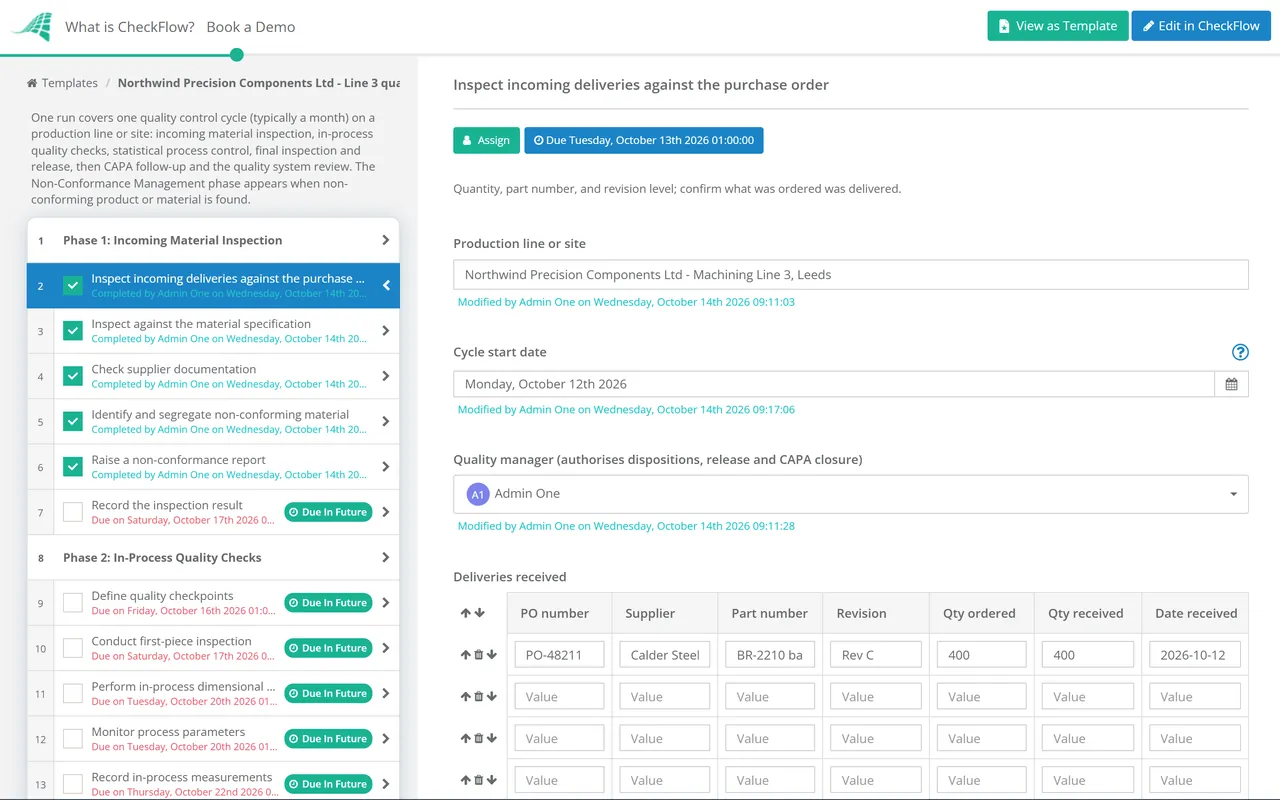
  • Inspect incoming deliveries against the purchase order — quantity, part number, and revision level; confirm what was ordered was delivered
  • Inspect against the material specification — dimensional, visual, or physical inspection per the approved incoming inspection procedure or acceptance criteria
  • Check supplier documentation — certificate of conformance, material test reports, or other required documentation; confirm it matches the delivery
  • Identify and segregate non-conforming material — clearly tagged and placed in the non-conforming material area; not stored alongside conforming stock
  • Raise a non-conformance report — for any rejected material; supplier notified; disposition plan (return, rework, or use-as-is with concession)
  • Record the inspection result — in the quality management system; feeds supplier quality performance data
Phase 2

In-Process Quality Checks

In-process quality checks reduce final inspection rejection rates by 40–60%. They are the highest-ROI quality investment in manufacturing — catching defects when they cost least to correct.

  • Define quality checkpoints — the specific process steps where quality checks are required; based on process risk (FMEA) and historical defect data
  • Conduct first-piece inspection — at the start of every production run; confirm the first produced unit meets specification before continuing
  • Perform in-process dimensional and visual checks — at defined intervals per the control plan; with calibrated measurement tools
  • Monitor process parameters — temperature, pressure, speed, or other critical process parameters; confirm within specification at each checkpoint
  • Record in-process measurements — against specification limits; with the operator ID, timestamp, and measurement result
  • Stop and notify when out of specification — production should halt when a critical characteristic is out of spec; do not continue producing non-conforming product
Phase 3

Statistical Process Control (SPC)

  • Identify critical characteristics for SPC — the process parameters and product characteristics with the highest defect risk; defined by FMEA or customer requirements
  • Maintain SPC control charts — X-bar R charts, p-charts, or other appropriate chart types; updated in real time or at defined sample intervals
  • Monitor for control chart signals — points outside control limits (special cause variation) require immediate investigation and action
  • Calculate process capability (Cpk) — monthly for critical characteristics; Cpk ≥ 1.33 is the minimum for most applications; <1.0 requires immediate improvement action
  • Investigate and address special cause variation — root cause of control chart signals identified; corrective action implemented; documented
Phase 4

Final Inspection & Release

  • Conduct final inspection per the inspection plan — sampling plan applied (AQL or 100% inspection as defined); all specified characteristics measured
  • Confirm all in-process quality records are complete — no product released without complete in-process documentation
  • Complete the final inspection record — all measurements recorded; acceptance or rejection decision documented; inspector ID and timestamp
  • Apply product identification — pass/fail label, lot number, inspection date, and any required traceability marking
  • Release conforming product to finished goods — with a formal release record; non-conforming product held and a non-conformance report raised
Phase 5

Non-Conformance Management

  • Open a non-conformance report (NCR) — for every identified non-conformity; description of the defect, quantity affected, location (incoming, in-process, or final inspection), and potential cause
  • Contain the non-conforming product — segregated, tagged, and removed from the production flow; all similar product in the same batch or production run assessed
  • Determine the disposition — rework (can it be corrected?), scrap (not correctable), use-as-is (concession if fit-for-purpose despite non-conformance), or return to supplier; authorised at the appropriate level
  • Investigate the root cause — what caused the non-conformance? Equipment, material, process, operator, or measurement system?
  • Issue a CAPA — Corrective and Preventive Action; specific actions to prevent recurrence; named owner and target date
Phase 6

CAPA & Quality System Improvement

  • Manage open CAPAs to completion — no CAPA is closed until the corrective action is implemented and verified as effective
  • Verify CAPA effectiveness — has the root cause been eliminated? Has the non-conformance recurred? Evidence of effectiveness required before closure
  • Conduct management review of quality data — monthly or quarterly; NCR volume and trends, scrap rate, customer complaints, CAPA status; presented to leadership
  • Track key quality KPIs — defect rate (PPM), first-pass yield, scrap rate, customer return rate, CAPA closure rate; trended over time
  • Conduct internal quality audits — per the annual audit schedule; all production areas and quality system elements audited against ISO 9001 or applicable standard

The Manufacturing Quality Metrics Every QA Team Must Track

Defect Rate (PPM)

Defective parts per million produced. The standard measure of quality output. Six Sigma target: 3.4 PPM.

First-Pass Yield (FPY)

Percentage of units completing a production process without requiring any rework or repair. High FPY = efficient, capable process. Low FPY = embedded quality problem.

Scrap Rate

Percentage of raw material or WIP that is scrapped rather than converted to saleable product. Direct cost impact.

Customer Return Rate

Percentage of shipped product returned by customers due to quality defects. The external failure cost that reaches your P&L and your customer relationship.

Process Capability (Cpk)

Statistical measure of how well a process produces within specification limits. Cpk ≥ 1.33 is industry minimum for most applications. <1.0 requires immediate action.

CAPA Closure Rate

Percentage of open CAPAs closed within their target date. Measures the quality system’s ability to close the loop on identified problems.

Why Run Your Quality Control Process in CheckFlow?

1

In-process quality checks built into the production workflow — not separate from it

Quality checks that require operators to stop, find a paper form, complete it, and file it are quality checks that will be skipped under production pressure. CheckFlow integrates quality checkpoint tasks into the production workflow — the check appears at the right stage, is completed in the same process, and creates a timestamped record automatically. Quality is in the workflow, not beside it.


2

NCR and CAPA tracking through to verified closure

A non-conformance that is identified, investigated, and issued a CAPA — but where the CAPA action is never implemented or verified — is a non-conformance that will recur. CheckFlow assigns CAPA tasks to named owners with deadlines, tracks their completion, and requires an effectiveness verification before the CAPA can be closed. The quality system closes the loop.

3

A quality record that survives an ISO or customer audit

ISO 9001 and customer quality audits ask for evidence that quality processes are systematically executed and documented. Every inspection result, every NCR, every CAPA action, and every management review conducted through CheckFlow is timestamped, attributed, and archived. The quality record that auditors require is built automatically as the process runs.

Quality control validation is a critical step in the manufacturing change order process. CheckFlow’s Manufacturing Change Order Checklist covers the full ECO process including first article inspection. See the Manufacturing Change Order Checklist →

Equipment calibration and maintenance directly affects measurement system accuracy and quality control effectiveness. CheckFlow’s Equipment Maintenance Workflow covers the maintenance process that keeps quality control equipment reliable. See the Equipment Maintenance Workflow →

Frequently Asked Questions

What should a manufacturing quality control checklist cover?

+

A manufacturing quality control checklist covers six phases: incoming material inspection (quantity, specification compliance, supplier documentation, and non-conforming material segregation), in-process quality checks (first-piece inspection, periodic in-process measurement, process parameter monitoring, and stop-when-non-conforming discipline), statistical process control (critical characteristic control charts, Cpk monitoring, and special cause investigation), final inspection and release (sampling or 100% inspection, full documentation, product identification, and formal release), non-conformance management (NCR, containment, disposition, root cause investigation, and CAPA), and quality system improvement (CAPA management to closure, quality KPI tracking, and internal audits).

What is a CAPA and when should one be issued?

+

A Corrective and Preventive Action (CAPA) is a structured quality improvement process consisting of a corrective action (addressing the specific non-conformance that occurred to prevent its recurrence) and a preventive action (addressing systemic factors that could cause similar non-conformances in future). A CAPA should be issued for every significant non-conformance — internal quality failures above a defined severity threshold, customer complaints and returns, audit findings, and any recurring non-conformance pattern. A CAPA is not complete until the corrective action has been implemented, the effectiveness has been verified (the non-conformance has not recurred after the action), and the record is formally closed.

What is statistical process control (SPC) and when should it be used?

+

Statistical Process Control (SPC) uses statistical methods — primarily control charts — to monitor process parameters and product characteristics over time, distinguishing between common cause variation (normal process variability within control limits) and special cause variation (unusual patterns or data points outside control limits that signal a process change requiring investigation). SPC should be applied to critical product characteristics and process parameters where real-time monitoring is possible and where drift or shift would produce defects. The key benefit of SPC over end-point inspection is that it detects the process moving out of control before defects are produced — enabling intervention before product is non-conforming.

What are the ISO 9001 documentation requirements for quality control?

+

ISO 9001:2015 requires documented information for several quality control activities: inspection and test results (records demonstrating products conform to requirements), calibration records for monitoring and measurement equipment, non-conforming product identification and disposition records, CAPA records demonstrating corrective actions and their effectiveness, and internal audit results. The 2025–2026 regulatory landscape is introducing enhanced requirements for digital documentation integrity and traceability. A quality management system that produces complete, timestamped, and accessible records for all required activities will satisfy ISO 9001 documentation requirements and be ready for the enhanced digital requirements.

Is CheckFlow free for this template?

+

You can start a free 14-day trial with no credit card required, giving you full access to all features including this template. The Business plan is $10 per user per month after the trial. Full details at checkflow.io/pricing.

Build Quality In at Every Stage — From Incoming Dock to Final Release

Free trial — no credit card required.