
Manufacturing Production Scheduling Checklist Template

A production schedule that ignores capacity constraints is a wish list. A schedule that ignores material availability is optimistic. A schedule that ignores customer demand is waste. The production schedule that works aligns all three.

Production scheduling is the intersection of three constraints that must be balanced simultaneously: what customers want (demand), what the facility can produce (capacity), and what materials are available (inventory and supply chain). A production plan that overestimates available capacity produces a schedule that cannot be met — creating overtime costs, missed commitments, and team exhaustion. A plan that does not confirm material availability before releasing work orders produces production stoppages when raw material is missing at the line. A plan disconnected from actual demand creates finished goods that sit in the warehouse. Effective manufacturing production scheduling works backwards from confirmed customer demand, checks that capacity is available to meet it, confirms materials will be on hand when needed, and translates all of this into a workable, sequenced shop floor plan that can actually be executed. This free checklist gives production planners, operations managers, and plant managers a structured framework for the full production scheduling cycle — from demand input to schedule adherence tracking.

Use This Template Free See Live Example
No Credit Card Required

The Three Pillars of Manufacturing Production Planning

Master Production Schedule (MPS)

What it is: The forward-looking plan of what finished goods or sub-assemblies will be produced, in what quantities, and when. The MPS translates customer orders and demand forecasts into a production plan.

Input: Sales orders, demand forecasts, customer delivery commitments, and existing finished goods inventory.

Output: A time-phased plan of what to produce, when, to fulfil committed demand and maintain target inventory levels.

Material Requirements Planning (MRP)

What it is: The process of calculating what raw materials, components, and sub-assemblies are needed to execute the MPS — and when they must be available.

Input: MPS, Bill of Materials (BOM), and current inventory on-hand and on-order.

Output: Purchase orders for materials not in stock, production orders for sub-assemblies, and planned receipt dates that confirm material will be available when production requires it.

Capacity Planning

What it is: The assessment of whether the facility has the production capacity (machine hours, labour hours, floor space) to execute the MPS within the committed timeframe.

Input: MPS and the routing for each product (which operations, at which work centres, for how long).

Output: A capacity utilisation view showing where constraints and bottlenecks exist — enabling rescheduling, overtime, subcontracting, or demand management decisions before commitments are made.

The Manufacturing Production Scheduling Checklist

Six phases covering the full production scheduling cycle — from demand input and capacity assessment through MPS creation, work order release, and schedule adherence tracking.

Phase 1

Demand Input & Order Review

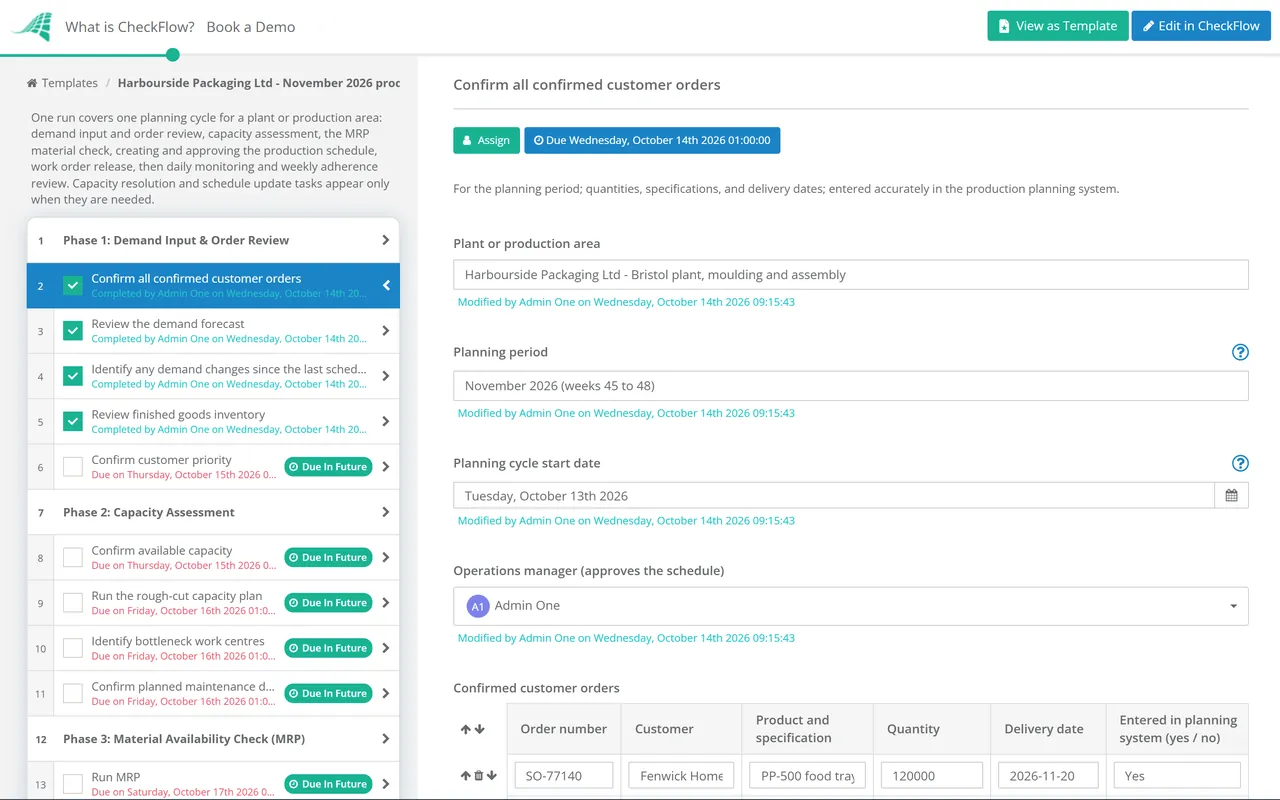
  • Confirm all confirmed customer orders — for the planning period; quantities, specifications, and delivery dates; entered accurately in the production planning system
  • Review the demand forecast — for periods beyond confirmed orders; statistical forecast reviewed with sales for any known adjustments
  • Identify any demand changes since the last schedule — new orders, order amendments, cancellations; confirm the schedule reflects current demand
  • Review finished goods inventory — what is already available in stock? Demand can be satisfied from inventory without production
  • Confirm customer priority — where there are constraints, which orders or customers have delivery priority?
Phase 2

Capacity Assessment

  • Confirm available capacity — production days, shifts, and hours available in the planning period; holidays, planned maintenance downtime, and any known constraints
  • Run the rough-cut capacity plan — compare the MPS requirements to available capacity by work centre; identify any over-capacity periods
  • Identify bottleneck work centres — where capacity is insufficient to meet the plan; the constraint that limits total throughput
  • Resolve capacity constraints — overtime, additional shifts, subcontracting, customer delivery renegotiation, or demand smoothing; confirm resolution before schedule is published
  • Confirm planned maintenance downtime is incorporated — maintenance windows reflected in available capacity; not scheduled during peak production periods unless unavoidable
Phase 3

Material Availability Check (MRP)

  • Run MRP — to calculate net material requirements against the MPS; identify shortfalls in raw materials and components
  • Confirm all materials are available — or will be available by the required date; for materials not available, expedite or reschedule production
  • Review open purchase orders — confirm supplier delivery dates are consistent with the production schedule; expedite any critical deliveries at risk
  • Identify long-lead-time materials — materials with lead times exceeding the planning horizon; order quantities confirmed with sufficient advance
  • Confirm no quarantined material is in the plan — inventory on hold or under quality investigation must not be included in available material
Phase 4

MPS Creation & Finalisation

  • Create the production schedule — for the planning period; product, quantity, work centre, and production date/time for each production run
  • Sequence production runs for efficiency — group similar setups to minimise changeover time; sequence by colour (light to dark), size (smallest to largest), or other changeover-minimising logic
  • Incorporate safety stock targets — ensure the schedule maintains defined safety stock levels for finished goods; does not produce to zero inventory
  • Confirm schedule is achievable — capacity check confirmed, material availability confirmed; not aspirational
  • Review and approve the schedule — with the operations manager and relevant stakeholders before publication and work order release
Phase 5

Work Order Release

  • Release work orders for the immediate period — typically 1–2 weeks horizon; enough to enable production but not so far ahead that changes cannot be accommodated
  • Confirm materials are picked or staged — required raw materials and components issued to the production floor or staged at the work centre
  • Issue work instructions — current revision work instructions available at the work centre before production starts
  • Confirm tooling and fixtures are ready — correct tooling set up and verified before the first piece is run
  • Brief production team — supervisor briefed on the schedule for the shift; any special requirements or customer priorities communicated
Phase 6

Schedule Monitoring & Adherence

  • Monitor production against the schedule daily — actual vs planned; identify deviations immediately
  • Address schedule deviations promptly — why did production fall behind? Equipment downtime, material shortage, quality issue, or capacity problem? Root cause addressed same day
  • Update the schedule — when deviations cannot be recovered; customer delivery dates confirmed or renegotiated proactively
  • Measure schedule adherence — actual production versus planned; percentage on time and in full; trend tracked weekly
  • Review schedule performance weekly — what caused deviations; are there recurring constraint types? Drive continuous improvement on the highest-frequency root causes

The Production Scheduling KPIs That Reveal Process Quality

On-Time Delivery (OTD)

Percentage of customer orders shipped on or before the committed date. The primary measure of scheduling effectiveness from the customer’s perspective.

Schedule Adherence Rate

Percentage of production orders completed on the planned date in the planned quantity. Measures internal execution against plan.

Schedule Attainment

Percentage of the planned production volume actually completed. Distinguishes between on-time performance and volume completion.

Capacity Utilisation

Actual production hours versus available hours. High utilisation is good; approaching 100% is a warning sign — no buffer for variability, maintenance, or demand spikes.

Changeover Time

Time taken to switch production between different products. A key driver of schedule efficiency — SMED (Single Minute Exchange of Die) methodology reduces changeover time and increases scheduling flexibility.

Why Run Your Production Scheduling in CheckFlow?

1

A structured daily scheduling review that happens consistently

Production schedule review that happens only when something goes wrong is not a schedule management process — it is crisis management. CheckFlow’s daily scheduling checklist ensures the demand review, material availability check, capacity confirmation, and schedule update happen every day, every shift, with the results documented and deviations logged. The process is the schedule.


2

Schedule deviations captured with root cause

A schedule that slips without a documented root cause produces the same problem next week. CheckFlow’s schedule monitoring phase requires a root cause task before a deviation can be closed — ensuring that equipment downtime, material shortages, and quality issues that affect the schedule are recorded, analysed, and addressed.

3

A complete scheduling history for continuous improvement

Schedule adherence trends — whether on-time performance is improving or declining, which root causes recur most frequently — are the data that drives production planning improvement. Every scheduling period managed through CheckFlow creates a timestamped record of the plan, the actuals, and the deviations. The improvement data is built automatically.

Production scheduling must account for planned maintenance windows. CheckFlow’s Equipment Maintenance Workflow covers the maintenance scheduling that needs to be built into the production calendar. See the Equipment Maintenance Workflow →

A production schedule is only as reliable as the inventory supporting it. CheckFlow’s Inventory Management for Manufacturing Checklist covers the material availability process that underpins the production plan. See the Inventory Management Checklist →

Frequently Asked Questions

What does a manufacturing production scheduling checklist cover?

+

A manufacturing production scheduling checklist covers six phases: demand input and order review (confirmed customer orders, demand forecast, changes since last schedule), capacity assessment (available hours, rough-cut capacity planning, bottleneck identification, and constraint resolution), material availability check via MRP (net requirements calculation, open PO confirmation, expediting), master production schedule creation (sequenced, achievable schedule with safety stock consideration), work order release (materials staged, tooling confirmed, team briefed), and schedule monitoring and performance tracking (daily actual vs plan, deviation root cause, schedule attainment and OTD metrics).

What is MRP and how does it connect to the production schedule?

+

Material Requirements Planning (MRP) is the calculation of what raw materials, components, and sub-assemblies are required to execute the Master Production Schedule (MPS), and when they must be available. MRP uses the MPS as input (what to produce and when), applies the Bill of Materials (BOM) for each product (what materials are needed per unit), and checks against current inventory on-hand and on-order (what is already available). The output is planned purchase orders for shortfalls and planned production orders for sub-assemblies, with dates that ensure materials arrive before they are needed in production. An MPS without MRP is a production plan that may not be executable.

What causes production schedule deviations and how should they be managed?

+

The most common causes of production schedule deviations are: unplanned equipment downtime (the most frequent and most impactful), material shortages (raw materials or components not available when required), quality failures requiring rework or scrap (consuming capacity and reducing output), labour unavailability (absenteeism or skill gaps), and late engineering changes creating uncertainty on the shop floor. Managing deviations requires same-day identification (daily schedule review), documented root cause, updated schedule reflecting reality rather than the original aspiration, and proactive customer communication when delivery commitments are affected. Unrecovered deviations that persist on the schedule without adjustment create an increasingly unrealistic plan that loses the production team’s confidence.

What is schedule adherence and why does it matter?

+

Schedule adherence (also called schedule attainment) measures the percentage of production orders completed on the planned date in the planned quantity — it is the internal measure of how well the production floor executes the plan. On-Time Delivery (OTD) measures the customer-facing outcome. High schedule adherence supports high OTD; low schedule adherence means the plan is either unrealistic (set too aggressively), or execution is constrained by equipment, material, or labour issues. Tracking schedule adherence by root cause category over time identifies the systematic constraints that, when addressed, produce the most improvement in production reliability.

Is CheckFlow free for this template?

+

You can start a free 14-day trial with no credit card required, giving you full access to all features including this template. The Business plan is $10 per user per month after the trial. Full details at checkflow.io/pricing.

Build a Production Schedule That Can Actually Be Executed — Every Time

Free trial — no credit card required.