Defect triage
Job: log a defect, classify it, contain it and decide what happens to the product.
Finishes with: a disposition: rework, scrap, use as is or return to the supplier.
Escalate when: the defect returns or its cause is unclear.
No Credit Card Required
Printed from checkflow.io/templates/quality-assurance/root-cause-analysis-checklist
8D, the eight disciplines, is a team method for problems whose cause nobody knows yet: a customer complaint, a failure that keeps coming back, a defect that slipped past final inspection. This free root cause analysis checklist takes a team through all nine steps, D0 to D8. Plan and respond, describe the problem precisely, contain it, prove the root cause and the escape point, fix both, then change the system so it cannot return elsewhere. Two questions at the start add the emergency response and customer report tasks only when the problem needs them.
8D is a method, not a standard. Ford Motor Company documented it in its 1987 manual Team Oriented Problem Solving (TOPS), and the later Global 8D version added D0 for planning and emergency response, which is why the “eight” disciplines now number nine. The approach spread through the automotive supply chain, where customers often ask a supplier for an 8D report after a complaint. AIAG’s CQI-20 Effective Problem Solving guide follows a similar nine-step path, from becoming aware of a problem to recognising the team.
Three processes are often confused. They work together, but each has a different job.
Job: log a defect, classify it, contain it and decide what happens to the product.
Finishes with: a disposition: rework, scrap, use as is or return to the supplier.
Escalate when: the defect returns or its cause is unclear.
Job: find and prove why the problem occurred and why it escaped, then remove both causes.
Finishes with: a verified root cause, validated actions and an updated FMEA and control plan.
Run by: a small cross-functional team with a champion. This template.
Job: log every nonconformity, decide whether corrective action is needed, approve the plan and check effectiveness.
Finishes with: an approved closure and a trend for management review.
Calls: an 8D when the problem is complex or a customer demands one.
Put simply, CAPA is the management loop and 8D is one of the methods it calls. If your quality system opens a corrective action for a customer complaint, run this checklist as the investigation and attach the closed 8D to the record in the CAPA (Corrective & Preventive Action) Checklist. Single defects caught at inspection belong in the Defect Reporting & Resolution Checklist until they recur. IT outages suit the incident postmortem template better, since it is built around timelines rather than physical stock.
Seven phases group the nine disciplines. Emergency tasks appear only for a safety or regulatory impact, customer report tasks only when a customer asked for an 8D. The champion approves the verified root cause before any permanent fix is chosen, and approves closure.
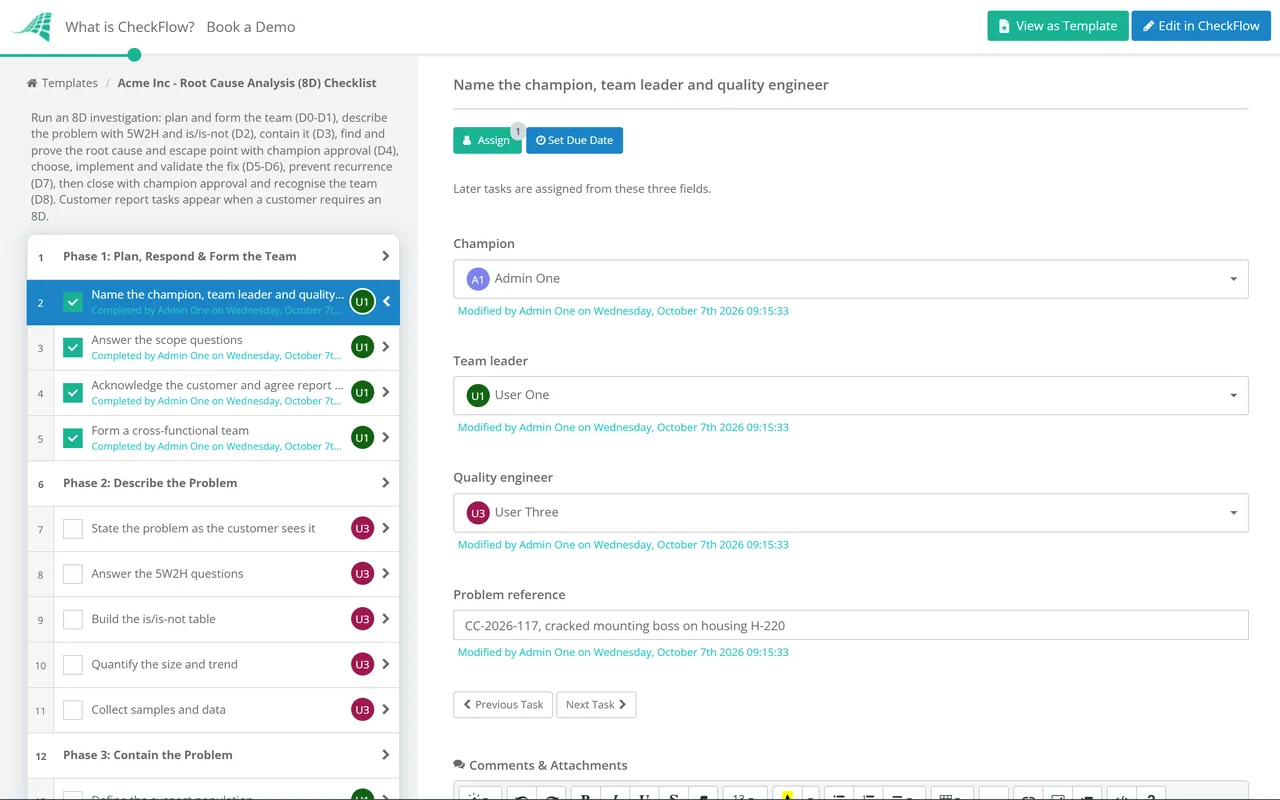
Owned by the team leader. Scope questions: did a customer raise this and require an 8D report (Yes/No), safety or regulatory impact (Yes/No). The emergency response and escalation tasks are shown only when the impact answer is Yes, and the customer acknowledgement only when the customer answer is Yes.
Assigned to the quality engineer. Describe the problem in measurable terms and leave causes out; theories wait for the fishbone in Phase 4.
Assigned to the team leader. Interim containment protects the customer while the investigation runs. It is temporary and expensive, so Phase 5 removes it once the permanent fix is validated. The containment report is shown only when a customer asked for an 8D.
Two causes are needed: why the problem occurred and why it was not detected. The root cause approval is assigned from the champion field and halts the checklist until it is Approved.
Assigned to the team leader. The customer update is shown only when a customer asked for an 8D.
Assigned to the quality engineer. D7 asks what in the management system allowed the problem, then fixes it for products the team never touched.
Customer acceptance is shown only when a customer asked for an 8D. The closure approval is assigned from the champion field and halts the checklist until it is Approved.
Each discipline answers one question and produces the output the next step needs. The last column is the shortcut that most often sends a team back to the start.
| Discipline | Question it answers | Output | Common mistake |
|---|---|---|---|
| D0 Plan | Is this an 8D, and does anyone need protecting today? | Emergency actions and a decision to proceed | Opening a full 8D for a problem one person could fix in an hour |
| D1 Team | Who knows enough to solve it? | Named champion, leader and members | A team of managers with nobody from the shop floor |
| D2 Describe | What exactly is wrong, and where is it not? | Problem statement, 5W2H and is/is-not | Writing the suspected cause into the problem statement |
| D3 Contain | How is the customer protected meanwhile? | Suspect stock sorted and an interim check | Sorting stock on site and forgetting goods in transit |
| D4 Root cause | Why did it happen, and why did it escape? | Verified occurrence and escape causes | Stopping at “operator error” |
| D5 Choose | Which actions remove both causes? | Actions proven in a trial | Picking the fix before the cause is verified |
| D6 Implement | Did the fix work in production? | Validation data, containment removed | Leaving the full sort in place for months |
| D7 Prevent | What let this happen, and where else could it? | Updated FMEA, control plan and read-across | Fixing one part number and ignoring its siblings |
| D8 Recognise | Is it closed, and did the team get credit? | Approved closure and recognition | Closing before the customer accepts the report |
The tools are not interchangeable. The is/is-not table shows where the problem stops. A fishbone generates candidate causes but proves nothing. 5 Whys follows one chain to a cause you can act on, once the team knows roughly where to look. A Pareto chart picks the defect type to tackle first, and fault tree analysis suits safety failures that need several events to line up. None of them is evidence. Verification is, which is why D4 ends with switching the problem on and off.
Phase 5 stays locked until the champion approves the verified root cause. A team cannot jump from a brainstorm straight to a corrective action, the commonest way an 8D goes wrong.
An internal scrap investigation skips the containment report, the D6 update and the acceptance task. A customer who wants an 8D gets all three, with due dates set from the start date.
The is/is-not table, the fishbone photo and the validation data sit on the task that produced them. The audit trail shows who did what and when, and a read-only, white-label share link lets the customer’s quality engineer follow progress.
CheckFlow is not a QMS or MES, and it does not hold your FMEA or control plan. It runs the team’s investigation around those systems, so every 8D follows the same disciplines in the same order. CheckFlow for manufacturing shows how plants use it for recurring quality and production checks. When the problem came in through your corrective action system, pair this template with the CAPA checklist, which owns the log, the action plan approval and the effectiveness check.
Sorting stock for months feels safe but hides the cause. The guide to lean manufacturing principles explains why fixing the source of a defect beats inspecting it out.
Describe the process in a sentence and the AI checklist generator drafts the phases and tasks for you.
D0 plan and take emergency action, D1 form the team, D2 describe the problem, D3 contain it, D4 find and verify the root cause and escape point, D5 choose and verify permanent corrective actions, D6 implement and validate them, D7 prevent recurrence across the system, and D8 recognise the team and close. That is nine steps, because D0 was added to Ford’s original eight in the later Global 8D version.
Use 8D when the cause is unknown, the problem recurs, it crosses several departments, it affects safety, or a customer has asked for an 8D report. A simple problem one person can trace in a morning only needs a 5 Whys and a correction.
The escape point is the earliest place in the process where the problem should have been detected and was not, such as a gauge that was not used or a test that did not cover the failure mode. Fixing the root cause stops the defect being made. Fixing the escape point means the next unexpected defect gets caught before it ships.
Switch it on and off. Put the suspected cause back and the defect should return; remove it and the defect should disappear. Where that is unsafe or impossible, use data: the cause must explain every line of the is/is-not table, including where the problem does not occur. A cause that only sounds right is a hypothesis, not a root cause.
No. CAPA is the formal system that records nonconformities, decides which need corrective action, approves the actions and checks they worked. 8D is one way to run the investigation inside it, chosen for complex or customer-raised problems. Many CAPAs never need an 8D, and an 8D is often run for a customer without a CAPA number.
14-day free trial, no card required. The Business plan is $10 per user per month after the trial. Full details at checkflow.io/pricing.
14-day free trial, no credit cardFull refund in your first 30 daysUS hosting, EU on request