
The rules that apply to you
One jurisdiction answer shows the FDA preventive controls tasks, the seafood, juice and meat plan check, the SFBB check or the EU guide check. A review run adds the reanalysis phase; a new plan skips it.
Last reviewed: October 2026
No Credit Card Required
Printed from checkflow.io/templates/quality-assurance/haccp-food-safety-checklist
This free HACCP checklist takes a team through building a food safety plan, or reviewing an existing one, step by step. It follows the 12 steps and 7 principles of the Codex General Principles of Food Hygiene: team and scope, product description, flow diagram, hazard analysis, critical control points, critical limits, monitoring, corrective action, validation, verification and records. Two questions at the start set it up: whether this is a new plan or a review, and which rules the site works under, US FDA, a US HACCP-regulated sector, the UK or the EU.
HACCP is a method, not a single law. The Codex Alimentarius text CXC 1-1969, revised in 2020 and amended in 2022 with a new annex of tools for deciding critical control points, is the international reference. National rules then decide who must have a plan, who may write it and how often it is reviewed. The table summarises the main ones. It is a starting point, not legal advice, so check the current text for your sector.
| Where | Rule | What it asks for | Review cycle |
|---|---|---|---|
| US food facilities registered with FDA | 21 CFR Part 117, Subpart C (Preventive Controls for Human Food) | A written food safety plan, prepared or overseen by a preventive controls qualified individual (PCQI), with a written hazard analysis and preventive controls | Reanalysis of the whole plan at least every 3 years, and sooner after a significant change (117.170) |
| US seafood processors | 21 CFR Part 123 | A HACCP plan for each location and kind of fish product where a hazard is reasonably likely to occur | Reassessment at least annually and whenever a change could affect the hazard analysis |
| US juice processors | 21 CFR Part 120 | A HACCP plan for each location and type of juice, developed by a trained individual | Validation at least annually and whenever the process changes |
| US meat and poultry establishments | 9 CFR Part 417 (USDA FSIS) | A HACCP plan signed and dated by the responsible establishment individual | Reassessment at least annually, with the plan signed and dated again |
| Great Britain | Assimilated Regulation (EC) No 852/2004, Article 5 | Permanent procedures based on the HACCP principles, with records proportionate to the size of the business | Review whenever the product, process or any step changes |
| European Union | Regulation (EC) No 852/2004, Article 5 | The same seven-principle requirement, with national guides to good practice supporting smaller businesses | Review whenever the product, process or any step changes |
Small caterers and retailers in England and Wales can meet the UK requirement with the Food Standards Agency’s Safer Food, Better Business (SFBB) packs, which apply the HACCP principles without the formal worksheets, plus the daily diary that local authority officers ask to see. Food manufacturers usually need a full plan. In the US, the FDA’s Food Traceability Rule (21 CFR Part 1, Subpart S) adds separate traceability records for foods on the Food Traceability List. It does not replace a HACCP or food safety plan. FDA has proposed moving its compliance date to 20 July 2028, and a 2026 appropriations act directed FDA not to enforce the rule before that date.
Seven phases follow the Codex sequence from the team to the signed plan. A review run adds a phase on what has changed, the jurisdiction answer shows the tasks for your rules, and the plan needs two approvals that each halt the checklist.
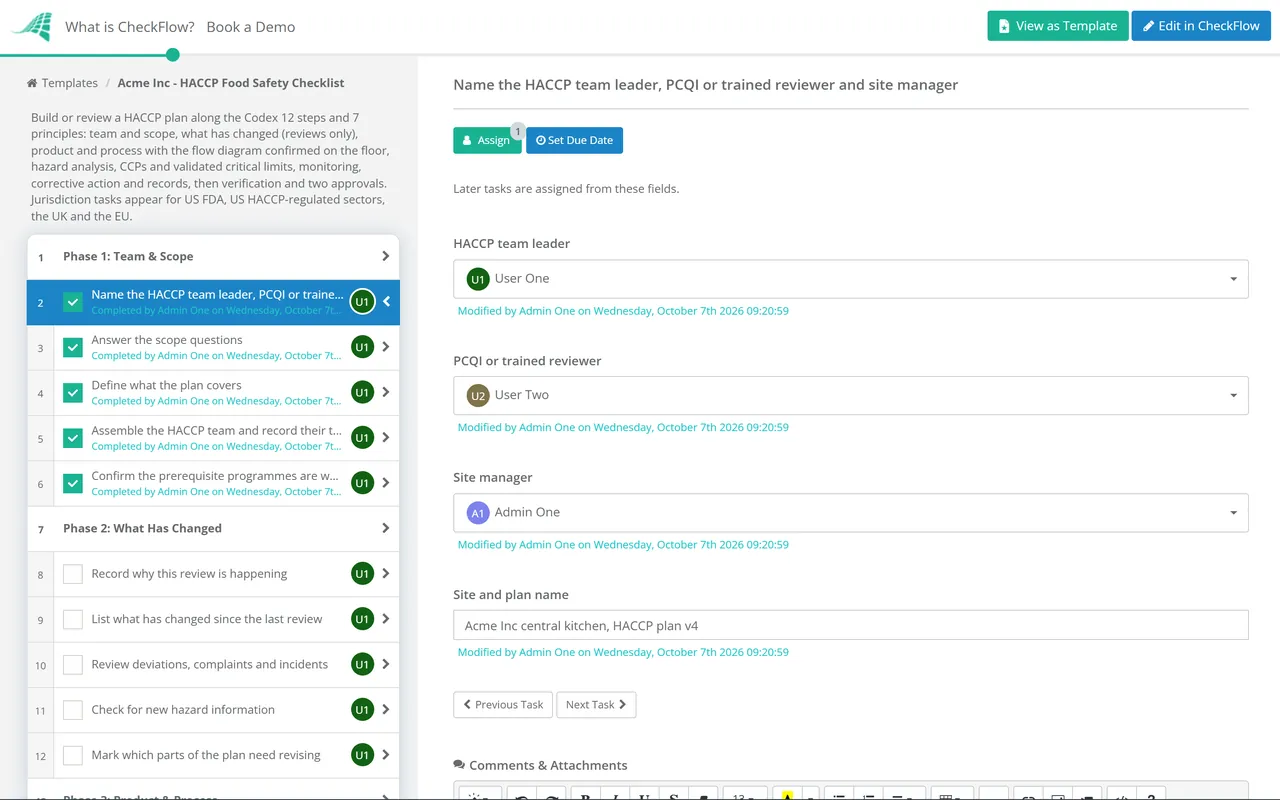
Codex step 1, owned by the HACCP team leader. Scope questions: run type (New plan / Annual review / Review after a change), jurisdiction (US FDA food facility / US HACCP-regulated sector / UK / EU / Other). The SFBB task is shown only when jurisdiction is UK.
Shown only when run type is Annual review or Review after a change. Owned by the HACCP team leader. A planned change is reanalysed before it goes live.
Codex steps 2 to 5. Assigned to the HACCP team leader. The last task is shown only when jurisdiction is EU.
Codex step 6, Principle 1. The last task is shown only when jurisdiction is US FDA food facility.
Codex steps 7 and 8, Principles 2 and 3. The last task is shown only when jurisdiction is US HACCP-regulated sector.
Codex steps 9, 10 and 12, Principles 4, 5 and 7. Assigned to the HACCP team leader.
Codex step 11, Principle 6. The plan approval is assigned from the PCQI or trained reviewer field, then the site manager signs off. The checklist halts at each approval until it is Approved.
Most plans fail at the CCP table, not the hazard list: the limit is vague, nobody owns the monitoring, or the corrective action says “inform supervisor” and stops. Here is one CCP for cooking chicken portions in a US food service kitchen, written the way Phases 5 to 7 build it.
| Element | Example |
|---|---|
| Process step | Cooking raw chicken portions in the combination oven |
| Significant hazard | Survival of Salmonella and Campylobacter from the raw meat |
| Control measure | Cooking to a validated core temperature |
| Critical limit | Core temperature of 74°C (165°F) or above, instantaneous, as the FDA Food Code sets for poultry in 3-401.11 |
| Monitoring | Cook probes the thickest part of the largest portion in every batch and logs the reading |
| Corrective action | Keep cooking and re-probe; if the oven cannot reach the limit, hold the batch, move cooking to another oven and call maintenance |
| Verification | Supervisor reviews and signs the cooking log daily; probes are checked for accuracy weekly and calibrated on schedule |
| Records | Cooking log, corrective action log and probe calibration record |
Use the limit your own rules or validation support. UK guidance uses different time and temperature combinations, and a manufacturer’s cook step may be validated at other values. The probe is the weak point in any temperature CCP: an inaccurate probe makes every logged reading worthless. The Calibration Management Checklist runs the calibration cycle for every thermometer and probe the plan relies on.
One jurisdiction answer shows the FDA preventive controls tasks, the seafood, juice and meat plan check, the SFBB check or the EU guide check. A review run adds the reanalysis phase; a new plan skips it.
The PCQI or trained reviewer approves the plan, then the site manager signs off its resources. Each approval halts the checklist, so a draft plan cannot be briefed to the floor by accident.
A recurring schedule starts the annual review on its date. Validation studies and flow diagrams sit on the task that produced them, and the audit trail shows who decided what and when.
CheckFlow is not a temperature logging system or a QMS. It runs the human process of building, approving and reviewing the plan, and a read-only, white-label share link lets an auditor follow it. Daily CCP checks can run as their own recurring checklists. See how CheckFlow’s compliance checklist software handles recurring regulated work.
When a critical limit is breached more than once, the CAPA (Corrective & Preventive Action) Checklist takes the deviation through root cause, action plan and effectiveness check.

Restaurant Opening & Closing Checklist

Restaurant Employee Training Checklist

Food Allergen Management Checklist

Restaurant Health Inspection Checklist

CAPA (Corrective & Preventive Action) Checklist
Describe the process in a sentence and the AI checklist generator drafts the phases and tasks for you.
Codex sets five preliminary steps: assemble the team and define the scope, describe the product, identify its intended use and users, draw the flow diagram and confirm it on site. The seven principles follow as steps 6 to 12: conduct a hazard analysis and identify control measures, determine the critical control points, set validated critical limits, monitor each CCP, set corrective actions, validate the plan and verify it is working, and keep documents and records.
In the UK and the EU, food businesses after primary production must have permanent procedures based on the HACCP principles under Article 5 of Regulation (EC) No 852/2004, scaled to the size of the business. In the US, HACCP plans are mandatory for seafood, juice, and meat and poultry. Many other FDA-registered facilities need a food safety plan under 21 CFR Part 117 instead, unless an exemption applies, which uses the same thinking but goes wider. Check the current rules for your sector.
Whenever something changes that could affect a hazard: a new product, supplier, recipe, piece of equipment or customer group. On top of that, US seafood and meat and poultry plans are reassessed at least annually, juice plans validated at least annually, and FDA food safety plans reanalysed at least every three years. An annual review is a sensible default everywhere else.
A HACCP plan centres on critical control points. A food safety plan under 21 CFR 117 covers CCPs where they exist, but also allergen, sanitation and supply-chain controls, plus a recall plan, and each control is managed in proportion to its role. A preventive controls qualified individual must prepare or oversee it, and also validation, record review and reanalysis.
People who know the product and the process: production, quality, hygiene and engineering, led by someone trained in HACCP. A small business may have one or two people, and Codex accepts outside expertise where the team lacks it. The people who do the monitoring should help write it, since they know what really happens on the line.
14-day free trial, no card required. The Business plan is $10 per user per month after the trial. Full details at checkflow.io/pricing.
14-day free trial, no credit cardFull refund in your first 30 daysUS hosting, EU on request