Batch Record Review Checklist Template

A batch record can be signed on every page and still not be ready for a decision. The yield sits outside its limits, a correction hides the original entry, or a deviation is still open when the batch is approved.

Last reviewed: November 2026

Printed from checkflow.io/templates/quality-assurance/batch-record-review-checklist

This free batch record review checklist is for QA reviewers, QC analysts and the quality managers who approve or reject batches at sites that make drug products, including contract manufacturers. One run is QA’s review of one executed batch record, from the day production of the batch finishes to the quality control unit’s decision. It checks the record against the current master record, then every entry, signature and correction, the components, weights and equipment, the in-process controls and the yield against the master record’s own limits, packaging, label reconciliation and line clearance, the laboratory results and every deviation against the batch. A GDP error count above zero adds a corrections review with production, a yield outside its limits adds a deviation, an electronic record adds an audit trail review, and a client’s product adds the quality agreement and the documents the client receives. While any deviation is open, a task to close them appears before the decision, which is completed only once they are closed. Approve shows the release tasks; Reject shows the rejected batch’s route instead. It is built on the US rules for drugs (21 CFR Part 211) and supports your own QA procedure; it does not replace it.

Every Batch Is Reviewed Before It Is Released

A batch record review is the quality control unit’s check of one batch’s executed production and control records before the batch is released. Under 21 CFR 211.192, all drug product production and control records, packaging and labelling included, “shall be reviewed and approved by the quality control unit to determine compliance with all established, approved written procedures before a batch is released or distributed”. The same section requires a thorough investigation of any unexplained discrepancy, a yield outside the master record’s limits included, and of any failure to meet a specification, extended to other batches of the same drug product and to other drug products that may have been associated with it. In the EU, a Qualified Person certifies each batch before it is released for sale or supply, and EU GMP Annex 16 lists what they must be sure of first. In Great Britain, the qualified person is responsible for securing that each batch manufactured there was manufactured and checked in line with the Regulations and its UK marketing authorisation or registration.

The review looks at one batch. A GMP audit looks at a whole site or area and samples batch records as one of its checks. Line clearance and the first-off check at the start of a run belong to production line start-up, the inspection of product samples to product inspection, and the systemic fix for a deviation to the site’s CAPA process.

This checklist

One batch record review

Who: a QA reviewer, with production, the QC laboratory and the quality control unit’s approver.

Against: the product’s approved master record, its specification and your written procedures.

Ends with: the quality control unit’s decision to approve or reject the batch, and the record filed.

The rule

21 CFR 211.192 and Annex 16

US drugs: the quality control unit reviews and approves the records before a batch is released or distributed.

EU: a Qualified Person certifies each batch before it is released for sale or supply; Great Britain sets its own qualified person duties.

Not covered here: dietary supplements (21 CFR Part 111) and medical devices (21 CFR Part 820), which have their own rules.

Neighbours

Audits, start-ups and CAPA

GMP audit: a self-inspection of a site or area against GMP.

Line start-up: line clearance and first-off approval before a run starts.

Batch record review: one finished batch’s records, checked before the decision.

What the Batch Record Review Checklist Covers

Nine phases take one executed batch record from hand-over to the decision and the filed record, counted in working days from the day production finishes. Choose how the record is kept and whose product it is on the first task, and the matching checks appear: an audit trail review for an electronic or hybrid record, and the quality agreement and the documents for a client’s product. A GDP error count above zero adds a corrections review with production, and a yield outside the master record’s limits adds a deviation. While any deviation is open, a task to close them appears before the decision. Nothing after the decision appears until it is made, or can be completed until it is done: Approve shows the release tasks, and Reject shows the rejected batch’s route instead.

  1. Phase 1

    Phase 1: Set Up the Review

    4 tasks

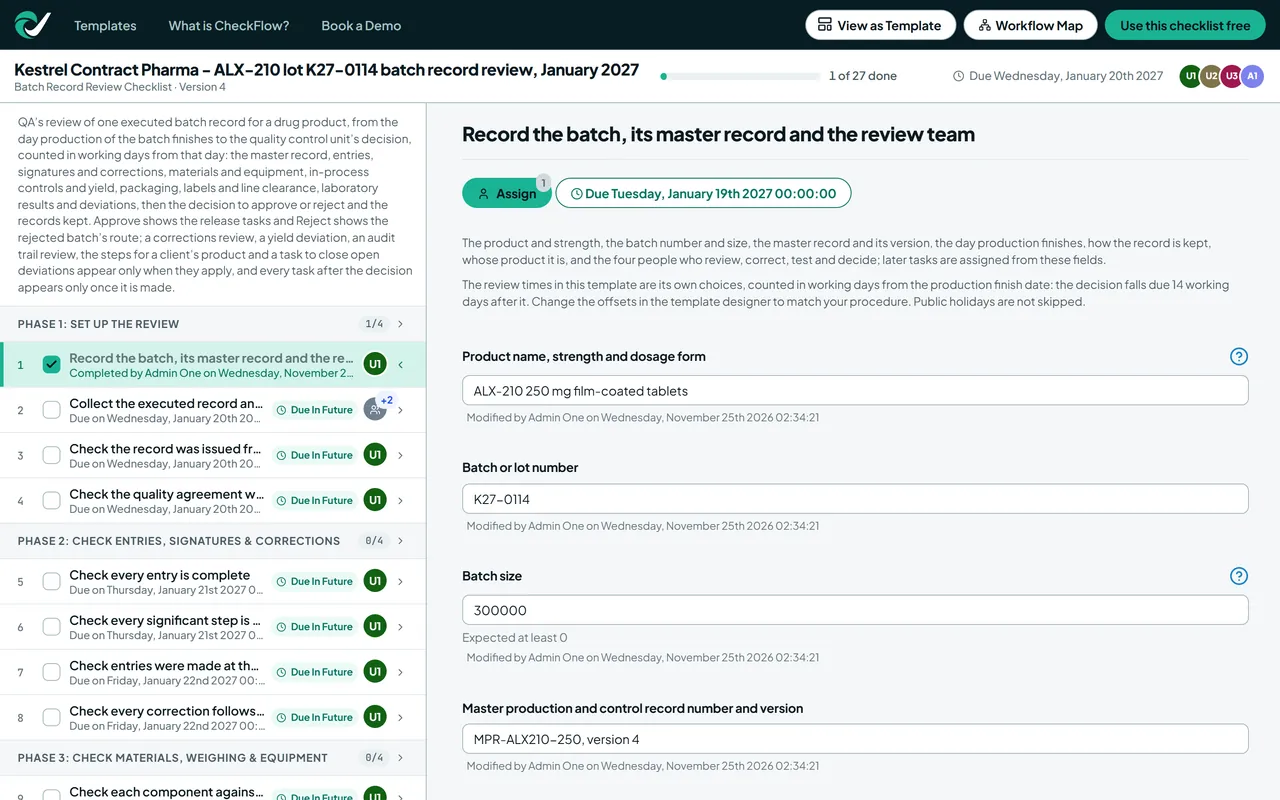
    One run is one executed batch record, from the day production of the batch finishes to the quality control unit’s decision. Every due date counts in working days from that day, so set it first.

    • Record the batch, its master record and the review team — the product and strength, the batch number and size, the master record and its version, the day production finishes, how the record is kept, whose product it is, and the four people who review, correct, test and decide; later tasks are assigned from these fields
    • Collect the executed record and everything attached to it — every issued page returned and accounted for, with the printouts, label specimens, line clearance records, equipment printouts and in-process results that belong to it
    • Check the record was issued from the current approved master record — the issued copy matches the current approved master production and control record for this product and batch size, and it was checked for accuracy, dated and signed when it was issued
    • Check the quality agreement with the client — what the agreement says your quality unit reviews and decides, what the client’s quality unit reviews, which documents go to the client and when, and how the client’s quality unit makes its final release decision
  2. Phase 2

    Phase 2: Check Entries, Signatures & Corrections

    6 tasks

    Read every page before judging any result. A record that is complete, signed, made at the time and corrected properly is the evidence that the batch was made as the master record says.

    • Check every entry is complete — no blank fields, every step has a result, a tick or a reason it did not apply, and every calculation is filled in and checked
    • Check every significant step is signed and dated — the person who performed each significant step and the person who checked it are identified, second-person checks are signed where the master record asks for them, and steps done by automated equipment show who checked them
    • Check entries were made at the time and in order — dates and times follow the order of the process, no entry was made before its step, and no page looks as if it was completed in one sitting
    • Check every correction follows good documentation practice — each change is signed and dated, the original entry can still be read, and a reason is given where one is needed, with no overwriting, correction fluid or obscured entries
    • Review the electronic record’s audit trail — changes, deletions, late entries and overridden alarms in the system’s audit trail for this batch, each one explained, and the system’s own checks on entries working as validated
    • Review the GDP errors with production and have them corrected — the person who made each entry corrects it the right way, a late entry is dated on the day it is made with the reason, and QA decides whether any error affects the batch and needs a deviation
  3. Phase 3

    Phase 3: Check Materials, Weighing & Equipment

    4 tasks

    Trace each component from the stores to the batch, and each piece of major equipment from its log to the record.

    • Check each component against the master record — every component listed, its lot or control number recorded, each lot released by the quality control unit before use, and each weight or measure matching the master record’s quantity
    • Check each component was added and verified — each component added by one person and verified by a second, or verified by one person where automated equipment adds it, at the step the master record gives
    • Check the equipment and lines used — each piece of major equipment and each line identified in the record, the right ones for this product and batch size, and each one clean, in calibration and released for use on the day
    • Check the equipment cleaning and use logs — each log shows the date, time, product and lot number of this batch, the cleaning before it signed by the person who did it and the person who checked it (or, for cleaning by automated equipment, the person who verified it), and entries in date order
  4. Phase 4

    Phase 4: Check In-Process Controls & Yield

    5 tasks

    Compare every result with the limits in this product’s own master record, not a general figure. A yield outside those limits must be investigated.

    • Check the in-process control results against their limits — each in-process test or examination done at the stage the master record sets, every result within its limit, and any rejected in-process material identified and quarantined
    • Check the time limits for each phase of production — where time limits are set for the product, each phase finished within them, or the overrun justified and documented
    • Check the sampling recorded in the record — each sample taken where the master record asks, with the stage, the quantity, who took it and where it went
    • Check the yield against the master record’s limits — the theoretical and actual yield at each stage the master record names, each percentage of theoretical yield calculated by one person and checked by a second (or checked by one person where automated equipment calculates it), and each compared with the master record’s minimum and maximum
    • Raise a deviation for the yield outside its limits — a deviation raised and the investigation started, with the other batches and products that may be affected identified
  5. Phase 5

    Phase 5: Check Packaging, Labelling & Line Clearance

    4 tasks

    Packaging is where a mix-up reaches the patient. Check the line was clear before and after, and that every label issued is accounted for.

    • Check the line clearance before and after packaging — the packaging and labelling area inspected immediately before use with nothing left from the previous run, inspected again after use, and both results recorded in the record
    • Check the packaging and labelling materials used — the containers, closures, labels and other labelling issued match the master record, were examined for identity and correctness before use, and that examination is recorded
    • Reconcile the labels issued, used and returned — the labelling issued, used, destroyed and returned adds up, any difference is inside the narrow preset limits your procedure sets, and excess labelling with the lot number was destroyed
    • Check the finished product inspection and the labelling records — the checks for correct labels during finishing and on a representative sample at the end recorded, the lot number on the product, and specimens or copies of all labelling used kept with the record
  6. Phase 6

    Phase 6: Check Laboratory Results & Deviations

    6 tasks

    The review is not complete until every result is in and every deviation against the batch is closed. While any deviation is open, a task to close them appears before the decision, and the decision is completed only once they are all closed.

    • Check the laboratory results against the specification — every test the specification asks for complete, the identity and strength of each active ingredient included, each result within its limit, and the laboratory records reviewed and approved
    • Confirm the reserve sample was taken and stored — a reserve sample representative of the batch, kept in the container-closure system the product is marketed in or one with essentially the same characteristics, under the conditions on its label
    • Check any out-of-specification results were investigated — each failed or out-of-specification result for the batch or its components investigated and closed with a conclusion, or counted as an open deviation below
    • Check change controls and other events that touch the batch — changes to the process, equipment, materials or methods that applied to this batch assessed and approved, and any complaint, recall or investigation on related batches that could affect it considered
    • List every deviation raised against the batch — each deviation recorded and justified, its classification and status, its investigation extended to other batches that may be affected, and how many are still open
    • Close the open deviations before the decision — each investigation finished, its root cause and its effect on this batch and other batches recorded, and its closure approved; then change the open deviations count to 0
  7. Phase 7

    Phase 7: Summarise & Decide

    2 tasks

    The quality control unit approves or rejects the batch. Nothing after the decision appears until it is made, or can be completed until it is done, and Reject shows the rejected batch’s route instead of the release.

    • Write the review summary — what was checked, the GDP errors and how they were corrected, the yield, the label reconciliation, each deviation and how it closed, and the laboratory results, with anything the approver must weigh
    • Approve or reject the batch — the quality control unit’s decision on the batch, made only when the record is complete, every deviation is closed and every result is in; complete this task with the decision
  8. Phase 8

    Phase 8: Release or Reject the Batch

    7 tasks

    The batch stays in quarantine until the decision is made. Approve shows the release tasks; Reject shows the rejected batch’s route, and never the release.

    • Move the batch from quarantine to released stock — the batch’s status changed in the inventory system and on its containers only after the approval, so it can be picked and shipped
    • Issue the release documents — the certificate of analysis and the release notice or certificate your procedure uses, signed and sent to the people who ship the batch
    • Confirm the batch can be traced once it ships — the lot number set up in the distribution system so that every shipment of this batch can be found quickly if it has to be recalled
    • Label the batch rejected and keep it apart — the batch marked rejected in the inventory system and on every container, and moved or locked where it cannot be used or shipped
    • Decide whether to reprocess or destroy the batch — reprocessing only under the written reprocessing procedure and with the quality control unit’s review and approval, and only where the reprocessed batch can be shown to meet every standard and specification
    • Record the destruction, or start the reprocessed batch’s review — a destruction record with the quantity, the date and who witnessed it, or, for reprocessing, a new run of this checklist for the reprocessed batch and its record
    • Open a CAPA for the cause of the rejection — the root cause from the investigation, the actions that stop it affecting other batches, an owner and a due date
  9. Phase 9

    Phase 9: Close the Review & Keep the Records

    2 tasks

    Both routes end here. The record is kept for as long as the rules require, and the batch’s data is kept for the product’s annual review, which looks at approved and rejected batches alike.

    • File the reviewed record and set its retention date — the complete record, the review summary and the decision filed together, with a keep-until date at least one year after the batch’s expiry date, and for a client’s product the documents the quality agreement lists sent to the client
    • Add the batch to the annual product review data — the batch, its yield, its deviations and their investigations, and its decision recorded for the product’s annual review of its quality standards

What the Reviewer Checks, and Where the Rule Is

21 CFR Part 211 sections behind each check

The table maps each part of the review to the section of 21 CFR Part 211 that asks for it, as published on eCFR on 24 November 2026, and to the phase that checks it. It is a map, not the text: review against the current rule and your own procedures.

What is checked 21 CFR Part 211 What the section asks for Checked in
Master record and the issued copy211.186, 211.188(a)A master record for each product and batch size, signed and independently checked; an accurate copy issued for each batchPhase 1
Entries, signatures and timing211.100(b), 211.188(b)(11)Production steps documented at the time; the people who perform and check each significant step identifiedPhase 2
Electronic records211.68(b); Part 11Changes to records made only by authorised people; Part 11 for records kept in electronic formPhase 2
Components and weighing211.101, 211.188(b)(3) and (4)Released components, weights checked by a second person, each addition verifiedPhase 3
Equipment and logs211.182, 211.188(b)(2)Major equipment identified; cleaning and use logs with the date, time, product and lotPhase 3
In-process controls and time limits211.110, 211.111In-process tests at set stages; time limits met or the overrun justifiedPhase 4
Yield211.186(b)(7), 211.188(b)(7), 211.103Actual yield and percentage of theoretical yield, independently checked, within the master record’s limitsPhase 4
Packaging, labels and line clearance211.125, 211.130, 211.134, 211.188(b)(6)Labels examined and reconciled; the area inspected before and after use; the finished product inspectedPhase 5
Laboratory results and reserve sample211.165, 211.170(b), 211.194Conformance to final specifications before release; a reserve sample kept; complete laboratory recordsPhase 6
Deviations and investigations211.100(b), 211.192Deviations recorded and justified; discrepancies and failures investigated and extended to other batchesPhase 6
The decision211.22(a), 211.192, 211.165(f)The quality control unit approves or rejects; failing product is rejectedPhase 7
Quarantine, release and rejection211.142(a), 211.115, 211.150(b)Quarantine until release; reprocessing only with the quality control unit’s approval; each lot traceablePhase 8
Retention and annual review211.180(a), (c) and (e)Records kept at least 1 year after expiry; each product’s quality standards reviewed at least annuallyPhase 9

Other rules for other markets and products

This template follows the US rules for drugs. If your batch is for another market, or is not a drug, these are the rules to read instead. None of them is built into the template.

Where or what The rules What they say about batch records
EUEudraLex Volume 4: Chapter 4, Documentation; Annex 16, Certification by a Qualified Person and Batch ReleaseChapter 4 sets what a batch processing and packaging record holds and how entries are made and corrected; Annex 16 lists what the Qualified Person must be sure of before certifying a batch
UK (Great Britain)Human Medicines Regulations 2012, Schedule 7The qualified person is responsible for securing that each batch manufactured in Great Britain was manufactured and checked in line with the Regulations and its UK marketing authorisation
US dietary supplements21 CFR Part 111A batch production record for each batch (111.255 and 111.260), and quality control review and approval of batch production records, and release or rejection of each finished batch (111.123)
US medical devices21 CFR Part 820, the Quality Management System RegulationIncorporates ISO 13485 by reference; the version in force since 2 February 2026 replaced the old Quality System Regulation

Correcting entries. Part 211 asks for steps to be documented at the time but does not say how a wrong entry is corrected, so this follows your own procedure. EU GMP Chapter 4, paragraph 4.9, says any alteration “should be signed and dated; the alteration should permit the reading of the original information. Where appropriate, the reason for the alteration should be recorded.”

Review times. No rule sets how long a review takes. The offsets in this template are its own choices: the record is collected 1 working day after production finishes and the decision is due 14 working days after it. Due dates are fixed offsets from the date you enter, so a quicker or slower review does not move them; change the offsets in the template designer to match your procedure.

Why Review Batch Records in CheckFlow?

1

Open deviations come before the decision

Enter the number of deviations still open and, while it is above zero, a task to close them appears before the decision, and the approver completes the decision only once it is done. A yield outside the master record’s limits, labels outside their limits and GDP errors each add the step they need, so the open questions are in front of the approver before the decision.

2

Reject never shows the release

The decision is assigned to the quality control unit’s approver alone, and nothing after it can be completed until it is done. Approve shows the release tasks; Reject shows the rejected batch’s route, from segregation to reprocessing or destruction and a CAPA, so the record shows who approved what, and when.

3

Every batch, the same review

Start one checklist per batch, assign the review, the corrections and the laboratory checks from the first task, and adapt the checks to your own procedures in the template designer. The Reports Grid shows every batch waiting for review and every decision due across your products.

CheckFlow does not review your batch records and does not replace your quality management system, your batch records or your quality control unit’s judgement. It runs the steps of a review around your own procedures, so every batch is reviewed in the same order with a record of who did what. If you keep GMP records in CheckFlow, assess and validate it under your own computerised system procedures first. See how CheckFlow’s manufacturing checklist software handles quality routines on the shop floor.

This template reviews one batch. Audit the whole site with the GMP Audit Checklist, run each systemic cause through the CAPA (Corrective & Preventive Action) Checklist, qualify the equipment the batch runs on with the Equipment Qualification (IQ/OQ/PQ) Checklist and prepare for an investigator with the FDA Inspection Readiness Checklist.

AI generator

Didn’t find what you need? Describe it.

Describe the process in a sentence and the AI checklist generator drafts the phases and tasks for you.

Frequently Asked Questions

What is a batch record review?

It is the quality control unit’s check of one batch’s executed production and control records before the batch is released. The reviewer compares the record with the approved master record and the written procedures: every entry, signature and correction, the materials and equipment, the in-process results and yield, packaging and labelling, the laboratory results and every deviation. Under 21 CFR 211.192 the review and approval come before the batch is released or distributed, and any unexplained discrepancy is investigated.

Who must review and approve a batch record before release?

For US drugs, the quality control unit. 21 CFR 211.22(a) gives it the authority to review production records and to approve or reject drug products, and 211.192 requires it to review and approve the records before a batch is released or distributed. In the EU, a Qualified Person certifies each batch before it is released for sale or supply. In Great Britain, the qualified person is responsible for securing that each batch manufactured in Great Britain was made and checked as the Regulations and its UK marketing authorisation require.

What happens if the yield is outside the master record’s limits?

The master record states the theoretical yield and the minimum and maximum percentages beyond which an investigation under 21 CFR 211.192 is required (211.186(b)(7)). A yield outside them is an unexplained discrepancy: it must be thoroughly investigated, whether or not the batch has already been distributed, with the investigation extended to other batches that may be affected. In this template, answering Outside adds a task to raise the deviation; count it as open in Phase 6 and a task to close it appears before the decision.

How should errors in a batch record be corrected?

Part 211 asks for production steps to be documented at the time they are done but does not say how a wrong entry is corrected, so follow your own procedure. EU GMP Chapter 4, paragraph 4.9, says an alteration should be signed and dated, should leave the original entry readable and, where appropriate, should give the reason. An entry should never be rewritten to look as if it was made at the time. An error that changes a result, or a step with no record, is a deviation.

Can a batch be approved while a deviation is still open?

Part 211 requires the records to be reviewed and approved before release, and unexplained discrepancies to be thoroughly investigated, with a written record that includes the conclusions and follow-up. EU GMP Annex 16 asks that every investigation pertaining to the batch is completed to a sufficient level to support certification. Your procedure says what is sufficient. In this template, while the count of open deviations is above zero, a task to close them appears before the decision, and the approver completes the decision only once it is done.

How long must batch records be kept?

Under 21 CFR 211.180(a), records associated with a batch of a drug product are kept for at least 1 year after the batch’s expiration date, or 3 years after distribution for certain OTC drug products exempt from expiration dating, and must be readily available for inspection. EU GMP Chapter 4 asks for batch documentation to be kept for one year after expiry or at least five years after Qualified Person certification, whichever is longer. Your licence or agreements may ask for longer.

Does this checklist work for dietary supplements or medical devices?

Not as it stands. Dietary supplements follow 21 CFR Part 111, which has its own batch production record (111.255 and 111.260) and quality control review of those records and release or rejection of each finished batch (111.123). Medical devices follow the Quality Management System Regulation in 21 CFR Part 820, which incorporates ISO 13485 and has applied since 2 February 2026. You can copy this template and change the checks and references in the template designer to match the rule you work under.

Is CheckFlow free for this template?

14-day free trial, no card required. The Business plan is $10 per user per month after the trial. Full details at checkflow.io/pricing.

Review Every Batch Record the Same Way

Free trial — no credit card required.

14-day free trial, no credit cardFull refund in your first 30 daysUS hosting, EU on request