Shift Handover Checklist Template

A shift handover usually fails on what was not said: a maintenance job stopped half way, a guard bypassed for a trial, a batch on hold that nobody tagged, or a setting changed in the middle of the night.

Last reviewed: October 2026

This free shift handover checklist is for shift supervisors, team leaders and production managers in plants that run around the clock or in shifts. One run is one handover between two shifts, on any day. The outgoing supervisor writes the log: production against the plan, downtime, line and machine status, maintenance in progress, changes, materials, staffing and open actions, plus open permits and isolations, overridden safety systems, incidents, equipment problems and quality holds when there are any. Both supervisors then go through it face to face, safety first. The incoming supervisor walks the area, checks each permit, override, flagged machine and hold, confirms the critical alarms and safety systems, and accepts the handover. They then brief their team and log the follow-ups.

Shift Handover, Permit Handover or Safety Inspection?

A shift handover passes responsibility for a plant area, and what the incoming shift needs to know to run it safely, from one shift to the next. HSE describes an effective handover as three parts: preparation by the outgoing shift, a handover in which both shifts exchange the information, and cross-checking by the incoming shift as they take over. This checklist runs those three parts for one handover between two shifts, then adds the incoming supervisor’s acceptance, the start-of-shift briefing and the follow-ups.

A handover touches other processes without replacing them. IT teams handing over a pager or a network operations shift use the On-Call Handover Checklist and the NOC Shift Checklist instead.

This checklist

Shift handover

Asks: does the incoming shift know everything they need to run this area safely, and have they checked it?

When: at every shift change, on any day, including weekends.

Output: a written log covering production, equipment, maintenance, permits, safety systems, incidents, quality, materials, people and actions, the incoming supervisor’s checks and acceptance, and the briefing to their team.

One job

Permit and isolation handover

Asks: does the incoming shift know every outstanding permit-controlled job, its status and the status of the plant?

When: when a job under a permit or an isolation runs past the end of a shift, in the Permit to Work Checklist and the Lockout/Tagout (LOTO) Procedure Checklist.

Output: signatures on the permit itself. The shift handover lists every open permit and isolation and checks them at the job; it does not manage them.

Periodic

Safety inspection

Asks: does the plant meet its safety standards, area by area?

When: on a set schedule, in the Safety Inspection Process for a Manufacturing Facility.

Output: findings and corrective actions. A handover looks only at what has changed since the last shift and what the next one must know.

What the Shift Handover Checklist Covers

Seven phases follow one handover between two shifts. The first task records the area, the shifts, the handover time and who gives, takes and backs up the handover, and asks what happened this shift. Open permits or isolations, overridden safety systems, equipment problems and quality holds each add a task to the written log and a check for the incoming supervisor; an incident or near miss adds a task to record it and one for the shift manager to confirm the report. A remote or written-only handover adds a task to confirm it, a supervisor back after a long absence gets a history of events, and questions still open after the handover add a task to resolve them before acceptance. Nothing after the incoming supervisor’s acceptance can be completed until they give it.

  1. Phase 1

    Phase 1: Production & Plant Status

    7 tasks

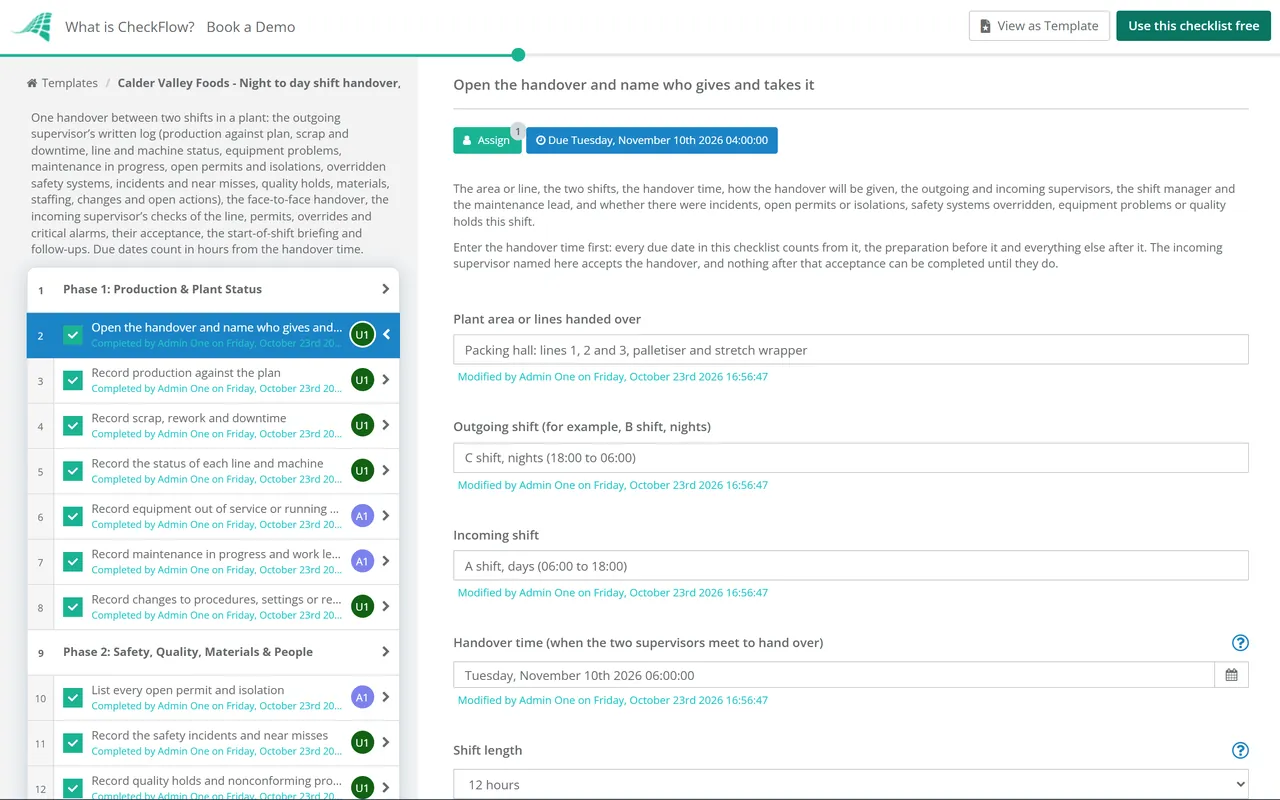
    The outgoing supervisor prepares the handover in the last part of the shift. Enter the handover time on the first task first: the preparation tasks count back from it, and the handover, the checks, the briefing and the follow-ups count forward from it. The answers on the first task add the tasks this handover needs.

    • Open the handover and name who gives and takes it — the area or line, the two shifts, the handover time, how the handover will be given, the outgoing and incoming supervisors, the shift manager and the maintenance lead, and whether there were incidents, open permits or isolations, safety systems overridden, equipment problems or quality holds this shift
    • Record production against the plan — output for the shift against the plan for each line or product, brought up to the latest count before the handover, the reason for any shortfall, and what the incoming shift is planned to make
    • Record scrap, rework and downtime — scrap and rework with their causes, and each stoppage with its length, its cause and whether it is fixed, brought up to the latest count before the handover
    • Record the status of each line and machine — running, stopped, in changeover, waiting for materials or out of service, with the product or job, the current settings and anything the incoming shift must watch
    • Record equipment out of service or running abnormally — appears when equipment is out of service or running abnormally: what is wrong and since when, what has been done, any temporary measure in place, the work order and what the incoming shift must or must not do with it
    • Record maintenance in progress and work left unfinished — each maintenance job under way or stopped part way, how far it has got, what is still to do, who is doing it and the state the equipment has been left in
    • Record changes to procedures, settings or recipes this shift — any change to a procedure, machine setting, recipe, program or material made or trialled this shift, who authorised it and whether it stays in place
  2. Phase 2

    Phase 2: Safety, Quality, Materials & People

    8 tasks

    The rest of the written log. The permit, override, incident and quality hold tasks appear only when the first task says there is something to hand over. Write for the incoming shift: what they need to know to work safely and keep production going, not a diary of the shift.

    • List every open permit and isolation — appears when permits or isolations are still open: each permit to work and isolation still live or suspended at the handover, the equipment and job it covers, its state and who holds it, so the incoming shift knows what must not be started or energised
    • List each safety system bypassed, inhibited or overridden — appears when a safety system is bypassed, inhibited or overridden: each interlock, guard, trip, alarm or detector affected, why, who authorised it, the extra precautions in place and when it is due to be restored
    • Record the safety incidents and near misses — appears when there was a safety incident or near miss: what happened, where, who was involved, any first aid or treatment, what was made safe and whether the incident report has been raised
    • Record quality holds and nonconforming product — appears when product is on hold: each batch or lot on hold, the reason, where it is stored and tagged, and what must not be run, used or shipped until it is released
    • Record materials, stock and supply issues — materials running short, deliveries due or late, wrong or suspect material at the line, and any line waiting for supplies
    • Record staffing for the incoming shift — absences and the cover arranged, new, agency or trainee staff who need supervision, and anyone not yet trained or authorised for a machine or task
    • List open actions and instructions from managers — actions still open from this or earlier shifts, with their owner and deadline, and any instruction from a manager or engineer that the incoming shift must follow
    • Write the key points the incoming shift must know first — a short summary at the top of the log of the most important points, starting with safety, so the conversation opens with them
  3. Phase 3

    Phase 3: The Face-to-Face Handover

    6 tasks

    The outgoing and incoming supervisors meet with the written log. HSE’s guidance is that a handover should be face to face, two-way, use both verbal and written communication and be given as much time as it needs. A remote or written-only handover adds a task to confirm it, and a supervisor back after a long absence or new to the area gets a history first.

    • Meet face to face with the written log — both supervisors together at the agreed time, at or near the area handed over, somewhere you can talk without distractions, with the log open in front of you both
    • Confirm the remote or written-only handover — appears when a face-to-face handover is not possible: the reason, how it was given, the incoming supervisor’s read-back of the safety points and how to reach the outgoing supervisor during the shift
    • Hand over safety first — open permits and isolations, overridden safety systems, incidents and near misses, equipment that is unsafe to use and any hazard on the plant now, before production
    • Walk through the log item by item — production, line and machine status, maintenance in progress, quality, materials, staffing, changes and open actions, the outgoing supervisor explaining each item and the incoming supervisor taking notes
    • Give a history of events since their last shift — appears when the incoming supervisor is back after a long absence or new to the area: what has changed since they were last here, including equipment, procedures, products and people, and any incident, not only this shift
    • Answer the incoming supervisor’s questions — the incoming supervisor asks about anything unclear or missing, reads back the key points, and both agree what is still uncertain
  4. Phase 4

    Phase 4: Incoming Supervisor’s Checks

    7 tasks

    The incoming supervisor checks what they have been told before accepting it: walk the area, look at each open permit and isolation, each override, each machine flagged and the hold area, and confirm the critical alarms and safety systems. Questions left open at the handover are resolved here, before acceptance.

    • Walk the line or area — a walk round the area handed over, with the outgoing supervisor where possible, comparing what you see with the log: machines running, guards in place, housekeeping, spills and anything the log does not mention
    • Check each open permit and isolation at the job — appears when permits or isolations are open: each permit displayed at the job, each isolation and lock in place as listed, and the work party aware that the shift has changed
    • Check each override is authorised and time-limited — appears when a safety system is overridden: each bypass authorised and recorded, its extra precautions in place and a time agreed to restore it
    • Look at each machine flagged out of service or abnormal — appears when equipment is out of service or running abnormally: each one tagged or isolated as described, temporary measures in place and the operators told what they may and may not do
    • Check the hold area and hold tags — appears when product is on hold: each batch or lot on hold in the hold area with its tag, nothing on hold left at the line, and no line running a product that is on hold
    • Confirm critical alarms and safety systems are working — emergency stops, guards and interlocks, the fire alarm panel and any process alarms your site marks as critical, checked at the panel or the machine, with any fault raised before acceptance
    • Resolve the open questions before acceptance — appears when questions are still open after the handover: each one checked or answered by the outgoing supervisor, the maintenance lead or the shift manager before the incoming supervisor accepts
  5. Phase 5

    Phase 5: Accept the Handover

    2 tasks

    The incoming supervisor accepts the handover and takes responsibility for the area. Nothing after the acceptance can be completed until they give it. If they are not satisfied, they leave it open and the outgoing supervisor stays responsible until the questions are resolved.

    • Incoming supervisor accepts the handover — the incoming supervisor confirms the log is complete, the checks are done and every question is answered, and takes over responsibility for the area when this task is completed
    • Release the outgoing shift — the outgoing supervisor confirms the log is saved, keys, radios and anything held for the shift are passed on, and the outgoing team can leave
  6. Phase 6

    Phase 6: Start-of-Shift Briefing

    5 tasks

    The incoming supervisor briefs their team from the accepted handover, safety first. Changes and quality holds are passed on so nobody runs held product or old settings.

    • Brief the team on safety first — open permits and isolations, overridden safety systems, incidents and near misses, equipment not to use and any hazard on the plant today
    • Give the shift plan and line allocations — what each line is to make, who is on which line or machine, the changeovers planned and any staffing gaps
    • Pass on changes to procedures and settings — each change made or trialled on the last shift, and every instruction the incoming shift must follow
    • Tell the team what is on hold and must not be run — appears when product is on hold: each batch or lot on hold and what must not be run, used or shipped until quality releases it
    • Record who attended the briefing — the crew or names present, anyone absent and how they will be told, and questions the team raised
  7. Phase 7

    Phase 7: Follow-Ups

    6 tasks

    Open actions get an owner and a time, escalations and incidents go to the shift manager, and issues that keep coming back are raised rather than handed over again.

    • Log each open action with an owner and a time — every action carried over from the handover and the checks, with who owns it and by when, so nothing depends on memory at the next handover
    • Shift manager acts on the escalated items — appears when the incoming supervisor escalates: each item reviewed by the shift manager, with a decision, an owner and a time
    • Confirm the incident report is raised and followed up — appears when there was an incident or near miss: the report raised in your reporting system, any report the law requires made by the person responsible, and an investigation assigned where one is needed
    • Check for issues repeating from earlier shifts — the same fault, stoppage, quality problem or near miss appearing in earlier handover logs
    • Raise the repeating issue with the shift manager — appears when an issue keeps repeating: the issue, how often it has come up and what has been tried, so it gets a fix at its cause rather than another handover note
    • Close the handover — every task complete or marked not applicable, the log kept with this checklist, and anything the next handover must pick up noted for the next outgoing supervisor

What to Hand Over at a Shift Change

The written log carries the detail and the conversation checks it is understood. HSE’s guidance is that the content of a handover should be based on an analysis of the information needs of the incoming staff, so treat the table below as a starting point and change the template to match your plant.

Area What the outgoing shift records What the incoming shift checks
ProductionOutput against the plan, shortfalls and their reasons, what the next shift is planned to makeThe plan and line allocations for the briefing
Downtime, scrap and reworkEach stoppage with its cause and whether it is fixed; scrap and rework with causesFaults still open, raised as actions
Lines and machinesThe status, product and settings of each line, and what to watchWhat the walk round the area shows against the log
Equipment problemsEquipment out of service or running abnormally, temporary measures and the work orderEach machine tagged or isolated as described
Maintenance in progressEach job under way, where it stopped and the state the equipment is inUnfinished work understood before anyone restarts the equipment
Permits and isolationsEvery permit and isolation still live or suspended, with its holderEach permit at the job and each isolation in place as listed
Safety systemsEach interlock, guard, trip or alarm bypassed or overridden, its precautions and restore timeEvery override authorised and time-limited; critical alarms and safety systems working
Incidents and near missesWhat happened, what was made safe and whether the report is raisedThe report confirmed by the shift manager
QualityEach batch or lot on hold, the reason, its location and what must not be runThe hold area and hold tags
Materials and peopleShortages and late deliveries; absences, cover and staff who need supervisionCover in place before lines start
Changes and actionsChanges to procedures, settings or recipes; open actions and instructionsEach one passed on at the briefing and logged with an owner

What HSE says. HSE’s shift handover guidance says organisations should identify higher risk handovers, develop staff’s communication skills, emphasise the importance of handover, provide procedures for it and plan maintenance work to be completed within one shift where possible. The handover itself should be conducted face to face; two-way, with both people taking joint responsibility; done using both verbal and written communication; based on an analysis of the information needs of the incoming staff; and given as much time and resource as necessary. HSE also notes that “many accidents have occurred because of failure of communication at shift handover, the majority of these involved planned maintenance work.”

Higher risk handovers. HSE’s inspection guidance on safety critical communications lists the risk areas as plant maintenance, particularly when it continues over a shift change; when safety systems have been overridden; during deviations from normal working; following a lengthy absence from work; and when handovers are between experienced and inexperienced staff. It also advises greater reliance on written communication when 12-hour shifts are in operation.

Why Run Shift Handovers in CheckFlow?

1

Nobody takes over an area they have not accepted

The outgoing and incoming supervisors, the shift manager and the maintenance lead are chosen on the first task, and each task is assigned to the person who owns it. Accepting the handover is assigned to the incoming supervisor alone, and nothing after that approval step can be completed until they accept.

2

Only the tasks this handover needs

Open permits, overridden safety systems, equipment problems and quality holds each add a task to the log and a check at the line. An incident adds the report follow-up, a remote handover adds a confirmation step and open questions add a task to resolve them before acceptance. Rules show and hide each one from the answers given.

3

Every handover on time and on record

Due dates count in hours and minutes from the handover time: the log before it, the handover, checks, acceptance, briefing and follow-ups after it. Set up a daily recurring schedule for each shift change, timed before the outgoing shift starts its log, so a handover is waiting at every change; the outgoing supervisor enters the handover time on the first task and every due date follows from it. Overdue alerts go to the task’s assignees. The Reports Grid lists every handover with its answers, such as the area, the shifts and whether there were open permits or holds, with filters and export. Analytics shows how long handovers take and where work runs late, by template, person and step.

CheckFlow does not replace your permit system, your maintenance system or your production data. Keep permits, work orders and output figures where they live and record their references in the log. CheckFlow runs the handover around them: what is handed over, who checked it and when the incoming supervisor accepted it. CheckFlow’s manufacturing checklist software shows how plants run their other routines the same way.

Run each permit with the Permit to Work Checklist and each isolation with the Lockout/Tagout (LOTO) Procedure Checklist. Inspect the plant with the Safety Inspection Process for a Manufacturing Facility, repair what the handover flagged with the Equipment Maintenance Workflow Checklist, investigate an accident with the Workplace Accident Investigation Checklist and fix a problem that keeps coming back with the Root Cause Analysis (8D) Checklist.

AI generator

Didn’t find what you need? Describe it.

Describe the process in a sentence and the AI checklist generator drafts the phases and tasks for you.

Frequently Asked Questions

What should a shift handover include?

Everything the incoming shift needs to run the area safely and keep production going: production against the plan, downtime and its causes, the status of each line and machine, equipment out of service or running abnormally, maintenance in progress, open permits and isolations, safety systems overridden, incidents and near misses, quality holds, materials, staffing, changes to procedures or settings and open actions. HSE’s guidance is to base the content on an analysis of what the incoming staff need to know, so adjust the list to your plant.

What does HSE say makes a good shift handover?

HSE’s guidance says a shift handover should be conducted face to face; two-way, with both people taking joint responsibility; done using both verbal and written communication; based on an analysis of the information needs of the incoming staff; and given as much time and resource as necessary. It describes an effective handover as preparation by the outgoing shift, the handover itself and cross-checking by the incoming shift as they take responsibility.

Why do shift handovers go wrong?

HSE’s inspection guidance lists missing, unnecessary or inaccurate information, poor or variable quality of information, misunderstandings and failing to carry information forward over successive shifts. It notes that misunderstandings are most likely when the two people have a different picture of the current state of the process, which is why the incoming supervisor checks the area as well as listening. HSE’s shift handover page also notes that the Cullen Report found a failure of information transmission at shift handover was one of the many factors in the Piper Alpha disaster.

Which shift handovers carry the most risk?

HSE’s inspection guidance lists plant maintenance, particularly when it continues over a shift change; times when safety systems have been overridden; deviations from normal working; handovers after a lengthy absence from work; and handovers between experienced and inexperienced staff. This checklist adds tasks for open permits and isolations, overridden safety systems, equipment problems and a supervisor returning after an absence, so those handovers get more attention.

Should a shift handover be written or verbal?

Both. HSE’s guidance is that handover should use both verbal and written communication: the written log is the record and the conversation is where questions are asked and understanding is checked. Its inspection guidance also advises greater reliance on written communication when 12-hour shifts are in operation.

What if a face-to-face handover is not possible?

HSE’s guidance is for handovers to be face to face, so treat a remote or written-only handover as the exception. When it happens, the incoming supervisor reads the whole log, then speaks to the outgoing supervisor by phone or video, reads back the safety points and asks their questions before accepting, and records how to reach the outgoing supervisor during the shift. This checklist adds that confirmation task when you choose a remote or written-only handover.

How are permits and isolations handed over at a shift change?

A permit-controlled job that runs past the end of a shift has its own handover. HSE’s permit-to-work guidance (HSG250) says the incoming shift should know about every outstanding permit-controlled job, its status and the status of the plant, and recommends that the incoming issuing authority signs to allow the permit to continue. The shift handover makes sure none is forgotten. The outgoing shift lists every permit and isolation still open, and the incoming supervisor checks each one at the job before accepting. Run the permits themselves with the Permit to Work Checklist and the Lockout/Tagout (LOTO) Procedure Checklist.

What happens if the incoming supervisor does not accept the handover?

They leave the acceptance task open, and the outgoing supervisor stays responsible for the area until their questions are answered. Questions still open after the handover add a task for the outgoing supervisor to resolve them, with the shift manager deciding anything they cannot settle between them. Nothing after the acceptance can be completed until the incoming supervisor gives it.

Is CheckFlow free for this template?

14-day free trial, no card required. The Business plan is $10 per user per month after the trial. Full details at checkflow.io/pricing.

Hand Over Every Shift With Nothing Left Unsaid

Free trial — no credit card required.

14-day free trial, no credit cardFull refund in your first 30 daysUS hosting, EU on request