Product Inspection Workflow Checklist Template

A product inspection without a documented standard is a product inspection where the result depends on who is inspecting rather than what is being inspected. Different inspectors, different shifts, different outcomes — and a quality record that cannot be compared over time.

Product inspection is the frontline activity of quality control — but it only delivers its value when it is conducted consistently, against defined criteria, by trained inspectors following a structured process. An inspection that varies by inspector produces data that reflects the inspector more than the product. An inspection that focuses only on visible surface characteristics misses the functional or dimensional defects that determine the product’s performance. An inspection that does not use statistical sampling is either inspecting too much (100% inspection of every unit, which is rarely cost-effective and still misses defects through inspector fatigue) or too little (informal spot checks that provide no statistical confidence). The structured product inspection workflow addresses all of this: defined inspection criteria for each product and stage, standardised inspection methods with calibrated tools, statistically valid AQL-based sampling, and a clear disposition decision process. This free checklist gives QA inspectors, quality engineers, and quality managers a structured framework for the full product inspection workflow.

Use This Template Free See Live Example
No Credit Card Required

Incoming, In-Process, and Final Inspection — Why All Three Matter

Incoming Inspection

What is inspected: Raw materials, components, and sub-assemblies received from suppliers before they enter production.

Purpose: Prevent defective materials from entering the production process where they can cause in-process defects, production stops, or product failures.

Value: A bad component caught at incoming inspection costs the price of the component. The same component caught after it is assembled into a finished product costs the component plus the assembly labour plus the disassembly plus the re-assembly.

In-Process Inspection

What is inspected: Semi-finished products at defined hold points in the production process — after operations that are most critical to quality or most difficult to reverse.

Purpose: Catch defects as they are introduced, before they are built upon by subsequent operations.

Value: A defect caught in process, before further value is added, costs significantly less to address than the same defect caught at final inspection or by the customer.

Final / Outgoing Inspection

What is inspected: Completed products before shipment to the customer, typically using AQL sampling.

Purpose: Provide a final quality gate before the product reaches the customer; detect and contain any defects that passed through the in-process controls.

Value: The last line of defence. A defect caught here costs rework or scrap. The same defect reaching the customer costs returns, warranty claims, and reputation damage.

The Product Inspection Workflow Checklist

Six phases covering the full inspection lifecycle — from preparation and calibration through incoming, first article, in-process, and final inspection to reporting and metrics.

Phase 1

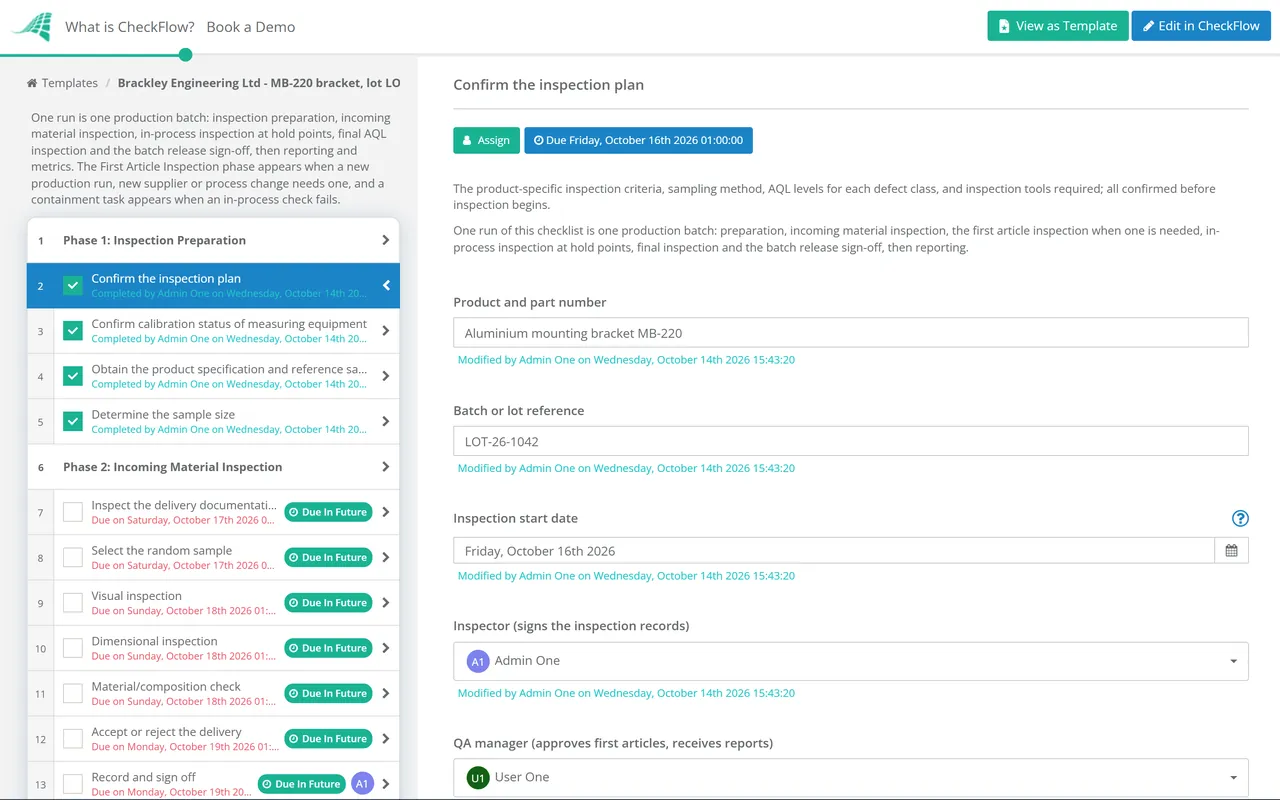
Phase 1: Inspection Preparation

  • Confirm the inspection plan — the product-specific inspection criteria, sampling method, AQL levels for each defect class, and inspection tools required; all confirmed before inspection begins
  • Confirm calibration status of measuring equipment — all gauges, calipers, and measuring instruments are within calibration date; out-of-calibration instruments must not be used for product inspection
  • Obtain the product specification and reference samples — the approved drawing, specification, and/or approved reference sample that defines what acceptable looks like
  • Determine the sample size — for AQL-based inspection; from the batch size and the AQL table (ANSI/ASQ Z1.4 for attributes; Z1.9 for variables); the sample size and acceptance/rejection number calculated before inspection
Phase 2

Phase 2: Incoming Material Inspection

  • Inspect the delivery documentation — supplier delivery note confirms the correct material, quantity, and any required certificates (material test certificate, certificate of conformance, regulatory certificates)
  • Select the random sample — from throughout the delivery (not just the top layer); sample is representative of the entire batch
  • Visual inspection — of each sampled unit; appearance, condition, and any visible defects against the classification criteria
  • Dimensional inspection — verify critical dimensions against specification using calibrated instruments; record all measurements
  • Material/composition check — where the material specification cannot be confirmed visually; by the appropriate test method
  • Accept or reject the delivery — against the AQL thresholds; if rejected: quarantine the delivery; notify the supplier; raise a non-conformance report
  • Record and sign off — the incoming inspection record; batch reference, sample size, defects found by classification, and disposition
Phase 3

Phase 3: First Article Inspection (FAI)

The First Article Inspection is the one-time inspection of the first unit from a new production run, a new supplier, or after a significant process change. Its purpose is to verify that the production process is capable of producing parts to specification before mass production begins.

  • Inspect 100% of all characteristics on the first article — every dimensional, visual, functional, and labelling requirement; no sampling at this stage
  • Compare to specification — every measurement recorded against the specification tolerance; pass/fail for each characteristic
  • If passed: approve for production — the approved first article serves as the reference sample for subsequent production inspections
  • If failed: identify root cause — process adjustment required before production proceeds
Phase 4

Phase 4: In-Process Inspection at Hold Points

  • Identify the inspection hold points — the specific process steps at which inspection is required before the next operation can proceed; at the highest-risk operations and at points of no return
  • Inspect at each hold point — against the defined criteria for that stage; use the correct inspection method and tools
  • Record the in-process inspection result — operator, date, time, batch/lot, quantity inspected, defects found, and disposition
  • For failed in-process checks — stop the operation; quarantine affected product; notify the production supervisor and QA; root cause investigation before restarting
Phase 5

Phase 5: Final / Outgoing Inspection

  • Draw the AQL sample — from the completed batch; random selection; the sample size calculated from the batch size and AQL table
  • Visual inspection — all sampled units; every visible surface and feature against the acceptance criteria; classify each defect as Critical, Major, or Minor
  • Dimensional inspection — key dimensions on a representative sub-sample; using calibrated instruments; record all measurements
  • Functional testing — all sampled units (or a defined sub-sample) functionally tested; confirming the product performs as specified
  • Labelling and documentation check — labels, barcodes, serial numbers, certificates, and any regulatory markings; correct and legible
  • Apply the AQL decision — count defects by class; compare to the acceptance/rejection numbers from the AQL table; accept or reject the batch
  • Sign and file the inspection report — inspector name, date, batch reference, quantity inspected, defects found by class, AQL decision, and disposition
Phase 6

Phase 6: Inspection Reporting & Quality Metrics

  • Produce a batch inspection report — for every final inspection; filed with the batch record; provided to the customer on request
  • Track inspection metrics monthly — batch rejection rate by product, supplier, and defect class; first-pass yield; defect rate trend
  • Report to QA management — any trend deterioration or any batch rejection; input to supplier performance review and continuous improvement programme

Why Run Your Product Inspection Process in CheckFlow?

1

Inspection executed against the same criteria every time, by every inspector

Inspection variability between inspectors — one accepting what another would reject, one checking dimensions that another ignores — undermines the entire value of the inspection programme. CheckFlow’s product inspection workflow presents every inspector with the same structured sequence, the same criteria, and the same measurement steps for the same product — regardless of shift, experience, or individual judgment.
2

A complete inspection record that supports traceability

When a customer reports a defect, the question is always “what does the inspection record show for that batch?” A paper inspection report that cannot be found, or an electronic record that contains incomplete data, is no record at all. Every inspection conducted through CheckFlow creates a dated, attributed, complete record — batch reference, sample size, each defect found, and the disposition decision.

3

Calibration status checked before every inspection

An inspection conducted with an out-of-calibration instrument produces data that cannot be relied upon — and may produce a false “pass” that releases a defective batch. CheckFlow’s inspection preparation phase requires calibration confirmation for every measuring instrument before any measurement data can be entered, making the calibration check a required process step rather than a reminder.

Product inspections that reject batches generate defect reports requiring CAPA. CheckFlow’s Defect Reporting & Resolution Checklist covers the structured defect management process. See the Defect Reporting & Resolution Checklist →

QA compliance audits verify that the inspection programme is being followed correctly. CheckFlow’s QA Compliance Audit Checklist covers the quality system audit process. See the QA Compliance Audit Checklist →

Frequently Asked Questions

What should a product inspection workflow include?

+

A product inspection workflow covers six phases: inspection preparation (inspection plan confirmed, calibration status checked, reference samples obtained, sample size calculated), incoming material inspection (documentation check, random sample selection, visual and dimensional inspection, material verification, accept/reject decision, record), first article inspection (100% inspection of all characteristics on the first unit), in-process inspection at hold points (inspection at defined stop points before irreversible operations), final/outgoing inspection (AQL sample, visual/dimensional/functional inspection, labelling check, AQL decision, inspection report), and reporting and metrics (batch reports filed, monthly metrics tracked, management reporting of trends and rejections).

What is AQL in product inspection?

+

AQL (Acceptable Quality Level) is the maximum defect percentage in a batch that is still considered acceptable for release, used as the basis for statistical sampling inspection. Rather than inspecting every unit in a large batch, a statistically representative sample is drawn, and the batch is accepted or rejected based on whether the number of defects found in the sample is below the acceptance number for that AQL level. ANSI/ASQ Z1.4 is the standard for attributes (pass/fail) inspection; Z1.9 for variables (measured) inspection. Different AQL levels are used for different defect classifications: typically zero tolerance for Critical, 0.65–1.5% for Major, and 2.5–6.5% for Minor defects.

What is a First Article Inspection (FAI)?

+

A First Article Inspection (FAI) is the comprehensive inspection of the first unit produced from a new production run, a new supplier, after a significant process change, or after a long period of production inactivity. Unlike routine production inspections which use statistical sampling, a FAI typically inspects 100% of all characteristics on the first unit — verifying that the production process is capable of producing parts that meet every dimension, tolerance, and specification before mass production begins.

What is the difference between quality control and quality assurance?

+

Quality control (QC) is reactive — it involves testing and inspecting products to detect defects. Product inspection is a QC activity. Quality assurance (QA) is proactive — it involves establishing and maintaining the processes, standards, and systems that prevent defects from occurring in the first place. QA includes process standardisation, supplier qualification, training, internal audits, CAPA, and continuous improvement. In practice, most organisations use “QA” to describe both functions, and effective quality management requires both: QC to find defects that slip through, and QA to eliminate the processes that produce them.

Is CheckFlow free for this template?

+

You can start a free 14-day trial with no credit card required, giving you full access to all features including this template. The Business plan is $10 per user per month after the trial. Full details at checkflow.io/pricing.

Inspect Every Product to the Same Standard — From Incoming Material to Final Shipment

Free trial — no credit card required.