GMP Audit Checklist Template

Most self-inspections miss what inspectors find. The auditor reads the procedures and the training matrix, signs off, and never notices the batch record entry made after the event or the label count nobody investigated.

Last reviewed: October 2026

This free GMP audit checklist is for QA managers, internal auditors and heads of quality at sites that make or pack medicines. One run is one self-inspection of one site, building or area. It plans the audit and sets its scope and criteria, checks the auditors are independent, and reviews earlier findings and quality data before the opening meeting. Two audit days cover the quality system and documentation, personnel, premises and equipment, production, packaging and the quality control laboratory, then deviations, complaints, returns and CAPA. Findings are logged with their evidence, graded critical, major or other, and presented at the closing meeting. The report, the CAPA plan, verification and close-out follow. Choose UK or EU GMP, US 21 CFR 210 and 211, or both, and the matching checks appear. A for-cause audit adds a review of the event behind it, and a critical finding adds containment and escalation the same day.

A Self-Inspection Finds the Gaps Before an Inspector Does

Good manufacturing practice (GMP) is the minimum standard a medicines manufacturer must meet in its production processes. A GMP audit run by the site itself, called a self-inspection in the EU GMP Guide, is how a manufacturer checks that it still meets that standard between regulatory inspections. Chapter 9 of the Guide asks for self-inspections of personnel, premises, equipment, documentation, production, quality control, distribution, complaints and recalls, and self-inspection itself, at intervals following a pre-arranged programme. In the US, 21 CFR Parts 210 and 211 contain no section on self-inspection, so the internal audit is set by the site’s own quality system, and it audits against the Part 211 subparts.

A GMP audit is narrower and deeper than a general quality audit. The QA compliance audit and the ISO 9001 internal audit test a quality management system against its own procedures or a standard. A GMP audit follows product: the batch record, line clearance, label reconciliation, laboratory raw data and the release decision. Its findings then run through the site’s CAPA process.

This checklist

GMP self-inspection

Who: your own designated, competent auditors, independent of the area they audit.

Against: the GMP rules for your market, your licence or application commitments and your site procedures.

Produces: a report of every observation with proposed corrective measures, and a record of the actions taken.

The regulator

MHRA GMP inspection

When: on applying for a licence, then periodically based on the site’s risk rating, sometimes with little or no notice.

How: inspectors interview staff, review documents and visit manufacturing areas, laboratories, storage and returns.

Ends with: deficiencies graded critical, major or other, and a written response with corrective actions and dates.

Neighbours

Supplier and system audits

Supplier audit: a second-party audit of another company’s site against your requirements.

ISO 9001 internal audit: one process tested against the standard’s clauses.

GMP audit: your own manufacturing site tested against the GMP rules for the medicines it makes.

What the GMP Audit Checklist Covers

Eight phases take one self-inspection from planning to close-out, with two days on site. Choose UK or EU GMP, US 21 CFR 210 and 211, or both on the first task and the matching checks appear: the product quality review, Qualified Person certification and defect reporting for the UK and EU, and the annual product review, the quality unit’s batch record review and adverse drug experience reporting for the US. A for-cause audit adds a review of the event behind it, a critical finding adds containment and escalation the same day, and nothing after the CAPA plan approval can be completed until it is given.

  1. Phase 1

    Phase 1: Plan & Scope the Self-Inspection

    6 tasks

    One run is one self-inspection of one site, building or area. Set the audit date first, because every due date counts from it, and choose the rules the site works under so the matching checks appear.

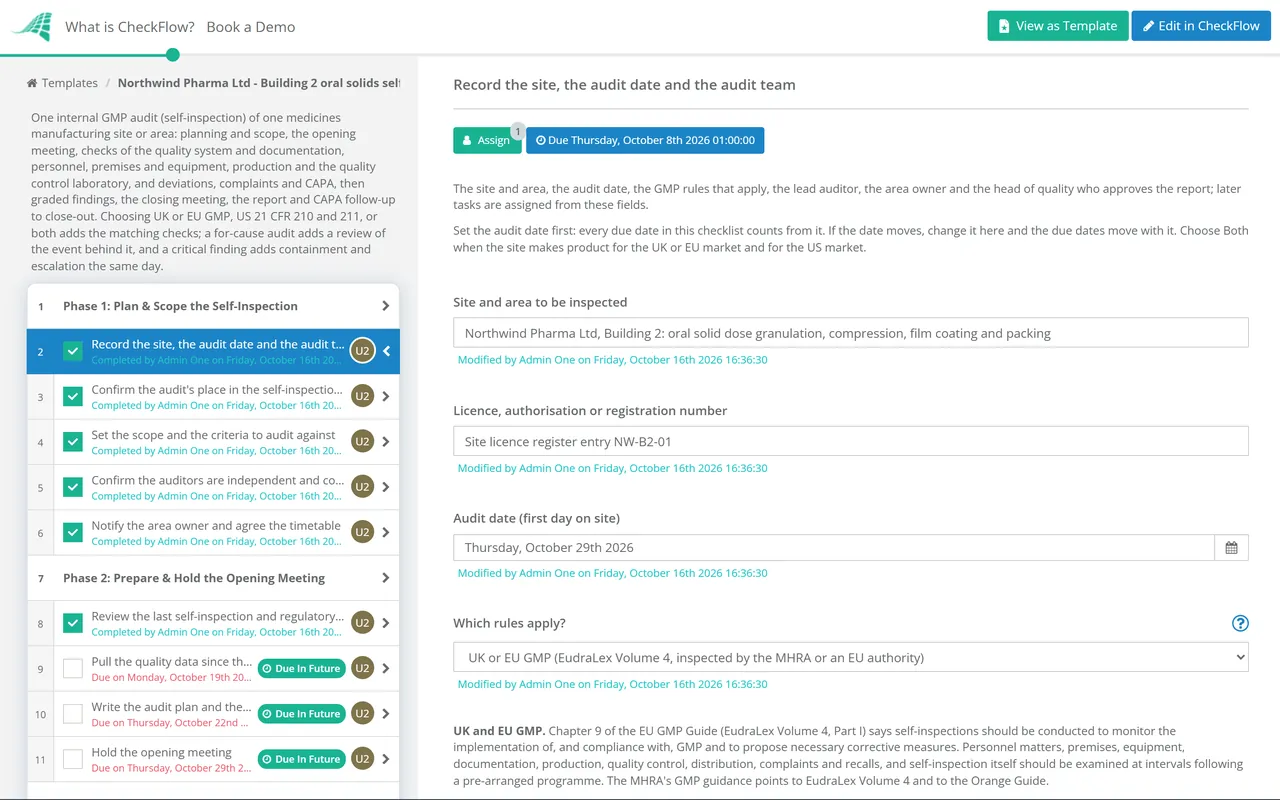
    • Record the site, the audit date and the audit team — the site and area, the audit date, the GMP rules that apply, the lead auditor, the area owner and the head of quality who approves the report; later tasks are assigned from these fields
    • Confirm the audit's place in the self-inspection programme — which areas the programme schedules this time, when each was last inspected, and why they are due now
    • Set the scope and the criteria to audit against — the buildings, rooms, processes, products and systems in scope, and the regulations, licence terms and site procedures they are audited against; mark tasks outside the scope not applicable
    • Review the event behind a for-cause audit — the deviation, complaint, failed result, trend or inspection finding that triggered it, and what the audit must establish
    • Confirm the auditors are independent and competent — nobody audits their own work, each auditor is trained in GMP and in auditing, and a subject expert joins for sterile, laboratory or computerised systems
    • Notify the area owner and agree the timetable — the scope, the dates, the people who must be available and the records to have ready
  2. Phase 2

    Phase 2: Prepare & Hold the Opening Meeting

    4 tasks

    The desk review decides where the audit looks hardest. Choose the records to sample yourself rather than accepting the ones the area offers.

    • Review the last self-inspection and regulatory inspection findings — every corrective action raised, whether it was closed on time, and which fixes to check on the floor
    • Pull the quality data since the last audit — deviations, failed or out-of-trend results, complaints, returns, change controls and overdue CAPAs for the area, looking for repeats
    • Write the audit plan and the sampling list — the areas in the order you will visit them, the people to interview, and the batches, logs and records you will sample
    • Hold the opening meeting — confirm the scope, the plan, how findings will be graded, who guides the auditors and when the closing meeting is
  3. Phase 3 — Audit day 1

    Phase 3: Quality System & Documentation

    7 tasks

    Test whether the system works, not only whether a procedure exists. Every claim needs a record behind it.

    • Check the quality unit's responsibilities and authority — written responsibilities, the authority to approve or reject materials and product, and heads of production and quality control who are independent of each other
    • Check document control — procedures approved, signed and dated with an effective date, reviewed and kept up to date, and the copy in use at the workplace is the current one
    • Check good documentation practice in records — entries made at the time, legible and indelible, and every correction signed and dated with the original still readable
    • Check computerised systems and data controls — who can change master records and data, how input and output are checked, and how data is backed up and protected from loss or alteration
    • Check change control — changes assessed and approved before they are made, regulatory approval sought where it is needed, and each change evaluated after it is made
    • Check the product quality reviews (UK and EU) — normally annual, covering starting materials, failed batches, significant deviations and CAPA effectiveness, changes, stability, complaints, returns and recalls
    • Check the annual product reviews (US) — at least annually for each drug product, reviewing a representative number of batches, complaints, recalls, returned or salvaged product and investigations
  4. Phase 4 — Audit day 1

    Phase 4: Personnel, Premises & Equipment

    6 tasks

    Walk the areas and talk to the people who do the work. Compare what you see with what the records say.

    • Check training records against the people on shift — operators, cleaners, engineers and analysts sampled on the floor, with GMP and job training completed before they started the work
    • Check gowning, hygiene and health reporting — protective clothing suited to the area, no food, drink or personal medication in production and storage areas, illness reported and kept away from product, and limited-access areas controlled
    • Walk the premises — repair, cleanliness and pest control, defined areas for quarantined, rejected and released material, and a flow of materials and people that prevents mix-ups and contamination
    • Check environmental controls and utilities — air handling, pressure differentials, temperature and humidity, water systems, the monitoring records and how excursions were handled
    • Check equipment cleaning, maintenance and logs — cleaning procedures followed, status labels in place, previous batch identification removed, and use and cleaning logs that show the date, product and batch
    • Check calibration of instruments and gauges — a written programme with intervals and limits, a current status on each instrument sampled, and what happened when one was found out of tolerance
  5. Phase 5 — Audit day 2

    Phase 5: Production & Laboratory Controls

    8 tasks

    Follow one batch through the area and the laboratory. Trace what you see back to the batch record and the raw data.

    • Check receipt, quarantine and release of materials — containers examined on receipt, a lot code and status on each, quarantine until sampled and released, an identity test on each component, and the oldest approved stock used first
    • Observe a batch being made against its batch record — instructions followed and recorded at the time, components checked by a second person, equipment identified, and yields calculated and verified
    • Check in-process controls and time limits — the tests at each stage, results against their specifications, rejected in-process material quarantined, and time limits for each phase met or the overrun justified
    • Check packaging and labelling controls — line clearance before use, labels issued, used and returned reconciled with discrepancies investigated, printed materials stored securely and obsolete labels destroyed
    • Check laboratory sampling, testing and records — samples identified, methods shown to be suitable, complete raw data and calculations, a second-person review, and out-of-specification results investigated
    • Check stability testing and reserve samples — the written stability programme followed, its results used for expiry dates, and reserve samples kept, stored and inspected as required
    • Check Qualified Person certification before release (UK and EU) — no batch sold or supplied until a Qualified Person has certified it against the marketing authorisation, with each certification recorded in a register or equivalent document
    • Check batch record review before release (US) — the quality control unit reviews and approves production and control records before release, and unexplained discrepancies are investigated, extending to other batches
  6. Phase 6 — Audit day 2

    Phase 6: Deviations, Complaints & CAPA

    6 tasks

    These systems show whether the site learns from its problems. Sample closed records as well as open ones.

    • Sample deviations and their investigations — each recorded and justified, investigated to a root cause, extended to other batches that could be affected, and closed with a CAPA where one was needed
    • Sample complaints and how they were handled — each recorded and assessed for a possible quality defect, investigated or the reason for not investigating recorded, and the complainant answered
    • Check quality defects are reported to the authorities (UK and EU) — a quality defect that may lead to a recall or an abnormal restriction in supply reported in good time to the marketing authorisation holder and the competent authorities
    • Check complaints are reviewed for adverse drug experience reporting (US) — the complaint procedure decides for each complaint whether it is a serious and unexpected adverse drug experience that must be reported to FDA
    • Check returns, recalls and recall readiness — returned product identified, held and assessed, distribution records that let each lot be traced, and recall arrangements tested
    • Check CAPAs from earlier findings were effective — actions completed on time, their effectiveness checked with data, and no repeat of the problem since
  7. Phase 7 — Audit day 2

    Phase 7: Findings & Closing Meeting

    5 tasks

    Agree the facts before discussing the grade. A critical deficiency is acted on the same day, not when the report is written.

    • Log every finding with the requirement and the evidence — one line per finding: the area, the rule or procedure not met, and what was seen, read or heard
    • Grade each finding critical, major or other — using your procedure's definitions, and record the highest grade raised
    • Contain the risk from the critical deficiency — stop the activity or hold the affected batches, and assess any product already released
    • Escalate the critical deficiency to senior management — the same day, with the evidence, the containment in place and whether the marketing authorisation holder or a regulator must be told
    • Hold the closing meeting — present each finding and its grade, correct any factual errors, agree the response dates and record who attended
  8. Phase 8

    Phase 8: Report, CAPA & Close-out

    7 tasks

    The audit is not finished when the report is issued. It closes when every action is done and shown to work, and nothing after the CAPA plan approval can be completed until it is given.

    • Write the self-inspection report — every observation with its evidence and grade, the proposed corrective measures, good practice seen and the overall conclusion
    • Head of quality approves and issues the report — to the area owner and senior management, with the date the CAPA responses are due
    • Area owner proposes a CAPA for each finding — the root cause, the correction, the corrective and preventive actions, an owner and a due date for each
    • Head of quality approves the CAPA plan — root causes credible, actions in proportion to the risk and dates realistic; nothing after this task can be completed until it is approved
    • Verify the actions and their effectiveness — evidence that each action was done, then records produced since the change that show the problem has not come back
    • Record the actions taken and close the self-inspection — a statement of the action taken on each finding, kept with the report, and the audit marked complete in the programme
    • Feed the results into management review and the programme — findings by grade, repeat findings and overdue actions for management review, and the date this area is next inspected

What to Audit Against: Part 211 and EU GMP Side by Side

The two rulebooks cover the same ground in a different order. The table maps each area this checklist audits to the part of 21 CFR Part 211 and the chapter of the EU GMP Guide (EudraLex Volume 4) that governs it, and to the phase that checks it. The MHRA’s GMP guidance points to EudraLex Volume 4 and to the Orange Guide. It is a map, not the text: audit against the current version your site is licensed or registered under.

Area 21 CFR Part 211 (US) EU GMP Guide, Part I (UK and EU) Checked in
Quality unit, quality system and product reviewsSubpart B, 211.22; annual product review, 211.180(e)Chapter 1, Pharmaceutical Quality SystemPhase 3
Documents, records and computerised systems211.68(b), 211.100; Subpart J, Records and ReportsChapter 4, DocumentationPhase 3
Personnel, training and hygieneSubpart B, 211.25 and 211.28Chapter 2, PersonnelPhase 4
Premises, utilities and equipmentSubpart C, Buildings and Facilities; Subpart D, Equipment; 211.160(b)(4) calibrationChapter 3, Premises and EquipmentPhase 4
Materials, production, packaging and labellingSubpart E, Components, Containers and Closures; Subpart F, Production and Process Controls; Subpart G, Packaging and LabelingChapter 5, ProductionPhase 5
Laboratory, stability and reserve samplesSubpart I, Laboratory Controls; 211.194 laboratory recordsChapter 6, Quality ControlPhase 5
Release211.165 testing and release; 211.192 production record reviewQualified Person certification, 1.4(xv) and 2.6Phase 5
Deviations, complaints, returns and recalls211.192 investigations; 211.198 complaint files; Subpart K, Returned and Salvaged Drug ProductsChapter 8, Complaints, Quality Defects and Product RecallsPhase 6
Self-inspectionNo section; set by your own quality system proceduresChapter 9, Self InspectionPhases 1, 7 and 8

Grading findings. Part 211 sets no grades for internal findings, and neither does Chapter 9. The MHRA grades its own inspection deficiencies at three levels, which make a ready-made scale if your procedure has none. In summary, a critical deficiency has produced, or significantly risks producing, a product that is harmful to human or veterinary patients. A major deficiency is non-critical but has produced or may produce a product that does not comply with its marketing authorisation, or shows a major deviation from GMP or from the licence, or a failure in batch release or in the Qualified Person’s duties; several other deficiencies together can add up to a major one. An other deficiency cannot be classed as critical or major but is still a departure from GMP.

Where the US and EU differ most. In the EU and UK, no batch is sold or supplied until a Qualified Person has certified it, and confirmed quality defects that may lead to a recall or an abnormal restriction in supply are reported to the competent authorities. Under Part 211, the quality control unit reviews and approves every production and control record before a batch is released, and complaints are reviewed to decide whether they are serious and unexpected adverse drug experiences that must be reported to FDA. The checklist adds those checks when you choose the rules.

Why Run GMP Self-Inspections in CheckFlow?

1

The checks match the rules you make medicines under

Choose UK or EU GMP, US 21 CFR 210 and 211, or both on the first task and the matching checks appear in the audit-day phases. A for-cause audit adds a review of the event behind it. Mark areas outside this audit’s scope not applicable, or adapt the checks to your own procedures in the template designer.

2

A critical finding cannot wait for the report

Grading a finding critical adds containment and escalation tasks for the head of quality, due the same day. The report and the CAPA plan are assigned to the head of quality alone, and nothing after the CAPA plan approval can be completed until it is given, so the record shows each action was approved before it was verified.

3

Every area of the programme, on time

Start each self-inspection from a recurring schedule, so every area in the programme comes round when it is due. Findings, sampled records and the CAPA plan sit in tables on the tasks that produced them, and the Reports Grid shows every open audit and overdue action across your sites.

CheckFlow does not inspect your site and does not replace your quality management system, your batch records or a Qualified Person’s judgement. It runs the steps of a self-inspection around your own procedures, so every audit is planned, carried out and closed in the same order with a record of who did what. If you keep GMP records in CheckFlow, assess and validate it under your own computerised system procedures first. See how CheckFlow’s manufacturing checklist software handles quality and safety routines on the shop floor.

This template audits one site or area against GMP. Run each finding through the CAPA (Corrective & Preventive Action) Checklist, dig into a stubborn one with the Root Cause Analysis (8D) Checklist, audit the companies that supply you with the Supplier Audit Checklist and keep instruments in date with the Calibration Management Checklist.

AI generator

Didn’t find what you need? Describe it.

Describe the process in a sentence and the AI checklist generator drafts the phases and tasks for you.

Frequently Asked Questions

What is a GMP audit?

A GMP audit checks whether a medicines manufacturing site meets good manufacturing practice. When the site runs it on itself, the EU GMP Guide calls it a self-inspection: Chapter 9 says it monitors the implementation of, and compliance with, GMP and proposes corrective measures. A regulatory inspection is different. The MHRA, FDA or another authority sends its own inspectors, and serious findings can lead to regulatory action. A supplier audit is different again: you audit another company’s site against your requirements.

What should a GMP audit checklist include?

The areas the EU GMP Guide lists for self-inspection: personnel, premises, equipment, documentation, production, quality control, distribution, complaints and recalls, and the self-inspection system itself. In practice that means the quality unit and change control, document control and good documentation practice, training and hygiene, premises, utilities, cleaning and calibration, materials, batch manufacture, in-process controls and labelling, laboratory records and stability, release, deviations, complaints, returns and CAPA. The checklist should also cover planning, graded findings, the report and verified close-out of every action.

How often should GMP self-inspections be done?

Neither rulebook sets a fixed interval. The EU GMP Guide asks for self-inspections at intervals following a pre-arranged programme, and Chapter 1 asks for a process that regularly appraises the effectiveness of the quality system. 21 CFR Part 211 has no self-inspection section, so the frequency comes from your own procedures. Set a cycle in your procedure that covers every area, and visit higher-risk areas, and areas with recent problems, more often. A deviation, complaint or trend can also trigger a for-cause audit between scheduled ones.

Who can carry out a GMP self-inspection?

The EU GMP Guide says self-inspections should be conducted in an independent and detailed way by designated competent people from the company, and that independent audits by external experts may also be useful. In practice, auditors should not audit their own work, should be trained in GMP and in auditing, and should bring in a subject expert for specialist areas such as sterile manufacture, the laboratory or computerised systems. Under 21 CFR 211.34, any consultant who advises on manufacturing must have the education, training and experience for the subject.

What are critical, major and other GMP deficiencies?

They are the MHRA’s three grades for inspection deficiencies. A critical deficiency has produced, or significantly risks producing, a product that is harmful to human or veterinary patients. A major deficiency is non-critical but has produced or may produce a product that does not comply with its marketing authorisation, or shows a major deviation from GMP or the licence, or a failure in batch release or the Qualified Person’s duties. Other covers any remaining departure from GMP. If your procedure has no grades of its own, using these three keeps internal findings comparable with an inspection’s.

Does 21 CFR 211 require internal audits?

Part 211 has no section on self-inspection or internal audit, and neither does Part 210. It does require a quality control unit with written responsibilities, an evaluation of each drug product’s quality standards at least annually under 211.180(e), and thorough investigation of unexplained discrepancies and failures under 211.192. An internal audit programme is how a site can check it meets these requirements before an FDA investigator does. Check your own procedures and any commitments in your applications for the frequency you have set.

What is the difference between a GMP audit and an ISO 9001 internal audit?

An ISO 9001 internal audit tests a quality management system against the clauses of a voluntary standard and the organisation’s own procedures, usually one process at a time. A GMP audit tests a medicines manufacturing site against the GMP rules a manufacturer must meet for the products it makes, and follows the product: batch records, line clearance, label reconciliation, laboratory raw data and the release decision. ISO 9001 certification does not show GMP compliance, so a certified site still needs its own GMP self-inspections.

Is CheckFlow free for this template?

14-day free trial, no card required. The Business plan is $10 per user per month after the trial. Full details at checkflow.io/pricing.

Run Every Self-Inspection the Same Way

Free trial — no credit card required.

14-day free trial, no credit cardFull refund in your first 30 daysUS or EU hosting