Warehouse Relocation Checklist Template

A warehouse move has to get every pallet out of one building and into a known location in another, with the racking, trucks and systems ready first and customers’ orders still going out.

Last reviewed: October 2026

Printed from checkflow.io/templates/operations-facilities-management/warehouse-relocation-checklist

This free warehouse relocation checklist runs one warehouse or distribution centre move as a project plan, from the new site’s layout to handing back the old building. It is for operations directors, warehouse managers and move project leads, whether a specialist mover or your own fleet carries the stock. One run covers the new site’s layout, racking, safety checks and permits, the WMS location map and labels, a stock reduction and a count before the move, a transfer plan in waves with orders shipped from both sites, carriers, suppliers and customers told, a go/no-go decision, the transfer, a final count and reconciliation at the new site, and the old site cleared and returned. Tasks for a specialist mover or your own vehicles, food, chilled or frozen stock, hazardous goods and a new WMS appear only when the first task says the move needs them, with short notes for the UK or the US.

Moving Stock, Racking and Systems, Not Just a Building

A warehouse move is a stock move first. Every pallet leaves one building at a known quantity and has to arrive in a known location in another, while customers keep ordering. The racking, the trucks and the warehouse management system all have to be ready at the new site before the first pallet arrives, and the old site has to keep shipping until the last one has gone.

This checklist runs one warehouse or distribution centre move, from the new site’s layout to handing back the old building. Once stock is in, the new site’s routine checks follow the Warehouse Safety Inspection Checklist, and deliveries from suppliers are checked in with the Goods Receiving & Inspection Checklist. Two other checklists sit close to this one.

This checklist

One warehouse or distribution centre move

Covers: the new site’s layout, racking, safety checks and permits, the WMS location map, a stock reduction and two counts, the transfer waves with orders shipped from both sites, carriers, suppliers and customers told, a go/no-go decision and the old site handed back.

Owned by: the move project lead, with the operations director deciding go or no-go.

Output: stock counted out of one building and into another, a new site that is safe to work in, and the old lease closed.


Office move

The Office Relocation & Office Move Checklist

Covers: people, desks, IT and telecoms, the fit-out, the lease exit, staff updates, move day and address changes.

Use it: for an office move, or for the offices inside a warehouse that move with it. Office Relocation & Office Move Checklist.

Stock count

The Inventory Audit Process Checklist

Covers: one inventory audit: preparation, the physical count, reconciliation with the system, variance analysis, root causes and the report.

Use it: for routine audits in a warehouse that is staying put. This checklist includes its own counts before and after the move. Inventory Audit Process Checklist.

What the Warehouse Relocation Checklist Covers

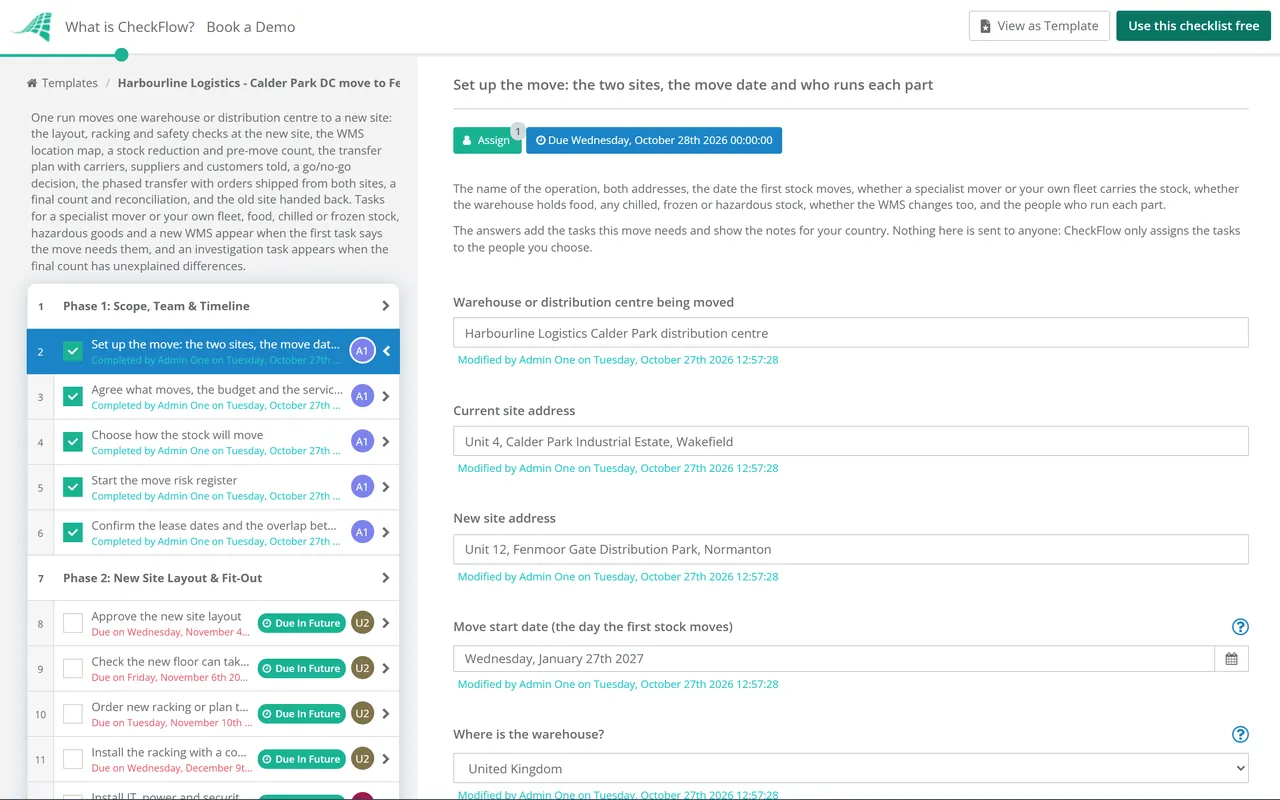
Nine phases take one warehouse move from scope and layout to the old site handed back. The first task records the move start date, which sets every due date, and whether a specialist mover or your own fleet carries the stock, whether the warehouse holds food, whether any stock is chilled, frozen or hazardous, and whether the WMS changes too; each answer adds its own tasks. The go/no-go decision is the gate: nothing after it can be completed until the operations director records it. A no-go adds a replanning task, and unexplained differences at the final count add an investigation.

  1. Phase 1

    Phase 1: Scope, Team & Timeline

    5 tasks

    Start this checklist once the new site is chosen. Enter the move start date on the first task: every task before the move counts back from it in business days and every task after it counts forward. The answers on the first task add the tasks for a specialist mover or your own fleet, food, chilled or frozen stock, hazardous goods and a new WMS, and show the notes for the UK or the US.

    • Set up the move: the two sites, the move date and who runs each part — the name of the operation, both addresses, the date the first stock moves, whether a specialist mover or your own fleet carries the stock, whether the warehouse holds food, any chilled, frozen or hazardous stock, whether the WMS changes too, and the people who run each part
    • Agree what moves, the budget and the service targets during the move — which stock, racking, equipment and teams move, what is sold or scrapped instead, the budget, and the order fill and despatch targets the business will accept while the move runs
    • Choose how the stock will move — in waves by zone or product line with orders shipped from both sites until the last wave, or in one cutover over a weekend or shutdown; record why, and the days the business can accept reduced service
    • Start the move risk register — the risks to service, stock, people and cost, such as racking delivered late, a WMS fault on the first day, damage in transit or a rise in orders during the move, with an owner and an action for each
    • Confirm the lease dates and the overlap between the sites — the date you get access to the new site, the date the old lease ends, the notice and reinstatement terms, and how many weeks both sites are paid for
  2. Phase 2

    Phase 2: New Site Layout & Fit-Out

    5 tasks

    The layout decides everything that follows: where the racking goes, how wide the aisles are, where trucks and people move and how many locations the WMS needs. This template orders the racking early because it is designed for the layout and installed before most of the fit-out.

    • Approve the new site layout — racking runs, aisle widths that suit the trucks you will use, dock doors, marshalling and returns areas, the battery charging area, and walkways kept apart from vehicle routes
    • Check the new floor can take the racking loads — a survey of the floor slab against the point load at each racking base plate, and any fixings into the building that the racking design needs
    • Order new racking or plan to reuse the old — the racking design and its rated loads for your heaviest pallets, delivery and installation dates, and for racking moved from the old site an inspection and any damaged parts replaced before it goes back up
    • Install the racking with a competent installer — erected to the manufacturer’s instructions, fixed to the floor where trucks work, with beam connector locks, run spacers on double-sided runs and protection on exposed uprights
    • Install IT, power and security at the new site — network and wireless coverage down every aisle for scanners, label printers, power for chargers and dock levellers, access control, intruder and fire alarm monitoring, and insurance cover for the building and stock
  3. Phase 3

    Phase 3: Safety, Equipment & Permits

    9 tasks

    The new site must be safe to work in before stock arrives. The racking is inspected, traffic routes are marked, trucks are examined, the fire risk assessment and emergency plan are written for the new building, and operators learn the new site. Food and hazardous goods tasks appear when the first task says the stock needs them.

    • Inspect the installed racking and name who is responsible for it — an inspection by a technically competent person before any stock goes in, a load notice on every run, and a named person responsible for racking safety who sets the routine visual inspections
    • Mark the aisles, traffic routes and walkways — vehicle routes, pedestrian walkways and crossings, barriers where people and trucks would otherwise meet, marked aisles, clearance signs at low doors and beams, and the yard and dock rules for visiting drivers
    • Commission the trucks and handling equipment — every truck, pallet truck and attachment needed at the new site, with its examination record, chargers installed and tested, and a daily pre-use check in place
    • Write the fire risk assessment and emergency plan for the new site — for the new building rather than copied from the old one: exits, alarms, fire points, sprinklers and storage heights, assembly points, and who does what in an evacuation
    • Confirm the permits and registrations the new site needs — the permissions your local authority, landlord and insurer require for the building and its use, any change to business rates or property tax, and the registrations tied to the address; this template does not list them because they depend on the site
    • Register the new site as a food business — with the authority that covers the new address, in time for the first delivery of food to the new site
    • Test the cold stores and temperature monitoring — each chilled or frozen area holding its set temperature before stock goes in, the monitoring and alarms working, and who responds to an alarm out of hours; follow your own food safety plan for how long to run the test
    • Set up storage for the hazardous goods — a separate, marked storage area that meets the conditions on the safety data sheets and your risk assessment, segregation of substances that react with each other, spill kits and the emergency arrangements
    • Train truck operators on the new site’s layout and routes — every operator, including agency staff, drives the new aisles, racking heights, docks and routes under supervision before the move, and the training is recorded
  4. Phase 4

    Phase 4: WMS & Location Map

    7 tasks

    Every location in the new building must exist in the warehouse management system, labelled and scannable, before the first pallet is put away. When a new WMS goes live with the move, its set-up and test tasks appear here.

    • Configure the new WMS and load its master data — products, units of measure, users and permissions, and the interfaces to the ERP, carriers and scanners, ready for the new site’s locations
    • Build the new site’s location map in the WMS — every location in the new building set up with its name (aisle, bay, level and position), type, size and weight limit, including pick faces, bulk, marshalling and quarantine locations
    • Decide where each product goes — fast movers near despatch, heavy and bulky lines at low levels within the racking’s rated loads, and products that must be kept apart in separate locations
    • Fix and scan-test the location labels — a barcode label on every location, a sample scanned in each aisle at every level, and scanners and label printers tested in every zone
    • Map old locations to new for each wave — for every zone or product line, the new zone it goes to and the wave it moves in, so each pallet can be labelled with its destination before it leaves
    • Test the new WMS end to end and train every user — receive, put away, replenish, pick, pack, despatch, count and return with real products, every defect fixed or accepted, and every user trained on the tasks they will do
    • Update every system that holds the warehouse address — the ship-from address in the ERP and order systems, carrier accounts and label templates, marketplace and online shop settings, EDI partners, and the returns address
  5. Phase 5

    Phase 5: Stock Reduction & Pre-Move Count

    6 tasks

    Every pallet you sell, return or scrap before the move is one you do not pay to move. The pre-move count gives the figure the final count at the new site is checked against.

    • Run stock down before the move — targets agreed with buying and sales: sell through slow movers, delay purchase orders that are not urgent and hold back promotions that would build stock
    • Clear obsolete, damaged and expired stock — sold, returned to the supplier or scrapped, with the write-off approved by finance, so none of it is moved
    • Set the last delivery date for the old site — the date after which purchase orders are delivered to the new site, and any delivery already booked after it moved
    • Count the stock at the old site before it moves — a full count of every location, in teams of two, with stock movements frozen or controlled while it runs, so the stock leaves the old site at a known quantity
    • Reconcile the pre-move count and post the adjustments — every difference recounted, explained and adjusted in the WMS, with finance approving the value of the adjustments
    • Prepare each pallet for the transfer — wrapped, labelled with its new zone and wave, and loose or part-pallet stock made up so it can be moved and scanned safely
  6. Phase 6

    Phase 6: Move Plan, Partners & Go/No-Go

    10 tasks

    The transfer is planned in waves so orders keep shipping from one site or the other. Carriers, suppliers and customers are told in good time. The operations director’s go or no-go decision is the gate: nothing after it can be completed until it is recorded.

    • Appoint a specialist mover — a site survey and written quotes, then a contract that sets the dates, vehicles and crew, the insurance and liability for goods in transit, and a method statement and risk assessment for the work
    • Book your own vehicles, drivers and loading equipment — trucks, trailers and drivers for each wave, extra hire where needed, drivers’ hours planned, and how every load is secured
    • Plan the transfer waves and the ship-from-both period — the dates each zone or product line moves, the pallets per wave, which site ships each product while the move runs, and how orders are routed until the old site stops shipping
    • Tell carriers and suppliers the new address and booking rules — the date from which collections and deliveries go to the new site, the new booking process, opening hours and any vehicle size limits
    • Tell customers about the move — the move dates, any change to order cut-off times or delivery during the move, the new returns address and who to contact; check contracts for any notice they require
    • Plan the cold chain for the transfer — temperature-controlled vehicles cooled before loading, a temperature record for every load, the shortest door-to-door time, and what happens to stock if the temperature goes out of range
    • Plan the carriage of the hazardous goods — the goods classified, packaged, labelled and documented for the journey, the people who handle them trained, and the carrier or mover able to carry them
    • Walk the new site and review readiness — the racking inspected, labels scanning, the WMS and devices working, trucks examined and operators trained, the transfer plan and staffing confirmed, and every high risk on the register closed or accepted
    • Decide go or no-go for the transfer — the operations director reviews the readiness walk and the open risks and records go, go with conditions or no-go; nothing after this task can be completed until the decision is recorded
    • Fix what stopped the move and set a new date — for a no-go: fix the open issues, agree a new date, enter it as the move start date on the first task so every due date moves, tell carriers, suppliers and customers, then un-complete the go/no-go task and record a new decision
  7. Phase 7

    Phase 7: Phased Transfer & Ship From Both

    5 tasks

    Stock moves wave by wave. Each pallet is checked out of the old site and scanned into its new location, and every order goes to the site that holds its stock until the old site stops shipping.

    • Move the first wave — loaded at the old site against the transfer list, signed for, and unloaded at the new site’s marshalling area
    • Check every pallet in and put it away by scan — each pallet checked against the transfer list, damage recorded, and put away by scanning the pallet and its new location so the WMS shows where it is
    • Ship orders from both sites until the last wave — orders routed to the site that holds the stock, a daily check for orders stuck between sites, and customer service told of any delay
    • Move the remaining waves — each wave moved, checked in and put away by scan as the first one was, and the transfer list closed when every pallet is accounted for
    • Stop shipping from the old site and close its locations — the last order despatched from the old site, its locations emptied and blocked in the WMS, and all order routing pointed at the new site
  8. Phase 8

    Phase 8: Final Count & Reconciliation

    4 tasks

    A full count at the new site, checked against the pre-move count and the WMS, shows whether anything was lost or damaged in the move. An unexplained variance adds an investigation task.

    • Count all stock at the new site — a full count of every location before normal cycle counting starts
    • Reconcile the final count with the pre-move count and the WMS — differences by product and location, with damage in transit and write-offs explained, against the tolerance agreed at the start
    • Investigate and correct each unexplained variance — recount, check the transfer lists, put-away scans and damage records, correct the WMS, and record the cause for the review
    • Agree the stock value with finance — the move adjustments and write-offs posted, the stock value at the new site agreed, and the move costs compared with the budget
  9. Phase 9

    Phase 9: Old Site Hand-Back & Review

    4 tasks

    The project ends when the old building is empty, handed back on the terms of the lease and closed on every system, and the lessons are written down for the next move.

    • Clear the old site — racking, equipment, signs and waste removed by competent contractors, nothing left in any location, and the building secured
    • Agree reinstatement and hand back the old site — reinstatement or dilapidations work agreed with the landlord, final meter readings and photos taken, and keys and access cards returned by the lease end date
    • Close the old site’s accounts and registrations — utilities, business rates or property tax, alarm monitoring, waste contracts and any registration tied to the old address, cancelled or moved
    • Review the move and record the lessons — what went well and what did not against the service targets, budget and stock accuracy, and what to change for the next move

Warehouse Move Rules and Timing at a Glance

The rules that shape a warehouse move, UK and US

The points that apply at the new site and during the transfer, with the source for each. The country chosen on the first task shows the matching notes in the checklist.

Point United Kingdom United States Where in the checklist
RackingHSE guidance (HSG76): installed by competent people to the manufacturer’s instructions, a maximum load notice, a person responsible for racking safety, and an expert inspection at intervals of not more than 12 months29 CFR 1910.176(b): stored material must not create a hazard, and tiers must be stable and secure against sliding or collapsePhases 2 and 3
Aisles and traffic routesHSE: organise the site so pedestrians and vehicles circulate safely, ideally on separate routes29 CFR 1910.176(a) and (e): safe clearances, aisles kept clear, permanent aisles marked, clearance signsPhase 3
Lift trucksThorough examination under LOLER 1998 and PUWER 1998; operator training ends with familiarisation on the job (HSE)29 CFR 1910.178: trucks examined before use, at least daily; refresher training when a workplace condition changesPhase 3
Fire and emergenciesEngland and Wales: the responsible person carries out and reviews a fire risk assessment; Scotland and Northern Ireland have their own rules29 CFR 1910.38, where an OSHA standard requires a plan: reviewed with each employee when it changesPhase 3
FoodRegister each site with its local authority at least 28 days before trading (England, Wales and Northern Ireland)Register with the FDA before the facility holds food (21 CFR 1.230); cancel the old site’s registration within 60 calendar days of it ceasing operations (1.235); temperature control in transport (1.908)Phases 3, 6 and 9
Hazardous goodsDSEAR 2002 (fire, explosion and corrosion of metal) and COSHH for storage; a dangerous goods safety adviser to transport them, with exceptionsHazmat employee training (49 CFR 172.702 and 172.704)Phases 3 and 6

How the timeline fits together

Every due date counts in business days from the move start date entered on the first task. Public holidays are not skipped, so check the dates that fall near them.

Stage What happens Due, in business days from the move start date Phase
ScopeSites, team, budget, method, risks, lease dates65 to 63 beforePhase 1
Fit-outLayout, floor, racking ordered and installed, IT and security60 to 30 beforePhase 2
Safety and permitsRacking inspected, routes, trucks, fire, permits, operator training30 to 5 beforePhase 3
SystemsLocation map, slotting, labels, mapping, addresses45 to 12 beforePhase 4
StockRun down, clear obsolete stock, pre-move count50 to 3 beforePhase 5
Plan and decisionWaves, partners and customers told, readiness, go/no-go45 to 1 beforePhase 6
TransferWaves moved, ship-from-both, old site stops shippingMove day to 10 afterPhase 7
ReconciliationFinal count, differences, stock value12 to 17 afterPhase 8
Hand-backOld site cleared and returned, accounts closed, review20 to 30 afterPhase 9

Sources. HSE: Warehousing, Warehousing and storage: a guide to health and safety (HSG76), lift-truck training, thorough examination, DSEAR and COSHH; gov.uk: Fire safety in the workplace, Food business registration and Dangerous goods safety adviser; eCFR: 29 CFR 1910.176, 1910.178, 1910.38, 21 CFR 1.230 to 1.235, 21 CFR 1.908 and 49 CFR 172 subpart H. SEMA’s SEIRS and SARI schemes are named in HSG76 as practice, not law. The timings in the second table are this template’s choices: change the offsets to fit your move. This table is not legal advice.

Why Run Your Warehouse Move in CheckFlow?

1

Every date counts from the move

Enter the move start date and every task gets a due date in business days: the layout, racking and permits weeks ahead, the counts and readiness walk in the last days, the waves and final count after. Change the date and the whole plan moves with it. Overdue alerts go to the people assigned, so a late racking delivery shows up before it delays the move.

2

Only the tasks this move needs

Five answers on the first task shape the run. A specialist mover adds the survey and contract, your own fleet adds vehicles and drivers, food adds registration, chilled or frozen food adds a cold store test and a cold chain plan, hazardous goods add storage and carriage tasks, and a new WMS adds its build, test and training. Choosing the UK or the US shows short, sourced notes on the tasks they affect.

3

A real go/no-go and a count you can show

The operations director chosen on the first task is the only person who can record the go/no-go decision, and no transfer task can be completed before it. The pre-move and final counts, the pallets sent and received and the stock value are recorded on the tasks that produced them. The Reports Grid lists every move with its answers, and Analytics shows overdue work.

CheckFlow is not a warehouse management system and does not move stock. It runs the plan around the move: who owns each step, by when, with what evidence, and who decided to go. Your WMS, your mover’s method statement and your own risk assessments still do their jobs. See how a running checklist works.

Once the new site is running, check it with the Warehouse Safety Inspection Checklist, check trucks each shift with the Forklift Pre-Use Inspection Checklist, and review the Fire Risk Assessment Checklist and Emergency Action Plan Checklist for the new building. New starters at the new site follow the Warehouse Employee Onboarding Checklist, and the offices that move with the warehouse follow the Office Relocation & Office Move Checklist.

AI generator

Didn’t find what you need? Describe it.

Describe the process in a sentence and the AI checklist generator drafts the phases and tasks for you.

Frequently Asked Questions

What should a warehouse relocation checklist include?

The new site’s layout, floor survey and racking, the racking inspection, traffic routes, trucks and fire plan, the WMS location map and labels, a stock reduction and a count before the move, a transfer plan in waves with orders shipped from both sites, carriers, suppliers and customers told, a go/no-go decision, the transfer itself, a final count and reconciliation at the new site, and the old site cleared and handed back.

How do you write a warehouse relocation project plan?

Start from the date the first stock moves and work back: the layout and racking come first in this template because everything else is fitted around them, then safety checks and the WMS, then the stock count and the transfer plan. This template counts every due date in business days from that one date, from about 13 weeks before the move to six weeks after. Those offsets are this template’s choices; change them to fit your move.

How do you keep shipping orders during a warehouse move?

Move the stock in waves by zone or product line, and route each order to the site that holds its stock until the last wave has moved, which this template calls ship-from-both. It plans the waves and which site ships each product in Phase 6, checks for orders stuck between sites every day during the transfer, and closes the old site’s locations in the WMS when its last order has gone.

Should you count stock before moving a warehouse?

Yes. A full count before the move tells you what left the old site, so the final count at the new site can show whether anything was lost or damaged on the way. This template counts every location in Phase 5, reconciles and adjusts the differences with finance, then counts again at the new site in Phase 8. Unexplained differences after the move add an investigation task.

Does racking need to be inspected at a new warehouse?

HSE’s guide HSG76 says racking should be installed by competent people to the manufacturer’s instructions, carry a notice of its maximum load, and be inspected by a technically competent person at intervals of not more than 12 months, with routine visual inspections set by a person responsible for racking safety. This template has the installed racking inspected before any stock goes in. SEMA’s SARI inspector scheme is named in HSG76 as practice.

Do forklift operators need training at a new warehouse?

In the US, 29 CFR 1910.178 requires refresher training when a condition in the workplace changes in a way that could affect safe operation of the truck. In the UK, HSE says operator training ends with familiarisation training on the job under close supervision, and that refresher training or retesting might be appropriate when operators change their working environment. This template has every operator, including agency staff, drive the new site’s aisles, racking heights and routes under supervision before the move, and records it.

What changes in the WMS when a warehouse moves?

Every location in the new building has to be created with its name, type, size and weight limit, labelled and scan-tested, and products are slotted into it. Old zones are mapped to new ones for each wave, and every system holding the warehouse address is updated. If a new WMS goes live with the move, choose that on the first task to add its configuration, testing and user training.

Who needs to be told about a warehouse move?

Carriers and couriers need the new collection address and times, suppliers need the new delivery address and booking rules, and customers need the move dates and any change to cut-off times or returns. Tell your insurer and landlord too, and any authority that registered the old site. A food business in England, Wales or Northern Ireland registers each site with its local authority at least 28 days before trading.

Is CheckFlow free for this template?

14-day free trial, no card required. The Business plan is $10 per user per month after the trial. Full details at checkflow.io/pricing.

Plan Every Step of Your Warehouse Move

Free trial — no credit card required.

14-day free trial, no credit cardFull refund in your first 30 daysUS hosting, EU on request