
Inventory that the system says is there but physically is not is phantom inventory. Phantom inventory inflates asset values, overstates profits, and produces stockouts that no forecast predicted. A structured inventory audit finds it before the external auditors do.
Inventory inaccuracy is one of the most pervasive and financially consequential operational problems in commerce. Stock discrepancies affect cost of goods sold calculations, working capital reporting, and financial statement accuracy. In operations, phantom inventory — stock showing in the system that does not physically exist — triggers production or fulfilment decisions against stock that is not available, producing failures that appear at the worst possible moment: when a customer order cannot be fulfilled or a production run cannot start. The global Inventory Management Solutions market is expected to reach nearly $5 billion by 2033, driven by organisations that have discovered how expensive inaccurate inventory is. A structured inventory audit process systematically closes the gap between what the system says and what is physically present — through disciplined pre-audit preparation, a controlled physical count, systematic reconciliation against system records, and rigorous root cause investigation for every material variance. This free checklist gives inventory managers, warehouse teams, and finance staff a structured framework for the full inventory audit lifecycle.
Full Physical Count, Cycle Count, and Spot Audit — When to Use Each
Full Physical Inventory Count
When
Annually; typically at or near fiscal year-end or at the end of a financial quarter. Also triggered by major system migrations or suspected significant loss.
What happens
All operations typically halt (or shift to a defined cut-off point) while every item in every location is physically counted against the system record.
Best for
Complete accuracy verification; financial reporting purposes; establishing a clean baseline for the next cycle.
Drawback
Most disruptive and resource-intensive audit type.
Cycle Count Audit
When
Continuously throughout the year on a defined schedule. A-class inventory counted most frequently (monthly/quarterly), B-class less often, C-class annually.
What happens
A defined subset of inventory is counted on a rotating schedule; discrepancies investigated immediately; the annual full count is largely replaced by a high-confidence continuous cycle.
Best for
Maintaining high inventory accuracy throughout the year without the disruption of annual full counts.
Best practice
All high-value or operationally critical items should be cycle-counted at least quarterly.
Spot / Random Audit
When
Unannounced; triggered by specific concerns (suspected theft, process change, new personnel, or anomalous system data), or as a random integrity check.
What happens
A specific category, location, or SKU range is counted without advance notice.
Best for
Testing process integrity; investigating specific concerns; deterring systematic shrinkage.
Note
The unannounced nature is operationally valuable — it tests whether the count reflects actual conditions rather than the result of pre-audit corrections.
What the Inventory Audit Process Checklist Covers
Six phases covering the complete inventory audit lifecycle — from pre-audit preparation through physical count execution, reconciliation, variance investigation, corrective action, and audit reporting.
Phase 1
Pre-Audit Preparation
The quality of an inventory audit is determined largely in the preparation phase. Counts that begin without a frozen system, organised locations, and trained counters produce data that cannot be trusted.
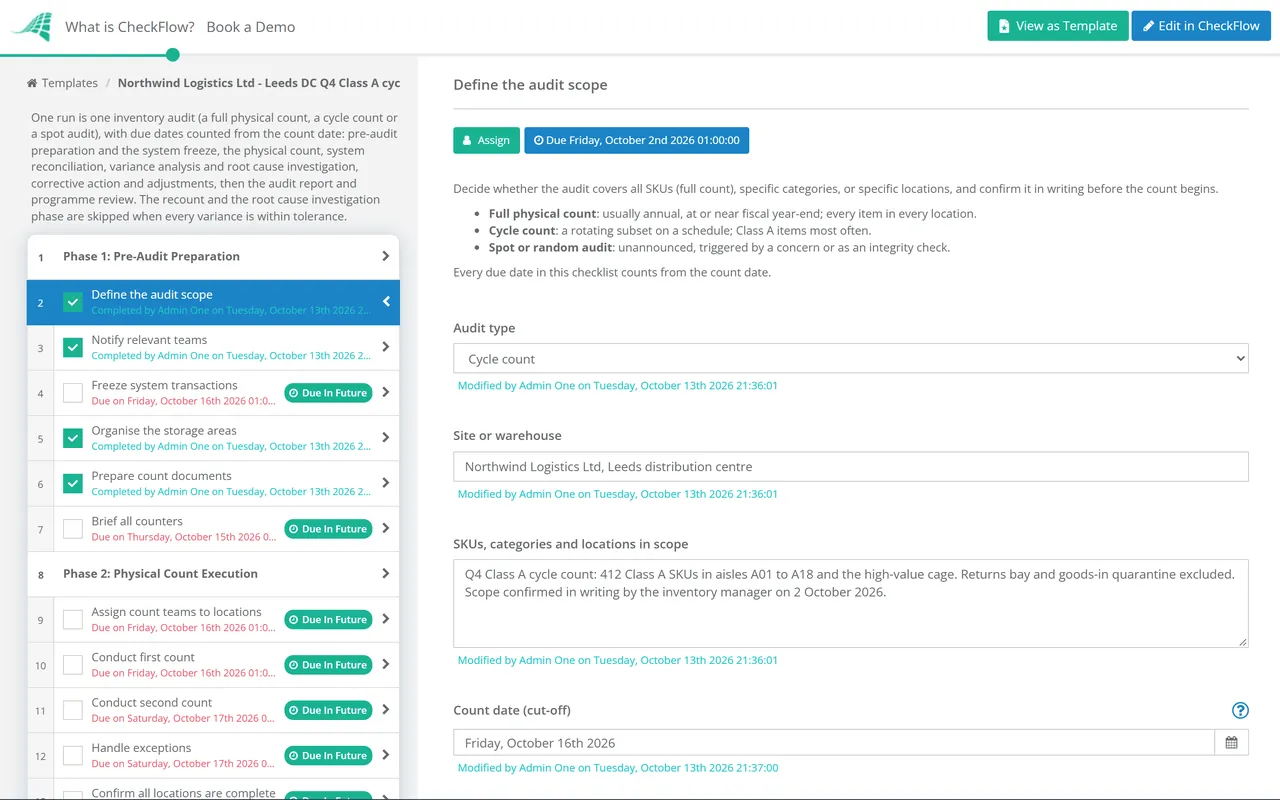
Define the audit scope — all SKUs (full count), specific categories, or specific locations; confirmed in writing before the count begins
Notify relevant teams — warehouse, operations, and finance of the audit date, scope, and any operational implications (partial or full operational halt)
Freeze system transactions — at the defined cut-off date and time; no receipts, issues, transfers, or adjustments processed during the count; this is the most critical preparation step
Organise the storage areas — stock tidied and organised by location; all items clearly labelled and in their assigned locations; items in transit clearly segregated and handled per the cut-off rules
Prepare count documents — count sheets or mobile count devices; listing location, SKU, and unit of measure without showing system quantity (blind count)
Brief all counters — counting methodology, how to handle exceptions (damaged, unlabelled, in transit), and who to contact with questions; every counter uses the same method
Phase 2
Physical Count Execution
Assign count teams to locations — each location or zone assigned to a specific count team; two-person teams where possible (one counts, one records)
Conduct first count — systematically, location by location; each item counted and recorded; no reference to system quantities until the reconciliation phase
Conduct second count — all items or all items above the defined value threshold; independently of the first count; discrepancies between first and second count resolved before moving to reconciliation
Handle exceptions — damaged stock (count and tag separately); unlabelled items (investigate and tag before counting); items in transit or quarantine (per cut-off rules)
Confirm all locations are complete — before releasing the count; no location skipped or partially counted
Re-open system transactions — only after all count sheets are collected and confirmed complete
Phase 3
System Reconciliation
Enter count data — into the inventory management system or reconciliation spreadsheet; all count quantities entered against the system quantity at the cut-off
Identify all variances — every SKU where the count quantity differs from the system quantity; presented as unit variance and value variance
Apply the variance tolerance filter — variances within the defined tolerance (e.g. ±1% by value or ±2 units for low-value items) may be adjusted without root cause investigation; variances above tolerance require investigation
Confirm count accuracy for high-value variances — before investigating; a recount of items with significant variances by a different count team
Phase 4
Variance Analysis & Root Cause Investigation
The recount is the integrity check; the root cause investigation is where the value lies. An inventory variance that is adjusted without investigation is a problem that will recur. An investigation that identifies the cause enables the fix.
Categorise each material variance — by likely cause type: counting/recording error, unreported damage/obsolescence, theft/shrinkage, data entry error in receipts or issues, transaction cut-off error, or location error (item in wrong location)
Investigate each significant variance — reviewing transaction history for the SKU in the relevant period; checking goods receipt records, issue records, and transfer records
Identify systemic issues — variances clustering in specific locations, suppliers, categories, or time periods may indicate a process failure rather than individual error
Document findings — for each material variance: probable cause, evidence, and recommended corrective action
Phase 5
Corrective Action & Inventory Adjustment
Raise inventory adjustment transactions — for each variance; approved by the finance lead or inventory manager; with the root cause code attached
Confirm the financial impact — total value of adjustments; reviewed by finance; material variances may require disclosure in financial reporting
Implement corrective actions for systemic issues — process changes that address the root cause; assigned to a named owner with a deadline
Update the cycle count schedule — for SKUs with material variances; increase frequency until accuracy is demonstrated
Phase 6
Audit Report & Programme Review
Prepare the inventory audit report — audit scope and date; number of SKUs counted; total inventory value audited; variance summary (number and value of variances by category); accuracy percentage; root causes identified; corrective actions raised
Calculate inventory accuracy percentage — (SKUs with no material variance / total SKUs counted) × 100; target 95%+ for Class A items; trend tracked over time
Present to finance and senior management — for material variances and systemic findings
Review the audit programme — was the audit scope appropriate? Were there enough counters? Should cycle count frequency be adjusted? Were corrective actions from the last audit implemented?
Why Inventory Accuracy Is a Financial Statement Issue — Not Just an Operations Issue
For any company that holds physical inventory, the inventory balance on the balance sheet is a direct function of the accuracy of the inventory records. Phantom inventory — stock that appears in the system but does not physically exist — inflates the asset value and understates the cost of goods sold, overstating profit. Unrecorded shrinkage or damage produces the same distortion. For companies with audited financial statements, external auditors typically perform or observe physical inventory counts as a standard audit procedure precisely because inventory misstatement is a common and material financial reporting risk.
Beyond financial reporting, inventory inaccuracy drives operational costs that accumulate silently: emergency procurement when stock that shows as available is not actually present, production stops when raw material shortfalls appear at the line, and customer service failures when committed stock cannot be fulfilled. A structured inventory audit programme that maintains high accuracy prevents all of these — and the operational and reputational costs are almost always more significant than the audit resource.
Why Run Your Inventory Audit in CheckFlow?
1
A structured count process that every counter follows identically
Inventory audits that produce different results depending on who does the count are audits that cannot be trusted. CheckFlow’s inventory audit checklist provides every counter with the same structured sequence — system freeze, blind count, double count, exception handling — ensuring consistent methodology regardless of who conducts the count.

2
Variance investigation tracked through to corrective action closure
An inventory variance that is adjusted in the system without a root cause investigation will recur at the next audit. CheckFlow assigns each material variance an investigation task to a named owner with a deadline, and tracks the corrective action through to confirmed implementation.
3
A complete audit record for financial and compliance purposes
External auditors and regulators who ask for evidence of a systematic inventory audit programme — when it was conducted, how many SKUs were counted, what variances were found, and what corrective actions were taken — receive a complete documented record from every audit conducted through CheckFlow.
Inventory audit findings often reveal procurement process failures — orders received without goods receipt transactions, or goods issued without matching POs. CheckFlow’s Purchase Order Approval Checklist covers the PO controls that prevent many inventory discrepancies. See the Purchase Order Approval Checklist →
Procurement compliance reviews cover inventory management controls as part of the broader procurement audit. CheckFlow’s Procurement Compliance Review covers the full procurement audit framework. See the Procurement Compliance Review →
Inventory audit is one of the strongest use cases for recurring checklists — cycle counts run on a schedule, full counts run annually. CheckFlow’s recurring checklist feature starts each count automatically at the right cadence. Learn about recurring checklists →
What is the inventory audit process and what does it cover?
+
The inventory audit process is a formal accuracy verification of physical inventory against system records, covering six phases: pre-audit preparation (scope definition, system transaction freeze, storage organisation, count document preparation, counter briefing), physical count execution (systematic first and second count using blind counting methodology, exception handling), system reconciliation (count data entry, variance identification, variance tolerance filtering), variance analysis and root cause investigation (categorising variances by cause type, investigating each material variance, identifying systemic issues), corrective action and inventory adjustment (finance-approved adjustments with root cause codes, process corrections, cycle count schedule update), and audit report and programme review (accuracy percentage calculation, management reporting, programme improvement).
What is “blind counting” in an inventory audit?
+
Blind counting is the practice of conducting the physical count without reference to the system quantity — the counter records only what they physically see, without knowing what the system shows for that SKU. Blind counting prevents the common human bias of counting to match the system quantity rather than reporting what is actually there. It is the single most important methodological control in a physical inventory count — counts that show the system quantity to the counter systematically underreport discrepancies.
What is the “system freeze” and why is it critical?
+
The system freeze is the suspension of all inventory transactions (receipts, issues, transfers, and adjustments) from the defined cut-off date and time until the physical count is complete and count data is entered into the system. Without a system freeze, the inventory quantities that the system shows at the time of counting are moving targets — goods are being received or issued during the count, making reconciliation impossible and variance analysis meaningless. The cut-off must be precisely defined and strictly enforced: any transaction processed during the count window that is not accounted for in the reconciliation will produce a false variance.
How often should inventory audits be conducted?
+
Best practice combines a continuous cycle count programme with periodic full physical counts. Cycle counts rotate through the inventory throughout the year, counting high-value (Class A) items monthly or quarterly, and lower-value items less frequently. This maintains high accuracy continuously without the operational disruption of frequent full counts. An annual full physical count is typically required for financial reporting purposes, conducted at or near the fiscal year-end. Spot audits may be conducted at any time, particularly after a system change, a personnel change, or when anomalous data suggests a process problem.
Is CheckFlow free for this template?
+
14-day free trial, no card required. The Business plan is $10 per user per month after the trial. Full details at checkflow.io/pricing.
Count What You Actually Have — Not What Your System Thinks You Have
Free trial — no credit card required.
Do you like cookies? 🍪 We use cookies to ensure you get the best experience on our website. Learn more