Emergency Action Plan Checklist Template

Most emergency action plans are written once for an inspection and filed. When the alarm sounds, the exit on the map is blocked by racking, the phone list is two managers out of date and nobody knows who is counting heads.

Last reviewed: October 2026

An emergency action plan tells every employee what to do in the first minutes of a fire, a chemical release, a tornado warning or any other workplace emergency: how to raise the alarm, which way to leave, who stays to shut down critical equipment, where to gather and who counts heads. This free emergency action plan checklist is for EHS managers, facility and site managers and safety coordinators at US workplaces where an OSHA standard requires a plan under 29 CFR 1910.38. One run is one site’s plan, written for the first time or taken through its annual review. It covers the scope, the emergencies, reporting and alarms, evacuation routes and critical operations, accounting, rescue and medical duties, the contact list and the site manager’s approval, then issue, training and a drill. A shelter-in-place phase appears when the site needs one, and extra tasks appear for small employers, critical plant operations and extinguisher users.

One Written Plan for the First Minutes of Any Emergency

29 CFR 1910.38 says an employer must have an emergency action plan whenever an OSHA standard in Part 1910 requires one. In practice that covers most workplaces. OSHA’s Evacuation Plans and Procedures eTool explains that if fire extinguishers are required or provided, and anyone will evacuate during a fire or other emergency, 29 CFR 1910.157 requires a plan. It must be in writing, kept in the workplace and available to employees for review, although an employer with 10 or fewer employees may communicate it orally.

The plan is easy to confuse with the documents around it. The fire prevention plan under 1910.39 is about stopping fires from starting. A fire drill tests whether people can actually follow the plan, and a fire risk assessment is where the fire hazards behind it are judged. This checklist writes the plan itself, or takes an existing one through its review, for one site at a time.

Emergency action plan

What employees do when an emergency happens

Rule: 29 CFR 1910.38.

Covers: reporting, the alarm, evacuation and exit routes, critical operations, accounting for employees, rescue and medical duties, and who to contact about the plan.

Output: an approved written plan, issued, and reviewed with each employee it covers.

Fire prevention plan

How fires are kept from starting

Rule: 29 CFR 1910.39.

Covers: major fire hazards, handling and storage of hazardous materials, ignition sources and their control, flammable and combustible waste, and maintenance of safeguards on heat-producing equipment.

Output: a written plan that names who maintains equipment and controls fuel sources.

Evacuation drill

Whether people can follow the plan

Rule: 1910.38 sets no drill frequency; OSHA’s eTool recommends drills as often as necessary.

Covers: the alarm, the routes, the wardens’ sweep, the head count and the time it all takes.

Output: a drill report whose findings come back into the next plan review.

What the Emergency Action Plan Checklist Covers

Eight phases take one site’s plan from scope to a trained workforce. Phase 5 appears only when the site needs a shelter-in-place option, and extra tasks appear for employers with 10 or fewer employees, for employees who stay to operate critical plant and for employees who may use fire extinguishers.

  1. Phase 1

    Phase 1: Scope the Plan & the Review

    5 tasks

    Answer the scope questions first. They decide which tasks this plan review shows.

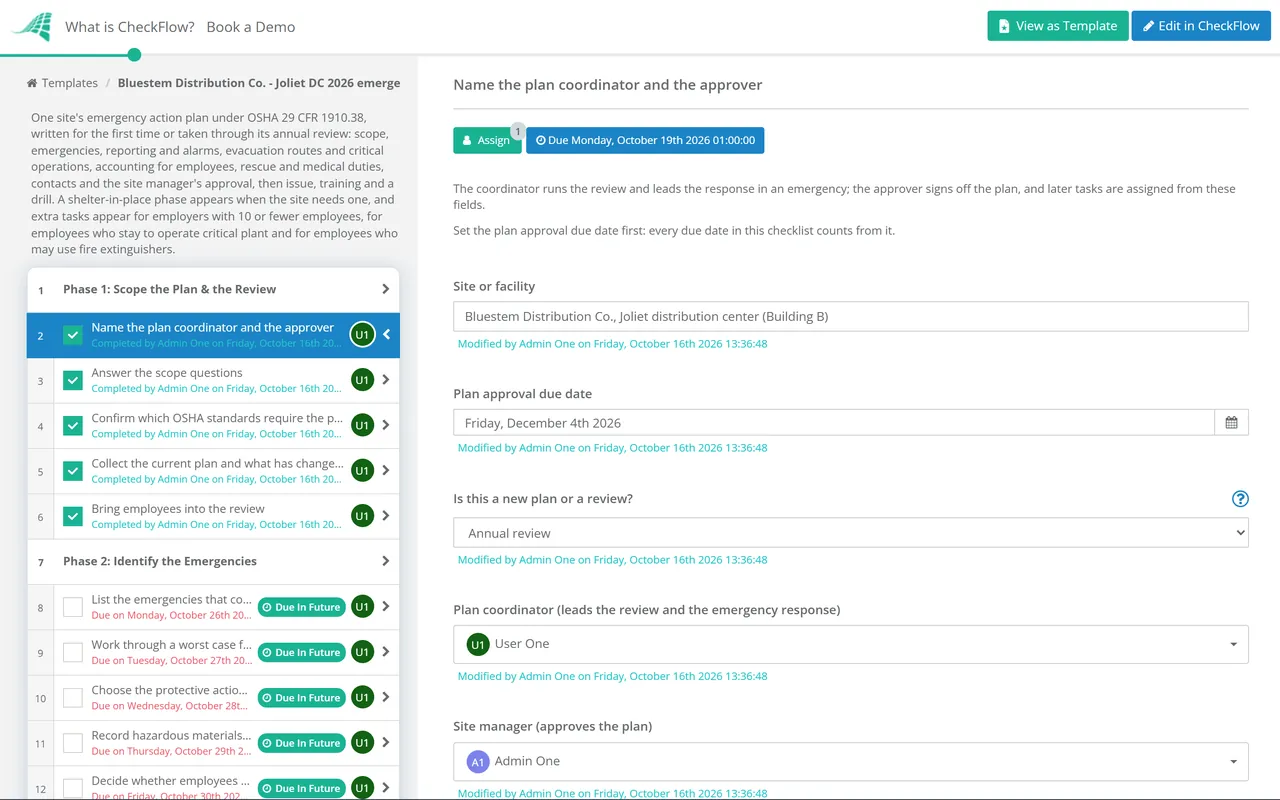
    • Name the plan coordinator and the approver — the coordinator runs the review and leads the response in an emergency; the approver signs off the plan, and later tasks are assigned from these fields
    • Answer the scope questions — whether the employer has 10 or fewer employees, and whether the site needs a shelter-in-place option
    • Confirm which OSHA standards require the plan — for most sites it is 29 CFR 1910.157, because fire extinguishers are provided and employees will evacuate
    • Collect the current plan and what has changed since — the last approved version, drill reports and incidents, and any change to the layout, equipment, hazardous materials, processes or staff
    • Bring employees into the review — managers and employees from each area and shift, asked about hazards, worst cases and what they would actually do
  2. Phase 2

    Phase 2: Identify the Emergencies

    6 tasks

    The plan has to say when and how employees respond to each type of emergency. A fire means leaving the building; a tornado or a chemical release outside may mean staying in.

    • List the emergencies that could affect the site — fire, explosion, severe weather, flooding, a chemical release on site or nearby, a medical emergency, workplace violence and a utility failure
    • Work through a worst case for each one — what happens if the storeroom catches fire, the river floods or a chemical is released next door, on the busiest shift
    • Choose the protective action for each emergency — evacuate to an outside assembly area, or gather inside, as for a tornado or a chemical spill on a nearby highway
    • Record hazardous materials and processes on site — flammable liquids, toxic chemicals, ammonia refrigeration and anything else employees and responders must know about
    • Decide whether employees fight small fires or evacuate — total evacuation, designated extinguisher users, or all employees; the choice sets the training the plan needs
    • Check hazards from neighbors and shared buildings — rail lines, highways, chemical plants and other employers who share the site or the building
  3. Phase 3

    Phase 3: Reporting, Alarms & Authority

    5 tasks

    Element 1 of the plan is the procedure for reporting a fire or other emergency. 1910.38(d) adds an employee alarm system with a distinctive signal for each purpose.

    • Write the procedure for reporting a fire or other emergency — 911, an internal emergency number, a manual pull station, radio or the public address system
    • Post emergency phone numbers where they will be seen — near telephones, on employee notice boards and in other conspicuous places, as 1910.165(b)(4) requires when phones are used to report emergencies
    • Confirm the alarm has a distinctive signal for each purpose — evacuation and any shelter-in-place signal, perceived above ambient noise and light by everyone in the affected areas
    • Check alarm testing and maintenance records — non-supervised systems tested every two months, supervised systems at least once a year, and a backup means of alarm when it is out of service
    • Name who can order an evacuation or shutdown — the coordinator and an alternate on every shift, and how command passes to the fire department when it arrives
  4. Phase 4

    Phase 4: Evacuation Routes & Critical Operations

    8 tasks

    Elements 2 and 3: the type of evacuation and exit route assignments, and the procedure for anyone who stays to operate critical plant before they leave.

    • Set the type of evacuation for each emergency — everyone out at once, one area moved, or people moved to an area of refuge inside
    • Assign exit routes and mark them on floor plans — a primary and a secondary route for each area, the exits, assembly points, extinguishers, first aid kits and spill kits
    • Walk every exit route — clearly marked, well lit, wide enough for the people using it, unobstructed and not leading toward a high hazard area
    • Appoint evacuation wardens for each area and shift — they sweep their area, check rooms and restrooms, close fire doors and leave last
    • Plan help for visitors and employees who need assistance — people with disabilities, people who do not speak English, and visitors and contractors on the sign-in list
    • Decide whether anyone stays behind to operate critical plant — the preferred approach, OSHA's eTool says, is immediate evacuation of everyone when the alarm sounds
    • Write the procedure for each critical operation — shown only when someone stays behind: who, by name or job title, each step, and where the utility shutoffs are
    • Set when those employees must leave — shown only when someone stays behind: the signs that tell them to abandon the task before their exit is blocked
  5. Phase 5 — If needed

    Phase 5: Shelter-in-Place Procedures

    6 tasks

    Shown only when the site needs a shelter-in-place option: a release outside that would make it safer to stay indoors than to evacuate.

    • Choose the shelter rooms — interior rooms with few or no windows, room for everyone to sit, and no ventilation equipment that cannot be sealed
    • Set a shelter-in-place signal different from the evacuation signal — and make sure employees can tell the two apart
    • Name who shuts down fans, heating and air conditioning — employees who know the building's mechanical systems, and who locks the outside doors and closes windows and vents
    • Stock shelter supplies — water, nonperishable food, a battery-powered radio, first aid supplies, flashlights, plastic sheeting and duct tape
    • Plan how people in each room are recorded and reported — everyone's name and whether they are an employee, visitor or customer, phoned to the designated emergency contact
    • Decide how official instructions and the all clear are received — radio, television or the internet, and leave at once if the authorities say to evacuate
  6. Phase 6

    Phase 6: Accounting, Rescue & Medical Duties

    6 tasks

    Elements 4 and 5: accounting for every employee after evacuation, and the procedures for employees who perform rescue or medical duties.

    • Designate the assembly areas — big enough for everyone, away from busy streets, upwind of the building where you can, and clear of rescue operations
    • Set the head-count procedure — who counts, from which lists, and who receives the names and last known locations of anyone missing
    • Plan a further move if the incident grows — sending people home, or transport to an offsite location
    • Decide who performs rescue and medical duties — public emergency services, or trained employees on site, and the procedure each one follows
    • Brief the local fire department and ambulance service — invite a walk-through of the site, and agree where injured employees will be treated
    • Check first-aid cover on every shift — trained first aiders and supplies when no clinic or hospital is close by
  7. Phase 7

    Phase 7: Contacts, Write-Up & Approval

    5 tasks

    Element 6 is the name or job title of every employee who can explain the plan. The site manager approves the finished plan before it is issued.

    • List who employees can contact about the plan — the name or job title of every person who can explain the plan or someone's duties under it
    • Update the emergency contact list — facility, utility and agency numbers, each one checked; OSHA's eTool calls this the item most often out of date
    • Complete the written plan against the six minimum elements — reporting, evacuation and exit routes, critical operations, accounting for employees, rescue and medical duties, and contacts
    • Review the draft with other employers and outside responders — other companies in the building, the fire department and any hazmat team the plan relies on
    • Site manager approves the emergency action plan — the approver's decision, recorded with any conditions, before the plan is issued and training starts
  8. Phase 8

    Phase 8: Issue, Train & Drill

    7 tasks

    A plan nobody has been taken through does not work. 1910.38(f) requires a review with each employee covered by the plan.

    • Issue the plan and keep it in the workplace — in writing, kept at the site and available to every employee for review, with the route maps posted
    • Communicate the plan orally — shown only when the employer has 10 or fewer employees, which 1910.38(b) allows; record who explained it to whom and when
    • Designate and train the people who will assist the evacuation — wardens, alternates, head counters and anyone helping people who need assistance, as 1910.38(e) requires
    • Review the plan with each employee — when the plan is developed or they are first assigned to the job, when their duties under it change and when the plan changes
    • Train designated extinguisher users — shown only when employees may use portable extinguishers: on first assignment and at least once a year after that
    • Schedule an evacuation drill — to practice the routes, the head count and any shelter-in-place procedure, then review what the drill showed
    • Set the next review date and the triggers for an earlier one — changes to anyone's duties, the layout, equipment, hazardous materials or processes, or a drill or incident that showed a gap

29 CFR 1910.38 Mapped to the Checklist

The regulation is short. Paragraph (c) lists six minimum elements, quoted below in the words of the eCFR, and the rest of the section sets the conditions around them. The table shows where each requirement leaves its evidence in a completed checklist. States that run their own OSHA-approved State Plan must be at least as effective as OSHA and may add requirements, so treat the table as a starting point, not legal advice.

29 CFR 1910.38 What it requires Where the checklist covers it
(a) ApplicationAn emergency action plan whenever an OSHA standard in Part 1910 requires onePhase 1
(b) Written and oral plansIn writing, kept in the workplace and available to employees for review; an employer with 10 or fewer employees may communicate the plan orallyPhases 1 and 8
(c)(1)Procedures for reporting a fire or other emergencyPhase 3
(c)(2)Procedures for emergency evacuation, including type of evacuation and exit route assignmentsPhase 4
(c)(3)Procedures to be followed by employees who remain to operate critical plant operations before they evacuatePhase 4
(c)(4)Procedures to account for all employees after evacuationPhase 6
(c)(5)Procedures to be followed by employees performing rescue or medical dutiesPhase 6
(c)(6)The name or job title of every employee who may be contacted by employees who need more information about the plan or an explanation of their duties under the planPhase 7
(d) Employee alarm systemAn employee alarm system, maintained, with a distinctive signal for each purpose, complying with 1910.165Phase 3
(e) TrainingDesignate and train employees to assist in a safe and orderly evacuation of other employeesPhase 8
(f) ReviewReview the plan with each employee it covers when the plan is developed or the employee is first assigned to a job, when the employee’s responsibilities under the plan change, and when the plan is changedPhase 8

What 1910.38 does not say. It sets no fixed review interval and no drill frequency. The review duty in paragraph (f) is triggered by events: a new plan, a new job assignment, changed responsibilities and a changed plan. OSHA’s Evacuation Plans and Procedures eTool adds advice that is not mandatory: review the plan regularly, update it when the layout, equipment, hazardous materials or processes change, consider retraining employees once a year, and hold practice drills as often as necessary to keep employees prepared. An annual review, plus an extra run after any of those changes, covers both.

The alarm rules sit in 1910.165. The alarm must be perceived above ambient noise or light levels by every employee in the affected areas. Non-supervised systems are tested every two months and supervised systems at least once a year, and a backup means of alarm, such as runners or telephones, is needed while the system is out of service. An employer with 10 or fewer employees in a workplace may sound the alarm by direct voice communication, provided every employee can hear it.

Why Run Emergency Action Plan Reviews in CheckFlow?

1

The review comes round every year

A yearly recurring schedule starts each site’s review with the plan coordinator assigned and every due date counted back from the approval date. When the layout, a process or the hazardous materials on site change, start an extra run from the same template the same day.

2

Nobody issues a plan that was not approved

The site manager is named on the first task, and the plan approval is assigned to them alone. Nothing in the issue, training and drill phase can be completed until they have recorded a decision, so the plan employees are trained on is the one that was signed off.

3

Proof that every employee was taken through it

Tables record each employee review, the reason for it and the date, beside the approved plan, the alarm test records and the route maps. Across many sites, the Reports Grid and analytics show which plan reviews are overdue and how far each one has got.

CheckFlow does not write the plan for you or check it against your state’s rules. It runs the review around your own documents: who does what, by when, with what evidence, and who approved the result. CheckFlow’s compliance checklist software shows how the same approach handles other recurring safety reviews.

The plan is one part of an emergency program. Test it with the Fire Drill & Evacuation Checklist, judge the fire hazards behind it with the Fire Risk Assessment Checklist, inspect the wider workplace with the Safety Audit Checklist and log injuries with the OSHA Recordkeeping Checklist. For keeping the business running once people are safe, use the Business Continuity Plan Testing Checklist.

AI generator

Didn’t find what you need? Describe it.

Describe the process in a sentence and the AI checklist generator drafts the phases and tasks for you.

Frequently Asked Questions

What is an OSHA emergency action plan?

It is the plan required by 29 CFR 1910.38 that organizes what the employer and employees do during a workplace emergency. It covers how emergencies are reported, how and where people evacuate, who stays to shut down critical operations, how everyone is accounted for, who performs rescue and medical duties, and who to ask about the plan. OSHA’s eTool explains that a well-developed plan and proper training mean fewer and less severe injuries, while a poorly prepared plan is likely to lead to a disorganized evacuation.

What must an emergency action plan include?

29 CFR 1910.38(c) lists six minimum elements: procedures for reporting a fire or other emergency; procedures for emergency evacuation, including type of evacuation and exit route assignments; procedures for employees who remain to operate critical plant operations before they evacuate; procedures to account for all employees after evacuation; procedures for employees performing rescue or medical duties; and the name or job title of every employee who can be contacted about the plan. The employer must also have an employee alarm system and train employees to assist in the evacuation.

Does an emergency action plan have to be in writing?

Usually, yes. 1910.38(b) says the plan must be in writing, kept in the workplace and available to employees for review. The exception is that an employer with 10 or fewer employees may communicate the plan orally. The plan still needs every minimum element, and a short written version keeps oral briefings consistent. When you answer that the employer has 10 or fewer employees, the checklist adds a task to record who explained the plan to whom, and when.

Which employers need an emergency action plan?

Any employer covered by an OSHA standard in Part 1910 that requires one; that is the trigger in 1910.38(a). OSHA’s eTool says almost every business needs one, because if fire extinguishers are required or provided and anyone will evacuate during a fire or other emergency, 1910.157 requires a plan. Other triggers include process safety management, grain handling and some chemical standards. The eTool describes one exemption from the extinguisher trigger: an in-house fire brigade in which every employee is trained and equipped to fight fires, so nobody evacuates.

How often should an emergency action plan be reviewed?

1910.38(f) ties the review to events rather than a calendar. The plan must be reviewed with each employee when it is developed or the employee is first assigned to the job, when their responsibilities under the plan change, and when the plan changes. OSHA’s eTool adds that the plan should be reviewed regularly and updated when the layout, equipment, hazardous materials or processes change, and suggests retraining employees once a year. An annual review, plus a run after any of those changes, covers both.

What is the difference between an emergency action plan and a fire prevention plan?

The emergency action plan under 1910.38 says what people do when an emergency happens. The fire prevention plan under 1910.39 is about stopping fires from starting. It lists the major fire hazards, the handling and storage of hazardous materials, ignition sources and their control, the fire protection equipment for each major hazard, procedures to control flammable and combustible waste and to maintain safeguards on heat-producing equipment, and who is responsible. Both must be written and available to employees, with the same exception for employers with 10 or fewer employees.

Does OSHA require emergency evacuation drills?

1910.38 does not set a drill frequency. OSHA’s eTool calls practice drills a good idea, held as often as necessary to keep employees prepared, with outside responders such as the fire department involved where possible, and a review of the plan’s strengths and weaknesses after each one. Check whether the fire code adopted where you are sets its own drill requirements. Plan the drill at the end of this checklist and run it with the Fire Drill & Evacuation Checklist.

Is CheckFlow free for this template?

14-day free trial, no card required. The Business plan is $10 per user per month after the trial. Full details at checkflow.io/pricing.

Keep Every Site’s Emergency Action Plan Current and Approved

Free trial — no credit card required.

14-day free trial, no credit cardFull refund in your first 30 daysUS or EU hosting