Forklift Pre-Use Inspection Checklist Template

Most forklift checks are a sheet of ticks on a clipboard, filled in the same way every morning. A cut tyre or a stretched chain gets ticked as fine, and a reported defect waits on a hook while the next driver takes the truck out.

Last reviewed: October 2026

Forklifts and other lift trucks need checking before they are used on every shift. This free forklift pre-use inspection checklist is for warehouse, distribution and production supervisors and the operators who drive counterbalance, reach and other powered industrial trucks. One run is one operator’s check of one truck at the start of one shift. It records the truck and confirms the operator is authorised to drive it, then works through the visual checks with the power off, the checks for the truck’s power source, and the operational checks with the truck running: seat belt, horn, lights, brakes, steering, controls, lift and tilt. The result decides what follows. A defect that affects safety opens an out-of-service phase that keeps the truck parked until the supervisor approves its return. Every check ends with the supervisor’s review and the truck parked safely at the end of the shift.

A Pre-Use Check Is Not a Service or a Thorough Examination

OSHA’s powered industrial truck standard says trucks shall be examined before being placed in service, at least daily, and after each shift where they are used round the clock. HSE guidance for rider-operated lift trucks asks the operator to check the truck at the beginning of each shift, following the vehicle handbook, and to document the results. Both make the same point about what happens next: a defect is reported straight away, and a truck that is not safe is taken out of service until it is repaired.

The pre-use check is one of three different jobs. The planned service is an engineer’s, usually counted in hours run. The thorough examination of the lifting parts is a competent person’s, at least every 12 months in the UK. HSE is clear that regular inspections and scheduled services are not a thorough examination. This checklist is the operator’s job on every shift, with a place to confirm the other two are in date. A road vehicle’s walkaround check belongs in the Fleet Vehicle Inspection Checklist, and the service programme for every asset in the Preventive Maintenance Checklist.

Pre-use check

The operator, at the start of every shift

Asks: is this truck safe to use today?

When: before the truck is used, on every shift it works.

Output: a signed check, defects reported to the supervisor, and the truck taken out of service if a defect affects safety.

Planned service

An engineer, by hours run

Asks: what needs adjusting, lubricating or replacing before it wears out?

When: at the intervals in the manufacturer’s handbook, which for most lift trucks are counted in hours run.

Output: a service record and the next service due.

Thorough examination

A competent person, at least yearly

Asks: are the mast, chains, carriage, forks and tilt mechanism safe to keep using?

When: in the UK at least every 12 months, every 6 months if the truck lifts people, or as an examination scheme sets.

Output: a report of thorough examination, kept for at least two years.

What the Forklift Pre-Use Inspection Checklist Covers

Seven phases follow one truck through one operator’s check at the start of a shift. Phase 3 shows only the checks for the truck’s power source: electric, LPG or diesel. Phase 6 appears only when a defect affects safety, and the truck stays out of service until the supervisor approves its return.

  1. Phase 1

    Phase 1: Operator, Truck & Shift

    6 tasks

    The power source chosen on the first task decides which checks appear in Phase 3. Every due date counts from the shift start.

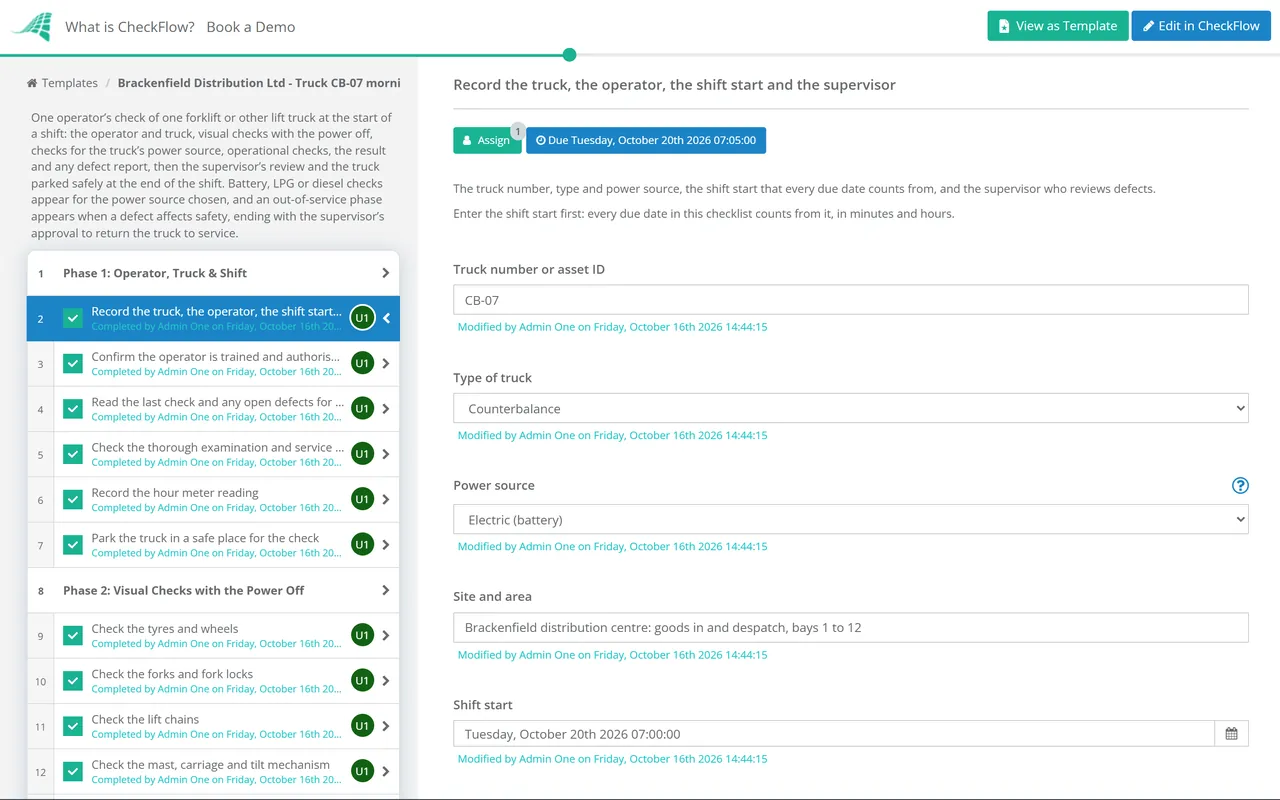
    • Record the truck, the operator, the shift start and the supervisor — the truck number, type and power source, the shift start that every due date counts from, and the supervisor who reviews defects
    • Confirm the operator is trained and authorised for this truck — written authorisation for this type of truck in the UK, or certified training and evaluation in the US; a trainee drives only under direct supervision
    • Read the last check and any open defects for this truck — a defect reported on an earlier shift must be repaired and the truck returned to service before anyone uses it again
    • Check the thorough examination and service dates — a report of thorough examination within the last 12 months, or 6 months if the truck lifts people, and the next service not overdue on the hour meter
    • Record the hour meter reading — hours run set the service intervals, and a jump between shifts shows use nobody recorded
    • Park the truck in a safe place for the check — level ground away from traffic routes, forks fully lowered, controls in neutral, parking brake on and power off
  2. Phase 2

    Phase 2: Visual Checks with the Power Off

    8 tasks

    Walk round the truck before switching on. Look and touch; never reach between the mast uprights.

    • Check the tyres and wheels — cuts, bubbles and embedded swarf or nails, especially in the side walls, wheel nuts tight, and on pneumatic tyres the pressures and rim flanges
    • Check the forks and fork locks — cracks at the heels and mounting hooks, bent or damaged tips, and positioning locks present and working
    • Check the lift chains — anchor pins secure, fixing bolts tight, no damaged or stretched links, and the chains lubricated
    • Check the mast, carriage and tilt mechanism — no cracks, bent sections, loose bolts or damage to the carriage or the tilt cylinders
    • Check the overhead guard and load backrest extension — both in place, secure and undamaged
    • Look for hydraulic leaks — hoses, fittings and cylinders, and fresh fluid under the truck, with the fluid level correct when the forks are parked
    • Check the data plate and markings — the capacity plate in place and legible, matching the truck and any attachment fitted
    • Check the seat, mirrors and visibility aids — seat secure and adjusting, mirrors and cameras clean and undamaged, and steps and handholds sound
  3. Phase 3 — By power source

    Phase 3: Power Source Checks

    7 tasks

    Only the checks for this truck’s power source appear: battery and charger for electric, cylinder and gas for LPG, fuel for diesel, and engine fluids for LPG and diesel.

    • Electric: check the battery is charged and free of leaks — charge level enough for the shift, no electrolyte leaks or corrosion, and the cover and vent caps in place
    • Electric: check the charger is off and the lead is stowed — charger switched off, charge lead disconnected and properly stored, and the battery retention device in place
    • Electric: check the electrolyte level when it is due — on wet batteries at the interval the manufacturer sets, topped up after charging, and never checked with a naked flame
    • LPG: check the cylinder is seated and secured — the cylinder in its cradle with the clamp fastened and the valve undamaged; cylinders are changed outside where possible, away from drains and pits
    • LPG: check the gas hose and coupling for leaks — coupling tight, hose not cracked or chafed and no smell of gas; a truck with a fuel leak is not used until the leak is fixed
    • Diesel: check the fuel level and the fuel system for leaks — refuel outside with the engine off, clean up any spill before starting, and do not use a truck with a fuel leak
    • LPG and diesel: check engine oil, coolant and transmission oil — each level correct on its dipstick or sight glass, checked with the engine off
  4. Phase 4

    Phase 4: Operational Checks

    8 tasks

    Seated, belted and in a clear area, with the truck switched on. Stop and report anything that does not work as it should.

    • Fasten and check the seat belt — it latches, releases and retracts and is not cut or frayed; wear it whenever one is fitted
    • Check the instruments and warning lights — no warning lights left on after start-up, and the battery or fuel gauge reading as expected
    • Test the horn and warning alarms — horn, reversing alarm and any beacon working
    • Test the lights — headlights, work lights and any pedestrian warning lights working
    • Test the service brake — at walking pace in a clear area, the truck stops smoothly and in a straight line
    • Test the parking brake — it applies fully and holds the truck still
    • Check the steering — it turns smoothly from lock to lock with no excessive free play or noise
    • Test the controls, lift, lower and tilt — each control labelled and returning to neutral when released, and lifting, lowering, tilting and any attachment working smoothly with no jerking, chain noise or leaks
  5. Phase 5

    Phase 5: Result & Defect Report

    4 tasks

    The result decides what follows. A defect that affects safety takes the truck out of service and opens Phase 6.

    • Record the result of the check — no defects, a defect that does not affect safety, or a defect that affects safety; the answer decides what follows
    • Describe and photograph each defect — the item, what is wrong and where, in words the engineer can act on
    • Report the defect to the supervisor straight away — in person or by radio, before the truck is used, as well as in this checklist
    • Sign the check as the operator — confirming each item was checked on this truck at the start of this shift
  6. Phase 6 — If a defect affects safety

    Phase 6: Out of Service & Return to Service

    6 tasks

    Shown only when a defect affects safety. The truck stays out of service until the supervisor approves its return; nobody uses it in the meantime.

    • Take the truck out of service — parked clear of traffic routes and fire exits, forks lowered, power off, and the key or PIN taken by the supervisor
    • Tag the truck so nobody uses it — a do-not-use tag on the controls with the defect, the date and your name
    • Give the operator another truck — one they are authorised to drive, with its own pre-use check before it is used
    • Book the repair with an authorised engineer — repairs and adjustments are made by authorised people only, never by the operator unless qualified and authorised
    • Record the repair — what was done, by whom and when, with replacement parts equivalent in safety to the originals
    • Supervisor approves the return to service — only after the engineer confirms the repair and the repaired item passes a functional check
  7. Phase 7

    Phase 7: Supervisor Review & End of Shift

    5 tasks

    The supervisor reviews every check, not only the ones with defects, and the truck’s record is kept up to date for the engineer and the next operator.

    • Supervisor reviews the check and any defects — every defect has an action and an owner, and repeat defects on the same truck are spotted
    • Book the repair of a defect that does not affect safety — with a date, so a small fault is fixed before it becomes one that does
    • Update the truck’s record — this shift’s defects and repairs added to its history, and the next thorough examination and service dates kept on the maintenance plan
    • Report anything that developed during the shift — new noises, warning lights or damage from a knock, reported before the truck is handed on
    • Park and secure the truck at the end of the shift — on level ground, forks fully lowered, parking brake on, power off and the key returned, electric trucks on charge in the charging area and LPG turned off at the supply

Forklift Inspection Rules in the US and UK

Both countries put the daily check on the operator and the repair decision on someone else. The US writes it into a federal standard, 29 CFR 1910.178. In Great Britain the duties come from the Provision and Use of Work Equipment Regulations 1998 (PUWER) and the Lifting Operations and Lifting Equipment Regulations 1998 (LOLER), and HSE’s Approved Code of Practice and guidance L117 sets out how to meet them for rider-operated lift trucks. Use the table to set your own site rules; it is not legal advice.

Topic United States (29 CFR 1910.178) United Kingdom (HSE guidance L117, PUWER, LOLER)
When to checkBefore the truck is placed in service and at least daily; after each shift where trucks are used round the clock (paragraph (q)(7))At the beginning of each shift, by the operator, following the vehicle handbook, with the results documented (L117 paragraph 162)
What to checkThe standard does not list items. Operator training covers any vehicle inspection and maintenance the operator will be required to perform ((l)(3)(i)(J)), and nameplates and markings are kept legible ((a)(6))Typically tyres and wheels, wheel nuts, brakes and steering, fluid levels or the battery and charger, lifting and tilting, hydraulic leaks, the overhead guard and load backrest extension, forks, chains, horn, lights and mirrors (L117 paragraph 162)
DefectsReported immediately and corrected. A truck not in safe operating condition is removed from service, and repairs are made by authorised personnel ((q)(1), (q)(7))Defects that might affect safe operation are reported to the supervisor, and a truck with a safety-critical defect is not used until the fault is put right (L117 paragraphs 162 and 172)
Written recordThe standard does not say the daily examination must be written down. The employer certifies each operator’s training and evaluation ((l)(6))A documented pre-shift check. There is no legal requirement to keep a record of maintenance checks, but one that is kept must be up to date (L117 paragraphs 161 and 164)
OperatorTrained and evaluated before operating, except a trainee under direct supervision; an evaluation at least once every three years ((l)(1), (l)(2), (l)(4))Written authorisation from the employer for the truck types the operator was trained on; nobody operates without it except a trainee under close supervision (L117 paragraphs 67 and 68)
Thorough examination1910.178 sets no periodic examination beyond the daily oneLifting parts thoroughly examined by a competent person at least every 12 months, every 6 months if the truck lifts people, or under an examination scheme; the report kept for at least two years (LOLER regulation 9, L117 paragraph 165)

Seat belts. HSE says that since 2002 counterbalanced trucks, rough-terrain trucks and side-loading trucks have had to be fitted with an operator restraining system, such as a seat belt, and that a restraint that is fitted should be used. 1910.178 does not mention seat belts, so follow the truck manufacturer’s instructions and your own site rules.

Defects found at a thorough examination follow their own rule. Under LOLER regulation 10 the competent person tells the employer straight away about a defect that is or could become a danger, and the employer must not use the truck before the defect is put right. Where a defect involves an existing or imminent risk of serious personal injury, the competent person also sends a copy of the report to the enforcing authority.

Why Run Forklift Pre-Use Inspections in CheckFlow?

1

A check waiting at every shift start

A daily recurring schedule starts a check for each truck before the shift begins, assigned to its operator, with every due date counted in minutes from the shift start. A truck whose check is not finished shows as an open checklist on the Reports Grid.

2

Only the checks that fit the truck

The power source chosen on the first task shows the battery and charger checks for an electric truck, the cylinder and gas checks for LPG, and the fuel checks for diesel. A clean check hides the defect tasks. Operators can complete it in a phone browser, with photos of any defect.

3

No truck back in use unsigned

A truck with a defect that affects safety waits on the supervisor. The return to service is assigned to them alone, and nothing after the approval step can be completed until they record a decision. Every defect, photo, repair note and decision is kept with who did it and when.

CheckFlow does not decide whether a truck is safe. That judgement belongs to the operator, the engineer and the supervisor. It makes sure the check happens on every shift, that defects reach the supervisor, and that a truck taken out of service stays out until someone signs it back in. CheckFlow for manufacturing shows how shift checks run alongside the rest of the floor’s routines.

Training and authorising new operators sits in the Warehouse Employee Onboarding Checklist. Repairs that need lockout run through the Equipment Maintenance Workflow Checklist, a single service visit through the Equipment Servicing Workflow Checklist, and the service programme for the whole fleet through the Preventive Maintenance Checklist. Vans and lorries have their own Fleet Vehicle Inspection Checklist.

AI generator

Didn’t find what you need? Describe it.

Describe the process in a sentence and the AI checklist generator drafts the phases and tasks for you.

Frequently Asked Questions

How often should a forklift be inspected?

On every shift it is used, before it is used. OSHA’s standard requires powered industrial trucks to be examined before being placed in service, at least daily, and after each shift where they are used round the clock. HSE guidance asks the operator to check the truck at the beginning of each shift. On top of that the truck needs planned servicing at the manufacturer’s intervals and, in the UK, a thorough examination of its lifting parts by a competent person at least every 12 months, or every 6 months if it lifts people.

What should a forklift daily inspection checklist include?

HSE’s list for rider-operated lift trucks is a good start: tyres and wheels, wheel nuts, the parking brake, service brakes and steering, fluid levels on engine trucks or the battery and charger on electric ones, lifting and tilting, hydraulic leaks, the overhead guard and load backrest extension, the forks and chains, the horn, lights and mirrors. Add the seat belt, warning alarms and the data plate. Follow the truck’s handbook too, because it lists the checks the manufacturer expects for that model.

Who should carry out the forklift pre-shift check?

The operator who is going to use the truck, at the start of their shift. OSHA requires operator training to cover any vehicle inspection and maintenance the operator will be required to perform, and HSE’s basic training objectives include carrying out pre-shift checks. Operators report defects; HSE says they should not carry out repairs or adjustments unless they are suitably qualified and authorised. Repairs are made by authorised people, and in this checklist the supervisor decides when a truck goes back into service.

What happens if a forklift fails its pre-use inspection?

If the defect affects safety, the truck is not used. OSHA requires a truck that is not in safe operating condition to be removed from service, with repairs made by authorised personnel. HSE says a truck with a safety-critical defect should not be used until the fault is put right. Park it out of the way, take the key, tag it so nobody else drives it, and record the repair and who approved its return. A defect that does not affect safety is reported and booked for repair.

Do forklift daily checks have to be written down?

In the US, 1910.178 requires the daily examination but does not say it must be written down, though a written check makes a missed one easy to see. In the UK, HSE’s guidance is a documented pre-shift check, with the operator recording the results. HSE adds that there is no legal requirement to keep a record of maintenance checks, but a record that is kept must be up to date. A record also shows when the same defect keeps coming back on one truck.

Is a daily forklift check the same as a LOLER thorough examination?

No. HSE says regular inspections and scheduled services are not a thorough examination. Under LOLER the lifting parts of a lift truck, such as the mast, chains, carriage, forks and tilt mechanism, are thoroughly examined by a competent person at least every 12 months, every 6 months if the truck is used to lift people, or at the intervals in an examination scheme. The competent person issues a report, which HSE says the employer keeps for at least two years. The daily check confirms the examination is in date.

Do forklift operators have to wear a seat belt?

In the UK, where one is fitted, yes. HSE says that since 2002 counterbalanced, rough-terrain and side-loading trucks have had to be fitted with an operator restraining system, such as a seat belt, and that restraints that are fitted should be used. For older trucks without one, HSE says to fit one where the risk assessment shows a risk of the truck overturning and trapping the operator. 1910.178 does not mention seat belts, so in the US follow the manufacturer’s instructions and your site rules.

Is CheckFlow free for this template?

14-day free trial, no card required. The Business plan is $10 per user per month after the trial. Full details at checkflow.io/pricing.

Check Every Truck Before Every Shift

Free trial — no credit card required.

14-day free trial, no credit cardFull refund in your first 30 daysUS or EU hosting