Most fire risk assessments fail at the follow-up, not at the walk-round. The hazards were spotted and written down; the wedged fire door and the missing self-closer were still there at the next review.
Printed from checkflow.io/templates/operations-facilities-management/fire-risk-assessment-checklist
In England and Wales the law puts fire safety on a “responsible person”: whoever controls the premises. Since October 2023 that person must record the whole assessment, not just the significant findings. This free fire risk assessment checklist is for facilities managers, operations managers, landlords and managing agents who carry out or commission the assessment and then have to prove the actions were done. It follows the government’s five steps: hazards, people at risk and means of escape, evaluating and reducing the risk, a recorded and signed-off action plan, then training and review. A phase for blocks of flats appears only when the building contains homes.
What a “Suitable and Sufficient” Fire Risk Assessment Covers
Article 9 of the Regulatory Reform (Fire Safety) Order 2005 requires the responsible person to make a suitable and sufficient assessment of the fire risks to people in and around the premises, so they can identify the fire precautions the Order requires. The Order covers workplaces and other non-domestic premises, plus the common parts of blocks of flats and houses in multiple occupation. Government guidance breaks the assessment into five steps: identify the fire hazards, identify the people at risk, evaluate and remove or reduce the risk, record the findings with an emergency plan and training, and review regularly.
Professional assessors usually work to PAS 79-1:2020 (premises other than housing) or PAS 79-2:2020 (housing), the codes of practice that replaced the old PAS 79. This template follows the same order, so it works whether you assess a single shop yourself or brief a consultant on a multi-tenant building.
The assessment is not the drill. It judges whether the building, its systems and its management would get everyone out. Whether people actually get out is tested with the Fire Drill & Evacuation Checklist, and each feeds the other.
Fire risk assessment
Judges the premises and the plan
Ignition sources, fuel and oxygen, room by room
Who is present, when, and who needs help to escape
Escape routes, fire doors, compartmentation, detection, lighting
A recorded action plan with owners, dates and a review date
Fire drill
Tests the evacuation in practice
Whether people hear the alarm and leave straight away
Whether wardens sweep their areas and the roll call works
How long the building really takes to clear
Problems that go back into the next assessment review
What the Fire Risk Assessment Checklist Covers
Seven phases follow the five steps from scoping to review. Phase 5 appears only when the building contains two or more homes, and individual tasks for sleeping accommodation, high-risk processes and residential buildings of 11 metres or more appear only when the scope questions say they apply.
1
Scope
Phase 1: Scope the Premises & Gather Records
5 tasks
Answer the three scope questions first. They decide which tasks and phases this assessment shows.
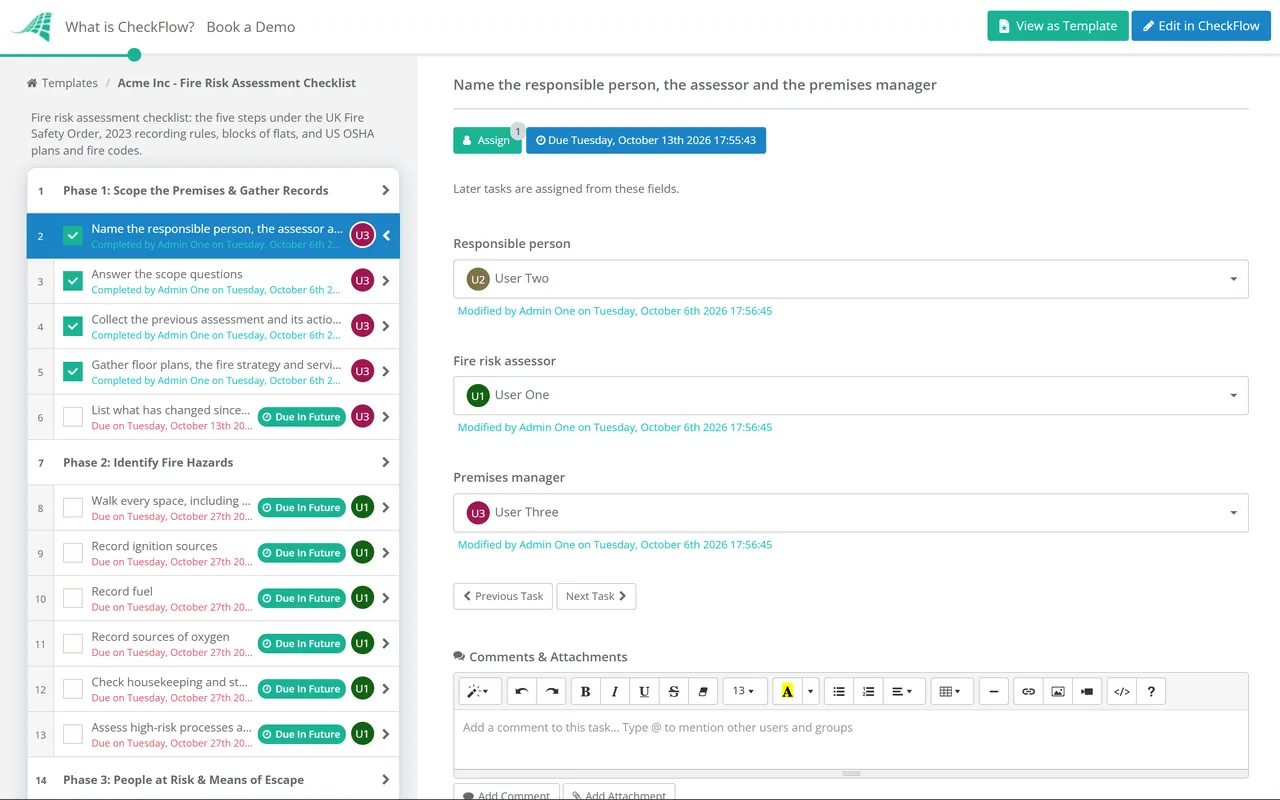
Name the responsible person, the assessor and the premises manager — later tasks are assigned from these fields
Answer the scope questions — sleeping accommodation, high-risk processes or flammable stock, and whether the building contains homes and is 11 metres or more
Collect the previous assessment and its action plan — and note which actions were never closed
Gather floor plans, the fire strategy and servicing records — alarm, emergency lighting, sprinklers and extinguishers
List what has changed since the last review — alterations, new tenants, changes of use, incidents and false alarms
2
Hazards
Phase 2: Identify Fire Hazards
6 tasks
Walk every space, including plant rooms, risers, stores and the outside — the cupboards nobody opens are where waste builds up
Record ignition sources — electrical equipment, charging points, heaters, cooking, hot work, smoking and arson risk
Record fuel — packaging, waste, furnishings, stock, flammable liquids and gases, and combustible external materials
Record sources of oxygen — mechanical ventilation, oxidising chemicals and any oxygen cylinders
Check housekeeping and storage — bins away from the building, nothing stored on escape routes
Assess high-risk processes and dangerous substances — shown only when the scope question says they are present; in Great Britain DSEAR requires its own assessment of these
3
People & Escape
Phase 3: People at Risk & Means of Escape
6 tasks
Map who is present by time of day — employees, visitors, contractors and lone workers, with peak numbers
Identify people especially at risk — disabled people, visitors unfamiliar with the building and lone workers, with a personal emergency evacuation plan where needed
Assess sleeping risk and night-time staffing — shown only when people sleep on the premises; sleeping occupants are slower to wake and react
Walk every escape route to a final exit — clear, openable without a key, signed and protected
Inspect fire doors and compartmentation — self-closers, gaps, seals, and holes cut through fire-resisting walls for cables
Check detection, warning and emergency lighting — the alarm is heard everywhere and routes stay lit in a power cut
4
Evaluate
Phase 4: Evaluate, Remove or Reduce the Risk
5 tasks
Rate the likelihood of a fire and the harm it would cause — one scale throughout, so the next review can compare
Remove or reduce each hazard from Phase 2 — and record what was fixed on the spot
Confirm firefighting equipment suits the hazards — the right extinguisher types, in date
Review the testing and servicing regime — alarm and emergency lighting tests and contractor servicing are recorded
Review management controls — hot work permits, contractor supervision and who keeps the fire safety logbook
5
If Residential
Phase 5: Buildings With Two or More Homes
5 tasks
Shown only when the building contains two or more sets of domestic premises. Tasks for buildings of 11 metres or more are shown only when that option is chosen.
Assess the structure, external walls and flat entrance doors — the Fire Safety Act 2021 confirmed these are within the Order, including cladding, balconies and windows
Issue fire safety instructions and fire door information to residents — to new residents soon after they move in and to everyone every 12 months under the Fire Safety (England) Regulations 2022
Check communal fire doors every three months and flat entrance doors annually — shown only for buildings of 11 metres or more; record the flats where access was refused
Identify residents who may need help to evacuate — residential PEEP duties apply in England from 6 April 2026 in buildings of 18 metres or seven storeys or more, and in buildings over 11 metres with a simultaneous evacuation strategy
Share fire risk information with residents and other responsible persons — such as a ground-floor shop operator, so precautions are coordinated
6
Record
Phase 6: Record the Assessment & Action Plan
6 tasks
Record the full assessment and the name of the assessor — every finding, not only the significant ones, as required since 1 October 2023
Write the action plan — each action with a priority, an owner and a deadline, the most serious first
Record the fire safety arrangements — who tests, maintains, trains and monitors, and how often
In the US, update the written emergency action plan and fire prevention plan — required in writing where OSHA calls for them and the employer has more than 10 employees
Responsible person approval of the assessment and action plan — required before the assessment is issued
Share the findings with employees — and with other employers in the building
7
Review
Phase 7: Emergency Plan, Training & Review
5 tasks
Update the emergency plan — evacuation strategy, calling the fire service and assembly point, then schedule a drill
Train staff and fire wardens — at induction, when risks change and periodically
Close each action with evidence — a photo of the new door closer or the contractor’s certificate, attached to the task
Set the review date and the triggers for an earlier one — alterations, a change of use, a fire or near miss, or a drill that went badly
Hand the assessment over if control changes — an outgoing responsible person must pass the relevant fire safety information to the incoming one
England and Wales have a single duty to assess fire risk, amended several times since 2021. The US has no general fire risk assessment law: OSHA’s written plans, the locally adopted fire code and, in practice, your insurer cover the same ground.
Question
England & Wales
United States
Who is responsible
The “responsible person” under the Regulatory Reform (Fire Safety) Order 2005: the employer, or the owner, landlord, occupier or anyone else in control of the premises
The employer, under OSHA 29 CFR 1910.38 and 1910.39; the owner or occupant under the locally adopted fire code, enforced by the fire marshal or local fire department
What must be produced
A suitable and sufficient fire risk assessment, kept under review, identifying the general fire precautions needed
An emergency action plan (reporting, evacuation, accounting for employees, contacts) and a fire prevention plan (major hazards, ignition sources, waste, maintenance of safeguards) where an OSHA standard requires them
Written record
The full assessment, the assessor’s name and the fire safety arrangements must be recorded for all premises since 1 October 2023; before that only where there were five or more employees, a licence or an alterations notice
Both plans must be written, kept in the workplace and available to employees, except that employers with 10 or fewer employees may communicate them orally
Method
Government guides and PAS 79-1:2020 or PAS 79-2:2020
NFPA 101 Life Safety Code, NFPA 1 Fire Code or the International Fire Code, as adopted and amended locally; insurers often add their own survey requirements
Residential buildings
Structure, external walls and flat entrance doors included (Fire Safety Act 2021); resident information, fire door checks and high-rise duties under the Fire Safety (England) Regulations 2022
Set by the adopted fire and building codes and by local inspection programmes rather than a federal rule
Review
Regularly, and whenever there is reason to think the assessment is no longer valid or the premises or their use change significantly
Review the emergency action plan with each employee when it is developed, when their duties change and when the plan changes
The October 2023 changes reached well beyond tall buildings. Section 156 of the Building Safety Act 2022 amended the Order from 1 October 2023 for all regulated premises. Small businesses and holiday lets must now record the assessment in full, responsible persons in shared buildings must cooperate, residents of buildings with two or more homes must be told the fire risks, and an outgoing responsible person must brief their successor. A duty that appointed assessors be competent is to be commenced later. The Fire Safety (England) Regulations 2022, in force since 23 January 2023, apply in England only.
Scotland and Northern Ireland are separate. Scotland’s duties sit in Part 3 of the Fire (Scotland) Act 2005 and the Fire Safety (Scotland) Regulations 2006. Northern Ireland uses Part 3 of the Fire and Rescue Services (Northern Ireland) Order 2006 and the Fire Safety Regulations (Northern Ireland) 2010. Check local guidance before reusing an English assessment there.
Why Run Fire Risk Assessments in CheckFlow?
1
The review never slips
A yearly schedule starts each building’s review on its due date, with the responsible person and assessor assigned. When the premises change, start an extra one the same day.
2
One template for every building
Three questions in Phase 1 tailor it. An office never sees the flat-door checks, and sleeping-risk and dangerous-substances tasks appear only where they apply.
3
Actions closed with proof
Walk-round photos and contractor certificates sit on the tasks that produced them. The responsible person’s sign-off holds the assessment until given, and the history shows an inspecting officer who did what and when.
Moving to a new office? Review the fire risk assessment for the new building, and how you will use it, before the move, and plan the rest of the move with the Office Relocation Checklist.
Describe the process in a sentence and the AI checklist generator drafts the phases and tasks for you.
Frequently Asked Questions
Is a fire risk assessment a legal requirement?
In England and Wales, yes, for almost all non-domestic premises and the common parts of blocks of flats, under the Regulatory Reform (Fire Safety) Order 2005. Scotland and Northern Ireland have their own laws. In the US there is no single fire risk assessment law: employers covered by the relevant OSHA standards need an emergency action plan and a fire prevention plan, and the locally adopted fire code sets further duties.
How often should a fire risk assessment be reviewed?
The Order sets no fixed interval. It requires a review regularly and whenever there is reason to think the assessment is out of date, for example after alterations, a change of use, a fire or a significant change in who uses the building. Many organisations review at least annually.
Can I do my own fire risk assessment?
Yes, if you have the knowledge. A small, simple workplace can often be assessed by its own manager using government guidance; complex, sleeping or residential premises usually need a professional assessor. The Building Safety Act 2022 added a requirement that anyone appointed to make or review the assessment must be competent, but that part had not been brought into force when this page was reviewed.
Do I have to write the fire risk assessment down?
In England and Wales, yes, since 1 October 2023, regardless of how many people you employ. The record must include all findings, the fire safety arrangements and the name of the person who carried out the assessment or review. Before that date, only premises with five or more employees, a licence or an alterations notice had to record the significant findings.
What is the difference between a fire risk assessment and a fire drill?
The assessment examines the building, its precautions and its management and produces an action plan. The drill tests the resulting emergency plan by evacuating people for real, and what it reveals feeds the next review.
Is CheckFlow free for this template?
14-day free trial, no card required. The Business plan is $10 per user per month after the trial. Full details at checkflow.io/pricing.
Keep Every Fire Risk Assessment Recorded, Signed Off and Acted On