Warehouse Employee Onboarding Checklist Template

A new warehouse starter can be walking aisles beside moving forklifts within an hour of arriving, and judged against a pick rate by the end of the week. The safety training and the targets are rarely written down anywhere they can both be checked.

This free warehouse employee onboarding checklist is for warehouse managers, shift supervisors and HR teams in distribution centres, third-party logistics sites and e-commerce fulfilment. It follows one new picker, packer, loader or operator through their first month: a traffic and site safety induction, PPE issued and fitted, manual handling practised on real loads, the WMS and scanner, each step of pick, pack and ship, and a ramp-up to full rate with safety check-ins along the way. Anyone who will drive a forklift or other powered truck also gets a training, evaluation and written authorisation phase. For a short induction given to every worker arriving at a building site, including subcontractors, use the Construction Site Induction Checklist. Contracts, payroll and benefits belong in the Employee Onboarding Checklist.

Use This Template Free See Live Example
No Credit Card Required

Last reviewed: October 2026

Two Pressures in the First Month: Traffic and Pace

Warehouse hazards do not wait for week two. On the first shift a starter shares aisles with lift trucks, crosses loading docks, works under high racking and lifts the same cartons hundreds of times. HSE guidance is that the most effective control is to keep people and vehicles on entirely separate routes, and that manual handling training only works when it is practical and based on the tasks the person will actually do. OSHA expects the same practical approach: PPE training ends with the worker showing they can use the equipment before doing work that needs it.

The second pressure is pace. Most sites measure picks, lines or units per hour, and a new starter cannot hit the site standard in their first week without cutting corners. A written ramp-up plan, agreed on day one and reviewed at set points, protects both sides. In several US states it is also a legal step: California, New York and Illinois are among those that require large warehouse distribution centres to give each worker a written description of any quota when they are hired.

Every starter

Pickers, packers, loaders and goods-in staff

Safety core: traffic routes, pedestrian zones, emergency exits and how to report a near miss.

Body: PPE fitted to them, and manual handling practised on the loads in their area.

Systems: WMS login, scanner, and each process from receiving to dispatch.

Signed off when: they work their area unaided at the agreed rate with no repeat errors.

Forklift and MHE operators

Counterbalance, reach, VNA and order-picker drivers

Everything above, plus training on each truck type they will drive.

Evaluation: a practical assessment in the workplace by a qualified person.

Authorisation: written, listing the truck types, before they drive unsupervised.

Review: a reassessment date set now, and retraining after any incident or near miss.

What the Warehouse Employee Onboarding Checklist Covers

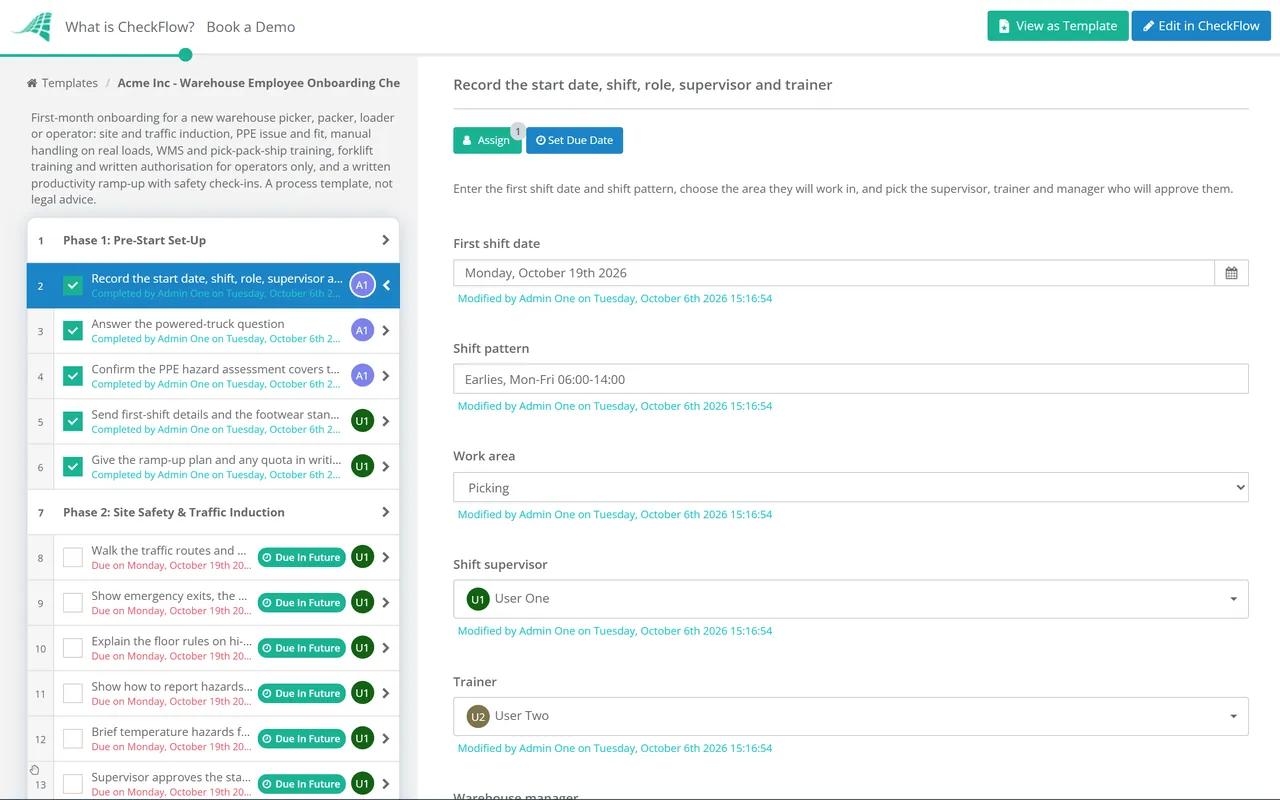
Six phases run from the week before the first shift to an approved full rate. The powered-truck phase appears only when the first phase records that the starter will drive one.

Phase 1

Phase 1: Pre-Start Set-Up

  • Record the start date, shift, role, supervisor and trainer — plus the area they will work in: goods-in, picking, packing or dispatch
  • Answer the powered-truck question — will they operate a forklift or other powered truck? In the US, the answer is always no for anyone under 18
  • Confirm the PPE hazard assessment covers the role — what the job needs: safety footwear, hi-vis, gloves, and freezer wear for chilled areas
  • Send first-shift details and the footwear standard — gate, locker, who to ask for, and the safety boots they need on arrival
  • Give the ramp-up plan and any quota in writing — the weekly targets, how rate is measured and what happens if it is missed
Phase 2

Phase 2: Site Safety & Traffic Induction

Done at the start of the first shift, before the starter goes onto the floor alone. It ends with a supervisor approval.

  • Walk the traffic routes and pedestrian zones — walkways, crossing points, blind corners, reversing areas and the dock edge
  • Show emergency exits, the assembly point, first aid and fire points
  • Explain the floor rules on hi-vis, phones and headphones
  • Show how to report hazards, near misses, racking damage and injuries
  • Brief temperature hazards for their area — cold store limits and breaks, or heat in summer and in trailers
  • Supervisor approves the starter to work on the warehouse floor
Phase 3

Phase 3: PPE Issue & Manual Handling

  • Issue PPE and check the fit — sizes and issue dates recorded, replacements free of charge
  • Train how to wear, check and replace each item — when it is needed, its limits, and how to spot when it is worn out
  • Run manual handling training on the real loads — the cartons, totes and sacks in their area, not a box in a training room
  • Show the handling aids and when to use them — pallet trucks, roll cages, conveyors, lift tables and team lifts
  • Observe the starter lift and move loads and record the result
Phase 4

Phase 4: WMS, Scanners & Pick-Pack-Ship

Train only the processes the starter will work. Each one is signed off when they do it correctly without prompting.

  • Set up the WMS login and assign a scanner — user permissions, handheld, ring scanner or voice headset
  • Train receiving and put-away — checking goods against the delivery, damage and labelling, scanning to location
  • Train picking, including short picks and exceptions — scan location then item, and what to do when the slot is empty
  • Train packing, labelling and dispatch checks — carton choice, void fill, shipping label, scan to close, carrier cut-off times
  • Train stock counts and damaged-goods handling — cycle counts and the quarantine area
  • Sign off each process on the training record
Phase 5 — If Operating Powered Trucks

Phase 5: Forklift & MHE Authorisation

Shown only when Phase 1 records that the starter will operate a forklift or other powered truck. Until the approval at the end, they drive only under close supervision.

  • Record previous training and the truck types needed — certificates from earlier jobs are evidence, not authorisation
  • Complete formal and practical training with a qualified instructor — off the job, away from production pressure
  • Run the practical evaluation in the workplace — on the truck and in the aisles they will use
  • Train the pre-use truck check — at least daily, and the truck stays out of service if a fault affects safety
  • Complete supervised familiarisation on site — real tasks and real loads under close supervision
  • Manager approves written authorisation for each truck type — with the next reassessment date recorded
Phase 6

Phase 6: Productivity Ramp-Up & Safety Check-Ins

Rate reviews and safety check-ins sit side by side, so nobody is pushed to full speed while a safety gap is still open.

  • Review rate and accuracy against the plan at the end of week one
  • Hold a two-week safety check-in with the starter — near misses seen, aches or strain, PPE that does not fit
  • Retrain any process with repeat errors — mis-picks, wrong labels, short shipments
  • Review rate, accuracy and safety at the end of week four
  • Supervisor approves the starter at full rate and working independently

Warehouse Safety Training Rules: US and UK Side by Side

The US writes its forklift rules into a federal standard with fixed intervals. The UK sets general duties to train and leaves the detail to an Approved Code of Practice and HSE guidance. Both arrive at the same three steps: train, assess in the workplace, then authorise in writing. Use it to build the checklist; it is not legal advice.

Topic United States United Kingdom
Forklift trainingFormal instruction, practical training and an evaluation of performance in the workplace, by a person with the knowledge and experience to train and evaluate (29 CFR 1910.178(l))Basic, specific job and familiarisation training. The first two, which can be combined, take place off the job; familiarisation happens on the job under close supervision (ACOP L117)
Proof of trainingThe employer certifies each operator: name, training date, evaluation date and who trained and evaluated themWritten authorisation from the employer naming the truck types. There is no such thing as a lift-truck licence, and basic training certificates are not legally required
ReassessmentEvaluation at least every three years, and refresher training after unsafe operation, an accident or near miss, a poor evaluation, or a change of truck or workplaceNo fixed period. Monitor operators and retest at set intervals; HSE says a retest every 3 to 5 years is one way to do it, with extra training after an accident or near miss
Minimum ageNobody under 18 may operate a forklift in non-agricultural work (Hazardous Occupations Order No. 7)Over the minimum school-leaving age; at least 18 in ports unless on a supervised training course
PPEA written, certified hazard assessment; training on when, what, how to wear, limits and care; employer pays, except non-specialty safety-toe footwear and prescription safety glasses that may be worn off sitePPE provided free where a risk assessment shows it is needed, with information, instruction and training. Since 6 April 2022 this covers limb (b) workers as well as employees
Manual handlingNo specific federal ergonomics standard; OSHA can cite serious recognised hazards under the General Duty ClauseAvoid hazardous manual handling where reasonably practicable, assess what cannot be avoided, and reduce the risk (Manual Handling Operations Regulations 1992)
QuotasIn states with warehouse quota laws, large distribution centres give each worker a written description of each quota at hireNo warehouse-specific quota law; general duties to assess risk still apply to work rate

Two points are moving. OSHA published a proposed federal rule on heat injury and illness prevention in August 2024 and held hearings in 2025, but no final rule has been issued. Some states already have their own: California’s indoor heat standard has applied since July 2024 to indoor workplaces that reach 82°F, which takes in many warehouses, and requires training before heat-exposed work begins. Warehouse quota laws are spreading: IllinoisWarehouse quota laws are also spreading, with Illinois the latest to take effect in January 2026.rsquo;s took effect in January 2026. The sources to check are OSHA 1910.178, OSHA 1910.132, HSE on lift-truck training, HSE on manual handling and OSHA’s heat rulemaking page.

Why Run Warehouse Onboarding in CheckFlow?

1

The forklift phase only for drivers

One answer on the second task decides whether the powered-truck phase appears. Pickers and packers never see it; operators cannot skip it, and the next reassessment date is captured on the authorisation so it can be tracked.

2

Approvals where the risk changes

The checklist halts until a supervisor approves the starter onto the floor, until a manager signs the written authorisation, and again before full rate. Due dates are counted from the start date, so the week-one and week-four reviews arrive on time.

3

A record that stands up after an incident

The PPE issue, the observed lift, the evaluation result and the signed authorisation sit on one checklist with names and timestamps. When something goes wrong, who was trained on what, and when, is already answered.

Warehouses hire in batches before peak. CheckFlow’s onboarding software runs a checklist per starter from one template and reports who is still waiting for sign-off.

Running pre-use truck checks, racking inspections or production-line routines too? CheckFlow for manufacturing and operations puts recurring floor checks on a schedule, next to the onboarding.

Frequently Asked Questions

Does a forklift driver need a licence?

+

Not in the sense of a public licence. HSE states that there is no such thing as a lift-truck licence in the UK: the employer gives written authorisation for the truck types the person has been trained on and assessed for. In the US, the employer certifies that each operator has been trained and evaluated, recording the operator’s name, the training and evaluation dates and who carried them out. A card from a previous employer or a training company is useful evidence in both countries, but it does not authorise anyone to drive at your site.

How often do forklift operators need to be reassessed?

+

In the US, OSHA requires an evaluation of each operator at least once every three years, and refresher training sooner after an accident or near miss, unsafe driving, a poor evaluation, or a change of truck type or workplace conditions. In the UK there is no fixed period. HSE expects operators to be monitored and retested at reasonable intervals, and suggests an automatic retest after a set period, such as three to five years, as one approach. Record the next date on the authorisation so it does not depend on memory.

Can a warehouse worker under 18 drive a forklift?

+

In the US, no. Federal child labor rules bar anyone under 18 from operating a forklift or other high-lift truck in non-agricultural work, whatever training they have had. In the UK, HSE guidance is that operators should be over the minimum school-leaving age, and at least 18 in ports unless they are on a properly supervised training course. Under-16s should never operate a lift truck.

Who pays for safety boots and other PPE?

+

In the UK, the employer provides PPE free of charge wherever the risk assessment shows it is needed, and since April 2022 that includes limb (b) workers as well as employees. In the US, the employer pays for required PPE, with a few exceptions: it does not have to pay for ordinary safety-toe shoes or prescription safety glasses if the worker is allowed to wear them away from the job. Protection beyond that, such as metatarsal guards, is the employerSpecialty footwear, such as metatarsal or insulated boots for a freezer, is the employer’s cost.rsquo;s cost.

How long should a productivity ramp-up last?

+

There is no legal standard, and the right length depends on the work. A common pattern is a reduced target that rises week by week over the first month, reviewed at the end of weeks one and four. Whatever you choose, give it to the starter in writing on day one. In US states with warehouse quota laws, large distribution centres must do this, and in California a quota cannot stop a worker taking meal or rest breaks or following health and safety rules.

Is CheckFlow free for this template?

+

14-day free trial, no card required. The Business plan is $10 per user per month after the trial. Full details at checkflow.io/pricing.

Every New Starter Safe on the Floor Before They Chase a Rate

Free trial — no credit card required.