Factory Relocation Checklist Template

A factory move is not finished when the last machine is bolted down. It is finished when the line makes good parts again at the new site and the customers have accepted them.

Last reviewed: October 2026

Printed from checkflow.io/templates/manufacturing-production/factory-relocation-checklist

This free factory relocation checklist runs one manufacturing relocation as a project plan: a production site, or one production line, moving to a new location. It is for plant and operations directors, engineering and maintenance leads, quality teams and the project lead who runs the move. One run covers the business case and the chosen site, the equipment register and the move sequence, the new building’s layout, foundations and utilities, permits, customers and regulators told, a production bank built ahead to cover the gap, the lifting plans, shutdown with every machine isolated, drained and dismantled, rigging, transport and reinstallation, inspection, re-qualification and first-off approval, and the decision to release production at the new site, then ramp-up and the old site handed back. Tasks for building work, customer re-approval (such as a PPAP resubmission) and a regulated product appear only when the move needs them, with short notes for Great Britain or the US.

Moving Machines and Proving the Process, Not Just Moving a Building

A factory move is finished when the line makes good parts again at the new site and the customers have accepted them, not when the last machine is bolted down. Before that, the new building has to take the machines, a bank of finished stock has to carry customers through the gap, every machine has to be isolated, lifted, moved, reinstalled and inspected, and the process has to be proved again.

This checklist runs one manufacturing relocation, a whole production site or one production line, from the business case to the old site handed back. It links out where a step has its own process: a customer’s PPAP resubmission runs in the PPAP Submission Checklist, a full first article inspection in the First Article Inspection Checklist, each machine’s isolation follows your Lockout/Tagout (LOTO) Procedure Checklist, and a change to the process that the move brings with it goes through the Management of Change (MOC) Checklist. Two other relocation checklists sit close to this one.

This checklist

One factory or production line move

Covers: the business case and equipment register, the new site’s layout, foundations and utilities, permits, customers and regulators, a production bank, lifting plans, isolation and decommissioning, rigging and reinstallation, re-qualification, first-off approval, the release decision, ramp-up and the old site handed back.

Owned by: the relocation project lead, with the plant or operations director deciding whether to release production at the new site.

Output: a line making approved parts at the new site, with the inspections and approvals recorded, and the old site closed.
Warehouse move

The Warehouse Relocation Checklist

Covers: racking and safety at the new site, the WMS location map, stock counts before and after the move, a phased transfer with orders shipped from both sites and the old building handed back.

Use it: for a warehouse or distribution centre, or for a factory’s finished goods store if it moves separately. Warehouse Relocation Checklist.

Office move

The Office Relocation & Office Move Checklist

Covers: people, desks, IT and telecoms, the fit-out, the lease exit, staff updates, move day and address changes, with no machinery.

Use it: for an office move, or for the offices that move with a factory. Office Relocation & Office Move Checklist.

What the Factory Relocation Checklist Covers

Nine phases take one factory or production line move from the business case to the old site handed back. The first task records the last production day at the old site, which sets every due date, and where the sites are; Phase 1 then asks whether customers require re-approval and whether the product is regulated, and the survey in Phase 2 asks whether building work is needed. Each answer adds its own tasks. The release decision is the gate: nothing after it can be completed until the release approver records it. Released with conditions or Not released adds a follow-up task.

  1. Phase 1

    Phase 1: Business Case, Scope & Timeline

    6 tasks

    Start once the business has decided to move, or while it chooses between sites. Enter the last production day at the old site on the first task: every task before it counts back in business days and every task after it counts forward. The first task asks where the sites are, and the fifth asks what customers and regulators require; each answer adds the tasks or notes it needs.

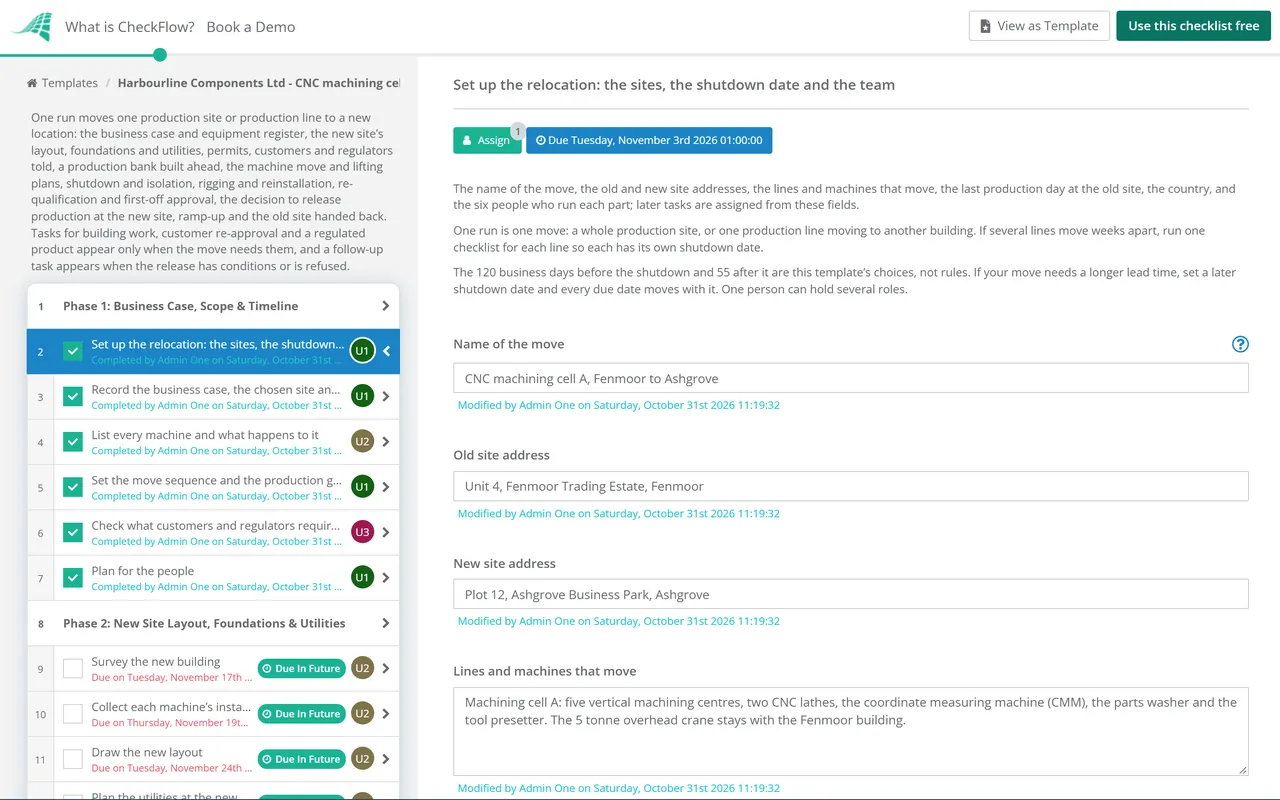
    • Set up the relocation: the sites, the shutdown date and the team — the name of the move, the old and new site addresses, the lines and machines that move, the last production day at the old site, the country, and the six people who run each part; later tasks are assigned from these fields
    • Record the business case, the chosen site and the budget — why the site or line is moving, the new site and why it was chosen, the options considered, the one-off costs and the approved budget
    • List every machine and what happens to it — each machine and asset, its weight, the services it needs, and whether it moves, is replaced, sold or scrapped, with the tooling, gauges, fixtures and spares that go with it
    • Set the move sequence and the production gap — the order the lines or machines move in, the move window, the planned restart date for each line and how many working days each part will have no production
    • Check what customers and regulators require for a change of site — the contracts, quality agreements and customer requirements that call for notice or approval before parts made at a new site are shipped, and any regulator that registers, licenses or approves the site where the product is made
    • Plan for the people — who moves with the work, who leaves, who is recruited and trained at the new site, and how the teams hand over, with HR and legal advice on any consultation
  2. Phase 2

    Phase 2: New Site Layout, Foundations & Utilities

    7 tasks

    The new building has to take the machines before they arrive: floor loading, a route in for the largest machine, foundations, power, air, water and extraction. The survey asks whether building work is needed; Yes adds the tasks to appoint the contractor and to accept the work before any machine is delivered.

    • Survey the new building — the floor slab and its loading, door, ceiling and crane heights, the route in for the largest machine, the existing services and anything to remove first
    • Collect each machine’s installation requirements — from the maker’s manuals or the maker itself: the foundation or base, anchoring and levelling, power, compressed air, water, extraction, the working environment and the maker’s instructions for moving it
    • Draw the new layout — machine footprints with space for maintenance and access, the flow of material, walkways kept apart from vehicles, storage, inspection areas and emergency routes, agreed with health and safety and quality
    • Plan the utilities at the new site — the electrical supply and distribution, compressed air, cooling water, gas, extraction, drainage and network for every machine, with capacity to spare and an isolation point for each
    • Appoint the designer and the building contractor — for the foundations, pits, services and structural work: the design, the programme, and who is responsible for health and safety while the work is done
    • Accept the completed building work — foundations and machine bases complete and checked against the drawings, services installed, and the contractor’s completion and handover documents received
    • Install and test the utilities before machines arrive — every supply installed, tested and labelled at each machine position, with each isolation point marked
  3. Phase 3

    Phase 3: Permits, Customers & Regulators

    5 tasks

    Find out what the new site needs before it can make product, and tell everyone who depends on the old one. The regulator and customer re-approval tasks appear when Phase 1 says they apply.

    • List the permits and registrations the new site needs — planning or building consents, environmental permits for the process, trade effluent and waste arrangements, fire safety, insurance, and what each permit at the old site requires when you leave
    • Ask the product regulator what the move needs — whether you must notify it, register the new site, wait for an inspection or get an approval before product made there is supplied, and how long each step takes
    • Agree a re-approval plan with each customer that requires one — what each customer wants to see from the new site (samples, a PPAP submission, a first article inspection, capability data or an audit), by when, and whether it will take parts from the production bank meanwhile
    • Tell customers the plan and the dates — the shutdown and restart dates, the production bank that covers the gap, who to contact, and any change to delivery addresses, lead times or paperwork
    • Tell suppliers, carriers, insurers and service providers — the new delivery and collection address, the dates, insurance for the machines in transit and at the new site, and the contracts that move or end
  4. Phase 4

    Phase 4: Production Bank & Stock

    5 tasks

    The production bank is the finished stock built ahead to supply customers while each line is down. This template sizes it part by part, builds it over the weeks before the shutdown and has quality release it before it is stored. How big a margin to hold is your decision.

    • Size the production bank for each part — each part’s demand for the working days its line will not run, plus a margin in case the restart is late, agreed with planning and, where it matters, with the customer
    • Secure the materials and capacity to build ahead — raw materials and bought-in parts, overtime or extra shifts, and any other site or subcontractor that will make parts during the move
    • Build the bank and track it against the plan — what has been built each week against the target for each part, with any shortfall raised as soon as it appears
    • Inspect and store the bank — the bank checked and released by quality, packed, labelled and stored where it can be shipped from during the move
    • Run down work in progress and materials at the old site — by the end of the last production day: work in progress finished or moved, materials and consumables used up or transferred, and a decision on what is moved, returned or scrapped
  5. Phase 5

    Phase 5: Machine Move Plan & Rigging

    6 tasks

    Plan every lift and every load before the shutdown. Moving a machine is a lifting operation, and dismantling or installing fixed plant can be construction work. Record each machine’s condition and settings now, so the re-qualification after the move has something to compare against.

    • Appoint the machinery mover or rigging contractor — their experience with machines of this size and type, their insurance, their method statements and the lifting equipment they will bring
    • Survey each machine with the mover — its weight, centre of gravity and lifting points, what has to be dismantled, the transport frames or skids it needs, and the route out of the old building and into the new one
    • Write and approve the lifting plans — for each lift: the lifting equipment, the slinging, the people, the exclusion zone and who supervises, written by someone competent for lifts of that kind
    • Book the transport and the insurance in transit — vehicles suited to each load, any permits or notice an abnormal load needs, the delivery sequence, and insurance cover from the old floor to the new one
    • Record each machine’s condition and settings before shutdown — photographs, levels and alignment, known faults, programs and parameters backed up, and current capability or measurement data to compare with after the move
    • Confirm the move is ready to start — the bank built and released, customers told, the new site’s foundations and utilities ready, the lifting plans approved and the mover booked; anything not ready is a reason to move the shutdown date
  6. Phase 6

    Phase 6: Shutdown, Isolation & Decommissioning

    4 tasks

    Production stops on the shutdown date. Every machine is isolated from every energy source before anyone dismantles it, and stays isolated until it is reconnected and inspected at the new site.

    • Run the last production and close the orders at the old site — the last parts made, inspected and added to the bank, and open work orders closed or moved to the new site
    • Isolate each machine from every energy source — electrical, pneumatic, hydraulic and gas supplies and stored energy such as springs, accumulators and raised parts, locked and tagged, with the isolation verified before work starts
    • Drain, clean and make each machine safe to move — oils, coolants, hydraulic fluid and process chemicals drained into labelled containers and sent for reuse or disposal, and moving parts secured for transport
    • Disconnect, dismantle and label each machine — cables, pipes and guards removed with match marks, parts labelled to their machine, fixings bagged, and tooling, gauges, fixtures and spares packed as controlled items
  7. Phase 7

    Phase 7: Rigging, Transport & Reinstallation

    6 tasks

    Each machine is lifted to its plan, moved and set down on its new base. No machine is used at the new site until it has been installed to the maker’s instructions, reconnected and inspected.

    • Lift and load each machine to its lifting plan — the lifting equipment checked before use, the exclusion zone in place and each lift supervised
    • Receive and check each machine at the new site — each machine checked for damage against the photographs taken before shutdown, before it is moved into place
    • Position, level and anchor each machine — on its base, to the layout and the maker’s installation instructions
    • Reconnect the utilities and refit the guards — power, air, water and extraction reconnected by competent people with the machine still isolated, guards and safety devices refitted, and isolation points labelled
    • Inspect each machine before it is used — a recorded check that each machine is installed correctly and safe to operate, with its guards, emergency stops and interlocks fitted, before energy is restored; their function is tested when the machine is commissioned
    • Brief and train the people at the new site — the new layout, emergency routes and isolation points, and any change to how each machine is set up or operated after the move
  8. Phase 8

    Phase 8: Re-qualification, First-Off & Release

    7 tasks

    Prove the moved line makes good parts before it makes product for customers. The customer and regulator tasks appear when Phase 1 says they apply. The release decision is the gate: nothing after it can be completed until the release approver records it.

    • Commission and test each machine — dry runs, function tests, safety devices and controls, with programs and parameters restored and checked against the backup
    • Recalibrate the gauges and measuring equipment — every gauge, fixture and measuring instrument that moved, checked or calibrated before it is used to accept parts
    • Re-qualify the process — capability or validation runs compared with the data recorded before the move, and any difference investigated
    • Make and approve the first-off parts — the first parts from the moved line inspected against the drawing, with a full first article inspection where the customer or your quality system requires one
    • Get each customer’s approval of parts from the new site — what each customer asked for in its re-approval plan sent, and each decision recorded, with any interim approval or conditions
    • Send the regulator what it asked for — the notification, registration or evidence the regulator asked for in Phase 3, with its reply or inspection result recorded before product from the new site is supplied
    • Decide whether to release production at the new site — the release approver reviews the inspections, the re-qualification, the first-off approval and any customer and regulator replies, and records the decision
  9. Phase 9

    Phase 9: Ramp-Up & Old Site Hand-Back

    7 tasks

    Once production is released, bring each line up to full rate, use the bank down and close the old site. Released with conditions adds a task to meet them, and Not released adds a task to fix what stopped the release.

    • Meet the conditions of the release — each condition the release approver recorded, met and evidenced before the line runs at full rate
    • Fix what stopped the release — the inspection, re-qualification, first-off or approval that was not ready, fixed and done again, and customers told if the bank will not cover the extra days
    • Ramp up to full rate and watch quality — output, scrap and rework, downtime and customer feedback each week against the plan, with extra checks on the first deliveries
    • Use the bank down and return stock to normal — ship from the bank until the line is at full rate, then bring finished stock back to its normal level and deal with any surplus
    • Clear and hand back the old site — machines, materials and waste removed, foundations and pits made good or left as the lease says, services made safe, and the keys returned on the agreed date
    • Close the old site’s permits, accounts and registrations — permits surrendered, utilities, waste and service contracts ended, and insurance and registrations moved or cancelled
    • Review the move and record the lessons — against the timeline, the budget, the production bank, quality after the restart and customer feedback, and what to change for the next move

Factory Move Rules and Timing at a Glance

The rules that shape a factory move, Great Britain and US

The points that apply when machines are isolated, lifted, moved and reinstalled, with the source for each. The country chosen on the first task shows the matching notes in the checklist.

Point Great Britain United States Where in the checklist
Isolating machinesPUWER regulation 19: suitable means to isolate work equipment from all its sources of energy, and reconnection that exposes no one to risk29 CFR 1910.147: documented energy control procedures for servicing and maintenance, which include installing and setting up machines; isolation verified before work starts; not construction employmentPhase 6
Lifting operationsLOLER regulation 8: every lifting operation properly planned by a competent person, appropriately supervised and carried out safely29 CFR 1910.184(c): safe operating practices for slings, such as no loading beyond rated capacity and everyone kept clear of suspended loadsPhases 5 and 7
Lifting equipment and slingsLOLER regulation 9: where deterioration could lead to danger, accessories for lifting thoroughly examined at least every 6 months and other lifting equipment every 12, unless an examination scheme says otherwise; equipment from another business used only with evidence of its last examination29 CFR 1910.184(d): slings and their fastenings inspected by a designated competent person each day before usePhase 7
Machines after installationPUWER regulation 6: equipment whose safety depends on its installation inspected after assembly at a new site, with the result recorded; LOLER regulation 9(2) for lifting equipment such as cranes29 CFR 1910.147(e): before energy is restored, the work area inspected, machine components operationally intact and employees safely positioned and toldPhase 7
Building and installation workCDM 2015: construction work includes fitting out, de-commissioning and dismantling a structure, which includes fixed plant; notifiable over 30 working days with more than 20 workers at once, or over 500 person days1910.147 does not cover construction employment: ask your safety adviser which standards apply to building workPhases 2 and 5
Environmental permitsEngland: a permit to operate an installation, from the Environment Agency or your local council; pay for it until it is surrendered. In Scotland ask SEPA, and in Wales Natural Resources WalesNo federal rule is cited here: ask your state environmental agency what the process needsPhases 3 and 9
Customers and regulatorsYour customers’ own requirements, such as a PPAP resubmission, and your product regulator’sThe samePhases 1, 3 and 8

How the timeline fits together

Every due date counts in business days from the last production day at the old site, entered on the first task. Public holidays are not skipped, so check the dates that fall near them.

Stage What happens Due, in business days from the last production day Phase
Business case and scopeSites, equipment register, move sequence, customer and regulator requirements, people120 to 115 beforePhase 1
New siteSurvey, installation requirements, layout, utilities, any building work110 to 15 beforePhase 2
Permits and noticesPermits, regulator, customer re-approval plans, customers and suppliers told100 to 75 beforePhase 3
Production bankSized, built, released and stored; old site run down95 before to the last production dayPhase 4
Move planMover, machine survey, lifting plans, transport, baseline, readiness70 to 2 beforePhase 5
ShutdownLast production, isolation, draining, dismantlingOn the day to 3 afterPhase 6
Move and reinstallLifts, arrival checks, positioning, reconnection, inspection, briefing4 to 12 afterPhase 7
Prove and releaseCommissioning, calibration, re-qualification, first-off, approvals, release decision13 to 23 afterPhase 8
Ramp-up and hand-backFull rate, bank used down, old site handed back, permits closed, review25 to 55 afterPhase 9

Sources. legislation.gov.uk: PUWER 1998 regulation 6, regulation 19, LOLER 1998 regulation 8, regulation 9, CDM 2015 regulations 2, 4, 5 and 6; HSE: Inspection of work equipment, Planning and organising lifting operations and Thorough examinations of lifting equipment; gov.uk: Check if you need an environmental permit and Change, transfer or cancel your environmental permit (England); SEPA authorisations (Scotland); Natural Resources Wales environmental permits (Wales); eCFR: 29 CFR 1910.147 and 1910.184. PPAP is named here as a customer requirement, not quoted. The timings in the second table are this template’s choices: change the offsets to fit your move. This table is not legal advice.

Why Run Your Factory Move in CheckFlow?

1

No customer parts until production is released

The release approver chosen on the first task is the only person who can record the decision to release production at the new site, and nothing after it can be completed until they do. Before it sit the machine inspections, the re-qualification, the first-off approval and, where they apply, each customer’s and the regulator’s replies. A release with conditions or a refusal adds the task that follows it up.

2

Only the tasks this move needs

Four answers shape the run. Customers that require re-approval add a plan with each customer and a task to record their decisions, a regulated product adds the regulator’s tasks, and building work at the new site adds the contractor and the hand-over of the finished work. Choosing Great Britain or the United States shows short, sourced notes on isolation, lifting, inspection, CDM and permits on the tasks they affect.

3

Every date counts from the shutdown

Enter the last production day at the old site and every task gets a due date in business days, from the business case 24 weeks before to the review 11 weeks after. If the shutdown moves, change the date and the whole plan moves with it. Tasks are assigned from the six people named on the first task, the Reports Grid lists every move with its answers, and Analytics shows overdue work.

CheckFlow is not a project scheduling tool or a maintenance system, and it does not move machines. It runs the plan around the move: who owns each step, by when, with what evidence, and who released production. Your lifting plans, your mover’s method statements, your own isolation procedures and your customers’ requirements still do their jobs. See how a running checklist works.

Once the line is running, keep each machine’s isolation procedure in the Lockout/Tagout (LOTO) Procedure Checklist and its servicing in the Equipment Maintenance Workflow Checklist, keep moved gauges on schedule with the Calibration Management Checklist, and run any new machine bought for the new site through the Factory Acceptance Test (FAT) Checklist before it ships. People who move house with the work can follow the Employee Relocation Checklist. CheckFlow’s manufacturing checklist software shows how plants run their other routines the same way.

AI generator

Didn’t find what you need? Describe it.

Describe the process in a sentence and the AI checklist generator drafts the phases and tasks for you.

Frequently Asked Questions

What should a factory relocation checklist include?

This template covers nine stages: the business case, scope and timeline; the new site’s layout, foundations and utilities; permits, customers and regulators; a production bank built ahead; the machine move plan and lifting plans; shutdown and isolation; rigging, transport and reinstallation; re-qualification, first-off approval and the release decision; and ramp-up with the old site handed back. Building work, customer re-approval and a regulated product add their own tasks only when they apply.

What goes into a factory relocation project plan?

Start from the last production day at the old site and plan in both directions. This template counts every due date in business days from that one date: the business case about 24 weeks before it, the production bank and lifting plans in the weeks before, then shutdown, the move, re-qualification and the release decision in the five weeks after, and the old site handed back about nine weeks after. Those offsets are this template’s choices, and changing the date moves every task.

How much stock should you build before moving a production line?

Enough to cover each part’s demand for the working days its line will not run, plus a margin in case the restart is late. This template sizes the bank part by part in Phase 4, about 19 weeks before the shutdown, tracks what is built each week, and has quality release it before it is stored. How big the margin is, and whether a customer agrees it, is your decision: no rule sets it.

Do machines need to be inspected after a factory move?

In Great Britain, yes where a machine’s safety depends on how it is installed. PUWER regulation 6 requires an inspection after assembly at a new site or in a new location, to ensure it has been installed correctly and is safe to operate, with the result recorded. Lifting equipment whose safety depends on how it is installed, such as a crane that moves with the line, is thoroughly examined after assembly under LOLER regulation 9. This template records both in Phase 7, before production is released.

Does lockout/tagout apply when machines are moved?

In the US, 29 CFR 1910.147 covers servicing and maintenance where unexpected energisation or start-up could injure employees, and defines that work to include installing, setting up and adjusting machines. It does not cover construction employment. In Great Britain, PUWER regulation 19 requires suitable means to isolate work equipment from all its sources of energy, and reconnection that exposes no one to risk. This template isolates every machine the day after shutdown and logs who verified it; the Lockout/Tagout (LOTO) Procedure Checklist covers each isolation in detail.

Do customers need to approve parts made at a new factory?

It depends on the customer. A customer that uses PPAP may require a new submission when production moves to another site, and other contracts and quality agreements may ask for notice, samples or a first article inspection. This template asks in Phase 1 whether any customer requires approval, agrees a plan with each one in Phase 3 and records each decision before production is released. The PPAP Submission Checklist runs the submission itself.

Does CDM apply to a factory relocation?

It can, in Great Britain. CDM 2015 defines construction work to include fitting out, commissioning, de-commissioning and dismantling a structure, and its definition of a structure includes fixed plant; installing or removing fixed electrical, compressed air and similar services counts too. A project is notifiable to HSE if the work is scheduled to last longer than 30 working days with more than 20 workers at once, or to exceed 500 person days. Ask your adviser how it applies to your move.

Can I use this instead of a factory relocation checklist in Excel?

Yes. A spreadsheet lists the tasks; this template also assigns each one to a person named on the first task, gives it a due date counted from the shutdown date, stops at the release decision and records who completed what and when. For a paper copy, use Print this checklist on this page, which prints the phases with a tick box for each task, or print a running checklist from your browser.

Is CheckFlow free for this template?

14-day free trial, no card required. The Business plan is $10 per user per month after the trial. Full details at checkflow.io/pricing.

Plan Every Step of Your Factory Move

Free trial — no credit card required.

14-day free trial, no credit cardFull refund in your first 30 daysUS hosting, EU on request