Contractor Management Checklist Template

A contractor on your site brings their risks into your workplace and walks into yours. Check they can do the job, agree how it will be done, approve the start, watch the work, and hand the area back only when it is safe.

Last reviewed: November 2026

Printed from checkflow.io/templates/operations-facilities-management/contractor-management-checklist

Contractor management is how a business that brings a contractor onto its premises keeps that job safe and under control: the roofer fixing a leak, the engineer servicing a lift, the electrician adding a circuit, the cleaning firm working at height. This free contractor management checklist is for facilities managers, site managers and health and safety leads who host contractors. One run is one contractor job on your site. It starts with the job and its hazards, checks the contractor’s competence, insurance and licences, sends them your site information and reviews their risk assessment and method statement (RAMS). You then agree how the work fits around your people, and an approver authorises the start. On the first day the contractor’s people are signed in, inducted and given any permits. The work is spot-checked until it finishes, then inspected, signed off and handed back, and a review scores the contractor for your approved contractor list. Tasks for permits, construction duties, an insurance shortfall, a problem found on a check, an incident and a low score appear only when they apply. A country question at the start adds short notes on the rules in the UK or the US.

Contractor Management Covers One Job on Your Own Site

Contractor management is the host’s side of one job: you own the site, the contractor does the work, and both of you have duties to each other’s people. This template follows the steps in HSE’s Using contractors: a brief guide: identify the job, select a suitable contractor, assess the risks, give information, co-operate and co-ordinate, consult your workforce, manage and supervise the work, then review it. It keeps the approval to start in one place, with one person who can stop the job.

Approving a construction firm once, before it joins your supply chain, is the Subcontractor Prequalification Checklist. The induction each worker gets on a construction site is the Construction Site Induction Checklist, which this template links to on its first day. Engaging an individual contractor through HR, with the contract, classification checks and system access, is the Contractor Onboarding Checklist. The permits themselves are the Permit to Work Checklist, the Hot Work Permit Checklist, the Confined Space Entry Checklist and the Lockout/Tagout Checklist: this template plans, issues and closes them by name and leaves the steps to those checklists. Bringing a new supplier into your business, from risk tiering to payment set-up, is the Vendor Onboarding Checklist.

Contractor management

The host’s checklist for one job on its own premises

Asks: can this contractor do this job safely here, and is the work done as agreed?

When: every time a contractor comes to work on your site.

Output: checked competence and insurance, accepted RAMS, an approval to start, a spot check log, a signed-off job and a score for your approved list.

Subcontractor prequalification

A construction firm approved once, before any job

Asks: should this firm be on our approved list at all?

When: before a firm is first used, and when it is re-qualified.

Output: a scored questionnaire and an approval decision.

Permit to work

One high-risk task inside the job

Asks: is it safe to start this specific high-risk task now?

When: for each hot work, confined space, isolation or other permitted task.

Output: a permit issued, accepted and handed back.

What the Contractor Management Checklist Covers

Eight phases take one job from its scope to a score for the contractor. The first task records the site, the contractor, the planned start and finish, the country and whether the job is construction work: the preparation falls due in the three working weeks before the start, the first-day tasks in the hours after it, the checks before the finish, and the hand-back and review in the two working weeks after it. Allow at least eight hours between the planned start and the planned finish. Any work that needs a permit adds tasks to plan, issue and close the permits. Cover below your minimum adds an insurance task for the approver. The approval in Phase 4 is assigned to the approver alone, and nothing from Phase 5 on can be completed until they approve the start.

  1. Phase 1

    Phase 1: Define the Job

    4 tasks

    Owned by the host manager, the facilities or site manager who brings the contractor onto your premises. Say what the work is, where it happens, who it affects and how risky it is before you choose who does it. The first task sets the dates and the people: every due date counts from the planned start or the planned finish.

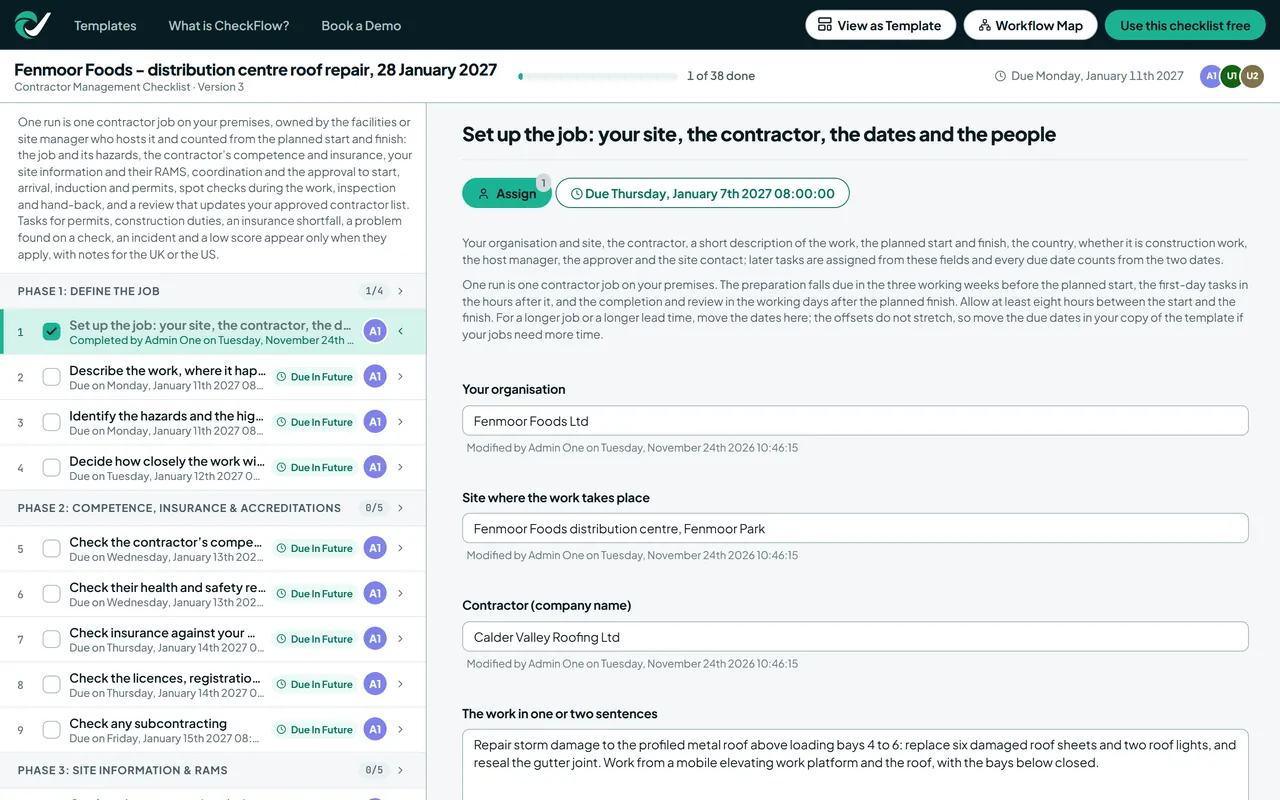
    • Set up the job: your site, the contractor, the dates and the people — your organisation and site, the contractor, a short description of the work, the planned start and finish, the country, whether it is construction work, the host manager, the approver and the site contact; later tasks are assigned from these fields and every due date counts from the two dates
    • Describe the work, where it happens and who it affects — the scope, the exact locations, the hours of work, the areas, services and equipment it touches, the staff, visitors and other contractors nearby, and the most workers the contractor will have on site at once
    • Identify the hazards and the high-risk work — the hazards the job brings to your site, the hazards your site brings to the job (asbestos, vehicles, live services, fragile roofs, chemicals), the kinds of work your permit to work system covers, and a risk level for the job
    • Decide how closely the work will be supervised — who supervises for you and for the contractor, how often you will check the work, what equipment the contractor may use, and how either side stops the work if there is a serious concern; the higher the risk, the closer the checks
  2. Phase 2

    Phase 2: Competence, Insurance & Accreditations

    5 tasks

    Check that this contractor can do this job safely before you agree the details. The depth of the checks follows the risk level from Phase 1. A contractor already on your approved list still needs current insurance and the right people for this job.

    • Check the contractor’s competence for this job — the skills, experience and qualifications of the people who will come, similar work done before, references, and whether the contractor is already on your approved contractor list
    • Check their health and safety record and arrangements — recent accidents and ill health, any enforcement action against them, their health and safety policy and risk assessments for similar work, and the training their workers get
    • Check insurance against your minimums — the public liability and employers’ liability (or workers’ compensation) cover the contractor holds, the minimums you require for this job, the dates the cover runs to, and the certificates
    • Check the licences, registrations and cards the work needs — any licence or registration the law requires for this kind of work where the site is, the cards or certificates of the people who will come, and any accreditation your own policy asks for
    • Check any subcontracting — whether the contractor will use subcontractors, who they are, and how the contractor checks their competence
  3. Phase 3

    Phase 3: Site Information & RAMS

    5 tasks

    Tell the contractor about your site before they plan the job, then review their risk assessment and method statement (RAMS) against what you know. Agree who provides equipment, personal protective equipment (PPE) and welfare before the job is approved.

    • Confirm the construction duties that apply — who the client and the contractors are, the information the contractor must have before the work starts, the construction phase plan, welfare, and whether the project must be notified; applies only when the job is construction work
    • Send the contractor your site information — the risks from your site and your work, the controls you have in place, your site rules, emergency procedures and who runs an evacuation, the asbestos register where there is one, and the job specification
    • Receive the contractor’s risk assessment and method statement — the risk assessment for this job and the method statement that sets out, step by step, how the work will be done safely, with the controls for each risk
    • Review the RAMS against the job and your site — every hazard from Phases 1 and 3 covered, controls that fit your site, the sequence of work, emergency and rescue arrangements, and anything to change; do not complete this task until the RAMS is accepted
    • Agree the equipment, PPE and welfare arrangements — the equipment the contractor brings and any of yours they may use, who provides each item of PPE, access routes, storage, parking, toilets, washing and rest facilities, and any services they need
  4. Phase 4

    Phase 4: Coordination & Approval to Start

    6 tasks

    Agree how your people and the contractor’s will work side by side, plan any permits, and tell the people the work affects. The approver then authorises the start: nothing on site can be completed until they do.

    • Agree how you will work together during the job — the contacts on each side, how the work fits around your operations and any other contractors on site, start-of-day meetings, how changes are agreed, and how the contractor reports a concern
    • Plan the permits and isolations — which permits the work needs, who issues and who accepts each one, the isolations and gas tests, and when they will be issued on the first day; applies only when the job includes work that needs a permit
    • Tell your staff and anyone else affected — what the work is, when and where, routes or areas closed, any noise, dust or disruption, and how to raise a concern about the contractor’s work
    • Resolve the insurance shortfall before the start — a certificate showing cover at or above your minimum, or the approver’s written acceptance of the risk with the reason; applies only when the cover is below a minimum
    • Put right what stopped the approval — the missing evidence, the RAMS changes or the arrangements the approver asked for; then ask the approver to change the decision to Approved and complete the next task
    • Authorise the work to start — the approver checks the competence, insurance, RAMS, coordination and any permits planned, then completes this task with the decision
  5. Phase 5

    Phase 5: Arrival, Induction & Permits

    5 tasks

    The first hours on site, before the work begins. Check the people who arrive are the people you approved, give them your site induction, issue any permits and see the work area set up as agreed.

    • Sign the contractor’s people in — names checked against the people approved, cards or passes, vehicles, and the sign-in record used for your emergency roll call
    • Give the contractor your site induction — your site rules, emergency procedures and assembly point, first aid, welfare, the hazards on your site, the areas they may and may not enter, and who to report to; record who was inducted
    • Check the workers have been briefed on the RAMS — the contractor’s supervisor briefs their team on the method statement and the controls before the work starts, and the team signs to say they understand it
    • Check the work area is set up as agreed — barriers, signs and exclusion zones in place, access and escape routes clear, equipment inspected, and your own staff kept out of the area
    • Issue the permits and confirm the isolations — each permit issued, accepted and displayed, the isolations in place and tested, and the gas tests done where the work needs them; applies only when the job includes work that needs a permit
  6. Phase 6

    Phase 6: Supervision & Spot Checks

    6 tasks

    Keep checking the work against what was agreed until the job is finished, and act at once on anything that is not. The checks fall due before the planned finish; an incident or a check that finds a problem adds its own task.

    • Check the work on the first day — the controls in the RAMS in place, permits followed, PPE worn, housekeeping and the area kept safe for your own people
    • Spot-check the work against the RAMS and permits — checks at the frequency planned in Phase 1, each one logged with what was found and what was done, until the work is finished
    • Review progress and any changes with the contractor — progress against the planned finish, any change to the scope, method, people or dates agreed before it happens, and a revised RAMS where the method changes
    • Record any accident, near miss or dangerous occurrence — anything that hurt someone or could have, during the job, whether to the contractor’s people, your staff or visitors
    • Stop the work and put it right — the work stopped or changed, the cause agreed with the contractor’s supervisor, the correction made, and the work checked before it restarts; applies only when a check found the work not as agreed
    • Investigate and report the incident — the facts gathered, who reports it to the regulator, the causes, and the actions agreed with the contractor; applies only when there was an incident
  7. Phase 7

    Phase 7: Completion, Inspection & Hand-Back

    7 tasks

    Close the permits, inspect the finished work with the contractor and hand the area back to the people who use it. The host manager signs the job off once the documents are in.

    • Close the permits and remove the isolations — every permit handed back and cancelled, the isolations removed only when it is safe, and the plant or services returned to use; applies only when the job included work that needs a permit
    • Inspect the finished work with the contractor — the work against the specification, any snags listed with a date to put them right, and the area checked again once they are
    • Check the area is clear, clean and safe — waste, materials and equipment removed, guards, covers and barriers restored, fire systems and services back in service, and nothing left that could harm the people who use the area
    • Sign the contractor’s people out — every worker signed out, passes, keys and access cards returned, and any access to your systems or buildings removed
    • Hand the area back to the people who use it — the area manager or team told it is ready, any new instructions for using it, and their confirmation
    • Collect the completion documents — certificates, test results, warranties, manuals and drawings for the work, and anything the construction duties require; store them with the site records
    • Sign off the completed job — the host manager checks the work is accepted, the area handed back and the documents in, then completes this task with the decision
  8. Phase 8

    Phase 8: Review & Approved Contractor List

    5 tasks

    Learn from the job while it is fresh, score the contractor, and keep your approved contractor list current for the next job.

    • Review the job with the contractor — what went well, what did not, any incidents or near misses, and what either side would change next time
    • Score the contractor’s performance — safety, quality of work, keeping to time, and communication, each scored 1 to 5, with an overall score and the reason
    • Agree improvements or take the contractor off the approved list — what must improve before the contractor is used again, or the decision to remove them from your approved list, and the contractor told; applies only when the overall score is below 3
    • Update your approved contractor list — the contractor’s status, the score, and the end dates of their insurance, licences and cards for the next job
    • Share the lessons and close the job — changes to your site information, induction or RAMS checks for next time, shared with the people who host contractors

The Rules Behind Hosting a Contractor in the UK and the US

The rules below are the ones the template’s notes name. Each note appears only for the country chosen on the first task. This is a summary, not legal advice: check the full text for your site, and your own contract with the contractor. The UK notes cover Great Britain and name the Northern Ireland equivalents. The US notes cover federal OSHA; states with their own OSHA-approved plans may have their own rules.

Rule Where it applies What it asks of the host (in short) Where it is in this template
Health and Safety at Work etc. Act 1974, section 3Great BritainConduct your undertaking so that, so far as is reasonably practicable, people not in your employment are not exposed to risks to their health or safetyEvery phase
Management of Health and Safety at Work Regulations 1999, regulation 11Great Britain (Northern Ireland: the 2000 Regulations, regulation 11)Where employers share a workplace: co-operate, take all reasonable steps to co-ordinate, and inform each other of the risksPhase 4, agree how you will work together
Management of Health and Safety at Work Regulations 1999, regulation 12Great BritainGive the outside workers’ employer comprehensible information on your risks and controls, and who runs evacuation for themPhase 3, site information; Phase 5, induction
Construction (Design and Management) Regulations 2015, regulations 4 and 6Great Britain (Northern Ireland: CDM 2016)For construction work, including repair and maintenance: the client’s arrangements, pre-construction information, a construction phase plan, and notice to HSE above the thresholdsPhase 3, construction duties (shown for construction work)
Employers’ Liability (Compulsory Insurance) Regulations 1998, regulation 3Great BritainThe contractor, as an employer, insures for at least £5 million; your public liability minimum is your ownPhase 2, insurance
RIDDORGreat BritainReports are made by the responsible person, such as employers for their workers and those in control of work premisesPhase 6, incident (shown when there is one)
OSHA Multi-Employer Citation Policy, CPL 02-00-124United States (federal OSHA)A controlling employer must exercise reasonable care to prevent and detect violations on the sitePhase 1, supervision; Phase 6, spot checks
29 CFR 1910.1200(e)(2), hazard communicationUnited StatesSay how other employers on site get safety data sheets and are told the precautionsPhase 3, site information
29 CFR 1910.119(h), process safety managementUnited States, processes the standard covers onlyCheck the contractor’s safety performance, tell them of fire, explosion and toxic release hazards, control their entry and exit, and keep an injury logPhase 2 and Phase 3
29 CFR 1910.12 and Part 1926United StatesConstruction work, including repair, follows the construction standardsPhase 3, construction duties
29 CFR 1904.31United StatesWhoever supervises the worker day to day records their injury or illnessPhase 6, incident

About HSE’s guide. Using contractors: a brief guide (INDG368) is HSE’s free leaflet for businesses that use contractors. It dates from 2012 and still refers to the 2007 construction regulations, which the Construction (Design and Management) Regulations 2015 now cover. Its steps and its checklist still match the duties above, and this template follows them.

Insurance. CheckFlow cannot compare one of your figures with another, so the template asks for the cover held and your minimum as numbers, and you choose whether the cover meets the minimum. Below the minimum adds a task for the approver before the start can be approved.

Why Manage Contractors in CheckFlow?

1

One person approves the start

The approval is assigned to the approver alone, and nothing on site can be completed until they decide. If they cannot approve it, a task appears for the host manager to put right what is missing. An insurance certificate below your minimum adds its own task before the approval step.

2

Only the tasks the job needs

Tick hot work, work at height or a confined space, and the tasks to plan, issue and close the permits appear. Say the job is construction work and the construction duties task appears. A spot check that finds a problem, an incident or a low score each adds its own follow-up.

3

Your approved list stays current

Each job ends with a score and the end dates of the contractor’s insurance and licences. The Reports Grid shows every contractor job in progress and the tasks that are overdue, and the record of each job stays with its checklist.

CheckFlow records the job; the duties are yours and the contractor’s. Everything is assigned to your own people from the first task, so the host manager, the approver and the site contact each see their own work. See how CheckFlow’s checklists work.

Approve construction firms once with the Subcontractor Prequalification Checklist, and induct each worker on a construction site with the Construction Site Induction Checklist. Run the permits with the Permit to Work Checklist and the Hot Work Permit Checklist, and investigate an incident with the Workplace Accident Investigation Checklist. The Health & Safety Risk Assessment Checklist covers your own site’s risk assessment, which the contractor needs to see.

AI generator

Didn’t find what you need? Describe it.

Describe the process in a sentence and the AI checklist generator drafts the phases and tasks for you.

Frequently Asked Questions

What is a contractor management checklist?

A contractor management checklist is the list a business works through when it brings a contractor onto its premises for a job. This template covers one job: the scope and hazards, the contractor’s competence and insurance, your site information and their risk assessment and method statement, an approval to start, the induction and permits, spot checks, inspection and hand-back, and a score for your approved contractor list.

What are a business’s duties when it uses contractors?

In Great Britain, section 3 of the Health and Safety at Work etc. Act 1974 covers people not in your employment, regulation 11 of the Management Regulations 1999 requires employers sharing a workplace to co-operate and co-ordinate, and regulation 12 requires information on your risks for the contractor’s workers. In the US, OSHA can cite a controlling employer that does not take reasonable care to prevent and detect violations. The table above lists each rule.

What is a RAMS, and does a contractor have to provide one?

RAMS stands for risk assessment and method statement. HSE’s guide says a written risk assessment is only required by law where five or more people are employed, and a safety method statement is not required by law. It also says a method statement describes how the job will be done safely and lets it be planned. This template asks for both for every job and reviews them before the approval.

What insurance should you ask a contractor for before work starts?

Ask for certificates for public or general liability and, where the contractor has employees, employers’ liability in the UK or workers’ compensation in the US. In Great Britain an employer must normally hold employers’ liability cover of at least £5 million. The public liability minimum is your own. The template records each figure and your minimum, and cover below it adds a task for the approver.

How closely should a contractor be supervised on site?

HSE’s guide says the greater the risk, the more you need to do, and asks who will supervise the work and how it will be stopped if there are serious concerns. OSHA’s policy says more frequent checks may be needed with a contractor you have not used before. This template plans the checks in Phase 1, checks the first day, and logs each spot check until the finish.

When does contractor work count as construction work?

It can include routine maintenance. CDM 2015 defines construction work in Great Britain to include the repair, upkeep, redecoration or other maintenance of a structure, so a roof repair counts. OSHA defines it as construction, alteration or repair, including painting and decorating. Answer Yes on the first task and the template adds a task on the construction duties that apply, with a link to the construction site induction.

Who reports an accident to a contractor’s worker?

In Great Britain, HSE says RIDDOR reports are made by the responsible person, such as employers for their workers, some self-employed people and those in control of work premises. In the US, 29 CFR 1904.31 says whoever supervises the worker day to day records the injury or illness. Agree it with the contractor before the work starts; the incident task in Phase 6 records the decision.

What should happen when a contractor finishes a job?

Close any permits and remove isolations safely, inspect the work with the contractor and list any snags, check the area is clear and safe, sign their people out and collect passes and keys, then hand the area back. This template then collects the completion documents, signs the job off, reviews it with the contractor and scores them for your approved list.

Is CheckFlow free for this template?

14-day free trial, no card required. The Business plan is $10 per user per month after the trial. Full details at checkflow.io/pricing.

Bring Every Contractor onto Site the Same Way

Free trial — no credit card required.

14-day free trial, no credit cardFull refund in your first 30 daysUS hosting, EU on request