
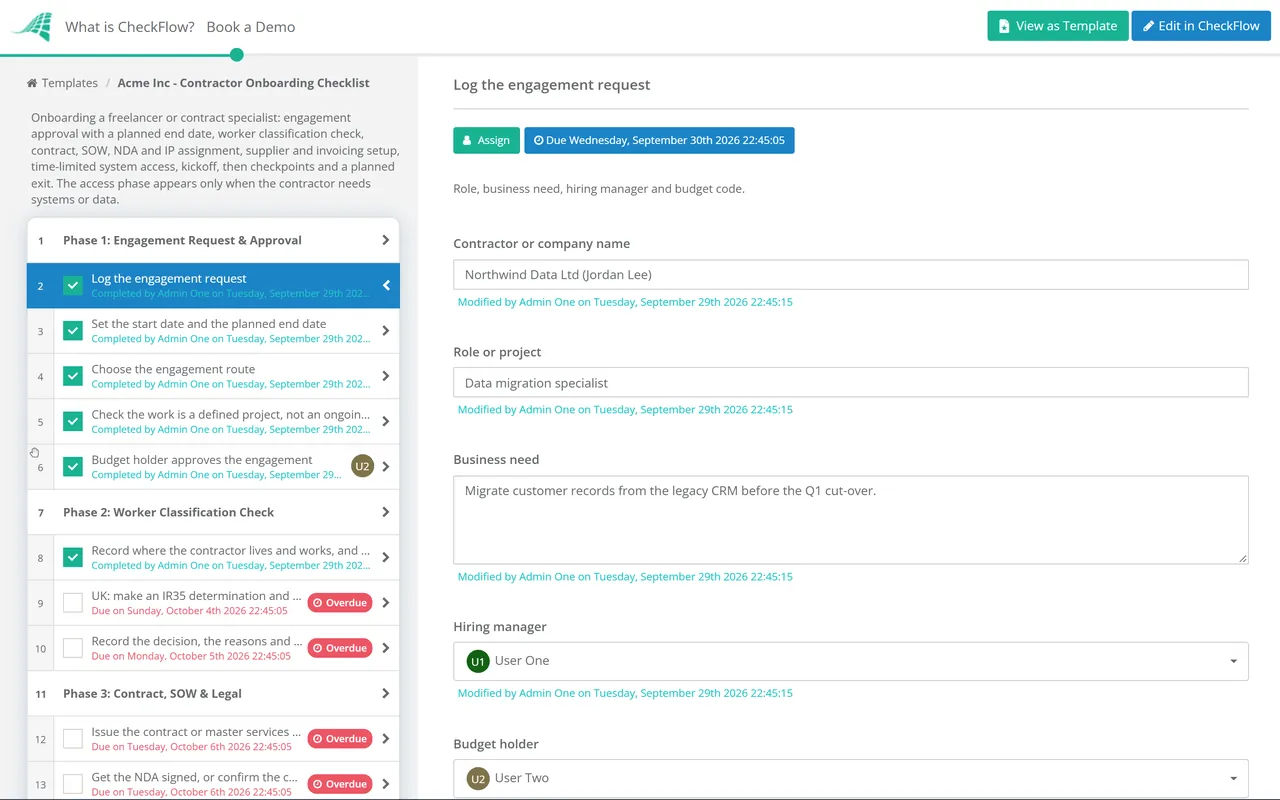
The end date drives the exit
The planned end date recorded in Phase 1 sets the due dates for the handover, the access removal and the final invoice. Nobody has to remember that a contract is ending, because the checklist has already scheduled it.
Onboarding a freelancer, consultant or contract specialist is a different job from onboarding an employee. There is no probation period, no benefits enrolment and no 90-day integration plan. Instead there is a contract and a statement of work, a check that the person really is self-employed, an NDA and an IP assignment, a supplier record for invoicing, and system access that has to end on a known date. This free contractor onboarding checklist covers exactly those steps, from the engagement request to the planned exit. It sets the offboarding date on day one, so access, equipment and the final invoice are dealt with on time. If you are hiring an employee, use the Employee Onboarding Checklist instead.
Most onboarding processes are built around employees: an offer letter, payroll, a handbook, a buddy and a series of 30, 60 and 90-day check-ins. Run a contractor through that process and two things go wrong. Steps that matter for contractors, such as the statement of work, the IP assignment and the end date on their accounts, are missing. And steps that treat the contractor like an employee, such as setting their hours or putting them through the standard induction, can undermine the self-employed status the engagement depends on.
The single most useful change is to set the end date at the start. When the planned end date is recorded on the first task, it can drive everything else: the contract term, the expiry date on every account, the reminder to start the handover and the date the final invoice is expected. A contractor whose access expires automatically is a much smaller risk than one whose accounts depend on someone remembering them.
Paperwork: offer letter, employment contract, payroll and benefits.
Access: role-based, open-ended, reviewed periodically.
Timeline: preboarding through a 90-day review.
Ends with: a fully integrated team member.

Paperwork: contract and SOW, classification record, NDA, IP assignment, supplier and tax forms.
Access: least privilege, limited to the SOW, expiring on the contract end date.
Timeline: request to kickoff, then planned checkpoints and exit.
Ends with: delivered work, recovered access and a paid final invoice.
Seven phases run from the engagement request to the planned exit. The access phase appears only when the contractor needs systems or data.
A process step, not legal advice. It makes sure the question is asked, answered by the right person and written down.
Shown only when the contractor needs access to systems or data. Conditional logic keeps IT out of engagements that don’t need them.
Keep the kickoff about the work, not how the contractor organises their day. Directing how and when someone works is a factor that points towards employment.
Due dates in this phase are set from the planned end date recorded in Phase 1.
There is no single test for whether someone is self-employed. Each country has its own, and in the US the tax, wage and state tests can give different answers for the same person. The table points to the main tests and the authority that publishes each one. It is a starting point for the Phase 2 check, not legal advice, and the answer always depends on how the work is actually done, not what the contract calls it.
| Where | Test | Who decides | Record to keep |
|---|---|---|---|
| US federal tax | IRS common-law rules: behavioural control, financial control and the type of relationship | The business; either party can ask the IRS to decide using Form SS-8 | The factors considered and the conclusion, plus the W-9 |
| US wage and hour | The Department of Labor’s “economic reality” test under the FLSA. The 2024 rule is still in force, but a February 2026 proposal would replace it and investigators have used the earlier test since May 2025 | The business, subject to DOL and court review | Control, opportunity for profit or loss, investment, permanence and integration |
| US states | Some states apply a stricter test, such as California’s ABC test | The business, under state law | Which state test applies and how each part is met |
| United Kingdom | IR35 off-payroll working rules, for contractors working through their own limited company | The client, if it is medium or large or in the public sector; otherwise the contractor’s company | A Status Determination Statement with reasons, passed to the contractor and the next party in the chain |
| Elsewhere | Local employment and tax tests | Local rules, or an employer of record who carries the risk | The local determination or the employer of record agreement |
Two details catch organisations out. In the UK, the company-size thresholds used for the off-payroll rules rose from April 2025, so some clients will fall outside the rules from April 2027, while others still in scope must keep issuing determinations and run a client-led process for contractors who disagree. In the US, the Form 1099-NEC reporting threshold rose to $2,000 for payments made from 2026. The authorities to check are the IRS, the Department of Labor and HMRC, whose CEST tool gives a view on UK status.
The planned end date recorded in Phase 1 sets the due dates for the handover, the access removal and the final invoice. Nobody has to remember that a contract is ending, because the checklist has already scheduled it.
One question, “Does this contractor need system access?”, decides whether the access phase appears. A copywriter who works from their own tools skips it. A developer gets least-privilege accounts with an expiry date, approved by each system owner.
The classification decision and its reasons, the signed contract, NDA and IP assignment, and the access log sit on one checklist, with names and timestamps. If a status question comes up two years later, the answer is already written down.
Contractors, employees, agency staff and interns all need a slightly different start. CheckFlow’s onboarding software runs each one from its own template, with conditional steps, approvals and handoffs between HR, finance and the hiring manager.
Access is where contractor onboarding most often goes wrong. CheckFlow’s IT onboarding checklist software shows how IT teams provision accounts and devices from a checklist, and the Employee Offboarding Checklist covers removing them again.
At minimum: an approved engagement with a start and end date, a recorded worker classification decision, a signed contract and statement of work, an NDA and a written IP assignment, a supplier record with the right tax forms, least-privilege access that expires on the end date, a kickoff with one point of contact, and planned checkpoints leading to the exit. The checklist should also show who completed each step and when.
Employee onboarding integrates someone into the organisation for the long term: payroll, benefits, culture and a 90-day plan. Contractor onboarding sets up a time-bound business relationship: a contract and SOW, a classification check, IP and confidentiality, invoicing, and access that ends on a fixed date. Treating a contractor like an employee during onboarding, for example by setting their hours or requiring the full staff induction, can also weaken the case that they are self-employed.
Apply the test for the country, and in the US the state, where the work is done, and write down the reasons. In the US that means the IRS common-law factors, the Department of Labor’s economic reality test and any stricter state test. In the UK it means the IR35 off-payroll rules, under which medium and large clients must issue a Status Determination Statement. The checklist makes sure the check happens and is recorded; it is not legal advice, so refer borderline cases to employment counsel or a tax adviser.
In most cases, yes. In both the US and the UK, work created by an employee in the course of their job normally belongs to the employer, but work created by an independent contractor normally belongs to the contractor unless a written agreement says otherwise. A clear IP assignment in the contract, signed before work starts, avoids a dispute over who owns the code, designs or content you paid for.
Give contractors only the access their statement of work needs, approved by each system owner, and set every account to expire on the contract end date. Label the accounts as contractor accounts, enforce MFA and keep a log of every account, licence and device issued. If the engagement is extended, move the expiry dates as part of the extension rather than leaving accounts open-ended.
Treat it as a change, not a formality. Issue a new or amended SOW, repeat the classification check, since a long engagement can look more like employment than a short one, and update the end date. In CheckFlow, updating the end date moves the due dates on the exit tasks and reminds IT to move the account expiry dates.
14-day free trial, no card required. The Business plan is $10 per user per month after the trial. Full details at checkflow.io/pricing.