30% of data breaches in 2024 involved a third-party vendor. Most organisations detect supplier risks only after onboarding is complete. A structured vendor onboarding process moves the risk checks to the only point where they are useful — before the vendor starts work.
Every vendor your organisation adds is a potential access point, compliance liability, or financial exposure if onboarded without a structured process. Third-party vendor involvement in data breaches doubled between 2023 and 2024, to 30% of all breaches — and research shows that more than 80% of organisations detect supplier risks only after onboarding has already begun. By then, the contract is signed, the access has been granted, and the leverage to demand compliance has largely disappeared. A structured vendor onboarding process also addresses the operational failures that are less dramatic but more common: the vendor whose invoices are held up for payment because their bank details were never captured correctly, the supplier whose insurance expired two years ago without anyone noticing, and the service provider who started delivering before the contract was signed. Manual vendor onboarding costs organisations an estimated $35,000 per supplier in staff time and administrative cost; a structured, consistently applied process brings that to below $2,500. This free checklist gives procurement managers, operations managers, and finance teams a structured framework for the full vendor onboarding lifecycle.
Vendor Risk Tiers — Why Not All Vendors Require the Same Onboarding Intensity
Tier 1 — High Risk
High-Risk Vendors
Definition: High spend, significant data access, business-critical dependency, or regulated sector involvement.
Examples: IT infrastructure providers, payroll processors, key professional services partners, cloud service providers with data processing agreements.
Onboarding requirements: Full compliance documentation (insurance, SOC 2/ISO 27001 for data processors, financial health check), thorough contract review by legal, data processing agreement (for GDPR), IT security review, senior approval, 1–3 week timeline.
Tier 2 — Medium Risk
Medium-Risk Vendors
Definition: Moderate spend or moderate dependencies; limited data access; replaceable within a reasonable timeframe.
Examples: Most professional services suppliers, regular vendors with annual contracts, facility management providers.
Onboarding requirements: Standard documentation (insurance, W-9/tax form, bank details), contract review, standard compliance check, finance team approval, 1–2 week timeline.
Tier 3 — Low Risk
Low-Risk Vendors
Definition: Low spend, no data access, easily replaceable, commodity product or service.
Examples: Office supplies vendors, courier services, minor one-off purchases.
Onboarding requirements: Basic details (business name, bank details, tax identification), standard terms and conditions, straightforward approval, 1–2 day timeline.
The Vendor Onboarding Process Checklist
Seven phases covering the complete vendor onboarding lifecycle — from need confirmation and risk tiering through documentation collection, compliance checks, contract execution, AP setup, relationship kickoff, and ongoing management.
Phase 1
Vendor Identification & Business Need Confirmation
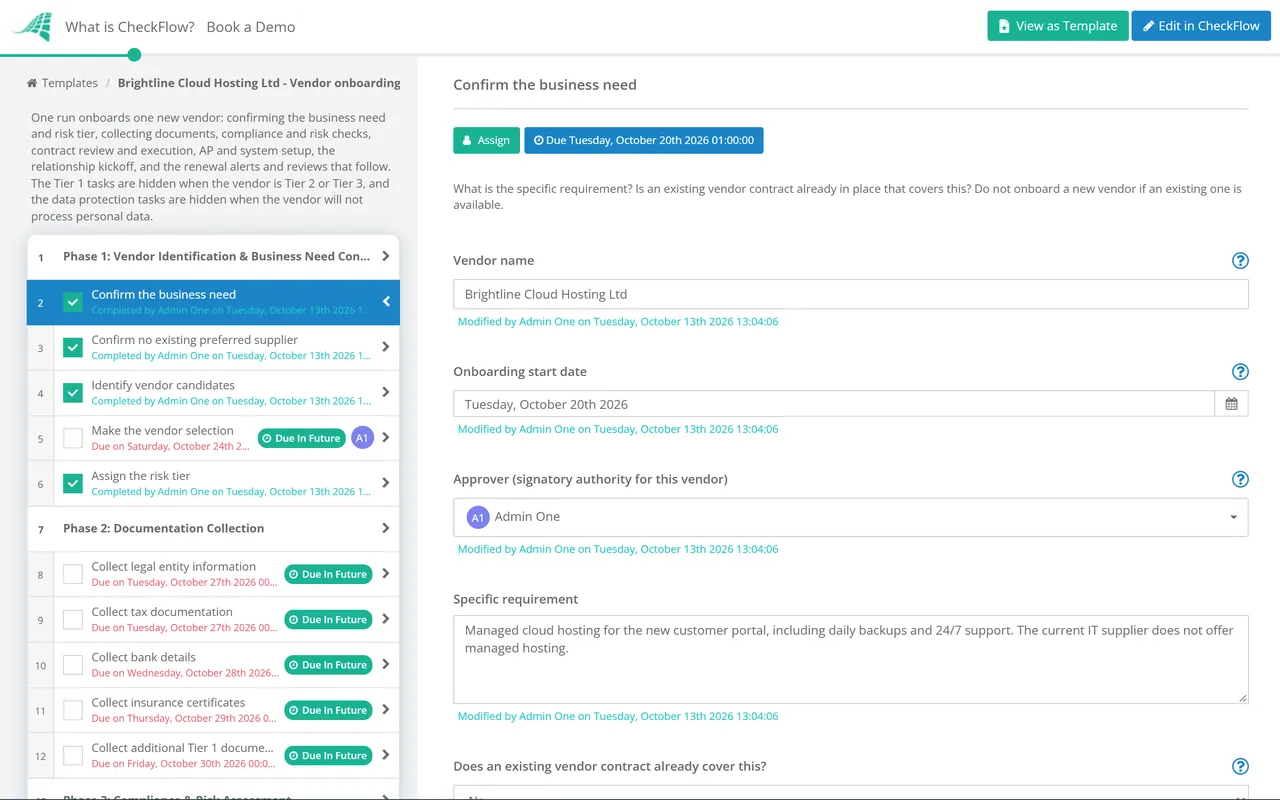
Confirm the business need — what is the specific requirement? Is an existing vendor contract already in place that covers this? Do not onboard a new vendor if an existing one is available
Confirm no existing preferred supplier — check the approved vendor list; check with the procurement team
Identify vendor candidates — minimum two or three for any significant spend; a competitive selection for Tier 1 and 2 vendors
Make the vendor selection — with appropriate business justification; documented; approved at the appropriate authority level
Assign the risk tier — Tier 1, 2, or 3; determines the onboarding documentation and approval requirements
Phase 2
Documentation Collection
The documentation collected at onboarding is the baseline for the entire vendor relationship. Missing documents at onboarding become missing protections when something goes wrong.
Collect legal entity information — registered company name, registration number, registered address, and country of incorporation; confirm this is the correct contracting entity
Collect tax documentation — W-9 (US) or VAT registration confirmation (UK/EU); required for AP and tax compliance
Collect bank details — for payment setup; verified directly with the vendor by phone before entry into AP system (fraud prevention)
Collect insurance certificates — public liability and employers’ liability (UK); general and professional liability (US); confirm coverage levels are adequate and expiry dates are current
Collect additional Tier 1 documentation — SOC 2 Type II or ISO 27001 certificate (for data processors), financial accounts or credit check (for critical dependencies), professional licences; checked for validity and date
Phase 3
Compliance & Risk Assessment
Sanctions screening — check the vendor and its directors against relevant sanctions lists (OFAC, HM Treasury, EU lists); required for any vendor in a relevant risk category or jurisdiction
Anti-bribery and corruption check — for vendors operating in higher-risk jurisdictions; due diligence consistent with FCPA (US) and Bribery Act (UK) obligations
Data protection assessment — for any vendor that will process personal data; confirm GDPR compliance (EU/UK); data processing agreement required
IT security review (Tier 1) — for vendors with system access; review SOC 2 report; penetration test; access control review; IT team sign-off
Confirm business continuity — for critical vendors; do they have a BCP? What is the recovery time if they experience a failure?
Document the risk assessment — findings recorded; any conditions or requirements arising from the assessment included in the contract
Phase 4
Contract Review & Execution
Review the contract — or confirm the vendor is operating under the organisation’s standard terms; for Tier 1: legal review; for Tier 2–3: standard terms applied
Confirm key contract terms — scope of services, pricing and payment terms, service levels, liability cap, data protection provisions, termination rights, and intellectual property
Confirm data processing agreement is in place — for any vendor processing personal data; GDPR/CCPA requirement; signed before data is shared
Obtain the required approvals — per the signatory authority matrix; confirmed before signing
Execute and file the contract — both parties signed; filed in the contract register; renewal alert set
Phase 5
Accounts Payable & System Setup
Create the vendor record in the AP/ERP system — using the collected documentation; legal name exactly as it appears on the registration documents
Enter verified bank details — confirming the account is in the vendor’s name; not from an unverified email (invoice redirection fraud prevention)
Confirm payment terms in the system — consistent with the contract; invoice processing rules set
Configure any system access — for Tier 1 vendors with system or data access; minimum necessary access; IT confirmed and documented
Notify finance and relevant teams — that the vendor is active; approval limits confirmed; budget code for purchases
Phase 6
Vendor Relationship Kickoff
Issue the welcome communication — introducing the key contacts on both sides; invoicing instructions; escalation contacts; service level expectations
Confirm communication channels — how are orders placed, how are invoices submitted, who is the account manager, who is the escalation contact?
Set performance expectations — the SLAs and KPIs the relationship will be managed against; documented and shared
Schedule the first performance review — 30-day check-in for critical vendors; 90-day for standard vendors
Add to the vendor register — all details, tier, contract expiry, and insurance renewal date tracked
Phase 7
Ongoing Vendor Management
Set insurance renewal reminders — 30 days before the vendor’s insurance expires; request updated certificates
Set contract renewal alerts — 90 days before contract expiry; performance review and renewal decision
Conduct periodic performance reviews — against the defined SLAs; any performance issues documented and raised with the vendor account manager
Conduct periodic compliance refresh — annually for Tier 1 vendors; confirm documentation and certifications are still current; sanctions and risk re-screen
The Vendor Bank Detail Scam — and How Onboarding Prevents It
Invoice Redirection Fraud: How It Works and How to Stop It
Invoice redirection fraud (also called business email compromise in the payment context) is one of the most common and costly fraud vectors affecting organisations. It typically works as follows: a fraudster intercepts a new vendor onboarding communication, or spoofs the vendor’s email address, and substitutes fraudulent bank details for the genuine vendor’s bank details. Finance enters the fraudulent details into the AP system. The first payment goes to the fraudster. The fraud is typically only discovered when the genuine vendor chases payment — by which point the funds are unrecoverable.
The preventive control is straightforward: bank details provided by a new vendor are always verified by phone call to a number obtained independently of the email that provided the bank details — directly from the vendor’s website or a previously used number. This single control eliminates the vast majority of invoice redirection fraud at the onboarding stage. The control is documented in the onboarding checklist as a required step before bank details are entered into the AP system.
Why Run Your Vendor Onboarding in CheckFlow?
1
A consistent onboarding process across every vendor, every tier
Vendor onboarding quality that depends on which procurement team member handles the process produces inconsistent outcomes — thorough for some vendors, minimal for others. CheckFlow runs the same structured onboarding sequence for every vendor at its assigned risk tier — from documentation collection through compliance checks to AP setup — with every required step confirmed before the vendor is marked active.
2
Risk and compliance checks before the relationship begins
The compliance check that happens after onboarding is already complete — after the contract is signed and access is granted — is a check that can identify a risk but cannot prevent it. CheckFlow’s compliance phase is positioned before contract execution, maintaining the leverage to require remediation or decline the vendor while it still exists.
3
A vendor register with all renewal and compliance alerts automated
The vendor whose insurance expired unnoticed, the service agreement that auto-renewed without review, the SOC 2 certificate that lapsed — all of these are renewal failures. CheckFlow sets insurance renewal reminders, contract renewal alerts, and compliance refresh tasks automatically at the point of onboarding — creating a vendor register that actively manages the relationship rather than archiving it.
Vendor contracts require review before execution. CheckFlow’s Contract Review & Approval Checklist in the Legal & Contract Management series covers the structured contract review process. See the Contract Review & Approval Checklist →
The equipment servicing vendors who maintain your facilities are the first vendor type to onboard in a new premises. CheckFlow’s Equipment Servicing Workflow covers the ongoing management of service vendor relationships. See the Equipment Servicing Workflow →
Other Operations & Facilities Management Checklist Templates
What should a vendor onboarding process checklist include?
+
A vendor onboarding checklist covers seven phases: vendor identification and need confirmation (checking existing approved vendors, making a justified selection, and assigning a risk tier), documentation collection (legal entity details, tax documentation, bank details, insurance certificates, and tier-specific compliance documents), compliance and risk assessment (sanctions screening, anti-bribery check, data protection assessment, IT security review for data processors), contract execution (review, standard terms for lower-tier vendors, data processing agreement, approval, and filing), system setup (AP/ERP vendor record, verified bank details, payment terms, system access configuration), vendor relationship kickoff (welcome communication, contact confirmation, performance expectations), and ongoing management (insurance and contract renewal alerts, performance reviews, annual compliance refresh).
Why is vendor bank detail verification so important?
+
Invoice redirection fraud (a form of business email compromise) is among the most common and financially damaging payment frauds. Fraudsters intercept or spoof vendor email communications during onboarding and substitute fraudulent bank details for genuine ones. Finance enters the fraudulent details into the AP system, and payment is made to the fraudster. The funds are typically unrecoverable once transferred. The preventive control is to verify bank details by phone call to a number obtained independently of the email that provided the details — from the vendor’s website or a previously verified source — before entering them into the AP system. This control should be a required, documented step in the onboarding checklist.
What is a data processing agreement and when is one required?
+
A data processing agreement (DPA) is a legally required contract under GDPR (EU/UK) and similar privacy laws whenever a controller (your organisation) shares personal data with a processor (a vendor that processes that data on your behalf). Any vendor who processes, stores, or accesses personal data about your employees, customers, or users requires a DPA before data is shared. This includes cloud service providers, payroll processors, IT systems vendors, HR software providers, email marketing platforms, and any other vendor with access to personal data. Under GDPR, using a processor without a valid DPA is a regulatory violation that can result in investigation and fines by the relevant supervisory authority.
How does vendor risk tiering work?
+
Vendor risk tiering assigns every vendor to a risk category based on the potential impact if the vendor fails, commits fraud, suffers a data breach, or becomes non-compliant. Tier 1 (high risk) vendors are those with significant spend, critical business dependency, or data access — they require the most thorough onboarding documentation and compliance assessment, and the most active ongoing management. Tier 2 (medium) requires standard documentation and review. Tier 3 (low) requires only basic details and streamlined setup. Tiering ensures that resources are concentrated on the vendor relationships that pose the greatest risk — not applied uniformly to every supplier regardless of significance.
Is CheckFlow free for this template?
+
You can start a free 14-day trial with no credit card required, giving you full access to all features including this template. The Business plan is $10 per user per month after the trial. Full details at checkflow.io/pricing.
Onboard Every Vendor Correctly Before They Start — Not After Something Goes Wrong
Free trial — no credit card required.
Do you like cookies? 🍪 We use cookies to ensure you get the best experience on our website. Learn more