Workplace Accident Investigation Checklist Template

After an accident the work restarts quickly and the questions stop. The photos stay on someone’s phone, the CCTV is overwritten, the report to the regulator goes in late and the action plan names nobody.

Last reviewed: October 2026

This free workplace accident investigation checklist is for managers, supervisors and health and safety leads who must find out why an accident, near miss or dangerous occurrence happened and stop it happening again. One run is one event, from first response to closed actions. It starts at the scene with first aid and making the area safe, then preserves the evidence: photos, equipment, CCTV and documents. Management is told, the level of investigation is set and a reportability check runs with UK (RIDDOR 2013), US (OSHA 29 CFR Part 1904) or other branches. Statements from witnesses and the injured person follow, then an analysis of immediate, underlying and root causes in the way HSE’s HSG245 sets out. The actions get owners and dates, the risk assessment is reviewed, the manager approves the report and action plan, the lessons are shared and every action is closed and checked.

An Accident Investigation Is Not an HR Investigation or a Log Entry

An accident investigation looks at the work, not at a person’s conduct. HSE’s guide HSG245 says the aim is to find out not only how the event happened but what allowed it to happen, and warns that blaming someone before the investigation starts makes people defensive and uncooperative. Its four steps are gathering the information, analysing it, identifying risk control measures, and the action plan and its implementation. This checklist follows them, with the first response and the reporting deadlines in front.

Three neighbouring jobs are often confused with it. A complaint about someone’s behaviour, such as bullying or misconduct, needs the Workplace Investigation Checklist, which feeds a grievance or disciplinary decision. The US injury log and its annual summary belong in the OSHA Recordkeeping Checklist, and the claim itself in the Workers’ Compensation Claim Checklist. Clinical patient-safety incidents in a hospital or clinic follow the Healthcare Incident Reporting Process Checklist.

Accident investigation

Why did it happen, and what stops it again?

Asks: what happened, what caused it at each level, and what must change?

When: straight after an accident, near miss or dangerous occurrence; the depth depends on how bad it could have been.

Output: a report, reports to the regulator where the law requires them, an approved action plan and a reviewed risk assessment.
HR workplace investigation

Did someone break the rules?

Asks: what are the facts behind a complaint or concern about someone’s conduct?

When: after a grievance, a disciplinary concern or a whistleblowing report.

Output: a findings report for whoever decides the outcome.

Recordkeeping and claims

What must be logged and paid?

Asks: is the case recordable, and what does the insurer need?

When: within days of the injury, and at year end for the OSHA annual summary.

Output: log entries, forms and a claim. They record the case but do not explain its causes.

What the Workplace Accident Investigation Checklist Covers

Eight phases follow one accident, near miss or dangerous occurrence from the scene to closed actions. The rules and the kind of event chosen in Phase 1 add the matching first aid, statement, reporting and return-to-work tasks. The manager approves the report and action plan before the lessons are shared and the investigation is closed.

  1. Phase 1

    Phase 1: First Response & Make Safe

    5 tasks

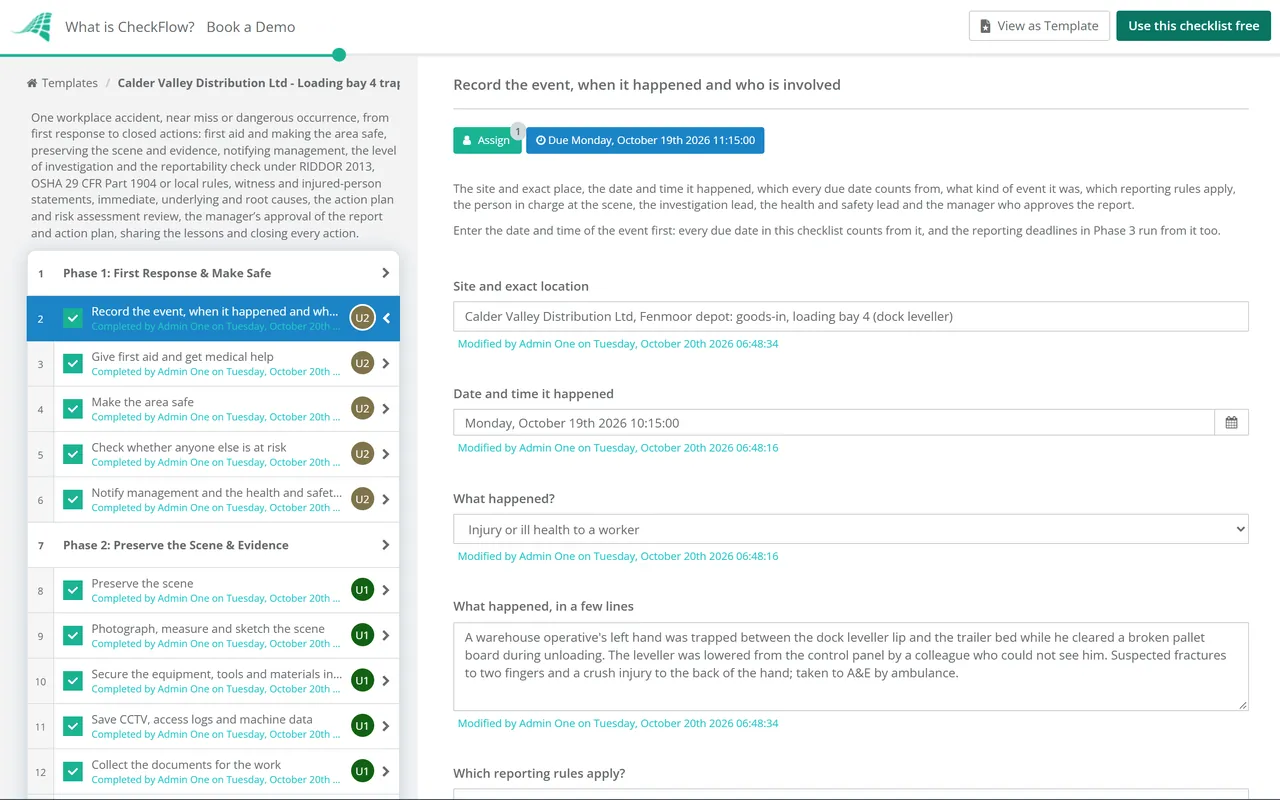
    Help the injured person and make the area safe before anything else. Then record the event: the date and time it happened is the clock every due date counts from, and the answers about the rules and the kind of event add the matching tasks.

    • Record the event, when it happened and who is involved — the site and exact place, the date and time it happened, which every due date counts from, what kind of event it was, which reporting rules apply, the person in charge at the scene, the investigation lead, the health and safety lead and the manager who approves the report
    • Give first aid and get medical help — a first aider with the injured person straight away, the emergency services called for anything serious, and a note of the treatment given and where the person was taken
    • Make the area safe — stop the work, isolate the machine or energy source and barrier off the area, doing only what is needed to remove the danger so the scene changes as little as possible
    • Check whether anyone else is at risk — the same job, machine or substance in use elsewhere on site, and any temporary control needed until the investigation is done
    • Notify management and the health and safety lead — tell the person responsible for health and safety, who decides what happens next, and the manager of the area, with the time each was told
  2. Phase 2

    Phase 2: Preserve the Scene & Evidence

    6 tasks

    Capture the evidence before it is moved, repaired, deleted or forgotten. Collect it now and decide later what matters.

    • Preserve the scene — leave it as it was found until the evidence is gathered, stop work and keep out anyone who does not need to be there; after a death the police may take charge of the scene
    • Photograph, measure and sketch the scene — from several angles and distances, with measurements, a sketch of where people and equipment were, and the lighting, weather and floor conditions at the time
    • Secure the equipment, tools and materials involved — quarantined and labelled so nobody repairs, reuses or throws them away, with the make, model and serial number recorded
    • Save CCTV, access logs and machine data — download the footage and any machine, vehicle or access-control records before they are overwritten
    • Collect the documents for the work — the risk assessment, safe system of work, permits-to-work, check sheets, training and maintenance records and the rota for the shift
    • List the people involved and every witness — the name, role and contact details of everyone who was hurt, involved, close by or arrived soon after
  3. Phase 3

    Phase 3: Investigation Level & Reportability

    10 tasks

    Decide how deep to investigate and whether the event must be reported before the investigation is finished: the deadlines do not wait for it. The rules chosen in Phase 1 show the matching tasks.

    • Decide the level of investigation — from the worst consequence the event could have had, not only what happened, and how likely it is to happen again; a minimal, low, medium or high level decides who investigates
    • UK: decide whether the event is reportable under RIDDOR — a death, a specified injury to a worker, a worker unable to do their normal work for more than seven days, a person not at work taken from the scene to hospital, or a dangerous occurrence listed in Schedule 2
    • UK: notify the enforcing authority and send the report — a death, specified injury, person not at work taken to hospital or dangerous occurrence without delay, with a report within 10 days; an over-seven-day injury within 15 days of the accident
    • UK: record the event in the accident book and the RIDDOR record — every reportable event, and every injury that keeps a worker off normal work for more than three days, with the date and method of reporting and the details Schedule 1 lists, kept for at least three years
    • US: decide whether OSHA must be told within 8 or 24 hours — a work-related death within 30 days of the incident is reported within 8 hours; an in-patient hospitalisation, amputation or loss of an eye within 24 hours of the incident is reported within 24 hours
    • US: report to OSHA — by phone or in person to the nearest Area Office, on 1-800-321-OSHA (1-800-321-6742), or online at osha.gov; not by voicemail, fax or email
    • US: decide whether the case is recordable — work-related, a new case, and a death, days away, restricted work or job transfer, medical treatment beyond first aid, loss of consciousness or a significant diagnosed injury or illness
    • US: enter the case on Forms 300 and 301 within 7 calendar days — or equivalent forms, with “privacy case” in place of the name where the rules require it, kept for five years after the end of the year they cover
    • Other: check and follow the local reporting rules — which regulator must be told, how quickly, and which records must be kept where the event happened
    • Tell the insurer where the policy requires it — a report to the regulator is not passed on to your insurer, so contact them separately
  4. Phase 4

    Phase 4: Witness & Injured-Person Statements

    5 tasks

    Talk to people as soon as they are able, one at a time and in their own words. The aim is to find out what happened and why, not who to blame.

    • Plan the interviews — who to speak to and in what order, a private place, an interpreter if needed, and a representative or colleague with them if they want one
    • Take the injured person’s account — when they are well enough, in person or by phone, covering what they were doing, what they saw and anything that made the job harder
    • Take a statement from each witness — what they saw and heard, in their own words, written down and read back to them, then signed and dated
    • Speak to the supervisor and whoever planned the work — how the job is meant to be done, how it is usually done, and what had changed
    • Check the accounts against the evidence — where statements agree or conflict with the photos, footage and records, and the questions still open
  5. Phase 5

    Phase 5: Analyse the Causes

    6 tasks

    Work from the facts to the causes. An investigation that ends at “human error” or “carelessness” has not gone deep enough: look for what allowed the event to happen.

    • Set out the sequence of events — what happened before, during and straight after the event, in time order, with the conditions at each point
    • Identify the immediate causes — the most obvious reasons it happened, such as the agent of injury, a missing guard or a slip on a wet floor
    • Identify the underlying causes — the unsafe acts and conditions behind the immediate causes, such as a guard removed or pre-start checks not carried out
    • Identify the root causes — the management, planning or organisational failings from which the others grew, such as training needs never identified, poor supervision or no risk assessment for the task
    • Check whether similar events have happened before — the accident book, near-miss reports and earlier investigations, and why the earlier actions did not stop this one
    • Check whether the same risk exists elsewhere — other sites, shifts, machines or tasks where the same causes could lead to the same event
  6. Phase 6

    Phase 6: Actions & Risk Assessment Review

    6 tasks

    Choose controls that deal with the root causes as well as the immediate ones, and give every action an owner and a date. Measures that remove the risk come before those that rely on people.

    • List the risk control measures that would stop a repeat — first measures that remove the risk, then measures that control it at source, then safe procedures, training and personal protective equipment
    • Put the most urgent controls in place now — anything needed to make the work safe today; if a serious risk cannot be controlled, the work stays stopped
    • Agree the action plan with owners and dates — each action linked to the cause it deals with, with a person responsible, a due date and a priority
    • Review the risk assessment — the assessment for the task or area reviewed and changed where the event shows it is no longer valid, with the new version dated
    • Update the safe system of work, training and briefings — procedures, permits, signs and training changed to match the new controls, and the people affected told
    • Write the investigation report — what happened, the evidence, the immediate, underlying and root causes, the reports made and the action plan
  7. Phase 7

    Phase 7: Approve & Share the Lessons

    3 tasks

    The manager’s approval is the gate: nothing after it can be completed until the report and action plan have a decision. Then share what was learned with the people involved and beyond.

    • Manager approves the investigation report and action plan — the causes found, the actions chosen with their owners and dates, and the resources to deliver them
    • Share the findings with the injured person and everyone involved — what was found and what will change, so they can say if anything is wrong or unrealistic
    • Share the lessons across the organisation — a short briefing for teams doing the same work, other sites with the same risk, the safety committee and employee representatives
  8. Phase 8

    Phase 8: Close the Actions

    6 tasks

    Keep the investigation open until every action is done and checked. If the injured person’s condition changes, the reports and records may need to change too.

    • Update the reports and records if the outcome changes — an absence that passes three or seven days, a death after the event, or a case that becomes recordable or changes on the OSHA log
    • Support the injured worker’s return to work — keep in touch, plan any adjusted duties with them and check the new controls are in place before they return
    • Track each action to completion — the action plan updated as each action is done, and overdue actions chased with their owner
    • Check the actions have worked — a follow-up visit or observation of the job, and no repeat of the same near misses
    • Keep the investigation file — statements, photos, reports and the action plan kept together; the RIDDOR record for at least three years, and OSHA forms for five years after the end of the year they cover
    • Health and safety lead closes the investigation — every action done and checked, the records complete, and the date it closed

Accident Reporting Rules in the UK and US

Report first, investigate second: neither country lets the deadline wait for the investigation. The table sets the rules side by side as they appear in RIDDOR 2013 and OSHA’s 29 CFR Part 1904. Use it to set your own procedure; it is not legal advice.

Topic UK (RIDDOR 2013) United States (29 CFR Part 1904)
Who reportsThe responsible person: the employer for an injury to an employee; whoever controls the premises for a person not at work, a self-employed person or another dangerous occurrence (reg. 3)The employer, for its employees (1904.39). A company with 10 or fewer employees all last year need not keep records unless told to in writing, but must still report (1904.1)
DeathsAnyone who dies as a result of a work-related accident: notify without delay and report within 10 days (reg. 6(1), Sch. 1). An employee who dies within a year of a reportable injury: notify the death without delay (reg. 6(3))An employee’s death from a work-related incident within 30 days of it: report within 8 hours (1904.39(a)(1), (b)(6))
Most serious injuriesSpecified injuries to workers, such as fractures other than to fingers, thumbs and toes, amputations, serious burns and loss of consciousness from a head injury: notify without delay and report within 10 days (reg. 4(1), Sch. 1)In-patient hospitalisation, amputation or loss of an eye within 24 hours of the incident: report within 24 hours (1904.39(a)(2), (b)(6))
Time off workA worker unable to do their normal work for more than seven consecutive days, not counting the day of the accident: report within 15 days (reg. 4(2)). More than three days: record only (reg. 12(1)(c))Days away, restricted work or job transfer make a case recordable; days are counted from the day after the injury (1904.7)
People not at workInjured and taken from the scene to hospital for treatment, or a specified injury on hospital premises (reg. 5)Not covered: 1904.39 is about employees
Near missesDangerous occurrences listed in Schedule 2, such as the collapse of lifting equipment or of a scaffold over 5 metres high, are reportable even if nobody is hurt (reg. 7)Part 1904 records injuries and illnesses, so a near miss with no injury is not recorded (1904.4)
How to reportOnline with HSE’s forms; only fatal accidents and specified injuries to workers can be phoned in, on 0345 300 9923 (HSE)The nearest Area Office by phone or in person, 1-800-321-6742, or online at osha.gov; not by voicemail, fax or email (1904.39(a)(3), (b)(1))
RecordsEvery reportable event and every over-three-day injury, with the details in Schedule 1, kept for at least three years at the workplace or usual place of business (reg. 12)Forms 300 and 301 within 7 calendar days of learning of a recordable case, kept for five years after the end of the year they cover (1904.29, 1904.33)

Exemptions. RIDDOR does not cover most injuries from a vehicle moving on a public road, or injuries from medical treatment by a doctor or dentist (reg. 14). OSHA does not need a report for a motor vehicle accident on a public street or highway outside a construction work zone, or for an event on public transport, but the case is still recorded (1904.39(b)(3)-(4)).

Occupational diseases. RIDDOR also covers certain diagnosed diseases and exposures (regs. 8 and 9), and OSHA records work-related illnesses. They are usually diagnosed over time rather than caused by one event, so they sit outside this checklist.

Why Run Accident Investigations in CheckFlow?

1

The right tasks for the event

Answer which rules apply and what happened in the first task, and conditional tasks add the RIDDOR or OSHA reporting steps, the first aid and statement tasks, and the return-to-work task only when they apply.

2

Deadlines from the moment it happened

Every due date counts from the date and time of the event, so the 8-hour and 24-hour OSHA reports, the RIDDOR report and the 7-day log entry fall due in the right order, each assigned to the person who owns it. Photos, statements and the report are uploaded to the task from a phone browser.

3

Nothing closes without approval

The manager’s approval step holds the rest of the checklist until the report and action plan have a decision. Open investigations show as open checklists on the Reports Grid, and every answer, photo and decision is kept with who did it and when.

CheckFlow does not decide whether an event is reportable or what caused it. That belongs to the responsible person, the investigation team and, where needed, a competent health and safety adviser. It makes sure the evidence is gathered, the reports go in on time and every action has an owner until it is closed. Compliance checklist software shows how processes like this one run across sites.

Review the assessment the event exposed with the Health & Safety Risk Assessment Checklist, break the job into steps with the Job Hazard Analysis (JHA) Checklist, and use the Root Cause Analysis (8D) Checklist when a team needs to prove a cause nobody can see yet. Plan the injured worker’s return with the Return-to-Work Checklist.

AI generator

Didn’t find what you need? Describe it.

Describe the process in a sentence and the AI checklist generator drafts the phases and tasks for you.

Frequently Asked Questions

What should a workplace accident investigation include?

HSE’s guide HSG245 sets out four steps: gather the information, analyse it, identify risk control measures, and agree and carry out an action plan. Before those come the emergency response, preserving the scene and deciding whether the event must be reported. A good investigation looks for the immediate, underlying and root causes, gives every action an owner and a date, feeds into a review of the risk assessment and shares the findings with everyone who needs to know.

Should near misses be investigated?

Yes. HSG245 says the level of investigation should depend on the worst consequence the event could have had and how likely it is to happen again, not only on the harm done this time. A near miss can have the same causes as a serious accident, and luck often decides which one happens. In the UK some near misses are also dangerous occurrences that must be reported under RIDDOR, such as the collapse of lifting equipment.

Which workplace accidents must be reported under RIDDOR?

RIDDOR 2013 requires the responsible person to report work-related deaths, specified injuries to workers such as most fractures, amputations and serious burns, injuries that stop a worker doing their normal work for more than seven consecutive days, injuries to people not at work who are taken from the scene to hospital, and the dangerous occurrences listed in Schedule 2. Certain diagnosed occupational diseases are reportable too. HSE says reportability does not depend on anyone being to blame.

How quickly must a RIDDOR report be made?

For a death, a specified injury, a person not at work taken to hospital or a dangerous occurrence, the responsible person must notify the enforcing authority by the quickest practicable means without delay, and send a report within 10 days. An over-seven-day injury must be reported within 15 days of the accident. HSE takes reports online, and only fatal accidents and specified injuries to workers can be phoned in, on 0345 300 9923.

When must a workplace accident be reported to OSHA?

Under 29 CFR 1904.39, an employer must report a work-related fatality within 8 hours, and an in-patient hospitalisation, amputation or loss of an eye within 24 hours. A death is reportable if it happens within 30 days of the incident, and the others if they happen within 24 hours of it. Report to the nearest Area Office, on 1-800-321-6742 or online at osha.gov. Separately, a recordable case goes on Forms 300 and 301 within 7 calendar days.

What is the difference between immediate, underlying and root causes?

HSG245 defines the immediate cause as the most obvious reason an event happens, such as a missing guard or a slip. Underlying causes are the less obvious system or organisational reasons behind it, such as pre-start checks not being carried out. Root causes are the management, planning or organisational failings from which the others grow, such as training needs never being identified. Dealing only with the immediate cause gives a short-term fix.

How long must accident records be kept?

In the UK, RIDDOR requires a record of every reportable event and every injury that keeps a worker off normal work for more than three days, kept for at least three years from the date of the entry, at the workplace or the usual place of business. In the US, the OSHA 300 Log, the annual summary and the 301 forms are kept for five years after the end of the calendar year they cover. Keep the investigation file alongside them.

Is CheckFlow free for this template?

14-day free trial, no card required. The Business plan is $10 per user per month after the trial. Full details at checkflow.io/pricing.

Investigate Every Accident and Close Every Action

Free trial — no credit card required.

14-day free trial, no credit cardFull refund in your first 30 daysUS hosting, EU on request