Every person who comes through the gate needs to know this site’s hazards before they pick up a tool, whoever employs them. A signature on a sheet in the cabin does not show what they were told, or whether their card was real.
This free construction site induction checklist is for principal contractors, general contractors, site managers and subcontractor supervisors. You run it once for each worker at each site: your own operatives, subcontractors’ crews and agency labour alike. It covers the arrival details, a card and competence check, the site rules and current hazards, emergency arrangements, PPE, fitness for work and the drugs and alcohol policy, and sign-in. Workers who will do permit-controlled work get a permit briefing that nobody else sees, and the first toolbox talk and a supervisor check after the first days close it out. Most of it is finished before the first task. For a warehouse employee’s weeks-long onboarding, with forklift authorisation and a productivity ramp-up, use the Warehouse Employee Onboarding Checklist. Contracts and payroll for your own new hires belong in the Employee Onboarding Checklist.
An Induction Belongs to the Site, Not the Employer
Employee onboarding happens once, when someone joins a company. A site induction happens every time someone arrives at a site, because each site has its own layout, hazards, emergency route and rules, and those change as the job moves from groundworks to fit-out. In the UK, the Construction (Design and Management) Regulations 2015 make the principal contractor responsible for ensuring a suitable site induction is provided. Where it has not been, each contractor must provide one to the workers it controls, and a contractor must not put anyone to work without the skills, knowledge, training and experience for the tasks they are given.
No US regulation uses the word induction, but OSHA’s construction standards require every employer to instruct each employee in recognising and avoiding unsafe conditions in their work environment. On a multi-employer site, OSHA can cite the controlling employer as well as the subcontractor whose workers are exposed. That is why many general contractors induct every worker through the gate, whoever pays them. The checklist treats every arrival the same way, and only the checks change.
Your own operatives
Know the company, not this site
Hazards and rules for this site
The emergency route here
The same card check as everyone
Subcontractor crews
Bring their employer’s training
RAMS for their package
Evidence of task training
A named supervisor on site
Agency labour
Least known, most checked
Identity matched to the card
Competence for the tasks given
Close supervision at first
Plant and permit work
Need more than the core
Plant cards for each machine
A briefing on each permit
Rescue plans explained
What the Construction Site Induction Checklist Covers
Six phases, most of them finished on the morning the worker arrives. The site’s country decides which card check appears, and the permit phase appears only for permit-controlled work.
Phase 1
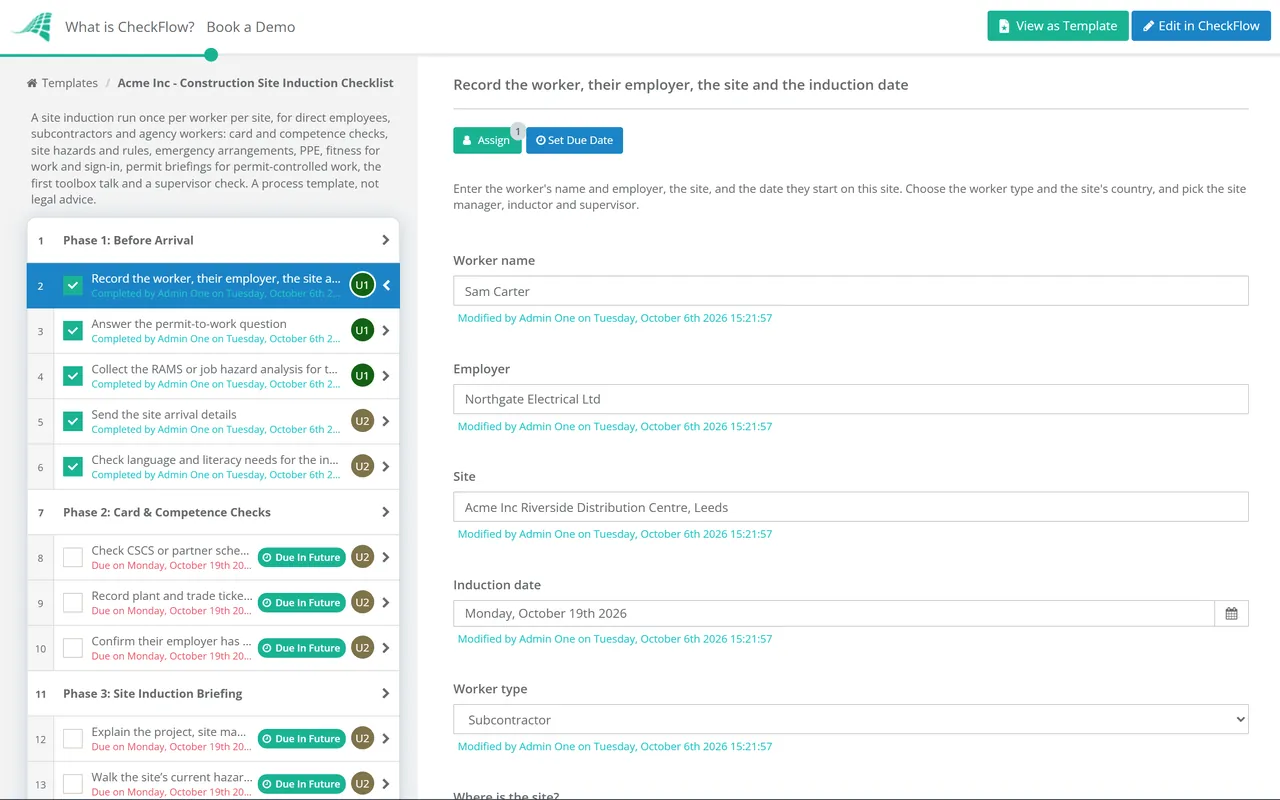
Phase 1: Before Arrival
Record the worker, their employer, the site and the induction date — plus whether they are direct, subcontractor or agency, and whether the site is in the UK or the US
Answer the permit-to-work question — will this worker carry out permit-controlled work?
Collect the RAMS or job hazard analysis for their work — from the subcontractor, before the crew arrives
Send the site arrival details — address, gate, parking, induction time, and the PPE and cards to bring
Check language and literacy needs for the induction — translated site rules or an interpreter if needed
Phase 2
Phase 2: Card & Competence Checks
A UK site shows the CSCS check and a US site shows the OSHA and SST check. Nobody sees both.
Check CSCS or partner scheme cards with Smart Check — in date, genuine and matching the person and the job; CPCS or equivalent for plant
Check OSHA 10, OSHA 30 or SST cards where required — where a state, city or contract requires them
Record plant and trade tickets for any machine they will operate
Confirm their employer has trained them for the tasks given — for example fall protection training records for work at height
Phase 3
Phase 3: Site Induction Briefing
Specific to this site and its current stage. Walk the site where possible rather than presenting from the cabin.
Explain the project, site management and who the worker reports to
Walk the site’s current hazards and no-go zones — open edges, excavations, lifting operations, plant and traffic routes, live services
Explain the site rules — PPE, smoking, phones, hot works, housekeeping and restricted areas
Show emergency procedures, first aid and the assembly point — the alarm, escape routes and first aiders
Explain how to report accidents, near misses and unsafe conditions — and that anyone can stop work that looks unsafe
Show the welfare facilities — toilets, washing, drinking water, drying room and the rest area
Phase 4
Phase 4: PPE, Fitness for Work & Sign-In
The last task is an approval. The checklist stops there until the site manager agrees the worker can start.
Check the worker’s PPE meets the site rules — and issue anything missing before they start
Explain the drugs and alcohol policy and fitness for work — testing arrangements, medication that affects safety, fatigue
Register the worker on the sign-in and sign-out system — it is the fire roll, so it has to be accurate
Ask check questions and record the signed induction declaration
Site manager approves the worker to start work
Phase 5 — If Permit-Controlled Work
Phase 5: Permits to Work
Shown only when Phase 1 records that the worker will carry out permit-controlled work. Complete it before their first permit is issued.
Identify the permits their work will need — hot work, confined space entry, work at height, excavation or breaking ground, electrical isolation
Explain how permits are issued, displayed and closed — who issues them, the conditions, time limits and handback
Confirm training for each permit-controlled task — such as confined space entry, fire watch or harness use
Brief the rescue and emergency arrangements for the permit work
Record the permit briefing against the worker’s induction
Phase 6
Phase 6: Toolbox Talks & First-Days Check
The induction is not finished at the gate. A supervisor looks at how the worker is actually working once they have settled in.
Add the worker to the toolbox talk schedule
Record attendance at their first toolbox talk
Supervisor checks the worker on the job after the first days — working to the RAMS, wearing the right PPE, keeping the area tidy
Re-brief anything missed and record it
Set the triggers for re-induction — a new site, a major change of stage or layout, or a long absence
The UK names the induction in law and leaves cards to the industry. The US has no induction rule but sets training duties standard by standard, and some states and cities add card requirements of their own. Treat it as the basis for the checklist rather than legal advice.
Topic
United Kingdom
United States
Duty to induct
The principal contractor ensures a suitable site induction is provided (CDM 2015 reg 13(4)(a)); a contractor provides one where the principal contractor has not (reg 15(9)(a))
No induction rule as such. Each employer instructs each employee in recognising and avoiding unsafe conditions (29 CFR 1926.21(b)(2))
Other contractors’ workers
Each contractor gives the workers it controls appropriate supervision, instructions and information, including emergency procedures (reg 15(8)–(9))
Under OSHA’s multi-employer citation policy, a controlling employer can be cited for hazards that expose another employer’s workers
Competence
Nobody is appointed without, or without working towards, the skills, knowledge, training and experience for their tasks (reg 15(7))
Only employees qualified by training or experience may operate equipment and machinery (29 CFR 1926.20(b)(4))
Cards
A CSCS card is not a legal requirement; the principal contractor or client decides. Cards should be checked with CSCS Smart Check
OSHA 10 and 30 are voluntary federally, but Nevada requires them within 15 days of hire and New York City requires an SST card (40 hours for workers) on many larger sites
Permits
HSE guidance uses written permits for high-risk work such as hot work and confined space entry, as part of a safe system of work
A written entry permit, signed by the entry supervisor, before entering a permit-required confined space (29 CFR 1926.1205)
Toolbox talks
No set frequency; HSE describes them as short talks on a single health and safety topic, and inductions should explain how ongoing briefings work
No federal frequency; California requires supervisors to hold toolbox or tailgate meetings at least every 10 working days
Drugs and alcohol
No general testing law. Employers have a general duty of care; testing needs the worker’s consent, and refusal without good reason can lead to discipline
No general OSHA testing rule; set by company policy, contracts and state law
Some of this is moving. CSCS stopped renewing cards issued through Industry Accreditation, and those cards expired at the end of 2024, so some older blue and gold cards are no longer valid; partner schemes are also changing their cards in 2026. Check every card electronically rather than by its colour. In the US, OSHA’s proposed heat injury and illness prevention rule has not been finalised, while states such as California already require heat training for outdoor construction work. The sources to check are the CDM Regulations 2015, HSE on site rules and induction, CSCS, OSHA’s Outreach Training Program and NYC Buildings on SST cards.
Why Run Site Inductions in CheckFlow?
1
One checklist per worker, per site
Start a checklist from the template for each arrival. The site’s country shows the right card check, and the permit answer adds the permit briefing only for the workers who need it, so a labourer’s induction stays short.

2
Nobody starts before approval
The checklist halts at the site manager’s approval, after the cards, briefing, PPE and declaration are done. Due dates run from the induction date, so the first toolbox talk and the supervisor’s check after the first days land on someone’s list.
3
Evidence for every worker on site
The card check result, the RAMS, the signed declaration and the permit briefing are held on each worker’s checklist, with names and timestamps. Reports show who is inducted on each site, which helps when the client or an inspector asks.
Site inductions sit alongside the onboarding of your own staff. CheckFlow’s onboarding software keeps both as templates with conditional steps, approvals and due dates, so a new site manager gets a full onboarding and every operative gets a site induction.
In the UK, yes. CDM 2015 requires the principal contractor to ensure a suitable site induction is provided, and on a project without one, each contractor must give its workers an induction along with information about the risks and emergency procedures. HSE guidance lists what it should cover, from an outline of the project to first aid, incident reporting and the site rules. In the US there is no rule that names an induction, but employers must instruct each worker in recognising and avoiding the hazards of their work, and many general contractors make a site orientation a condition of entry.
Do subcontractors and agency workers need their own induction?
+
Every person working on the site needs a site induction, whoever employs them. The induction covers the site, so a subcontractor’s own company training does not replace it. In practice the principal or general contractor usually inducts everyone at the gate, and each subcontractor still supervises and briefs its own crew on its tasks and method statements. Agency workers should be treated like anyone else, with extra care over checking their identity, their card and what they are competent to do.
Is a CSCS card a legal requirement?
+
No. CSCS says plainly that holding a card is not a legislative requirement; it is up to the principal contractor or client whether a card is needed on their site, and most large contractors require one. What the law does require is that workers have the skills, knowledge, training and experience for their tasks, and a card is common evidence of that. Check each card with CSCS Smart Check rather than by eye, because cards expire and some older card routes have been withdrawn.
Is an OSHA 10 card required to work on a construction site?
+
Not under federal law. OSHA describes its 10-hour and 30-hour outreach courses as voluntary, and they do not satisfy the training requirements in its standards. Some states, cities and contracts do require them. Nevada requires construction workers to hold an OSHA 10 card, and supervisors an OSHA 30 card, within 15 days of hire, and New York City requires a Site Safety Training card on sites that must have a construction superintendent, site safety coordinator or site safety manager. Record which rule applies on each site.
When does a worker need to be inducted again?
+
Whenever they move to a new site, because the induction is about the site. On the same site, re-brief them when the hazards change significantly, for example when the job moves from groundworks to working at height, or when the layout, access routes or emergency arrangements change. A worker returning after a long absence should also be re-inducted. Set these triggers when you close the checklist so they are not left to memory.
Is CheckFlow free for this template?
+
14-day free trial, no card required. The Business plan is $10 per user per month after the trial. Full details at checkflow.io/pricing.
Every Worker Through the Gate, Inducted and on Record
Free trial — no credit card required.
Do you like cookies? 🍪 We use cookies to ensure you get the best experience on our website. Learn more