Hot Work Permit Checklist Template

A hot work permit is only as good as the checks behind it. Clear the area, have it inspected and the permit issued before the first spark, keep the fire watch for the full period after the work, and check again before the permit is closed.

Last reviewed: November 2026

Printed from checkflow.io/templates/manufacturing-production/hot-work-permit-checklist

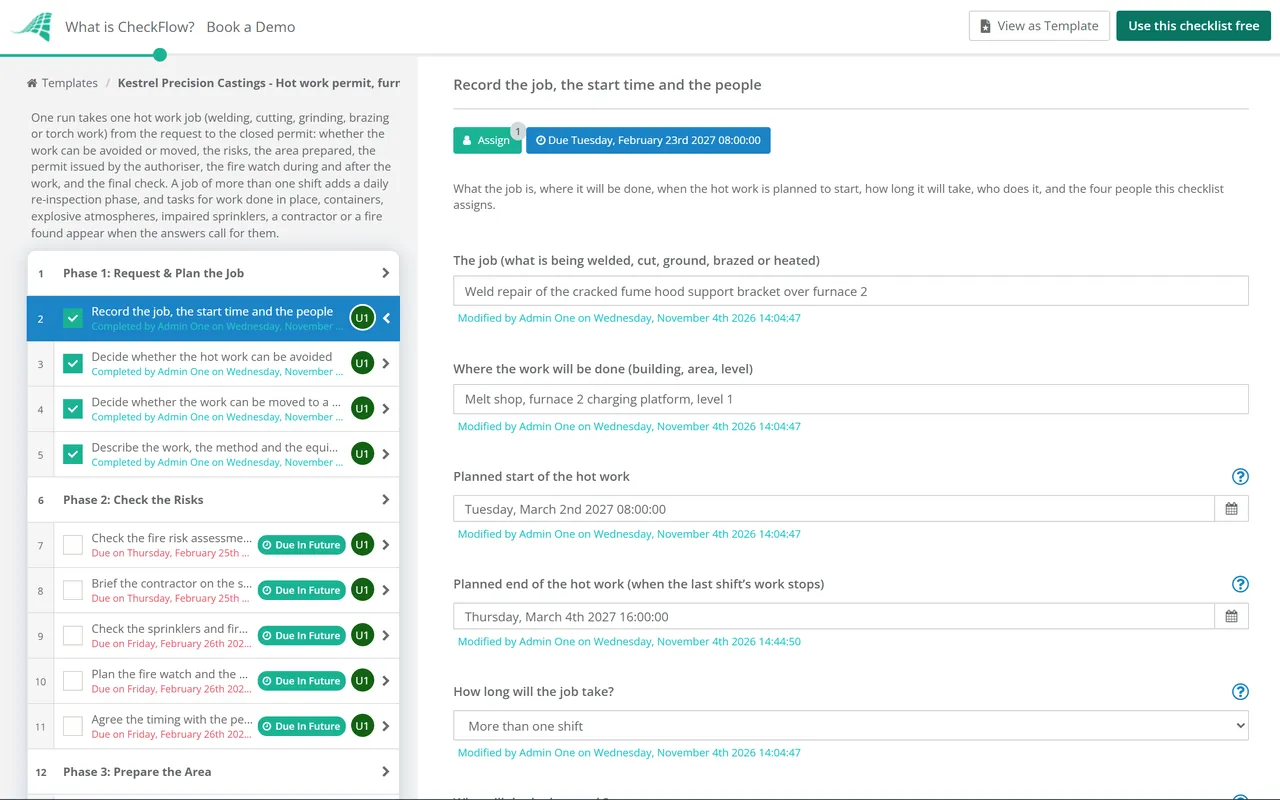
This free hot work permit checklist is for maintenance, production and facilities teams, and the contractors they bring in, who weld, cut, grind, braze or use a torch outside an area set up for it. One run covers one job, planned from the start of the hot work. It asks first whether the heat can be avoided or the work moved to a safe area, then checks the risks, including explosive atmospheres, containers and the sprinklers and detection, and prepares the area: combustibles moved or covered, floors swept, openings sealed and ducts protected. A named authoriser inspects the area and issues the permit before any work starts. The fire watch is briefed and kept during the work and for the period set after it, a job of more than one shift is re-inspected each day, and a final check closes the permit. Short notes from the Great Britain or US rules appear on the tasks where they apply.

One Hot Work Job, from the Request to the Final Check

This checklist runs one hot work job: welding, cutting, grinding, brazing or torch work outside an area set up for it. It starts with whether the heat can be avoided or the work moved, then prepares the area, has a named authoriser inspect it and issue the permit, keeps a fire watch during and after the work, and ends with a final check. A job that runs over several shifts gets a daily re-inspection in the same run.

Sites that run every permit through one system, with hot work beside isolations, confined spaces and work at height, can use the Permit to Work Checklist instead, which covers hot work as one permit type. The premises’ own assessment belongs in the Fire Risk Assessment Checklist, and routine checks of alarms, exits and equipment in the Fire Safety Checklist. Work inside a tank or vessel also needs the Confined Space Entry Checklist, and isolating plant before the work the Lockout/Tagout (LOTO) Procedure Checklist.

This checklist

One hot work job

Covers: avoiding or moving the work, the risks, combustibles, openings, ducts, sprinklers and detection, containers and gas tests where needed, the permit, the fire watch during and after, daily re-inspection on a longer job, and the final check.

Planned around: the planned start and end of the hot work.

Output: a permit issued on an inspected area, and a record of every watch and check.

Every permit

Permit to work

Covers: one permit of any type, from the request and risk assessment to isolations, gas tests, issue, handover and hand-back, with hot work as one of the types.

Planned around: the site’s permit system.

Output: a controlled permit for any high-risk job. Use this checklist where hot work needs its own run.

The premises

Fire risk assessment

Covers: the fire hazards, the people at risk and the fire precautions for a whole building.

Planned around: its review date.

Output: an assessment that this checklist reads before each job.

What the Hot Work Permit Checklist Covers

Eight phases take one job from the request to the closed permit. The first task records the planned start and end of the hot work, which set every due date, how long the job will take, who does it and which rules apply. Later answers add tasks for work done in place, containers, explosive atmospheres, impaired sprinklers, a contractor or a fire found, and a daily re-inspection phase for a job of more than one shift. The permit in Phase 4 is assigned to the authoriser alone, and nothing after it can be completed until they issue it.

  1. Phase 1

    Phase 1: Request & Plan the Job

    5 tasks

    Start a run as soon as a job needs heat, sparks or flame. The first questions are whether the job needs hot work at all and whether it can be moved to a safe area: avoiding the heat removes the fire risk, and moving the work keeps the sparks away from what can burn.

    • Record the job, the start time and the people — what the job is, where it will be done, when the hot work is planned to start, how long it will take, who does it, and the four people this checklist assigns
    • Decide whether the hot work can be avoided — whether a cold method would do the job, such as mechanical cutting, bolting, clamping or a part made up elsewhere, so that no heat or sparks are needed in the area
    • Decide whether the work can be moved to a safe area — whether the object can be taken to an area set up for hot work (then change the answer above and close this run) or to a temporary safe area free of combustibles; if it cannot be moved, the area around it has to be made safe
    • Close the run and record why no permit is needed — the cold method that will be used instead, or the area set up for hot work where the job will be done, who agreed it, and the checklist archived without a permit
    • Describe the work, the method and the equipment — the process, the equipment and any gas cylinders it uses, the materials being worked on, and anything on or inside them that could burn or give off fumes when heated
  2. Phase 2

    Phase 2: Check the Risks

    5 tasks

    Work out what could catch fire or explode, check the area’s fire protection, and plan the fire watch before the day of the work. A contractor is told about hazards they may not know.

    • Check the fire risk assessment and the area’s hazards — what in the area could burn, any explosive atmosphere, flammable vapour or combustible dust, any tank, drum or pipe that has held flammable material, and any area where the site does not allow hot work
    • Brief the contractor on the site’s hazards and hot work rules — the flammable materials and hazardous conditions in the area they may not know about, this site’s permit rules, the alarm and the escape routes, and the training and equipment they bring
    • Check the sprinklers and fire detection in the area — whether the sprinklers and detection are in service, whether any detector near the work is to be isolated to avoid false alarms, and who must agree an impairment
    • Plan the fire watch and the extinguishing equipment — who keeps the fire watch, where they stand, which areas they watch (including any area below or beyond a wall), the extinguishing equipment they will have, and how they raise the alarm
    • Agree the timing with the people who run the area — when the work will happen, nothing started nearby during the work that could expose combustibles to ignition, and the people in or next to the area told
  3. Phase 3

    Phase 3: Prepare the Area

    10 tasks

    Make the area safe on the day, before the authoriser inspects it. Tasks for work done in place, containers, explosive atmospheres and impaired sprinklers appear only when the answers in Phases 1 and 2 call for them.

    • Clean, vent and test the container before any heat — the tank, drum, pipe or container emptied and cleaned so no flammable or toxic residue is left, connected pipes disconnected or blanked, the container vented, and the result tested
    • Move combustibles away, or cover what cannot be moved — everything that can burn moved the distance your site rule sets, and anything left protected with fire-resistant covers, guards or shields
    • Sweep the floor and protect a combustible floor — the floor swept clean of shavings, paper, fibres and dust around the work, and a combustible floor kept wet, covered with damp sand or protected by fire-resistant shields
    • Protect the fire hazards that cannot be moved — guards, fire-resistant shields or covers fitted to confine heat, sparks and slag and to protect what stays in place, including combustible walls, partitions, ceilings or roofs near the work
    • Seal or cover openings, gaps and cracks — floor openings and cracks, holes in walls, open doorways and windows near the work closed or covered so sparks cannot drop or pass through to combustibles beyond
    • Protect or shut down ducts and conveyors — any duct, conveyor or extraction system that could carry sparks to combustibles further away protected or stopped for the work
    • Check the other side of walls, floors and ceilings — what is on the far side of any wall, floor, ceiling or roof being worked on or near, combustibles there moved, and a fire watch placed there where they cannot be
    • Put the sprinkler or detection impairment under control — what is impaired or isolated and for how long, who agreed it under the site’s impairment procedure, who was told, the extra cover in place while it lasts, and in US general industry the sprinklers back in service before the permit is issued
    • Test the atmosphere before the work, and plan repeat tests — a test for flammable gas or vapour at the work and in any space nearby, by a competent person with a calibrated instrument, with the times for repeat tests during the work
    • Put the extinguishing equipment and the alarm point in place — the extinguishing equipment planned in Phase 2 at the work and ready for instant use, and the nearest alarm point and escape route known to everyone at the job
  4. Phase 4

    Phase 4: Authorise the Permit

    3 tasks

    The authoriser inspects the prepared area and issues the permit before any hot work starts. The permit task is assigned to the authoriser alone, and nothing after it can be completed until it is done.

    • Inspect the area with the person doing the work — every precaution from Phase 3 checked at the work, the equipment and gas supplies looked at, and anything still to put right listed
    • Put right what the authoriser found, then ask for the permit again — after ‘Not issued’ only: put right each point the authoriser recorded, then ask them to inspect again, change the decision to Issued and complete the permit task; if the job is called off, record it here and archive the checklist
    • Issue the hot work permit — the precautions the permit sets, who may do the work, where, the time it is valid until, the fire watch, and how long the watch continues after the work ends
  5. Phase 5

    Phase 5: The Work & the Fire Watch

    6 tasks

    The fire watch is briefed, the permit is displayed at the job and the person doing the work confirms the conditions before starting. On a job of more than one shift, these tasks cover the first shift; later shifts are recorded in Phase 7.

    • Brief the fire watch — the areas to watch, including below and beyond any wall, the extinguishing equipment and its use, how to raise the alarm, and that they tackle a fire only when it is clearly within the capacity of the equipment
    • Display the permit at the job — a copy of the permit where the work is being done, so anyone in the area can see what is allowed and the precautions in force
    • Confirm the conditions are safe before starting — the person doing the work checks the precautions on the permit are in place and agrees with the person in charge that it is safe to start
    • Do the work as the permit allows, and stop if anything changes — only the work, place and method on the permit; stop and tell the person in charge if conditions change, an alarm sounds, a gas test fails or the job grows
    • Keep the fire watch during the work — the fire watch in place the whole time the work is under way, watching every exposed area, with nothing else to do
    • Make the equipment safe at breaks and at the end of the shift — electrodes out of their holders and the welding machine disconnected, torch valves closed and the gas supply shut off, and in a confined or enclosed space the torch and hoses taken out at the end of the shift
  6. Phase 6

    Phase 6: Fire Watch After the Work

    2 tasks

    Fires from hot work can start after the work has stopped. The fire watch stays for the period set on the permit, then checks the area before leaving.

    • Keep the fire watch for the set period after the work ends — the watch kept for at least the minutes set on the permit, over every exposed area including below and beyond walls, with a check for smouldering before the watch ends
    • Deal with the fire or damage, and report it — after a fire, smouldering or heat damage only: the alarm raised if it was needed, the area made safe, the damage recorded, the incident reported as your site requires, and the permit not reused until the cause is understood
  7. Phase 7

    Phase 7: Daily Re-Inspection

    3 tasks

    Applies only when the job runs over more than one shift. Before work restarts each day, the authoriser re-inspects the area and revalidates the permit; at each shift change the permit is handed over; and each day’s fire watch after the work is recorded. These tasks fall due at the planned end of the hot work on the first task: complete them after the last day’s entry.

    • Re-inspect the area and revalidate the permit before work restarts each day — each day, the precautions checked again, anything brought into the area since the last shift moved or covered, any gas test repeated, and the permit revalidated with a new time limit
    • Hand over the permit at each shift change — the incoming person in charge, person doing the work and fire watch told the hazards, the precautions and the state of the job, with the handover recorded
    • Record each day’s fire watch after the work — for each day after the first, the time the work ended, the time the watch ended and anything found
  8. Phase 8

    Phase 8: Close-Out & Final Check

    4 tasks

    After the last shift’s work and fire watch, check the area once more, return any impaired protection to service and close the permit. The due dates count from the planned end of the hot work on the first task, so on a one-shift job they fall the same day.

    • Make the final check of the area — the work area, the floor below and the other side of any wall checked for heat, smoke or smouldering, and any later check your site rule or insurer requires done and recorded
    • Return the sprinklers and fire detection to service — every impaired or isolated system returned to service after the last shift, tested where your procedure says so, and everyone told under the impairment procedure
    • Close the permit and hand back the area — the person in charge confirms the work is finished and the area is safe, the authoriser closes the permit, and the covers, guards and equipment are taken away
    • File the permit and record any lessons — the permit, the checks and the fire watch records kept with the job, and anything to change in the site’s hot work rules noted

Hot Work Rules in Great Britain and the US at a Glance

The rules this checklist’s notes come from, side by side. The answer on the first task shows the notes for your site.

Check Great Britain US general industry (29 CFR 1910.252) US construction (29 CFR 1926.352)
Authorising the workHSE’s HSG250, written for the petroleum, chemical and allied industries, describes hot work permits and asks whether permits clearly specify a time limit. For work in hazardous places or hazardous activities under DSEAR, its Schedule 1 lists permits issued before the work starts by a person with responsibility for this.The person responsible for authorising cutting and welding inspects the area and designates the precautions, preferably in a written permit.The section sets fire precautions but does not mention a permit; a written permit is the site’s or contractor’s rule.
Move the work, or the hazardsClear away wood, fabric, cardboard and other flammable material before starting.Move the object, or take movable fire hazards to a safe place; guard what cannot be moved; if neither is possible, no welding or cutting.Move the object to a designated safe location when practical, or take movable fire hazards to a safe place or protect them.
Distance for combustiblesNo fixed distance in HSE’s guidance; sparks and slag can travel a considerable distance. Use your site rule or insurer’s.Relocate at least 35 feet (10.7 m) where practicable, otherwise flameproofed covers or shields; sweep combustible floors for 35 feet.No distance given: confine the heat, sparks and slag where hazards cannot be removed.
Openings and the other sideSparks and slag can start fires in adjacent rooms.Protect material below floor openings and cracks and beyond wall holes, doorways and windows; on metal walls, prevent ignition on the other side, with a fire watch there if combustibles stay.The same precautions on the opposite side of walls, floors and ceilings as on the side being worked on.
Sprinklers, atmospheres and containersDSEAR: identify areas where explosive atmospheres may occur and avoid ignition sources there. HSE’s INDG314 covers small tanks and drums.Not permitted in sprinklered buildings while protection is impaired (the sprinklers go back into service before the work), in explosive atmospheres, or on used containers until thoroughly cleaned.No rule on impaired sprinklers. Not where flammable paints, compounds or heavy dust create a hazard; containers filled with water, or cleaned, ventilated and tested.
Fire watch during the workWhere hot work cannot be done in a safe area or combustible material cannot be removed.Where more than a minor fire might develop, or in four listed conditions, such as appreciable combustibles closer than 35 feet.Extra personnel when normal fire prevention precautions are not sufficient.
Fire watch after the workAt least 30 minutes, which may need to be 60 where an ignition may be difficult to detect or slow to develop.At least half an hour after welding or cutting is completed.A sufficient period after the work to ensure no possibility of fire exists.

Where this comes from. 29 CFR 1910.252 and 29 CFR 1926.352 on eCFR, up to date as of 2 November 2026; HSE’s safety risks from welding, introduction to fire safety and DSEAR pages, HSG250 (2005, HSE’s guide to permit-to-work systems for the petroleum, chemical and allied industries) and INDG314, and Schedule 1 to DSEAR on legislation.gov.uk, all read on 4 November 2026. In England and Wales the Regulatory Reform (Fire Safety) Order 2005 requires a fire risk assessment of the premises; Scotland and Northern Ireland have their own fire safety rules. NFPA 51B, the Standard for Fire Prevention During Welding, Cutting, and Other Hot Work (2024 edition), and the hot work recommendations of the Fire Protection Association and RISCAuthority are not quoted here: if your insurer or site follows them, use their requirements where they are stricter.

Why Run Hot Work Permits in CheckFlow?

1

No hot work before the permit

The permit task is assigned to the authoriser alone, and the checklist halts there: the work, the fire watch and the close-out cannot be completed until the permit is issued. If the authoriser finds something to put right, a task appears above the permit and it stays open until the area is ready.

2

Only the checks the job needs

Answers in the first two phases add the tasks that apply: protecting what cannot be moved, cleaning and testing a container, testing the atmosphere, controlling a sprinkler impairment, briefing a contractor or dealing with a fire. A job of more than one shift adds daily re-inspection, shift handover and fire watch logs in the same run.

3

A timed record of every watch

Name the person in charge, the authoriser, the person doing the work and the fire watch on the first task, and every task is assigned from those fields and dated from the planned start or end of the work. The fire watch records when the work ended, when the watch ended and what it found. Track every open permit in the Reports Grid.

CheckFlow does not inspect the area, test the atmosphere or decide whether hot work is safe: those stay with your competent people. CheckFlow makes sure every check is done in order, by the right person, with the record kept.

Run the wider permit system with the Permit to Work Checklist, assess the job’s other hazards with the Job Hazard Analysis (JHA) Checklist, and check a site’s hot work during an inspection with the Construction Site Safety Inspection Checklist.

AI generator

Didn’t find what you need? Describe it.

Describe the process in a sentence and the AI checklist generator drafts the phases and tasks for you.

Frequently Asked Questions

What should a hot work permit checklist include?

Whether the hot work can be avoided or moved to a safe area, the job and its equipment, what could burn or explode nearby, combustibles moved or covered, openings sealed, ducts protected, sprinklers and detection checked, extinguishing equipment ready, the authoriser’s inspection and the permit, a briefed fire watch during and after the work, daily re-inspection on a longer job and a final check before the permit is closed. This template covers those steps for one job.

What counts as hot work?

Welding, flame and plasma cutting, brazing and soldering, torch heating, and grinding or other work that throws sparks. In the US, 29 CFR 1910.252 covers welding and cutting in general industry, and 1926.352 covers welding, cutting and heating on construction work. HSE’s HSG250 adds electrical equipment that is not intrinsically safe or suitably protected, used where there may be a risk of fire or explosion. This template asks first whether a cold method would do the job.

How long should a fire watch last after hot work?

In US general industry, 29 CFR 1910.252 requires a fire watch, where one is needed, for at least half an hour after welding or cutting ends. For construction, 1926.352 says a sufficient period to ensure no possibility of fire exists. HSE’s welding guidance says at least 30 minutes, extended to 60 where an ignition may be difficult to detect or slow to develop. NFPA 51B, your insurer or your site rule may set more; this template records the period on the permit.

Who can authorise a hot work permit?

In US general industry, management designates an individual responsible for authorising cutting and welding in areas not designed for it, and that person inspects the area and sets the precautions, preferably in a written permit (29 CFR 1910.252). In Great Britain, for work in places where an explosive atmosphere may occur or other hazardous activities under DSEAR, its Schedule 1 lists permits issued before the work starts by a person with responsibility for this function. Here, only the authoriser named on the first task can issue the permit.

How far should combustibles be moved from hot work?

In US general industry, 29 CFR 1910.252 says to relocate all combustibles at least 35 feet (10.7 m) from the work where practicable, and otherwise to protect them with flameproofed covers or shields; floors with combustible debris are swept for 35 feet. HSE’s welding guidance gives no fixed distance but warns that sparks and slag can travel a considerable distance and start fires in adjacent rooms. Use your site rule or insurer’s distance where it is greater.

Can you do hot work while the sprinklers are out of service?

In US general industry, no: 29 CFR 1910.252 does not permit cutting or welding in sprinklered buildings while that protection is impaired, so the sprinklers go back into service before the permit is issued. 29 CFR 1926.352 sets no such rule for construction, and HSE’s guidance read for this page sets none for Great Britain: follow your fire risk assessment, your site’s impairment procedure and your insurer. Isolating a detector near the work is a separate question, which this template records too.

How long is a hot work permit valid?

None of the rules read for this template sets a fixed period. HSE’s HSG250, written for the petroleum, chemical and allied industries, asks whether permits clearly specify a time limit for expiry or renewal and include a handover for work that runs beyond a shift, and says suspended work should not restart until the issuer has verified it is safe and revalidated the permit. This template records a valid-until time and, on a job of more than one shift, re-inspects and revalidates the permit each day.

What does a fire watch do?

Under 29 CFR 1910.252, fire watchers have fire extinguishing equipment readily available and are trained in its use, know how to sound the alarm, watch for fires in all exposed areas, try to put out a fire only when it is obviously within the capacity of the equipment, and otherwise sound the alarm. For construction, 29 CFR 1926.352 says they are instructed on the specific fire hazards expected and how to use the firefighting equipment provided.

Is CheckFlow free for this template?

14-day free trial, no card required. The Business plan is $10 per user per month after the trial. Full details at checkflow.io/pricing.

Issue Every Hot Work Permit on a Checked Area

Free trial — no credit card required.

14-day free trial, no credit cardFull refund in your first 30 daysUS hosting, EU on request