Plant Shutdown & Turnaround Checklist

A request added in the last week, a blind left in a line, a part that arrives on day ten of a fourteen-day outage. A shutdown runs to a fixed restart date, and every job, isolation and decision on the way needs an owner and a due date.

Last reviewed: November 2026

Printed from checkflow.io/templates/manufacturing-production/plant-shutdown-turnaround-checklist

This free plant shutdown checklist runs one planned shutdown or turnaround of a line, unit or plant, for turnaround managers, maintenance planners, operations and safety leads. It starts about 13 weeks before the plant comes off line with the objectives, the dates and the team. Every work request is challenged and justified, long-lead parts are ordered and the scope is frozen. Contractors are booked, each job gets a work pack, and the isolations, blinds and permits are planned before the budget, its contingency and the scope are signed off. After a readiness review, operations shut the plant down, make it safe and hand it to maintenance. The work is then controlled every day against the critical path: a forecast restart behind the plan adds a recovery review, and emergent work above the contingency goes to the sponsor. Mechanical completion, reinstatement and a pre-start safety review come before the restart is authorised, and the run ends with the restart, the hand-back and a review of the actual days and cost. US sites with a process covered by OSHA’s process safety management standard, and UK sites under COMAH or the pressure systems rules, get their own checks.

A Shutdown, Routine Maintenance or One Job?

A planned shutdown, or turnaround, takes a line, unit or whole plant off line for work that cannot be done while it runs: inspections, repairs, replacements and project tie-ins. It is a one-off project with a hard restart date, planned for months and carried out in days or weeks, and its risk comes from the number of jobs, people and isolations at once.

It sits beside other processes without replacing them. Routine work between shutdowns belongs to the Preventive Maintenance Checklist and the Equipment Maintenance Workflow Checklist; each isolation is applied with the Lockout/Tagout (LOTO) Procedure Checklist and each permit issued with the Permit to Work Checklist; each contractor’s job runs through the Contractor Management Checklist; and any change to the plant goes through the Management of Change (MOC) Checklist. Moving a line to another building is a Factory Relocation Checklist job.

This checklist

One planned shutdown or turnaround

Asks: is the scope right, is everything ready before the plant comes down, is the work on time and on budget, and is the plant safe to restart?

When: once for each planned outage, from about 13 weeks before it to the review after the restart.

Output: the frozen scope, the budget and its use, the daily record, the pre-start review and the authorised restart.
Between shutdowns

Routine maintenance

Covers: the monthly plan of preventive work, compliance and backlog, and single maintenance jobs with their isolation and restart.

Use it: for work that can be done with the plant running or in a short stop, in the Preventive Maintenance Checklist and the Equipment Maintenance Workflow Checklist. Work that needs a longer outage goes on this checklist’s request list.

What the Plant Shutdown & Turnaround Checklist Covers

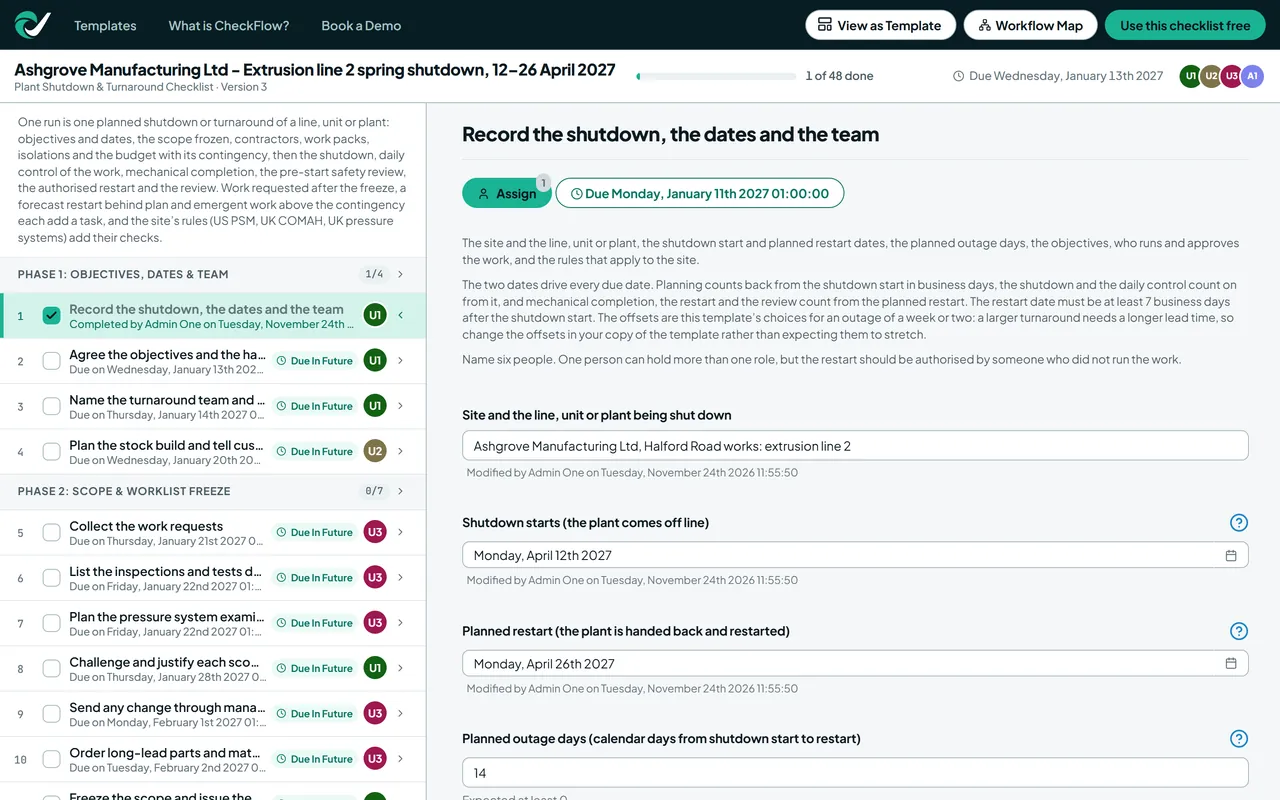
Nine phases take one shutdown from set-up about 13 weeks before the plant comes off line to the review after the restart. Two dates on the first task drive the due dates, in business days: planning counts back from the shutdown start and the daily control counts on from it, while mechanical completion, the restart and the review count from the planned restart. The two dates must be at least 7 business days apart. The offsets are fixed, not scaled: for a larger turnaround that needs longer to plan, change them in your copy of the template; if the restart moves, change its date on the first task and the later tasks move with it. Authorising the restart is the gate: nothing after it can be completed until it is done. Work requested after the freeze, a forecast restart behind the plan, emergent work above the contingency and the site’s rules each add their own tasks.

  1. Phase 1

    Phase 1: Objectives, Dates & Team

    4 tasks

    Start about 13 weeks before the plant comes off line. The first task sets the two dates the timetable counts from, the objectives, the six people who run and approve the shutdown and the rules that apply to the site.

    • Record the shutdown, the dates and the team — the site and the line, unit or plant, the shutdown start and planned restart dates, the planned outage days, the objectives, who runs and approves the work, and the rules that apply to the site
    • Agree the objectives and the hard restart date with the sponsor — what the shutdown must achieve, what fixes the restart date, and what the sponsor will and will not trade for time
    • Name the turnaround team and set the meeting rhythm — the planner, scheduler, engineers, operations, maintenance, safety and contractor coordinator, their deputies and the weekly planning meeting
    • Plan the stock build and tell customers — how much product to make ahead so supply continues through the outage, and which customers need to know the dates
  2. Phase 2

    Phase 2: Scope & Worklist Freeze

    9 tasks

    Collect every request, make each item earn its place, order what takes longest to arrive and freeze the worklist about nine weeks before the shutdown. The site’s rules add their checks here.

    • Collect the work requests — from the maintenance backlog, inspections and tests due, defects that need the plant off line, reliability work, projects and operations’ own list
    • List the inspections and tests due in the window — statutory examinations, insurers’ inspections and the plant’s own inspection plan for vessels, piping, relief devices, trips, alarms and lifting equipment
    • Plan the pressure system examinations due under the written scheme — the parts of each pressure system the written scheme of examination covers, which examinations fall due, the competent person and how the system is prepared
    • Check the PSM elements for covered equipment — which equipment in the scope is in a covered process, and how mechanical integrity, contractors, hot work, management of change and the pre-startup safety review apply to it
    • Check the shutdown against the COMAH safety management system — the site’s procedures for maintenance, temporary stoppages and planning modifications, and anything the shutdown changes in them
    • Challenge and justify each scope item — each item needs a reason (safety, legal, integrity, reliability or a project) and a reason it cannot be done with the plant running
    • Send any change through management of change — any item that is not a like-for-like replacement goes through your management of change process before it is planned in
    • Order long-lead parts and materials — valves, seals, exchanger bundles, motors, refractory and anything else that could arrive after the plant comes down
    • Freeze the scope and issue the worklist — the agreed list of jobs, each with its reason, owner and estimate, issued to everyone planning the shutdown
  3. Phase 3

    Phase 3: Contractors, Work Packs & Isolations

    5 tasks

    Book the contractors, write a work pack for every job, then plan the isolations and the permits each job needs and build the schedule around the critical path.

    • Select and book the contractors — the firms for each work package, checked for competence, safety record and insurance, and booked for the dates
    • Write a work pack for each scope item — the job steps, isolations and permits needed, drawings, materials, tools, labour hours, inspection and test points and the hand-back checks
    • Plan the isolations and the blind list — every isolation point, any boundary isolation at the plant’s limits, and every blind or spade, so they go in to a plan and come out in full
    • List the permits each job needs — permit to work, hot work, confined space entry, work at height and lifting, with who issues each and how many the issuers can handle each shift
    • Build the schedule and the critical path — the shutdown sequence, every job with its duration and labour, the inspection hold points and the critical path to the restart
  4. Phase 4

    Phase 4: Budget, Logistics & Readiness

    9 tasks

    Set the budget and its contingency, get the scope signed off, settle late requests, get materials and the site ready, and check the plan in a readiness review two days before the shutdown.

    • Set the budget and the contingency — the cost of the frozen scope from the work packs and quotes, and a contingency held for emergent work found during the outage
    • Get the scope, schedule and budget signed off by the sponsor — the sponsor checks the frozen worklist, the planned outage days and the budget with its contingency against the objectives
    • Review work requested after the scope freeze — count every request received since the freeze and check each one with the maintenance lead before it goes to the sponsor
    • Get the sponsor’s decision on each late request — add it with its cost and time, or leave it for running maintenance or the next shutdown
    • Plan site logistics and access — laydown areas, cranes and lifting, scaffolding, welfare, parking, access control, waste and the emergency routes
    • Receive, check and kit the materials — each part checked against the order and the work pack, and kitted by job so it is at the plant when the job starts
    • Agree the shutdown sequence and the handover certificate — operations’ steps to bring the plant down, drain, purge and clean it, and the certificate that hands it to maintenance
    • Brief the workforce on the hazards and the emergency arrangements — the plant’s hazards, the permit and isolation rules, the emergency arrangements and how to report a concern, for staff and every contractor
    • Hold the readiness review — work packs, materials, contractors, permits, isolations, logistics and the shutdown procedure checked as ready, with any gap given an owner
  5. Phase 5

    Phase 5: Shutdown, Isolation & Handover

    4 tasks

    Operations bring the plant down to the agreed sequence and make it safe. The isolations go in, and the plant is handed to maintenance with a signed certificate.

    • Shut the plant down to the agreed sequence — follow operations’ shutdown procedure and record when the plant came off line and anything that did not go to plan
    • Valve off, drain, purge and clean the plant — with the plant valved off to the isolation plan, remove the process materials, purge and clean, and record the gas tests or other checks that show it is ready for the blinds
    • Complete the isolations and fit the blinds — complete each isolation to the plan, fit the blinds once the plant is depressurised and purged, prove each isolation and record the blinds in the blind register
    • Hand the plant over to maintenance — operations and maintenance sign the handover certificate once the plant is isolated and proven safe
  6. Phase 6

    Phase 6: Execution & Daily Control

    7 tasks

    Run the work against the critical path every day. A forecast restart behind the plan adds a recovery review, and emergent work above the contingency goes to the sponsor.

    • Run the daily progress meetings against the critical path — progress on each critical job, permits and safety, emergent work and the forecast restart, reviewed every day of the outage
    • Control permits, isolations and shift handovers — check permits on the job, keep the isolation and blind registers current, and hand permits over at each shift change
    • Hold a schedule recovery review — agree with operations, maintenance and the sponsor how to recover the time, or a new restart date
    • Assess and price emergent work — each defect found once the plant is open, assessed for whether it must be fixed now, priced and approved against the contingency
    • Get the sponsor’s approval for spend above the contingency — the sponsor approves the extra spend, approves part of it, or the work is deferred to a later outage
    • Carry out the inspections and tests and record the results — each inspection and test in the register done, its result recorded and each defect fixed, made safe or deferred with a reason
    • Record safety observations, near misses and incidents — log what is found on site walks and reported by the workforce, and report any incident under your own reporting rules
  7. Phase 7

    Phase 7: Mechanical Completion & Pre-Start Safety Review

    7 tasks

    Close every work pack, take the blinds out, put the plant back together and check it with operations. The pre-start safety review comes before the restart is authorised, and nothing after the authorisation can be completed until it is given.

    • Close each work pack and confirm mechanical completion — every job finished, inspected and signed off, with the remaining punch items listed and owned
    • Remove the blinds and reinstate the plant — remove each blind against the register, make and test the disturbed joints and remove the isolations in the planned sequence
    • Restore overridden trips, alarms and protection systems — every trip, alarm and interlock overridden or bypassed for the work put back to normal and tested
    • Walk the plant with operations and hand it back — operations check the plant against the drawings, with valve positions set for start-up and no isolation tags left, and accept it back from maintenance
    • Hold the pre-start safety review — confirm the plant is built and reinstated as designed, procedures are in place, people are trained on any change and every permit for the shutdown work is closed
    • Close the items that stop the restart — close each item the restart authoriser named, then ask them to change the decision on the next task to Restart authorised and complete it
    • Authorise the restart — the restart authoriser checks the pre-start review, the hand-back and the open items, and completes this task with the decision
  8. Phase 8

    Phase 8: Restart & Handover to Operations

    5 tasks

    Operations restart the plant to the start-up procedure and watch it closely. Then the contractors leave, and every permit and punch item is closed.

    • Restart the plant to the start-up procedure — bring the plant back up in the planned sequence and record when it restarted and any problem on the way
    • Release the first good product — quality checks the first product against its specification before the line runs to plan
    • Watch the plant closely after the restart — extra rounds for leaks, vibration, temperatures and trips on everything that was opened or changed
    • Demobilise the contractors and clear the site — contractors signed off site, tools and scaffolding removed, waste cleared and laydown areas handed back
    • File the permits and close the punch list — each permit filed, any permit issued for demobilisation or post-restart work closed, and each punch item closed or moved to the maintenance backlog with an owner
  9. Phase 9

    Phase 9: Post-Turnaround Review

    4 tasks

    Record what the shutdown took against the plan, update the records, and carry the lessons and the deferred work into the next one.

    • Record the actual outage days and the final cost — the actual outage against the plan, the final cost against the budget, the contingency used and the scope completed and deferred
    • Update the maintenance records and drawings — inspection and test results, repairs, replaced parts and changed drawings filed and entered in the maintenance system
    • Hold the lessons-learned review — what went well and what did not in planning, safety, the schedule, cost, contractors and the restart, with an owner for each action
    • Carry the deferred work and the lessons into the next shutdown — deferred items, emergent work that can wait and the lessons go onto the next shutdown’s request list

Rules That Touch a Plant Shutdown

No single law covers every shutdown. Which rules apply depends on the plant, what it holds and where it is. The table lists the rules and guidance this template draws on, with who each one covers, as read on 24 November 2026 (the US regulations from Cornell’s Legal Information Institute, the UK regulations from legislation.gov.uk). Check your own sector’s rules, your insurer’s requirements and your site procedures; none of this is legal advice.

Rule or guidance Who it covers What it says about a shutdown Where in this checklist
29 CFR 1910.119(h)US employers with a process covered by OSHA’s process safety management standardApplies to contractors doing “maintenance or repair, turnaround, major renovation, or specialty work on or adjacent to a covered process”: the employer evaluates their safety performance, informs them of the known fire, explosion and toxic release hazards, explains the emergency action plan and controls their entrance, presence and exit in covered process areasPhases 3 and 4
29 CFR 1910.119(j)The same covered processesMechanical integrity of vessels, piping, relief and vent systems, emergency shutdown systems, controls and pumps: inspections and tests documented with the date, who did them, the equipment and the results, and deficiencies outside acceptable limits corrected before further use, or in a safe and timely manner when necessary means are taken to assure safe operationPhases 2 and 6
29 CFR 1910.119(i), (k) and (l)The same covered processesA hot work permit for hot work on or near a covered process; management of change for changes to process chemicals, technology, equipment and procedures, and to facilities that affect a covered process, other than replacements in kind; a pre-startup safety review for new facilities and for modified facilities where the change requires a change in the process safety informationPhases 2, 3 and 7
29 CFR 1910.147(f)(3)US general industry: servicing and maintenance of machines and equipment where unexpected start-up or a release of stored energy could injure employeesWhen a crew or department does the work, a group lockout or tagout procedure that gives each employee protection equal to a personal lockout or tagout device, with one authorised employee coordinating where more than one crew is involvedPhase 5
HSE HSG253, The safe isolation of plant and equipmentGuidance for oil and gas, chemical manufacturing and pipelines, and generally applicable to any industry undertaking process isolationsPlan intrusive maintenance for shutdown periods where practicable; boundary isolation at the plant limits, typical on turnarounds where the hazardous inventory is removed; a blind register, disturbed-joint control, leak testing and a full check by operations before reinstatementPhases 3, 5 and 7
COMAH Regulations 2015, Schedule 2Major hazard establishments in Great Britain (Northern Ireland has its own 2015 regulations)Regulation 7: every operator’s safety management system addresses the matters in Schedule 2, which include safe operation “including maintenance”, alarm management and temporary stoppages, and the planning of modificationsPhase 2 (UK COMAH sites)
Pressure Systems Safety Regulations 2000, regulations 8 and 9Users of installed pressure systems in Great Britain (Northern Ireland has its own 2004 regulations)A written scheme of examination by a competent person, examinations within the intervals the scheme sets, and the system prepared safely before each examinationPhase 2 (UK sites)

What the template leaves to you. The size of the contingency, when the scope is frozen, who may authorise a restart and how long a pre-start review takes are your site’s own choices. The template asks for them rather than setting them. Its timetable, about 13 weeks of planning before the shutdown and due dates counted in business days from two dates, is its own choice too: change it to fit your plant. It holds a pre-start safety review before every restart, which goes further than OSHA’s rule: that requires one only for new facilities and for modifications that change the process safety information.

Each job’s safety steps stay in their own checklists: the Lockout/Tagout (LOTO) Procedure Checklist, the Permit to Work Checklist, the Hot Work Permit Checklist, the Confined Space Entry Checklist and the Contractor Management Checklist.

Why Run Plant Shutdowns in CheckFlow?

1

Two dates set the whole timetable

Enter the shutdown start and the planned restart, and every task falls due a set number of business days from one of them. If the restart moves, change its date and the restart, hand-back and review move with it. Tasks are assigned from the six people named on the first task.

2

Numbers that add the right task

Enter the days the forecast runs behind the plan and a recovery review appears. Enter the emergent work cost above the contingency and the sponsor gets an approval task. Late requests after the freeze go to the sponsor the same way. Rules show and hide each one from the figures entered.

3

The restart waits for its authorisation

The restart authoriser alone can complete the authorisation, and nothing after that approval step can be completed until it is done. Each shutdown sits on the Reports Grid with its answers, so a slipping restart or a spent contingency stands out, and Analytics shows completion and overdue work by person and by step.

CheckFlow does not schedule jobs, hold your maintenance system or apply locks. Keep the schedule, the work orders and the inspection records where they live and record their references here. CheckFlow runs the shutdown around them: who froze the scope, who approved the spend, what was found and who authorised the restart. CheckFlow’s manufacturing checklist software shows how plants run their other routines the same way.

Plan routine work with the Preventive Maintenance Checklist, handle a single repair with the Equipment Maintenance Workflow Checklist, put any change through the Management of Change (MOC) Checklist and release the first product after the restart with the Production Line Start-Up & First-Off Approval Checklist.

AI generator

Didn’t find what you need? Describe it.

Describe the process in a sentence and the AI checklist generator drafts the phases and tasks for you.

Frequently Asked Questions

What is a plant shutdown or turnaround?

A planned shutdown, also called a turnaround or outage, takes a line, unit or plant off line on purpose for work that cannot be done while it runs: inspections and tests, repairs, part replacements and project tie-ins. It is planned for weeks or months, carried out to a fixed restart date and closed with a review. This checklist runs one shutdown from the objectives and the scope to the authorised restart.

What should a plant shutdown checklist include?

This checklist covers the objectives and dates, the team, the stock build, the work requests and the inspections due, a scope frozen with each item justified, long-lead parts, contractors, work packs, isolations, blinds and permits, the budget and contingency, a readiness review, the shutdown and handover, daily progress against the critical path, emergent work, mechanical completion, reinstatement, a pre-start safety review, the authorised restart, demobilisation and a review of the actual days and cost.

How far ahead should a turnaround be planned?

No rule sets it: it depends on the size of the scope and the lead time of the parts. This template’s timetable starts about 13 weeks before the plant comes off line, which suits an outage of a week or two on one line or unit. A larger turnaround needs longer, so change the offsets in your copy of the template: they are fixed business days from the shutdown date and do not stretch on their own.

What is a scope freeze in a shutdown?

A scope freeze is the date after which the list of shutdown jobs stops changing without a decision. Before it, every request is challenged: each item needs a reason and a reason it cannot be done with the plant running. After it, the work packs, materials and schedule are built on a fixed list. In this checklist the freeze is about nine weeks before the shutdown, and any later request goes to the sponsor.

How do you control emergent work during a turnaround?

Emergent work is a defect found once the plant is opened up. In this checklist each emergent job is assessed, priced and approved against the contingency set with the budget, and gets the same work pack, isolation and permit checks as planned work. When the emergent work priced goes above the contingency, the sponsor gets a task to approve the extra spend, approve part of it or defer the work to a later outage. Work that must be fixed before the plant runs safely is not deferred on cost.

Does a turnaround need a pre-start safety review?

Under OSHA’s 29 CFR 1910.119(i), a PSM-covered process needs a pre-startup safety review for new facilities and for modifications significant enough to change the process safety information, so a turnaround that only replaces equipment in kind does not trigger it. Run any modification through the Management of Change (MOC) Checklist. This template holds a pre-start safety review before every restart anyway, as its own choice: it checks reinstatement, procedures, training, permits and inspection results before the restart is authorised.

What does OSHA’s PSM standard require for contractors in a turnaround?

29 CFR 1910.119(h) applies to contractors doing “maintenance or repair, turnaround, major renovation, or specialty work on or adjacent to a covered process”. The employer evaluates each contractor’s safety performance and programmes, informs them of the known fire, explosion and toxic release hazards, explains the emergency action plan, controls their entrance, presence and exit in covered process areas, evaluates their performance and keeps an injury and illness log for their work.

Which UK rules apply to a plant shutdown?

It depends on the site. In Great Britain, a COMAH establishment’s safety management system must address safe operation including maintenance, temporary stoppages and the planning of modifications, and the Pressure Systems Safety Regulations 2000 require the parts of a pressure system in its written scheme to be examined by a competent person within the scheme’s intervals. HSE’s guidance HSG253 covers safe isolation and reinstatement. Northern Ireland has its own COMAH and pressure systems regulations. This checklist adds the matching tasks for UK sites.

Is CheckFlow free for this template?

14-day free trial, no card required. The Business plan is $10 per user per month after the trial. Full details at checkflow.io/pricing.

Bring Every Shutdown Back on Time and Safe to Restart

Free trial — no credit card required.

14-day free trial, no credit cardFull refund in your first 30 daysUS hosting, EU on request