Confined Space Entry Checklist Template

A confined space can look safe and still leave someone unconscious in seconds. The air was never tested, a line feeding the space was left open, or a colleague went in to help without breathing apparatus and became the second casualty.

Last reviewed: October 2026

This free confined space entry checklist is for entry supervisors, maintenance planners, EHS leads and contractors who plan and authorise work inside tanks, vessels, pits, sumps, wet wells, silos and vaults. One run is one entry into one space under one entry permit. It starts by asking whether the work can be done from outside, then covers the risk assessment and the acceptable entry conditions, the permit, training, equipment and rescue arrangements, isolation, cleaning and ventilation, atmospheric testing in the right order and the entry supervisor’s authorisation. During the entry the attendant logs who is inside and the atmosphere is monitored; afterwards the permit is cancelled and the entry reviewed. Choose US OSHA 29 CFR 1910.146 or the UK Confined Spaces Regulations 1997 and the matching legal steps appear. A stop, evacuate and re-assess phase appears if a reading goes outside the limits, and contractor steps appear when contractors take part.

Two Rulebooks, One Safe Entry

A confined space is not just a small room. A tank, a pit, a sump, a vault or a wet well can hold air that kills in seconds, a liquid that can flood in, or machinery that can start up. OSHA’s general industry standard and Great Britain’s Confined Spaces Regulations 1997 define these spaces differently, but both expect the same discipline: know the hazards, isolate the space, test the air, keep someone outside, have a rescue ready and control the entry with a permit. This checklist runs that discipline for one entry, from asking whether entry is needed to cancelling the permit.

It works beside two other safety routines. The lockout/tagout checklist isolates each energy source, a step this checklist calls up in Phase 4. The site’s emergency action plan covers fires and evacuations for the whole workplace; a confined space needs its own rescue plan for the space being entered, ready before anyone goes in.

United States

Permit-required confined spaces, 29 CFR 1910.146

Applies to: general industry. It does not apply to agriculture, construction or shipyard employment, which have their own rules.

Trigger: a confined space with a hazardous atmosphere, a material that can engulf, a shape that can trap, or another serious hazard.

Requires: a written permit space program, a permit signed by the entry supervisor, an attendant outside, trained entrants and an evaluated rescue service.

Great Britain

Confined Spaces Regulations 1997

Applies to: work in England, Wales and Scotland, except normal shipboard work by a sea-going ship’s crew, places below ground in a mine and diving projects.

Trigger: an enclosed space with a reasonably foreseeable specified risk: fire or explosion, loss of consciousness, asphyxiation, drowning, or entrapment by a free-flowing solid.

Requires: no entry when the work can reasonably be done another way, a safe system of work, and rescue arrangements prepared before entry.

One entry

What this checklist records

Before: the hazards and limits, the permit, the people, the equipment, the rescue plan and every isolation.

On the day: the tests in order, the entry supervisor’s signature, who went in and out, and the readings throughout.

After: the cancelled permit, any problems met and the changes to make before the next entry.

What the Confined Space Entry Checklist Covers

Eight phases take one entry from planning to review. Choose US OSHA or the UK Regulations on the first task and the matching legal steps appear; contractor steps appear when contractors take part. Phase 7 appears only if a reading goes outside the acceptable entry conditions, and nothing after the entry supervisor’s authorisation can be completed until it is given.

  1. Phase 1

    Phase 1: Plan the Entry

    6 tasks

    One run is one entry into one space under one permit. Set the planned entry date first, because every due date counts from it, and choose the rules that apply so the matching legal steps appear.

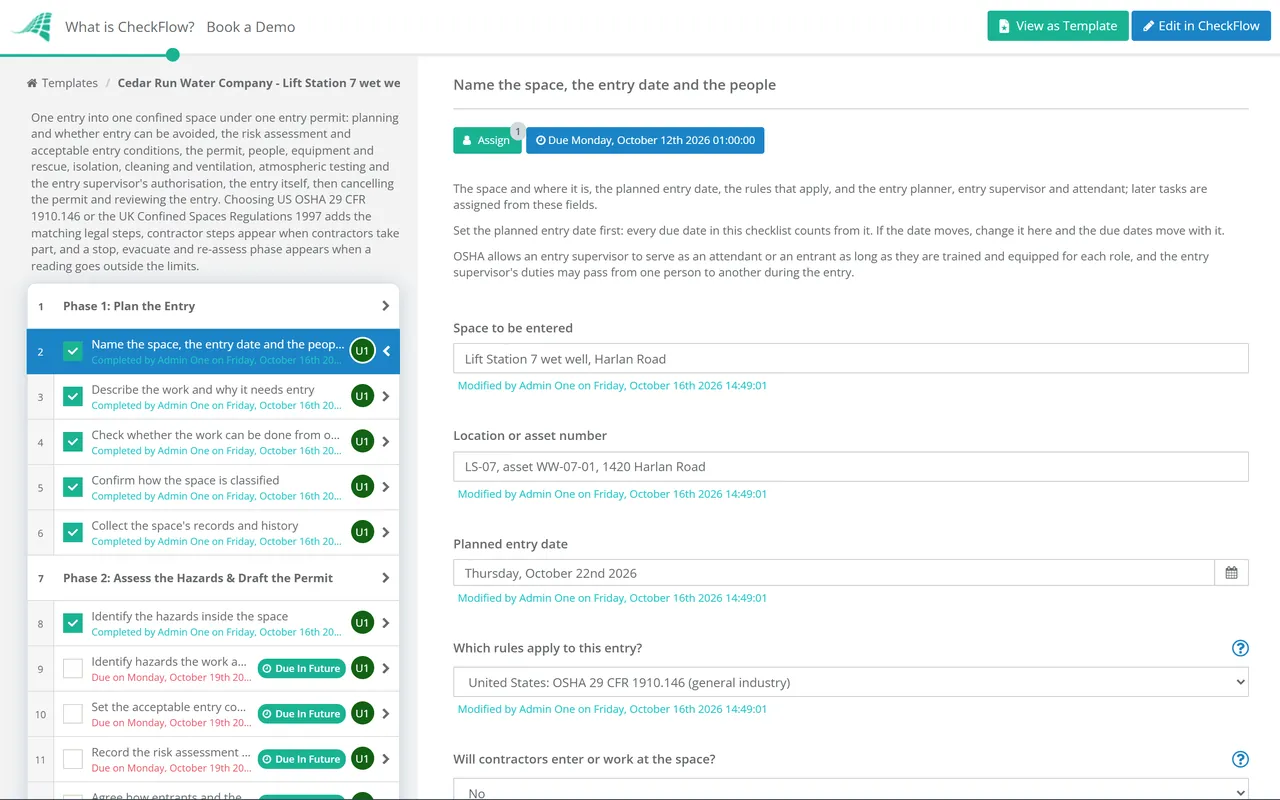
    • Name the space, the entry date and the people — the space and where it is, the planned entry date, the rules that apply, and the entry planner, entry supervisor and attendant; later tasks are assigned from these fields
    • Describe the work and why it needs entry — the job, the tools and materials to be used and how long it should take; the purpose of entry goes on the permit
    • Check whether the work can be done from outside — cameras, long-handled tools, probes, water jetting or in-place cleaning; in Great Britain entry is allowed only when it is not reasonably practicable to do the work without it
    • Confirm how the space is classified — a permit-required confined space under OSHA, or a confined space with a reasonably foreseeable specified risk under the UK Regulations, and why
    • Collect the space's records and history — drawings, previous contents and residues, connected lines, earlier permits and test results, and any incidents or near misses in this space
    • Brief the contractor and agree who does what — the hazards, your experience with the space and your precautions, whose entry procedure applies, and how work is coordinated when both employers' staff are present
  2. Phase 2

    Phase 2: Assess the Hazards & Draft the Permit

    6 tasks

    The assessment decides every precaution the permit lists. Decide here what will be tested for and what the limits are; the tests themselves come on the day.

    • Identify the hazards inside the space — a hazardous atmosphere, engulfment or rising liquid, a shape that can trap, moving parts, live electrics, heat, falls and corroded or weakened structure
    • Identify hazards the work and surroundings add — hot work, cleaning chemicals, sludge that releases gas when disturbed, engine exhaust, inflow from connected lines, traffic, rain and nearby plant
    • Set the acceptable entry conditions — the limits for oxygen, flammable gas and each toxic contaminant the assessment found, and the conditions that end the entry
    • Record the risk assessment and who made it — made by a competent person, with the people who will do the work consulted; it sets the precautions the permit lists
    • Agree how entrants and the attendant keep in contact — voice, radio or rope signals that work with breathing apparatus on, the signal to get out, and how the attendant raises the alarm
    • Draft the entry permit — the space, the purpose, the date and authorised duration, the hazards, the isolation and control measures, the acceptable entry conditions and any other permits issued
  3. Phase 3

    Phase 3: People, Equipment & Rescue

    8 tasks

    Rescue arrangements must be ready before anyone enters. HSE notes that the people killed in confined spaces include those who try to rescue others without proper training and equipment.

    • Check each person is trained for their role — entrants, attendants, the entry supervisor and whoever tests the air, each trained for the hazards of this space
    • Check each entrant is suited to this entry — build for the size of the opening, fitness to wear breathing apparatus, and conditions such as claustrophobia or asthma
    • Provide and check the entry equipment — gas monitors, ventilation, communications, lighting safe for the atmosphere, ladders, barriers and PPE, each checked before use
    • Write the rescue plan for this space — who gets an entrant out, how and with what equipment, and how others are stopped from attempting an unplanned rescue
    • Set up the retrieval system — a harness and retrieval line on each entrant, fixed to a point outside the space, and a winch or other mechanical device for a vertical entry
    • Evaluate and brief the rescue service — whether it can reach the space in time and is equipped and proficient for it; tell it the hazards and give it access to plan and practise
    • Decide whether to tell the emergency services in advance — useful for long or high-risk entries; ask what information they would want, but never treat them as the rescue plan
    • Put rescue, first-aid and resuscitation equipment at the entry point — lifting equipment, breathing apparatus for rescuers where needed, first aid and resuscitation equipment, and a trained first aider
  4. Phase 4

    Phase 4: Isolate, Clean & Ventilate

    6 tasks

    Make the space safe before it is tested for entry. The tests in Phase 5 confirm that these measures worked.

    • Lock out energy and moving parts — pumps, mixers, conveyors, valve actuators and electrical supplies, under your lockout/tagout procedure, with each lock recorded
    • Isolate every line that could let material in — blanking or blinding, removing a section of pipe, or double block and bleed; where the space cannot be fully isolated, as in a sewer, monitor continuously
    • Make the opening safe and control the area — deal with anything that makes it unsafe to remove the cover, guard the opening at once, and set up barriers and danger signs
    • Drain, clean or purge the space — remove residues that give off gas when disturbed; purge flammable contents with inert gas, not air, and treat an inerted space as oxygen-deficient
    • Ventilate the space — forced air from a clean source, ducted to where people will work and kept running until everyone is out; never add oxygen to sweeten the air
    • Check every isolation is effective — try the controls, check each blank or bleed point for flow or pressure, and record who checked
  5. Phase 5

    Phase 5: Test the Atmosphere & Authorise Entry

    8 tasks

    Test from outside the space, in this order, with a calibrated instrument. Entry begins only when the entry supervisor signs the permit, and the checklist halts at that step until they do.

    • Bump test the gas detector — calibrated to the maker's schedule and response-checked before use, with the instrument and its calibration date recorded
    • Offer the entrants the chance to watch the tests — each authorized entrant or their representative may observe the pre-entry and later testing, and gets the results straight away
    • Test for oxygen first — from outside, through a probe at the top, middle and bottom of the space; most combustible gas meters do not read reliably in low oxygen
    • Then test for flammable gases and vapours — as a percentage of the lower flammable limit, at the same three levels
    • Then test for toxic gases and vapours — hydrogen sulphide, carbon monoxide and every other contaminant the assessment identified
    • Record the results on the permit — each reading beside its acceptable limit, with the tester's name or initials and the time
    • Brief the entry team at the entry point — the job, the hazards and signs of exposure, the contact and evacuation signals, the retrieval system and the rescue plan
    • Entry supervisor authorises entry — checks every test, procedure and piece of equipment on the permit is in place and that rescue can be summoned, then signs the permit
  6. Phase 6

    Phase 6: During the Entry

    6 tasks

    The attendant stays outside for the whole entry and takes on nothing that distracts from watching the entrants. If a reading goes outside the limits, record it on the monitoring task and Phase 7 appears.

    • Post the signed permit at the entry point — so each entrant can confirm the preparations are complete before going in
    • Log every entrant in and out — the attendant keeps an accurate count of who is inside for the whole entry
    • Monitor the atmosphere throughout the entry — personal monitors on the entrants and readings logged at the intervals the permit sets; any alarm or prohibited condition means everyone gets out
    • Keep the attendant outside and watching — in contact with the entrants, alert to signs of exposure, and ready to order an evacuation or summon rescue
    • Keep unauthorised people away — the attendant warns them off and tells the entry supervisor, who removes anyone who enters
    • Hand over at a change of attendant or supervisor — the incoming person checks the entry is still within the permit and the acceptable entry conditions are still met
  7. Phase 7 — If limits are exceeded

    Phase 7: Stop, Evacuate & Re-assess

    5 tasks

    Applies only when a reading went outside the acceptable entry conditions or a monitor alarmed. Nobody goes back in until the cause is found and fixed.

    • Order everyone out of the space — at once, by the agreed signal; start the rescue plan if anyone cannot get out, and never send in an untrained rescuer
    • End the entry and cancel the permit — a condition the permit does not allow ends the entry; the entry supervisor cancels the permit and records why
    • Find out how the atmosphere changed — inflow from a connected line, disturbed residues, failed ventilation, the work itself or a faulty instrument
    • Correct the cause and retest from outside — fix the isolation or ventilation, then repeat the tests in the same order and record the new readings
    • Decide whether entry can resume — only under a new permit with the changes recorded, or stop the job and re-plan it
  8. Phase 8

    Phase 8: End the Entry & Review

    5 tasks

    Close the permit properly: the next entry into this space depends on what this one recorded. The contractor debrief appears only when contractors took part.

    • Confirm everyone and everything is out — every entrant counted out against the log, and tools, equipment and materials removed
    • Close the space and remove the isolations — covers back on, then locks, tags and blanks removed under your procedures and the space returned to service
    • Entry supervisor cancels the permit — when the work is done, with any problems met during the entry noted on it, and kept with the test records
    • Debrief the contractor — on the procedure followed and any hazards met or created during the entry
    • Review the entry and the procedure — what went wrong or nearly did, and whether the risk assessment, permit or procedure needs changing before the next entry

Atmospheric Testing: The Order and the Limits

Both rulebooks test in the same order: oxygen first, then flammable gases and vapours, then toxic gases and vapours. OSHA writes the order into the standard at 1910.146(d)(5)(iii), and HSE’s Approved Code of Practice, L101, gives the same sequence. The US figures below are the standard’s own definitions of a hazardous atmosphere. The Confined Spaces Regulations 1997 set no figures, so in Great Britain the risk assessment sets the limits for each space.

Order Test for Why in this order (OSHA Appendix B) OSHA: a hazardous atmosphere includes Great Britain (HSE L101)
1OxygenMost combustible gas meters are oxygen dependent and will not give reliable readings in an oxygen-deficient atmosphereOxygen below 19.5 percent or above 23.5 percentNormal air is 20.9% oxygen. Investigate any difference from normal; below 16% can lead to unconsciousness and death. Never add oxygen to sweeten the air.
2Flammable gases and vapoursThe threat of fire or explosion is, in most cases, more immediate and more life-threatening than toxic exposureFlammable gas, vapor or mist in excess of 10 percent of its lower flammable limit (LFL); combustible dust at or above its LFLUse monitors suited to flammable atmospheres and calibrated for the gases the risk assessment identified.
3Toxic gases and vapoursTested last, where the assessment says they may be presentAny substance above its dose or permissible exposure limit in 29 CFR 1910 subpart G or Z. Appendix E suggests sewer alarms at hydrogen sulfide 10 ppm and carbon monoxide 35 ppm (8-hour time-weighted averages)Test for each toxic gas, vapour or dust the risk assessment identified. Some flammable substances are toxic too.

Testing well. Appendix B to 1910.146, which is non-mandatory, says to read each value for at least the instrument’s minimum response time and, when descending into an atmosphere that may be stratified, to test about 4 feet (1.22 m) ahead in the direction of travel and to each side. L101 adds that the air can often be tested from outside through a long probe, allowing time for the sample to displace the air in the tube, and that representative parts of the space should be tested to find pockets of poor air.

Testing does not stop at the entry. OSHA requires testing or monitoring as necessary to confirm acceptable conditions are maintained throughout the entry, and continuous monitoring where the space cannot be isolated, such as a sewer. L101 says the atmosphere should be continuously monitored when forced ventilation is used and where the work could change it. A reading outside the limits means everyone gets out. Federal OSHA covers most private-sector employers; in a state with an OSHA-approved State Plan, the state’s rules apply and must be at least as effective, and some State Plans cover state and local government workers, such as municipal utilities.

Why Run Confined Space Entries in CheckFlow?

1

Nobody goes in before the permit is signed

The entry supervisor is named on the first task, and the authorisation is assigned to them alone. Until they record a decision the checklist halts, so the entry log and the monitoring readings cannot be completed. The record shows the permit was approved before entry began.

2

The steps match the rules you work under

Choose OSHA 29 CFR 1910.146 or the Confined Spaces Regulations 1997 on the first task and the matching steps and limits appear. Contractor briefings appear only when contractors take part, and the stop and re-assess phase only if a reading goes outside the limits. Adapt it to your own permit in the template designer.

3

Every name and reading on the record

Tables hold the isolation points, the entry team, the in-and-out log and the monitoring readings, beside the signed and cancelled permit. The entry supervisor sees the log update as the attendant fills it in, and the Reports Grid shows every open entry across your sites.

CheckFlow does not test the air, and it is not a gas monitor or an electronic permit-to-work system. It runs the steps around your own permit and procedure, so every entry follows them in the same order with a record of who did what. See how CheckFlow’s manufacturing checklist software handles maintenance and safety routines on the shop floor.

This template controls one entry into one space. Isolate each energy source with the Lockout/Tagout (LOTO) Procedure Checklist, assess the wider workplace with the Health & Safety Risk Assessment Checklist, inspect the plant with the Safety Inspection Process for a Manufacturing Facility and plan for site-wide emergencies with the Emergency Action Plan Checklist.

AI generator

Didn’t find what you need? Describe it.

Describe the process in a sentence and the AI checklist generator drafts the phases and tasks for you.

Frequently Asked Questions

What is a permit-required confined space?

Under OSHA’s 29 CFR 1910.146, a confined space is large enough to enter bodily and do work, has limited or restricted means of entry or exit, and is not designed for continuous occupancy: tanks, vessels, silos, hoppers, vaults and pits are examples. It is a permit-required confined space if it contains or could contain a hazardous atmosphere, contains a material that could engulf an entrant, has inwardly converging walls or a downward-sloping, tapering floor that could trap an entrant, or contains any other recognised serious safety or health hazard.

What must a confined space entry permit include?

1910.146(f) lists fifteen items: the space, the purpose of entry, the date and authorised duration, the entrants, the attendants and the entry supervisor by name, the hazards, the isolation and control measures, the acceptable entry conditions, the test results with the testers’ initials and times, the rescue services and how to summon them, the communication procedures, the equipment provided, any other information needed for safety, and other permits such as hot work. The entry supervisor signs it before entry, it is posted at the entry point, and cancelled permits are kept for at least a year.

What goes into a confined space risk assessment?

HSE’s guidance says the assessment will usually consider the task, the working environment, the materials and tools, the suitability of the people doing the work and the arrangements for emergency rescue. For the space itself, look at its previous contents, residues, contamination from nearby plant or the ground, the oxygen level and its layout, then at the hazards the work adds, such as cleaning chemicals, hot work and heat. In Great Britain it must be made by a competent person, and employers with five or more employees record the significant findings.

In what order should you test the atmosphere in a confined space?

Oxygen first, then flammable gases and vapours, then toxic gases and vapours. OSHA sets that order in 1910.146(d)(5)(iii), and HSE’s Approved Code of Practice gives the same one. Oxygen comes first because most combustible gas meters depend on oxygen and do not read reliably when it is low. Flammables come next because fire or explosion is usually the more immediate threat. Test from outside the space with a probe at different depths, use a calibrated instrument, and keep monitoring throughout the entry.

What does a confined space attendant do?

The attendant stays outside the space for the whole entry until relieved by another attendant. Under 1910.146(i) they keep an accurate count of who is inside, stay in contact with the entrants, watch for signs of exposure inside and dangers outside, order an evacuation when something is wrong, summon rescue, warn off unauthorised people and perform non-entry rescues, and take on no duty that could distract them. The UK Regulations do not use the term, but HSE asks whether someone outside is needed to keep watch, raise the alarm and take charge of the rescue.

What do the Confined Spaces Regulations 1997 require?

HSE summarises three key duties: avoid entry to confined spaces, for example by doing the work from outside; if entry is unavoidable, follow a safe system of work; and put adequate emergency arrangements in place before the work starts. A confined space is any place where its enclosed nature gives rise to a reasonably foreseeable specified risk, such as fire, explosion, loss of consciousness, asphyxiation or drowning. HSE’s Approved Code of Practice, L101, explains how to comply, including when a permit-to-work is needed.

Can you rely on the fire service for a confined space rescue?

No. HSE’s Approved Code of Practice says you should not rely on the public emergency services, and that relying on them alone will not satisfy the Regulations. Under OSHA, the employer must evaluate and select a rescue service that can reach the space in time and is equipped and proficient for it, and Appendix F says posting its number or planning to call 911 is not enough. Plan the rescue for the space being entered, rig the retrieval equipment, and stop anyone attempting an unplanned rescue, since ill-conceived rescue attempts are a major cause of death in these incidents.

Is CheckFlow free for this template?

14-day free trial, no card required. The Business plan is $10 per user per month after the trial. Full details at checkflow.io/pricing.

Put Every Confined Space Entry Through the Same Checks

Free trial — no credit card required.

14-day free trial, no credit cardFull refund in your first 30 daysUS or EU hosting