Subcontractor Prequalification Checklist Template

Most subcontractor failures were visible before the appointment. The insurance had lapsed, the method statement was a generic download, or nobody asked about the last accident, because the questionnaire went into a folder unread and the firm went onto the list anyway.

Last reviewed: October 2026

This free subcontractor prequalification checklist is for main contractors, principal contractors, general contractors and their commercial and health and safety teams. One run prequalifies one subcontractor for one trade package, either to join your approved list or before you invite them to tender. It starts by rating the package risk and sending the questionnaire, then checks the company and its insurance, health and safety, quality, environmental and financial standing, references, capacity, supply chain and labour. A scored assessment goes to an approver, and nothing after the decision can be completed until it is recorded. Approved firms go on the list with renewal dates and a re-qualification cycle. Choose UK (CDM 2015) or US (OSHA) rules and the matching steps appear. A high-risk work phase appears for scaffolding, demolition, asbestos and other high-risk packages, and approval with conditions adds the conditions and the monitoring.

Check the Firm Before You Price the Work

A subcontractor is usually appointed under time pressure, from a price, by someone who has to start the job next week. Prequalification moves the hard questions earlier. Before a firm goes on your approved list or receives a tender, you check who they are, whether their insurance is real and in date, how they manage health and safety, whether they can do work of this risk and size, and what their last clients say. In the UK, CDM 2015 makes that a legal duty for whoever appoints a contractor. In the US, OSHA expects a controlling employer to take reasonable care, and what it knows about a subcontractor’s safety record shapes how closely it has to watch them.

Prequalification is a different job from its neighbours. Supplier onboarding sets up a firm that supplies goods. A vendor risk assessment looks at data and security risk in a service provider. Contractor onboarding brings in one self-employed individual. And a construction site induction briefs each worker at the gate, after the firm has been appointed.

Prequalification

Can this firm do this work safely?

When: before the firm joins the approved list or is invited to tender, then again on a cycle.

Checks: company, insurance, health and safety, competence for high-risk work, quality, money, references and capacity.

Ends with: a scored, signed decision and renewal dates.

Tender and appointment

Is this the right price and contract?

When: for each package, among firms that have already passed prequalification.

Checks: price, programme, scope, exclusions and the contract terms.

Ends with: a signed subcontract or order for one package.

Site induction

Does each worker know this site?

When: every time one of the firm’s operatives arrives at a site.

Checks: cards, site rules, hazards, emergency arrangements and sign-in.

Ends with: an inducted worker approved to start.

What the Subcontractor Prequalification Checklist Covers

Eight phases take one subcontractor from the questionnaire to the approved list. Choose UK or US rules on the first task and the matching steps and notes appear. Phase 4 appears only when the package includes scaffolding or other work at height, demolition, asbestos or other high-risk work. Nothing after the approver’s decision can be completed until it is recorded, and approval with conditions adds the conditions and the monitoring they need.

  1. Phase 1

    Phase 1: Package, Risk & Questionnaire

    5 tasks

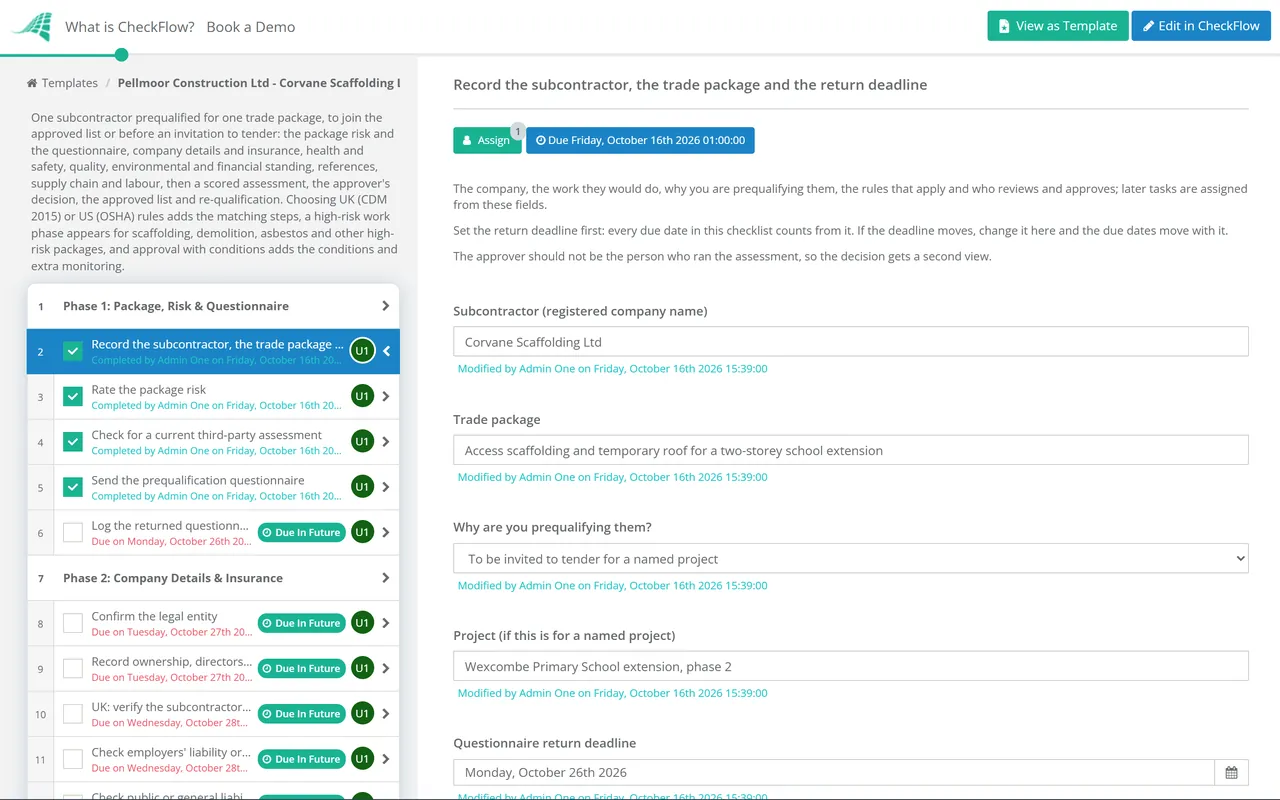
    One run prequalifies one subcontractor for one trade package. Set the questionnaire return deadline first, because every due date counts from it, and rate the risk so the later checks match the work.

    • Record the subcontractor, the trade package and the return deadline — the company, the work they would do, why you are prequalifying them, the rules that apply and who reviews and approves; later tasks are assigned from these fields
    • Rate the package risk — what the work involves, where it happens and its main hazards; the depth of every later check follows this rating
    • Check for a current third-party assessment — a prequalification certificate they already hold, such as an SSIP member scheme in the UK, so you do not ask the same questions twice
    • Send the prequalification questionnaire — only the questions this risk level needs, with the documents to attach and the return deadline
    • Log the returned questionnaire and chase what is missing — the date it came back, the documents attached and anything still outstanding
  2. Phase 2

    Phase 2: Company Details & Insurance

    7 tasks

    Check what the questionnaire says against the documents and the public records, not just the answers.

    • Confirm the legal entity — registered name, number and address against the company register, such as Companies House in the UK, which lists current and resigned officers
    • Record ownership, directors and any parent company — and any recent change of name, ownership or directors that a reference or credit check should take into account
    • UK: verify the subcontractor with HMRC under CIS — before the first payment, to confirm their registration and the deduction rate to use
    • Check employers’ liability or workers’ compensation cover — the certificate, the insured company name, the limit and the expiry date
    • Check public or general liability cover — the limit against your contract’s requirement, the policy period and any condition that would exclude this work
    • Check professional indemnity where they design — for packages that include design, such as scaffold or temporary works design; mark it not applicable if they do no design
    • Record each policy and expiry date in the insurance register — so renewals can be chased before cover lapses
  3. Phase 3

    Phase 3: Health & Safety

    7 tasks

    In the UK, CDM 2015 requires whoever appoints a contractor to take reasonable steps to check they have the skills, knowledge, experience and organisational capability for the work. In the US, OSHA weighs how much a controlling employer knows about a subcontractor’s safety history when it judges reasonable care.

    • Review the health and safety policy and arrangements — who is responsible, how work is supervised, how equipment is checked and how the policy is kept up to date
    • Review sample risk assessments and method statements — for similar work, specific to the task and the site rather than generic
    • Check training and competence records for the people who will do the work — cards, qualifications and task training for the operatives and supervisors, without relying on cards alone
    • Review accident, incident and enforcement history — accidents, ill health and near misses, any enforcement action against them, and what changed afterwards
    • US: collect OSHA 300A summaries and the EMR — the annual summaries of the OSHA 300 log, with employees and hours worked, and the experience modification rate their workers’ compensation insurer applies
    • US: search OSHA’s inspection and citation records — OSHA’s public establishment search, for inspections, citations and whether they were closed
    • Record the health and safety reviewer’s view — acceptable, acceptable with improvements, or not acceptable, with the reasons the approver will read
  4. Phase 4

    Phase 4: High-Risk Work Competence

    5 tasks

    Shown only when the package includes scaffolding or other work at height, demolition, work with asbestos or other high-risk work. The checks for that activity appear with it.

    • Get the method statement for the high-risk activity — sequence, controls, equipment, supervision and emergency and rescue arrangements for this package
    • Scaffolding or work at height: check design, supervision and competence — design calculations or a standard configuration, the plan for erecting and dismantling, and who supervises and inspects
    • Demolition: check the planning and survey arrangements — how the structure will be surveyed and brought down, and the written arrangements before work starts
    • Asbestos: check the licence or the training — the licence or training the work requires, its scope and conditions, and when it expires
    • Confirm the named supervisor or competent person for the high-risk work — their experience on similar jobs, their cards or certificates, and that they will be on site
  5. Phase 5

    Phase 5: Quality, Environment & Financial Standing

    5 tasks

    A firm that works safely can still deliver poor work, pollute the site or fail halfway through the job.

    • Review the quality management system — inspection and test plans, how defects are recorded and closed, and any ISO 9001 certificate with its scope and expiry
    • Review environmental management — how they handle and remove waste, prevent pollution and manage noise and dust, and any ISO 14001 certificate
    • Review financial standing — filed accounts or a credit report, trends in turnover and profit, and any court judgments or insolvency
    • Compare the package value with their turnover — a package that would be a large share of their annual turnover is a capacity and cash-flow risk; apply your own limit
    • Confirm capacity and key people — current workload, labour and plant free for your dates, and the named manager and site supervisor
  6. Phase 6

    Phase 6: References, Supply Chain & Labour

    5 tasks

    Past performance on similar work is the best guide to the next job. HSE’s guidance suggests checking experience and track record after the questionnaire and before the appointment.

    • Take up references from recent clients — on similar work: quality, programme, safety, payment disputes and whether they would use them again
    • Visit or review a current or recent project — where the risk rating is high, see their work and site standards for yourself
    • Ask how they appoint and check their own subcontractors — whether they sub-let any of the work, and how they check those firms’ competence
    • Check how they employ and supervise their workforce — direct employees, agency or self-employed operatives, how they check identity and right to work, and how they induct and supervise them
    • UK: check their modern slavery statement where they must publish one — a commercial organisation with a total turnover of £36 million or more publishes one each financial year; ask smaller firms what steps they take
  7. Phase 7

    Phase 7: Scored Assessment & Approval

    7 tasks

    Nothing after the approver’s decision can be completed until it is recorded. Approved with conditions adds the conditions and the monitoring they need.

    • Score the assessment against your criteria — each section scored and weighted, with the pass mark and any knock-out criteria set before the questionnaire came back
    • List the gaps and the improvements needed — what is missing or weak, and whether each must be fixed before appointment or can be monitored
    • Make a recommendation to the approver — approve, approve with conditions or reject, with the score and the main reasons
    • Approver decides whether to approve the subcontractor — approved, approved with conditions or rejected, with the trades and package value it covers; nothing after this can be completed until it is recorded
    • Record the conditions and how they will be met — what must change, by when and who checks it, agreed with the subcontractor
    • Set extra monitoring for their first package — more frequent site inspections at the start, and a review when the conditions fall due
    • Record the rejection and when they may apply again — the reasons, and what would have to change for a new application to succeed
  8. Phase 8

    Phase 8: Approved List & Re-qualification

    5 tasks

    Approval is not permanent. Insurance lapses, people leave and firms change hands, so the list needs renewal dates and triggers.

    • Tell the subcontractor the outcome — in writing, with any conditions and the trades and package values they are approved for
    • Add them to the approved subcontractor list — trades, maximum package value, risk level, conditions and the approval date; mark it not applicable if they were rejected
    • Set renewal dates for every expiring document — insurance, licences, accreditations and the assessment itself, with a reminder before each
    • Agree the re-qualification cycle and triggers — a fixed cycle, plus triggers such as a serious incident, enforcement action, a change of ownership or lapsed insurance that suspend them until re-checked
    • Review their performance after the first package — safety, quality, programme and cooperation on site, recorded for the next re-qualification; move the due date to the end of their first package

A Scoring Matrix for Subcontractor Prequalification

Neither CDM 2015 nor OSHA sets a scoring method, so the weights below are an example to adapt, not a standard. Score the sections that show quality of management out of 5 and weight them; treat the sections that show legal or insurance minimums as pass or fail, so a high score elsewhere cannot carry a firm with no employers’ liability cover. Set the weights, the pass mark and the knock-out criteria before the questionnaires come back, and use the same ones for every firm you compare for a package.

Section Evidence to ask for Example weight Fail if
Company, legal and insuranceRegister entry, ownership, employers’ liability or workers’ compensation, public or general liability and, where they design, professional indemnity certificatesPass / failThe company cannot be verified, or required cover is missing or expired
Health and safetyPolicy and arrangements, sample risk assessments and method statements, training records, accident and enforcement history; in the US, OSHA 300A summaries and the EMR30%Serious enforcement action with no evidence of change, or no usable RAMS
High-risk work competence (if applicable)Method statement for the activity, scaffold design basis, demolition survey, asbestos licence or training, named supervisorPass / failThe licence, training or competent person the work needs is missing
Quality managementInspection and test plans, defect records, ISO 9001 certificate with scope15%Your own minimum, if you set one
Environmental managementWaste, pollution, noise and dust arrangements, ISO 14001 certificate10%Your own minimum, if you set one
Financial standingFiled accounts or a credit report, turnover against the package value15%Insolvency, or a package too large for their turnover
References and past performanceAt least two references on similar work, a site visit for high-risk packages20%References that would not use them again
Capacity and key peopleCurrent workload, labour and plant for your dates, named manager and supervisor10%No capacity for your programme
Supply chain and labourHow they sub-let and check their own subcontractors, how they employ and supervise labour; in the UK, a modern slavery statement where one is requiredPass / failNo checks on their own subcontractors or labour

Keep it proportionate. HSE’s guidance on CDM 2015, L153, says enquiries about a contractor’s organisational capability should be sensible and proportionate to the risks, and that excessive or duplicated paperwork should be avoided because it distracts from the practical management of risks. It suggests the standard health and safety questions in PAS 91 as a useful aid, and accepts a third-party assessment, such as one from an SSIP Forum member scheme, as one way, but not the only way, to show capability. A small decorating firm and a scaffolding contractor should not get the same questionnaire.

Then check the track record. L153 also says those making appointments should check that the contractor has enough experience and a good record in managing the risks involved, ideally after the prequalification checks and before the appointment. That is what Phase 6 does: references, a site visit and a look at how the firm manages its own supply chain.

Why Run Subcontractor Prequalification in CheckFlow?

1

Nobody goes on the list without a decision

The approver is named on the first task and the decision is assigned to them alone. Until they record Approved, Approved with conditions or Rejected, the checklist halts, so the firm cannot be added to the approved list. The record shows who approved the subcontractor, when, and on what score.

2

The checks follow the risk and the rules

Choose UK or US rules and the matching steps appear: HMRC verification and the modern slavery check in the UK, OSHA 300A summaries and the inspection search in the US. Scaffolding, demolition and asbestos packages add their own competence checks. Change the questions to match your own questionnaire in the template designer.

3

Expiry dates and re-qualification on a schedule

The insurance register and renewal dates sit on the checklist beside the evidence. A recurring checklist can start each firm’s re-qualification on its cycle, and the Reports Grid shows every subcontractor still being assessed.

CheckFlow is not a prequalification scheme, an accredited assessor or a credit agency, and it does not score questionnaires for you. It runs your own questionnaire, checks and approval in the same order for every firm, with a record of who checked what.

Prequalification is the first step with a new firm. Once they are appointed, each of their operatives goes through the Construction Site Induction Checklist, permit-controlled work runs through the Permit to Work Checklist, and the Supplier Performance Evaluation Checklist gives a structure for reviewing how they performed. For a self-employed individual rather than a firm, use the Contractor Onboarding Checklist.

AI generator

Didn’t find what you need? Describe it.

Describe the process in a sentence and the AI checklist generator drafts the phases and tasks for you.

Frequently Asked Questions

What is subcontractor prequalification?

Subcontractor prequalification is the check a main contractor makes on a firm before it joins the approved list or is invited to tender. It confirms the company is who it says it is, that its insurance is valid, and that it has the health and safety arrangements, competence, quality systems, financial standing and capacity for the work. It ends with a scored decision: approved, approved with conditions or rejected. Price and contract terms are dealt with later, in the tender, among firms that have already passed.

What should a subcontractor prequalification questionnaire include?

Ask for company details and ownership, insurance certificates, the health and safety policy and arrangements, sample risk assessments and method statements, training and competence records, accident and enforcement history, quality and environmental arrangements, accounts or a credit report, references on similar work, capacity and key people, and how they check their own subcontractors. HSE’s own guide to using contractors suggests similar questions. Ask only what the risk of the package needs: a high-risk trade needs more evidence than a low-risk one.

What does CDM 2015 require when you appoint a subcontractor?

Regulation 8 says a contractor appointed to a project must have the skills, knowledge and experience and, if it is an organisation, the organisational capability to do the work in a way that secures health and safety. Whoever appoints them must take reasonable steps to satisfy themselves of that. HSE’s guidance, L153, says the steps depend on the complexity and risks of the project, that enquiries should be proportionate, and that PAS 91’s standard health and safety questions are a useful aid. CDM 2015 applies to construction projects in Great Britain.

Do subcontractors need SSIP accreditation?

No. HSE’s guidance on CDM 2015 says the law does not require any business to use a third party to help it bid for work. An assessment from a member scheme of the Safety Schemes in Procurement (SSIP) Forum is one way to show organisational capability at the prequalification stage, but not the only way: a firm may assess itself and send its own documents. If a firm already holds one, check its expiry date and that it covers the trade you are appointing them for, rather than asking the same questions again.

What insurance should a subcontractor have?

In Great Britain most employers must hold employers’ liability insurance of at least £5 million, and the certificate shows the cover and the companies insured; a company that employs only its owner is exempt. Public liability is generally voluntary in law, so the limit comes from your contract. In the US, workers’ compensation is run by each state, and the general liability limit comes from your contract. Ask for professional indemnity where the firm designs. Check names, limits and expiry dates, and record them so renewals are chased.

What safety records should you ask a US subcontractor for?

Ask for the OSHA 300A annual summaries for recent years, which give the recordable cases, average employees and total hours worked, and the experience modification rate on their workers’ compensation policy. Employers keep the 300 log and its summaries for five years, but a company with 10 or fewer employees throughout the last calendar year is partly exempt and may have no log. OSHA’s public establishment search shows inspections and citations. Under OSHA’s multi-employer citation policy, what you know about a subcontractor’s safety history affects how closely you must watch them.

How often should subcontractors be re-qualified?

No regulation sets a cycle, so choose one, for example every year or every two years, and re-qualify sooner after a trigger: a serious incident, enforcement action, a change of ownership, poor performance or lapsed insurance. Some documents expire on their own timetable. An HSE asbestos licence, for example, lasts up to three years. Record the expiry date of every certificate when you approve the firm, so the next check is due before something lapses rather than after.

Is CheckFlow free for this template?

14-day free trial, no card required. The Business plan is $10 per user per month after the trial. Full details at checkflow.io/pricing.

Put Every New Subcontractor Through the Same Checks

Free trial — no credit card required.

14-day free trial, no credit cardFull refund in your first 30 daysUS or EU hosting