Gemba Walk Checklist Template

A gemba walk goes wrong when it turns into an inspection: too many managers, a clipboard of scores, fixes ordered on the spot, and nobody in the area told what happened next.

Last reviewed: October 2026

This free gemba walk checklist is for managers, team leaders and continuous improvement leads who go and see how work is done, in a factory, a warehouse, an office, a laboratory or a hospital. One run is one walk through one area or process. The walk leader sets the purpose, the theme and the route, tells the area what the walk is for and checks the safety rules. On the walk, the walkers watch the work at each stop, compare it with the standard work, follow the flow, look for waste and check safety, quality and visual management, then ask the people doing the work open questions and record what they see and hear without fixing it on the spot. The debrief picks the few things that matter, the area owner agrees the follow-up actions and owners, and the checklist follows each action through and sets the next walk.

Gemba Walk, 5S Audit or Kaizen Event?

A gemba walk is a way of learning. The Lean Enterprise Institute defines it as “a management practice for grasping the current situation through direct observation and inquiry before taking action,” and explains that gemba is the Japanese term for “actual place”: the shop floor, or anywhere value-creating work happens. This checklist runs one walk, from its purpose to the follow-up actions and the date of the next walk.

A walk sits beside processes that inspect, score or change an area without replacing them. A safety inspection checks an area against its safety standards, in the Warehouse Safety Inspection Checklist or the Safety Inspection Process for a Manufacturing Facility; a gemba walk looks at safety as part of the work and stops only for a serious hazard. The Continuous Improvement Cycle Process Checklist runs a plan, do, check, act cycle, which the actions from a walk often feed.

This checklist

Gemba walk

Asks: how is the work really done here, and what gets in the way of the people doing it?

When: regularly, led by managers, team leaders or improvement leads, in a factory, a warehouse, an office, a laboratory or a ward.

Output: observations recorded as facts, what people said, two to five actions the area owner agrees, and the date of the next walk.
Scored audit

5S audit

Asks: how well does this area keep Sort, Set in Order, Shine, Standardise and Sustain?

When: on a schedule, in the 5S Audit Checklist.

Output: a score for each S, red tags and actions. A gemba walk with a 5S theme looks at the same things without scoring them.

Improvement event

Kaizen event

Asks: how do we improve this one process against a target, over a few days?

When: when a problem is too big to fix through the actions of a walk, in the Kaizen Event Checklist.

Output: changes tried in the area, new standard work and a 30-day review. A walk can hand a problem to one.

What the Gemba Walk Checklist Covers

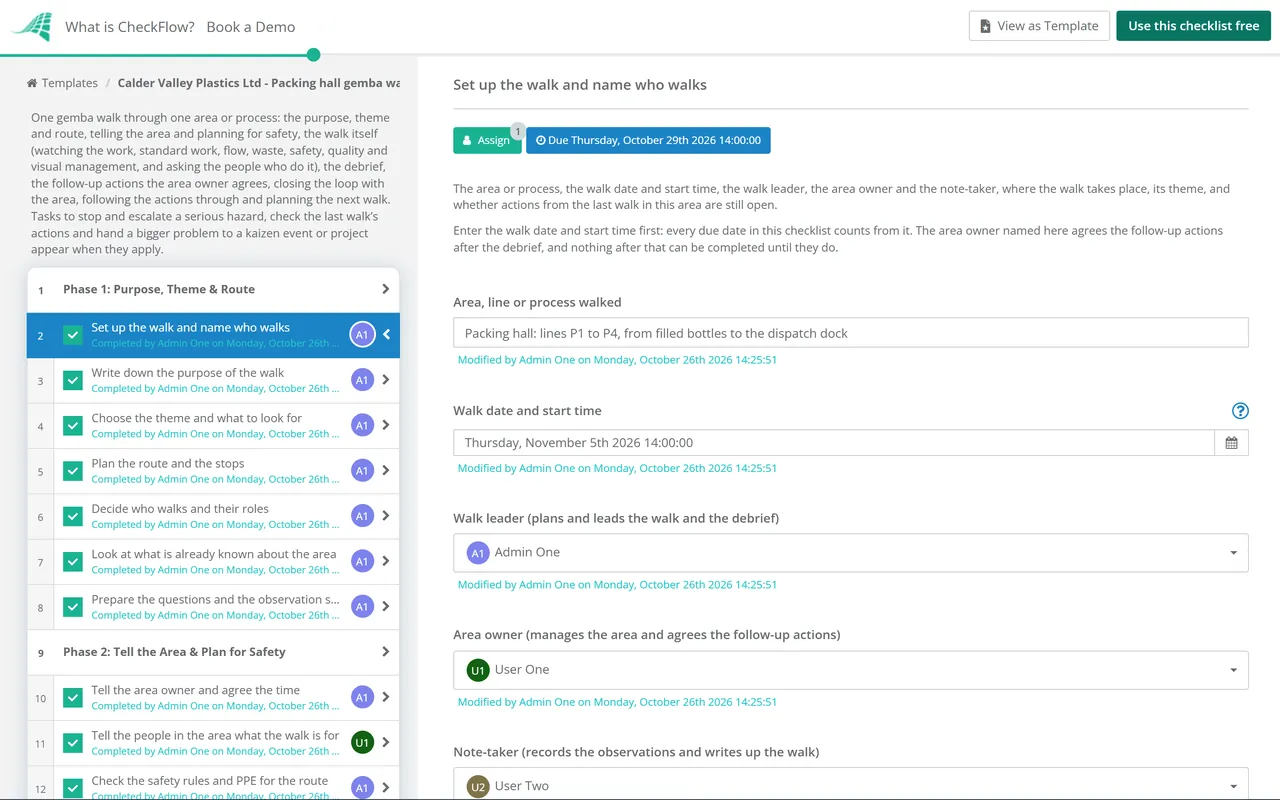
Nine phases follow one gemba walk, from planning it to setting the next one. The first task records the area, the walk date and start time, the walk leader, the area owner and the note-taker, where the walk takes place, its theme and whether actions from the last walk are still open. The setting and the theme each show a short note on what to watch for, and open actions from the last walk add a task to check them in the area. A serious hazard seen on the walk adds three tasks to stop the work, report the hazard the same day and confirm the controls, and a problem too big for the area adds a task to hand it to a kaizen event or an improvement project. Nothing after the area owner agrees the follow-up actions can be completed until they do.

  1. Phase 1

    Phase 1: Purpose, Theme & Route

    7 tasks

    The walk leader plans the walk in the week before it. Enter the walk date and start time on the first task first: the preparation counts back from it, and the walk, the debrief and the follow-up count forward from it. The answers on the first task add the notes and tasks this walk needs.

    • Set up the walk and name who walks — the area or process, the walk date and start time, the walk leader, the area owner and the note-taker, where the walk takes place, its theme, and whether actions from the last walk in this area are still open
    • Write down the purpose of the walk — what the walk is for and the question it should answer, such as why orders wait at packing or whether the new changeover standard is followed, written so the people in the area can understand it
    • Choose the theme and what to look for — the one theme this walk looks at most closely, such as safety, quality, flow, 5S or standard work, and two or three things to look for under it, so the walk stays focused
    • Plan the route and the stops — the route through the area in the order the work flows, the stops where the walkers will watch and ask, and the walkways that keep the walkers out of the way of the work
    • Decide who walks and their roles — a small group: the walk leader, the note-taker and the area owner or team leader, plus anyone the theme needs, such as a health and safety adviser or a quality engineer, each with a clear role
    • Look at what is already known about the area — the actions from the last walk, the standard work and visual boards for the area, recent incidents, complaints or defects and the area’s measures, read to prepare questions rather than to reach conclusions before the walk
    • Prepare the questions and the observation sheet — a few open questions for each stop, the route and stops printed or on a phone, and somewhere to note observations as facts, with no scoring sheet
  2. Phase 2

    Phase 2: Tell the Area & Plan for Safety

    5 tasks

    A walk should not surprise the people who work in the area or put the walkers at risk. Tell the area what the walk is for, check the safety rules for the route and agree what happens if someone could be hurt, all before the day.

    • Tell the area owner and agree the time — the purpose, theme, route and time agreed with the area owner, at a time that avoids a changeover, a peak or a shift change unless that is what the walk is there to see
    • Tell the people in the area what the walk is for — the team told by their area owner or team leader that the walk is there to learn how the work is done and what gets in the way, not to check on them, and that they will hear what it finds
    • Check the safety rules and PPE for the route — the site induction, the personal protective equipment for each area on the route, restricted zones and any permits, so every walker is trained and equipped before the day
    • Agree how the walk will stay out of the way of the work — where the walkers will stand, that nobody stops a line or a task to ask a question, and that questions wait for a natural pause in the work
    • Agree what to do if a serious hazard is seen — who on the walk can stop the work, who makes the area safe, who to tell the same day and how the hazard is reported in the site’s own system
  3. Phase 3

    Phase 3: Start the Walk

    3 tasks

    The walk starts where the work starts. Brief the walkers in a few minutes, sign in, then go to the first stop.

    • Brief the walkers at the start point — the purpose, the theme, the route, who does what, the safety rules, and the three rules for the walk: watch first, ask open questions, and record without fixing
    • Sign in and put on the PPE each area needs — every walker signed in as the site requires and wearing the PPE for each area on the route, with anything missing sorted before entering
    • Start at the beginning of the process — the first stop on the route, where the product, order or request starts, so the walk follows the work in the order it flows
  4. Phase 4

    Phase 4: Observe at Each Stop

    12 tasks

    At each stop, watch before you ask. Look at the process, the standard work, the flow, waste, safety, quality and visual management, and write down what you see as facts. Nobody fixes anything on the spot unless someone could be hurt.

    • Watch the work before asking anything — a few full cycles of the work at each stop, watched from where the walkers are not in the way, noting what is done, in what order and how long it takes
    • Compare the work with the standard work — whether a standard exists for each step, whether it is current and posted where the work is done, whether people follow it and, where they do not, the reason
    • Follow the flow between steps — queues and waiting, work in progress building up between steps, handoffs, batches and anything that makes the product, order or request stop moving
    • Look for waste — the seven wastes Taiichi Ohno named, as the Lean Enterprise Institute lists them: overproduction, waiting, conveyance, processing, inventory, motion and correction
    • Look at safety at each stop — how people and equipment share the space, guards, housekeeping, manual handling and postures, and anything that could hurt someone, including near misses people mention
    • Stop the work and make the area safe — appears when a serious hazard was seen: the work stopped by whoever the site’s rules allow, the area made safe and the people in it told why, before the walk moves on
    • Report the hazard the same day — appears when a serious hazard was seen: the hazard reported in the site’s own reporting system and to the person agreed before the walk, on the day, with photos if it is safe to take them
    • Confirm the controls before the work restarts — appears when a serious hazard was seen: the controls in place and checked by the area owner before the work restarts, and a lasting fix added to the follow-up actions
    • Check the actions from the last walk where the work is done — appears when actions from the last walk are still open: each open action looked at in the area, to see whether the change happened and whether it works
    • Check visual management at each stop — whether boards, labels, floor markings and signals show the plan, the status and what is normal, whether a problem would be obvious to someone walking past, and whether the boards are up to date
    • Look at quality at the point of work — how people know the work is right, the checks done at each step, defects, rework and scrap, and what someone does when something is not right
    • Record each observation as a fact — what was seen, where and when, without blame or a fix attached, with photos where the site allows them, so the debrief works from facts
  5. Phase 5

    Phase 5: Ask, Listen & Record

    6 tasks

    The people who do the work know it best. Ask open questions at a natural pause, listen, and write down what they say. Note ideas and problems for the debrief instead of fixing them on the spot.

    • Ask the people doing the work to show you how it is done — open questions at a natural pause, such as “Can you show me how you do this?” and “How do you know it is right?”, asked of the person doing the work rather than their manager
    • Ask what gets in the way — what slows the work down, what goes wrong most often, the workarounds people use and what they would change if they could
    • Ask how a problem is raised and what happens next — what someone does when something is wrong, who they tell, how quickly help comes and whether they hear back
    • Write down what people said — what people said, in their words where possible, played back to them to check it is right, and recorded without names where they prefer
    • Note fixes as ideas, not instructions — any fix a walker thinks of noted for the debrief rather than given as an instruction on the spot, unless someone could be hurt
    • Thank people and say what happens next — a thank-you at each stop, and when and how the team will hear what the walk found and what will be done
  6. Phase 6

    Phase 6: Debrief & Agree the Actions

    7 tasks

    Hold the debrief while the walk is fresh, ideally straight after it. Pick the few things that matter most, agree actions with owners and dates, and hand anything bigger to a kaizen event or an improvement project. The area owner agrees the actions before they are tracked.

    • Hold the debrief straight after the walk — the walkers and the area owner together, as soon as possible after the walk while the details are fresh, somewhere away from the work
    • Go through the observations stop by stop — each observation and what people said, read out in the order of the route, with anything unclear checked against the notes and photos
    • Separate facts from opinions and group by theme — what was seen kept apart from what walkers think caused it, and the observations grouped under safety, quality, flow, 5S, standard work and other
    • Pick the few observations that matter most — the two to five observations with the most effect on safety, quality or flow, or that people raised most often, chosen so the area can act on them
    • Decide what needs more study or a bigger project — observations whose cause is not yet clear, which need data or another look, and problems too big for the area to fix in a few weeks, which go to a kaizen event or an improvement project
    • Draft the follow-up actions with owners and dates — one action per priority, each small enough to finish, with an owner from the area and a due date, written so the owner knows what done looks like
    • Area owner agrees the follow-up actions and owners — the area owner confirms that each action, owner and due date can be met, or changes them, and agrees to track them; nothing after this task can be completed until they agree
  7. Phase 7

    Phase 7: Close the Loop With the Area

    3 tasks

    The people in the area gave their time and their answers. Write up the walk, tell them what it found and what will happen, and put the actions where the team can see them.

    • Write up the walk record — the purpose, theme, route, observations, what people said, the priorities and the agreed actions, kept with this checklist
    • Feed back to the people in the area — what the walk saw, what people told the walkers, which actions were agreed and who owns them, told to the team at their next briefing
    • Put the actions on the area’s board or tracker — each agreed action, its owner and due date, posted where the team can see progress, such as the team board or the site’s action tracker
  8. Phase 8

    Phase 8: Follow Up the Actions

    6 tasks

    Actions take days to weeks. Check progress, help remove what blocks an action, and go back to the area to see each change working before closing it.

    • Check progress on each action — each action’s progress checked with its owner a week after the walk, with any that are late given a new date or help
    • Hand the bigger problem to a kaizen event or improvement project — appears when a problem needs a kaizen event or improvement project: the problem, the observations behind it and what is already known, handed to whoever runs kaizen events or improvement projects, with a reference back to this walk
    • Help clear what is blocking an action — anything stopping an action, such as time, budget, parts or a decision from someone else, taken up by the walk leader with whoever can remove it
    • Go back and see each change working — each finished action checked at the gemba, by watching the work again and asking the people who do it whether the change helps
    • Update the standard work where a change has altered it — the standard work, visual aids and training updated wherever an action changed how the work is done, so the change holds
    • Close the actions and record what changed — each action closed with what changed and its effect, and any that were dropped recorded with the reason
  9. Phase 9

    Phase 9: Plan the Next Walk

    3 tasks

    A gemba walk works best as a habit rather than a one-off. Learn from this walk, then set the date and theme of the next one.

    • Note what to do differently next time — what went well on this walk and what to change, such as the route, the time of day, the size of the group or the questions
    • Set the date and theme of the next walk — the next walk in this area or the next area on the plan, with its date, theme and walk leader, and the open actions to check on it
    • Close the walk — every task complete or marked not applicable, the walk record and photos kept with this checklist, and anything still open carried to the next walk

What to Look For and What to Ask on a Gemba Walk

Watch first, then ask. Use the rows that fit the theme of the walk as prompts at each stop, and ask the person doing the work rather than their manager. The questions are this template’s suggestions: change them to fit your area.

Look at What to look for Questions to ask the people doing the work
The processWhat is done, in what order and how long it takes, and whether it runs the same way each timeCan you show me how you do this? What happens before and after your step?
Standard workWhether a standard exists, is current, is posted where the work is done and is followedIs there a standard for this? Is it the best way you know? What makes it hard to follow?
FlowQueues, waiting, work in progress between steps, handoffs and batchesWhat are you waiting for most often? Where does work pile up?
WasteOverproduction, waiting, conveyance, processing, inventory, motion and correctionWhat do you do that does not help the customer? What do you have to redo or check twice?
SafetyHow people and equipment share the space, guards, housekeeping, manual handling and near missesWhat could hurt someone here? What happens when you raise a safety concern?
QualityChecks at the point of work, defects, rework and what happens when something is not rightHow do you know this is right? What do you do when it is not?
Visual managementWhether boards, labels and markings show the plan, the status and what is normalHow do you know if you are ahead or behind? Who uses this board?
Problems and ideasWorkarounds, problems that keep coming back and how problems are raisedWhat gets in the way? Who do you tell when something goes wrong, and do you hear back? What would you change?

Where the terms come from. The Lean Enterprise Institute’s lexicon lists Taiichi Ohno’s seven wastes as overproduction, waiting, conveyance, processing, inventory, motion and correction, and bases standardized work on three elements: takt time, the precise work sequence and the standard inventory. Its gemba walk entry suggests following a product family, a design or a customer-facing process from start to finish, across departments where it crosses them, which is why this checklist plans the route in the order the work flows.

Watch, ask, then act. The Lean Enterprise Institute describes Jim Womack’s practice as “go and see, ask why, and show respect.” This checklist keeps fixes for the debrief and asks the area owner to agree the actions, so the people who do the work stay part of the change.

Why Run Gemba Walks in CheckFlow?

1

Nobody tracks an action the area has not agreed

The walk leader, the area owner and the note-taker are chosen on the first task, and each task is assigned to the person who owns it. Agreeing the follow-up actions is assigned to the area owner alone, and nothing after that approval step can be completed until they agree.

2

Only the tasks this walk needs

The setting and the theme each show a short note on what to watch for. Open actions from the last walk add a task to check them in the area, a serious hazard adds three tasks to stop the work, report it the same day and confirm the controls, and a problem too big for the area adds a task to hand it to a kaizen event or a project. Rules show and hide each one from the answers given.

3

Every walk on a schedule and on record

Due dates count from the walk date and start time: the preparation in working days before it, the walk and the debrief in hours after it, and the follow-up in working days after that. Set up a recurring schedule for each area so the next walk is waiting before it is due. Overdue alerts go to the task’s assignees. The Reports Grid lists every walk with its answers, such as the area, the theme and whether a serious hazard was seen, with filters and export. Analytics shows how long walks and their actions take and where work runs late, by template, person and step.

CheckFlow does not replace your safety reporting system or your site’s action tracker. Report hazards where your site reports them and record the reference in the walk. CheckFlow runs the walk around them: what was seen, what people said, which actions the area owner agreed and whether each change works. CheckFlow’s manufacturing checklist software shows how plants run their other routines the same way.

Score an area with the 5S Audit Checklist, run a focused improvement with the Kaizen Event Checklist and write down a new way of working with the Process Standardization Checklist. To see the whole flow of a product or service before you walk it, read our guide to value stream mapping.

AI generator

Didn’t find what you need? Describe it.

Describe the process in a sentence and the AI checklist generator drafts the phases and tasks for you.

Frequently Asked Questions

What is a gemba walk?

The Lean Enterprise Institute defines a gemba walk as “a management practice for grasping the current situation through direct observation and inquiry before taking action.” Leaders go to where the work is done, watch it, ask the people doing it open questions and only then decide what to do. It is a way of learning how the work really happens, not an inspection of the people doing it.

What does gemba mean?

Gemba is the Japanese term for “actual place.” The Lean Enterprise Institute notes that it is often used for the shop floor but covers any place where value-creating work happens: a factory floor, an operating room, a kitchen, a job site or, in software, the code itself. Japanese companies often pair it with genchi genbutsu, essentially “go and see,” to stress learning from what you see rather than from reports.

What questions should you ask on a gemba walk?

Open questions, asked of the person doing the work at a natural pause: “Can you show me how you do this?”, “How do you know it is right?”, “What gets in the way?”, “What happens when something goes wrong?” and “What would you change if you could?” Avoid questions that judge or lead, and play back what you heard. The table above has questions for each theme; they are this template’s suggestions.

What should you look for on a gemba walk?

The process itself, whether the work follows its standard, the flow between steps, waste, safety, quality at the point of work and visual management. The Lean Enterprise Institute lists Taiichi Ohno’s seven wastes as overproduction, waiting, conveyance, processing, inventory, motion and correction, and bases standardized work on takt time, the precise work sequence and the standard inventory. Choose one theme per walk so it stays focused.

How is a gemba walk different from an audit or a safety inspection?

An audit or an inspection checks an area against a standard and records findings or a score. A gemba walk is there to understand how the work is done and what gets in the way of the people doing it, so it watches and asks rather than scores. It still looks at safety, and a serious hazard is stopped and reported the same day. Use the 5S Audit Checklist to score an area.

Should you fix problems during a gemba walk?

Not on the spot, unless someone could be hurt. A fix ordered during the walk skips the people who do the work and the area owner, and often treats a symptom rather than the cause. This template notes ideas for the debrief, where the walkers pick the few that matter most and the area owner agrees the actions, owners and dates before they are tracked.

Who should go on a gemba walk?

A small group: a walk leader, usually a manager or an improvement lead, a note-taker and the area owner or team leader, plus a specialist the theme needs, such as a health and safety adviser or a quality engineer. This template’s practice is three or four people, so the walk does not crowd the area. The people who do the work are not walkers: they are the people the walk learns from.

How long does a gemba walk take, and how often should you do one?

There is no fixed rule. This template plans about an hour and three quarters on the floor, a debrief straight afterwards and follow-up actions over about four weeks, counted in working days from the walk date and time. How often depends on the area. This template suggests a regular walk, set up as a recurring schedule, so each walk can check the last one’s actions. Change the due dates to fit your site.

What happens after a gemba walk?

The walkers debrief while the walk is fresh, separate facts from opinions, pick two to five priorities and draft actions with owners and dates. The area owner agrees them, the team hears what the walk found and the actions go on the area’s board. The walk leader checks progress, goes back to see each change working and sets the date and theme of the next walk.

Is CheckFlow free for this template?

14-day free trial, no card required. The Business plan is $10 per user per month after the trial. Full details at checkflow.io/pricing.

Walk the Gemba and See Every Action Through

Free trial — no credit card required.

14-day free trial, no credit cardFull refund in your first 30 daysUS hosting, EU on request