Safety Inspection Process for a Manufacturing Facility
Lockout/Tagout is third on OSHA’s preliminary FY2026 list of most-cited standards, after 2,443 citations in FY2024. Machine guarding violations have cost manufacturers millions in penalties and settlements. The safety inspection that does not happen is the one that gets replaced by an OSHA investigation.
Printed from checkflow.io/templates/manufacturing-production/manufacturing-safety-inspection-checklist
Manufacturing safety is not a compliance exercise — it is an operational discipline with direct human consequences when it fails. Hazardous energy alone shows the stakes: OSHA’s lockout/tagout fact sheet (FS-3529) estimates that compliance with its lockout/tagout standard prevents about 120 fatalities and 50,000 injuries each year. Machine guarding failures, unprotected fall hazards, inadequate PPE, and poor housekeeping contribute to thousands more. The facilities that maintain strong safety records are not the ones that are lucky — they are the ones that inspect systematically, document honestly, and act on findings before OSHA does. A structured safety inspection process translates the facility’s safety obligations into a structured, recurring audit across every category: energy control, machine guarding, PPE, emergency systems, chemical handling, fire protection, housekeeping, and incident reporting. Every finding generates a corrective action. Every corrective action is tracked to closure. Every inspection creates the documented record that demonstrates a proactive safety programme — not just to an OSHA inspector, but to the workforce that needs to trust that the facility takes their safety seriously. This free checklist gives EHS officers, plant managers, and safety supervisors a structured framework for the full manufacturing facility safety inspection.
The Safety Violations OSHA Finds Most Frequently — and the Cost of Each One
Lockout/Tagout (1910.147)
FY2024 citations: 2,443 (5th most cited); 3rd on the preliminary FY2026 list. What it requires: written, machine-specific LOTO procedures for every piece of equipment; trained and authorised personnel; annual procedure inspections. Failure consequence: Worker fatalities and amputations from unexpected energisation during maintenance.
Machine Guarding (1910.212)
One of the most frequently cited standards. What it requires: every machine with moving parts, in-running nip points, rotating parts, or flying chips must have physical guarding that prevents worker contact with the hazard. Failure consequence: Amputations, crushing injuries, and fatalities.
Electrical Safety (1910.303/305)
Common citation area. What it requires: electrical equipment installed and maintained per NEC; covers not in use or exposed; junction boxes covered; no use of damaged equipment. Failure consequence: Electrocution, arc flash burns, and fires.
Powered Industrial Trucks (1910.178)
Forklift/PIT safety is consistently cited. What it requires: operator training and certification; pre-shift inspection; capacity plates; pedestrian/vehicle separation. Failure consequence: Pedestrian fatalities, load collapse injuries.
Fall Protection — General Industry (1910.23)
Cited for elevated platforms, open floor holes, and unguarded stairways. What it requires: guardrails or fall arrest systems at defined heights; hole covers; safe access to elevated work. Failure consequence: Falls from elevation — a leading cause of fatal injuries.
Hazard Communication (1910.1200)
Chemical labelling and SDS requirements. What it requires: all hazardous chemicals labelled per GHS; SDS available for every chemical; worker training on chemical hazards. Failure consequence: Chemical exposure injuries and regulatory penalties.
The Manufacturing Facility Safety Inspection Checklist
Seven phases covering the full facility safety audit — from LOTO programme inspection through machine guarding, PPE, emergency systems, chemical safety, housekeeping, and safety programme governance.
1
Phase 1
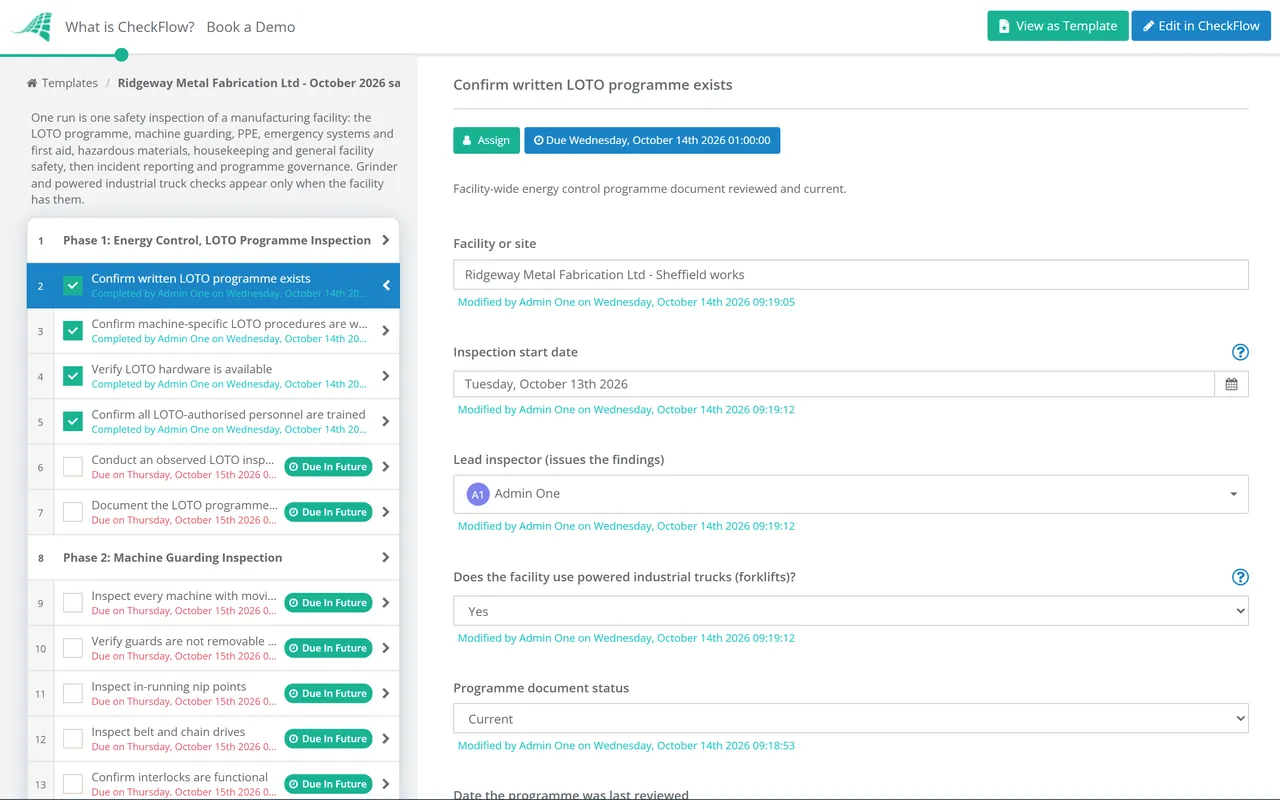
Energy Control — LOTO Programme Inspection
6 tasks
The LOTO programme audit checks both the programme-level requirements (written procedures, training records, hardware availability) and the task-level implementation (are technicians actually following LOTO before starting maintenance work?).
Confirm written LOTO programme exists — facility-wide energy control programme document reviewed and current
Confirm machine-specific LOTO procedures are written and posted — for every piece of equipment requiring LOTO; posted at or accessible at the equipment
Verify LOTO hardware is available — sufficient locks per technician, hasps, tags, lockout boxes, and valve lockouts; damaged hardware replaced
Confirm all LOTO-authorised personnel are trained — training records current; any new personnel trained before performing LOTO
Conduct an observed LOTO inspection — observe a LOTO procedure being performed; confirm the technician follows the written procedure correctly; required annually per OSHA 1910.147(c)(6) by an authorised employee who is not the one performing the LOTO
Document the LOTO programme annual inspection — in writing; required by OSHA; include machine, employee, date, and inspector
2
Phase 2
Machine Guarding Inspection
7 tasks
Inspect every machine with moving parts — confirm all required guards are in place and functioning; no guards removed or bypassed
Verify guards are not removable without a tool — guards that can be casually removed by hand do not meet OSHA requirements
Inspect in-running nip points — all points where two rotating surfaces create an in-running nip (rollers, gears, belts/pulleys) guarded
Inspect belt and chain drives — all exposed belts, chains, and pulleys guarded; guards intact
Confirm interlocks are functional — guards with interlocks tested; machine stops when guard is opened
Inspect abrasive wheels and grinders — wheel guards in place; tool rests adjusted correctly; tongue guards within specification
Document any missing or damaged guards — as corrective actions with immediate timeline for correction; no production use until guarding is restored
3
Phase 3
PPE Inspection
5 tasks
Confirm PPE hazard assessment is current — written assessment identifying PPE requirements by area and task; reviewed annually and when tasks or hazards change
Confirm PPE is provided at no cost — required PPE available and accessible to all workers who need it
Inspect PPE condition — hard hats, safety glasses, hearing protection, respirators, gloves, and safety footwear inspected; damaged or expired PPE replaced
Confirm PPE training is current — workers trained on when PPE is required, how to use and maintain it; training records on file
Verify PPE is being worn correctly — observe workers in areas requiring PPE; any non-compliance addressed immediately
4
Phase 4
Emergency Systems, Exits & First Aid
6 tasks
Inspect all emergency exits — unobstructed, marked, and illuminated; all exit doors accessible; no storage blocking aisles leading to exits
Test emergency lighting — confirm emergency lighting activates on power failure; batteries functional
Inspect fire extinguishers — in designated locations; current inspection tag; unobstructed access; pins and seals intact
Inspect fire suppression systems — sprinkler heads unobstructed (18-inch clearance); no material stored near sprinkler heads; last tested within required interval
Confirm eyewash and emergency shower stations — in areas with chemical hazards; unobstructed; tested weekly; flow adequate
Inspect first aid stations — stocked, accessible, and known to workers; trained first aiders identified per OSHA/applicable requirements
5
Phase 5
Hazardous Materials & Chemical Safety (HazCom)
5 tasks
Confirm SDS are available — for every hazardous chemical used, stored, or produced; in a known, accessible location for all workers
Confirm all chemicals are labelled — per GHS (Globally Harmonized System); secondary containers labelled; no unlabelled chemicals
Inspect chemical storage areas — incompatible chemicals segregated; flammables in flammable storage cabinets; quantity limits not exceeded; secondary containment for liquids
Confirm HazCom training is current — all workers handling hazardous chemicals trained; training records on file
Inspect for chemical leaks or spills — any uncontrolled releases noted and immediately reported; spill response equipment available and accessible
6
Phase 6
Housekeeping, Ergonomics & General Facility Safety
5 tasks
Inspect all walkways and aisles — clearly marked, unobstructed; no material stored in aisle ways; adequate width maintained
Inspect floors for slip and trip hazards — oil, water, or material spills; uneven surfaces; cables or hoses crossing walkways
Inspect lighting levels — adequate illumination in all work areas and storage areas; failed bulbs replaced
Inspect racking and storage — maximum load capacities posted and not exceeded; items stored safely; no overhead storage that creates a falling object hazard
Inspect powered industrial trucks — pre-shift inspection records current; pedestrian separation measures in place; speed limits posted
7
Phase 7
Incident Reporting & Safety Programme Governance
6 tasks
Confirm OSHA 300 log is current — all recordable incidents logged; 300A summary posted from February 1 to April 30
Review near-miss reporting — is the near-miss reporting culture active? Near misses reported and investigated; not just major incidents
Confirm safety training records — current for all required training (LOTO, HazCom, forklift, emergency response, PPE); new employees trained before exposure
Review open corrective actions from previous inspections — all findings from the last safety inspection have been closed or are on track
Confirm safety committee is meeting — safety committee or equivalent regular meetings; minutes retained
Document the inspection findings — all observations, findings, and corrective actions formally recorded; issued to responsible managers with deadlines
The 7-Step LOTO Procedure (Based on OSHA 1910.147(c)(9) and (d))
1
Prepare for shutdown
Identify all energy sources (electrical, pneumatic, hydraulic, thermal, mechanical, gravitational). Gather all required LOTO devices and hardware.
2
Notify affected employees
Inform all employees in the area that equipment is being shut down for maintenance. Document notification.
3
Shut down equipment
Use the normal stopping procedure; all equipment at zero speed or stopped state.
4
Isolate all energy sources
At every isolation point (disconnect switch, valve, breaker): move to the off/closed/open position.
5
Apply locks and tags
One lock per authorised employee at each isolation point. Tag applied identifying the technician and reason for lockout.
6
Dissipate residual stored energy
Bleed pneumatic pressure. Discharge capacitors. Block gravity loads. Release spring tension. Zero residual energy.
7
Verify zero energy state
Attempt to start equipment at normal controls. Equipment does not start = zero energy confirmed. Document verification.
Restoration: Performed in reverse order with all employees clear. Each employee removes only their own lock. Document the restoration.
Why Run Your Safety Inspections in CheckFlow?
1
Recurring safety inspections at every required frequency
Manufacturing safety requires inspection at multiple frequencies — daily safety walks, weekly formal inspections, monthly PPE audits, and annual comprehensive reviews. CheckFlow’s recurring feature schedules each inspection type automatically at its required frequency, assigns it to the responsible person, and sends reminders before deadlines. The inspection that must happen does not depend on someone remembering.
2
Corrective actions tracked to closure
A safety inspection that finds a missing machine guard and generates a corrective action that is never implemented has done less than nothing — it has created a documented record of a known hazard that was not addressed. CheckFlow assigns each corrective action to a named person with a deadline, sends reminders, and escalates overdue items. The safety gap that is found is also the safety gap that gets closed.
3
A documented inspection record for OSHA compliance and legal defence
OSHA inspections begin by reviewing your safety inspection records — do you inspect, do you find things, and do you fix them? Every inspection completed through CheckFlow is timestamped, attributed, and archived. The evidence of a systematic safety programme is built as the process runs — not assembled in a hurry when the inspector arrives.
Safety inspection findings related to equipment maintenance — missing LOTO procedures, worn guards, or defective safety devices — connect directly to the equipment maintenance workflow. CheckFlow’s Equipment Maintenance Workflow covers the maintenance process that corrects these findings. See the Equipment Maintenance Workflow →
Manufacturing safety inspections are one of the strongest recurring checklist use cases on the platform — with daily, weekly, monthly, and annual inspection frequencies running simultaneously. CheckFlow’s recurring feature manages the full safety inspection calendar. Learn more about recurring checklists →
Other Manufacturing & Production Checklist Templates
Describe the process in a sentence and the AI checklist generator drafts the phases and tasks for you.
Frequently Asked Questions
What should a manufacturing facility safety inspection cover?
A manufacturing safety inspection covers seven areas: energy control and LOTO (written procedures, hardware availability, training currency, and annual observed inspection per OSHA 1910.147), machine guarding (all moving parts guarded, interlocks functional, no bypassed guards), PPE (written hazard assessment, PPE provision, condition, and correct usage), emergency systems and exits (exits unobstructed, emergency lighting, fire extinguishers, eyewash stations), hazardous materials (SDS availability, GHS labelling, chemical storage compliance), housekeeping and general facility (clear walkways, floor hazards, lighting, racking safety), and safety programme governance (OSHA 300 log, near-miss reporting, training records, corrective action closure).
How often should a manufacturing facility safety inspection be conducted?
Manufacturing safety inspections should be conducted at multiple frequencies. Daily informal safety walks by supervisors maintain daily situational awareness. Weekly formal inspections of specific areas or hazard categories ensure regular structured review. Monthly audits of specific programmes (PPE, HazCom, forklift safety) provide deeper periodic review. Annual comprehensive safety audits assess the complete safety programme. OSHA specifically requires annual inspections of LOTO energy control procedures under 1910.147(c)(6). Emergency equipment (fire extinguishers, eyewash stations) has its own required inspection frequencies (monthly visual, annual service for extinguishers; weekly activation test for eyewash).
What are the most common OSHA citations in manufacturing?
OSHA’s most frequently cited standards in general industry manufacturing include: Lockout/Tagout (1910.147), consistently cited with 2,443 citations in FY2024; Machine Guarding (1910.212), protecting against moving parts, rotating components, and flying hazards; Electrical Safety (1910.303/305), covering installation and maintenance of electrical equipment; Powered Industrial Trucks (1910.178), forklift operator training and inspection requirements; Respiratory Protection (1910.134), programme requirements where respiratory hazards exist; and Hazard Communication (1910.1200), chemical labelling and SDS requirements. A structured safety inspection programme that covers all these categories systematically provides the most direct protection against both workplace injuries and OSHA penalty exposure.
What is the OSHA 300 log and who must maintain it?
The OSHA 300 Log (Form 300) is a required record of all work-related injuries and illnesses that meet OSHA’s recordability criteria — including days away from work, restricted work, medical treatment beyond first aid, diagnosis of a specified condition, or loss of consciousness. Employers with 10 or more employees (unless in a partially exempt industry) must maintain the OSHA 300 Log and associated Forms 300A (annual summary) and 301 (incident report). The Form 300A summary must be posted in the workplace from February 1 through April 30 each year and signed by a company executive. Records must be retained for five years. Electronic submission of injury data to OSHA is required for establishments with 100+ employees in high-hazard industries and 250+ employees in any industry.
Is CheckFlow free for this template?
You can start a free 14-day trial with no credit card required, giving you full access to all features including this template. The Business plan is $10 per user per month after the trial. Full details at checkflow.io/pricing.
Inspect Systematically, Document Completely, Close Every Finding — Before OSHA Does It For You