Hotel Night Audit Checklist Template

The night audit closes the hotel’s day: every occupied room charged once, every payment matched and the date rolled before the morning team takes over.

Last reviewed: November 2026

Printed from checkflow.io/templates/hospitality/hotel-night-audit-checklist

Night audits go wrong in quiet ways: a room charged twice, a no-show charged when the guest had arrived under another name, a card batch that never settled. This free night audit checklist is for night auditors, night managers and front office managers, on any property management system (PMS). One run is one night’s audit, built to start each evening on a daily recurring schedule. It takes over the desk from the evening shift, runs the pre-audit checks on room status, arrivals, departures and registrations, checks postings, rates and folios, balances the cashier shifts and card payments, makes the cash drop, and processes no-shows and late cancellations by the hotel’s own policy. Then it rolls the business date, produces the reports, walks the building and hands over to the morning manager. Nothing goes to accounts until the duty manager signs the audit off. The no-show phase appears only on nights that have no-shows or late cancellations to process.

One Record for the Whole Night

A hotel’s day does not end when the restaurant closes. Overnight, the PMS has to be matched to the rooms, every occupied room charged once, every cashier shift and card payment balanced, the guests who never arrived dealt with and the business date rolled, while the building stays safe and the desk stays open. Written night audit procedures help, but the evidence that each step happened can be spread across printouts, a logbook and the handover note.

This checklist keeps the night in one record. It is built for the front desk and the PMS. Counting a single till at the end of trading is covered by the End-of-Day Cash-Up Checklist, a company’s own card statements each month by the Corporate Credit Card Reconciliation Checklist, and the hotel bar’s close by the Bar Opening & Closing Checklist.

Before the rollover

Make the PMS match the night

Asks: does the PMS show who is really in the hotel, with every room charged once and every payment matched?

When: from the start of the night shift to the rollover.

Output: balanced cashier shifts, a settled card batch, the cash drop and any no-show charges.

The rollover

Close the business date

Asks: is everything posted to the right day before the date moves on?

When: once the checks before the rollover pass.

Output: the trial balance, the manager’s report and the exception reports for the day.

Until the morning

Keep the hotel safe and hand over

Asks: is the building secure, are the early departures ready and does the morning team know what is still open?

When: from the rollover to the handover.

Output: the overnight log, the handover note and the duty manager’s sign-off.

What the Hotel Night Audit Checklist Covers

Eight phases follow one night at the front desk. Phases 1 to 5 bring the PMS into line with the night, Phase 6 rolls the date, and Phases 7 and 8 carry the hotel through to the morning. The room check appears only when room statuses differ, the variance task only when card totals do not match, the no-show phase only on nights with no-shows or late cancellations, and nothing goes to accounts until the duty manager signs the audit off.

  1. Phase 1

    Phase 1: Set Up the Night

    4 tasks

    Enter the time the night shift starts first: every task falls due a set time after it. Then take over the desk from the evening shift.

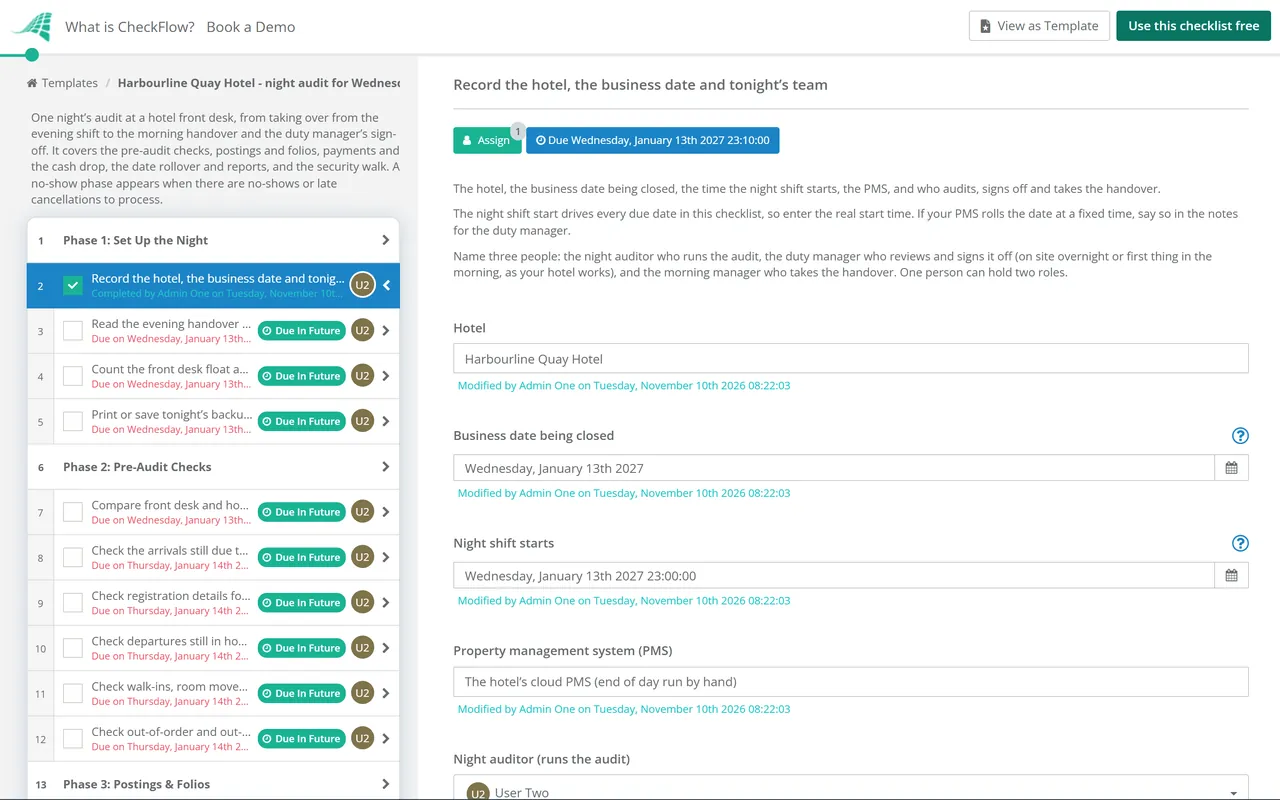
    • Record the hotel, the business date and tonight’s team — the hotel, the business date being closed, the time the night shift starts, the PMS, and who audits, signs off and takes the handover
    • Read the evening handover and the manager’s log — open guest issues, VIPs and late arrivals, maintenance faults, and anything the evening shift left unfinished
    • Count the front desk float and open your cashier shift — counted with the outgoing clerk, any difference recorded before you sign for it, and your own cashier shift opened in the PMS
    • Print or save tonight’s backup reports — in-house, arrivals and departures lists and the room status, so the desk can keep working if the PMS goes down
  2. Phase 2

    Phase 2: Pre-Audit Checks

    7 tasks

    Before anything is posted, make sure the PMS shows who is really in the hotel: room status, arrivals, departures and registrations.

    • Compare front desk and housekeeping room status — the PMS room status against housekeeping’s evening report, with every room where the two differ listed
    • Check mismatched rooms and correct their status — each room checked by the procedure the hotel sets, a sleeper (shown occupied, but the guest has paid and left), a skipper (shown occupied, but the guest has left without paying) or a room shown vacant that is occupied corrected, and the duty manager told
    • Check the arrivals still due tonight — guaranteed and non-guaranteed bookings, late arrival messages, and which bookings will be no-shows under the hotel’s cut-off
    • Check registration details for tonight’s arrivals — every guest who checked in has a complete registration record, with what your country’s rules ask the hotel to keep
    • Check departures still in house — guests due out today who have not checked out, with late check-outs and extensions entered in the PMS
    • Check walk-ins, room moves and day-use rooms — walk-ins registered with a payment method, room moves reflected on the right folio, and day-use rooms checked out
    • Check out-of-order and out-of-service rooms — each one has a reason and a return date that match the maintenance log, so tonight’s figures count them correctly
  3. Phase 3

    Phase 3: Postings & Folios

    6 tasks

    Every occupied room charged once at the right rate, every outlet charge on the right folio, and every correction made with a reason.

    • Post room and tax for every occupied room — posted by the night audit routine or by hand, once per room, at the rate on the booking, with the right tax
    • Check rates against the booking and any approvals — the rate variance report reviewed, and every override, discount or complimentary room matched to a reason and an approver
    • Check outlet charges posted to rooms — restaurant, bar and other outlet totals in the PMS matched to each outlet’s report, and charges on the wrong room moved
    • Check packages, allowances and deposits — breakfast and package allowances posted as sold, and advance deposits applied to the right folio
    • Correct posting errors with an authorised adjustment — every correction made as an adjustment with a reason code and an approver, never by deleting a charge
    • Check direct bill and group master accounts — charges routed to the right master account, and balances moved to the city ledger only for accounts with approved credit
  4. Phase 4

    Phase 4: Payments & the Cash Drop

    7 tasks

    Cashier shifts closed, card payments matched to the terminal or gateway, the batch settled and the cash dropped with a witness.

    • Close and balance each front desk cashier shift — each cashier’s report matched to the cash counted and the card payments taken, with any difference recorded against the shift
    • Review high balances against authorisations and deposits — in-house guests whose balance has passed their card authorisation, deposit or the hotel’s limit, listed for follow-up in the morning
    • Match card payments to the terminal or gateway totals — PMS card payments by card type against the terminal or payment gateway report for the business date
    • Find and record the card payment variance — each difference traced to a payment, a refund or a timing gap, corrected or passed to accounts with the details
    • Settle the card batch — the batch closed on each terminal or the gateway’s automatic settlement confirmed, and the settlement report kept
    • Make the cash drop with a witness — cash counted, sealed in a numbered envelope, logged with both signatures and dropped in the safe
    • Check paid-outs and refunds — every paid-out and refund made tonight has a receipt, a reason and an approver
  5. Phase 5

    Phase 5: No-Shows & Late Cancellations

    4 tasks

    Applies only when there are no-shows or late cancellations to process tonight. Charges follow the hotel’s policy and the guest’s booking terms, never a rule of this template.

    • Confirm each no-show before charging — not checked in under another name or another room, no late arrival message, and the booking guaranteed
    • Charge no-shows and late cancellations by the hotel’s policy — only what the booking’s terms allow, to the card or deposit given for that booking, with each result recorded
    • Release or amend the rest of each no-show’s stay — later nights cancelled or kept as the policy and the booking terms say, so the rooms can be sold
    • Mark no-shows with the booking channel — third-party bookings marked as no-shows in the channel or agent’s system as its terms require
  6. Phase 6

    Phase 6: Date Rollover & Reports

    6 tasks

    Once the date rolls, charges post to the new day, so the checks above come first.

    • Run the PMS’s checks before the rollover — arrivals checked in or marked as no-shows, departures checked out, and every cashier shift closed
    • Run the end of day and roll the business date — the PMS’s end-of-day routine run, so the day just audited closes and the next day opens
    • Produce and save the night audit reports — the trial balance, manager’s report, revenue and ledger reports and the exception reports your PMS gives
    • Check the guest, city and deposit ledgers balance — each ledger’s opening balance plus charges less payments equal to its closing balance, with any difference explained
    • Record tonight’s key figures — rooms sold, occupancy, average daily rate, RevPAR and revenue, as the PMS’s manager report shows them
    • Confirm the system backup ran and the reports are filed — the PMS backup or export confirmed, and the reports saved where the hotel keeps them
  7. Phase 7

    Phase 7: Security Walk & Overnight Duties

    6 tasks

    The building, the fire panel and the guests’ early mornings, with every incident written down as it happens.

    • Walk the building and check it is secure — fire exits and escape routes, external doors, public areas, plant and store doors, at the times the hotel’s procedure sets
    • Check the fire alarm panel and record any fault — the panel shows normal, and any fault or alarm reported as the hotel’s fire procedure says
    • Prepare wake-up calls and early departures — wake-up calls set, early breakfasts and taxis arranged, and early departures’ folios ready
    • Send or deliver folios for express check-out — guests leaving today get their folio as the hotel offers it, with any wrong charge corrected first
    • Check today’s arrivals and blocked rooms — today’s arrivals list, special requests and blocked or pre-assigned rooms ready for the morning team
    • Log overnight incidents, complaints and requests — what happened, the time, the room or place and what was done, written as it happens
  8. Phase 8

    Phase 8: Handover & Sign-Off

    5 tasks

    The morning manager takes the desk, the duty manager reviews the audit, and the pack goes to accounts only once it is approved.

    • Write the handover note for the morning manager — open variances, high balances, no-show charges, faults, incidents and guests to follow up
    • Take over the desk, the float and the keys — the float counted with the night auditor, keys and master keys accounted for, and the handover note read
    • Fix what the duty manager’s review found — each point corrected or explained, then the duty manager changes the decision and completes the sign-off
    • Duty manager signs off the night audit — the reports, variances, no-show charges, cash drop and handover reviewed, and the audit approved or sent back
    • Send the audit pack to accounts — the reports, settlement report, cash drop log and sign-off passed to accounts or the income auditor

Night Audit Reports and the Rules Behind Them

Report names differ from one PMS to another. The table lists the reports this template asks for and what the night auditor looks for in each. A few checks also touch rules outside the hotel; they are set out below the table with their sources. None of this is legal or tax advice.

Report or check What it shows What the auditor looks for
Room status discrepancy reportRooms where the front desk and housekeeping statuses differSleepers, skippers and occupied rooms shown as vacant checked and corrected before room and tax post
Arrivals and no-show reportBookings due today that have not checked inEach booking confirmed as a real no-show before any charge
Rate variance reportRooms sold at a rate other than the booking’s rateA reason and an approver for every override, discount or complimentary room
High balance reportGuests whose balance has passed their authorisation, deposit or limitAuthorisations topped up, or the guest listed for the morning team
Cashier (shift) reportsPayments each cashier took, by payment typeCash counted and card payments matched, with differences recorded per shift
Card settlement reportCard payments sent for settlement by the terminal or gatewayThe same totals as the PMS’s card payments for the business date
Trial balance and ledger reportsOpening balance, charges, payments and closing balance for the guest, city and deposit ledgersEvery ledger balances, and any difference is explained before sign-off
Manager’s reportRooms sold, occupancy, average daily rate, RevPAR and revenue for the dayFigures that look wrong against the day’s bookings, checked before the report goes out

Guest registration records. In the UK, the Immigration (Hotel Records) Order 1972 asks every guest aged 16 or over to give their full name and nationality on arrival. Guests who are not Commonwealth citizens (British citizens are), British protected persons or Irish citizens also give their passport or identity document details and their next destination, and the hotel keeps a written record for at least 12 months, open to inspection by the police (articles 4 and 5). In the US, guest record rules are state and local. In City of Los Angeles v. Patel (2015) the Supreme Court considered a Los Angeles ordinance requiring hotels to keep guest records for 90 days, and held its provision letting police inspect them without a chance of precompliance review facially unconstitutional.

Card data. The PCI Security Standards Council says card verification codes are sensitive authentication data that cannot be stored after authorisation under PCI DSS Requirement 3, even encrypted and even with the customer’s permission. This template never asks for a card number or a security code.

Room taxes. In the UK, when an individual guest stays in a hotel for a continuous period of more than 28 days, VAT from the 29th day is charged only on the part of the payment that is not for accommodation, and at least 20% of what remains once meals, drinks and other services are taken out is treated as being for facilities, on which VAT is charged (VAT Notice 709/3, section 3). In the US, room taxes are state and local: in Texas, for example, the state hotel occupancy tax is 6 percent of the cost of a room, and cities, certain counties and special purpose districts may add their own (Texas Comptroller).

Why Run the Night Audit in CheckFlow?

1

A fresh audit every night

A daily recurring schedule starts each night’s audit before the night shift arrives, with tasks assigned to the night auditor, the duty manager and the morning manager. Due times count on from the shift start you enter, so a late start moves the whole night.

2

Nothing filed until the manager signs

The duty manager’s sign-off holds the last step. If the audit is not approved, a task appears above the sign-off for the morning manager to fix, and the pack goes to accounts only once it is approved.

3

Every night on record

Each night is its own checklist with its variances, no-show charges, cash drop and overnight log. The Reports Grid lists every audit and how far it got, so a missed sign-off stands out the next morning.

CheckFlow does not post charges, settle cards or roll the date: your PMS and payment systems do that. It makes sure each check happens every night, that variances and incidents are written down while they are fresh, and that the audit is not filed until the duty manager signs it off.

Running a bar or restaurant too? Close the bar with the Bar Opening & Closing Checklist and count each outlet’s till with the End-of-Day Cash-Up Checklist. Review how the hotel handles card data with the PCI DSS 4.0 Compliance Checklist, and get rooms ready for the day’s arrivals with the Hotel Housekeeping Room Checklist.

AI generator

Didn’t find what you need? Describe it.

Describe the process in a sentence and the AI checklist generator drafts the phases and tasks for you.

Frequently Asked Questions

What is a night audit in a hotel?

The night audit closes the hotel’s business day. Overnight, the night auditor checks that the PMS matches who is really in the hotel, posts room and tax, checks rates and outlet charges, balances the cashier shifts and card payments, processes no-shows, then rolls the business date and produces the day’s reports. This template adds the security walk, the handover to the morning manager and a duty manager’s sign-off, so one record shows the whole night.

What does a night auditor do on a shift?

A night auditor runs the front desk overnight and closes the day’s accounts. In this template that means taking over the float and the evening handover, the pre-audit checks on room status, arrivals and departures, postings and rate checks, cashier and card payments, the cash drop, no-shows, the date rollover and reports, a security walk, wake-up calls and express check-out, and a written handover to the morning manager.

What reports does a night audit produce?

Names differ by PMS. This template asks for a trial balance or ledger report for the guest, city and deposit ledgers, a manager’s report with rooms sold, occupancy, average daily rate and RevPAR, revenue reports, cashier and card settlement reports, and exception reports such as rate variance, high balance, room status discrepancy and no-shows. Save them where the hotel keeps them and attach them to the audit in the checklist.

What happens at the date rollover in a PMS?

The rollover, often called the end of day, closes the business date and opens the next one. Depending on the system, it may first check that arrivals are checked in or marked as no-shows, departures are checked out and cashier shifts are closed, and it may post room and tax as part of the routine. After it, charges post to the new date, so this template puts the postings, payments and no-shows first.

How should a hotel charge no-shows?

Only as the hotel’s policy and the guest’s booking terms allow. This template first confirms the guest really is a no-show (not checked in under another name, no late arrival message, a guaranteed booking), then charges what the terms allow to the card or deposit given for that booking, records each result, releases or keeps the later nights as the policy says, and marks third-party bookings in the channel’s own system.

What is the difference between a sleeper and a skipper?

Both are room status mismatches the night audit looks for. A sleeper is a room still shown as occupied after the guest has paid and left, so it may be charged again or kept off sale. A skipper is a room shown as occupied after the guest has left without settling the bill. A room shown as vacant with someone in it is a third case. This template checks each mismatched room by the hotel’s procedure, corrects the status and tells the duty manager.

Does a UK hotel have to keep a guest register?

Yes. Under the Immigration (Hotel Records) Order 1972, every guest aged 16 or over gives their full name and nationality on arrival, and guests who are not Commonwealth citizens, British protected persons or Irish citizens also give their passport or identity document details and their next destination. The hotel keeps a written record for at least 12 months, open to inspection by any constable or a person the Secretary of State authorises. In the US, guest record rules are set by states and cities.

Can the front desk keep a guest’s card security code?

No. The PCI Security Standards Council says card verification codes are sensitive authentication data that cannot be stored after authorisation under PCI DSS Requirement 3, even encrypted and even with the guest’s permission. Take the code only to authorise a payment, never write it or the full card number on a registration card, a handover note or a checklist, and keep card details in the payment system the hotel has set up for them.

Is CheckFlow free for this template?

14-day free trial, no card required. The Business plan is $10 per user per month after the trial. Full details at checkflow.io/pricing.

Close Every Night the Same Way

Free trial — no credit card required.

14-day free trial, no credit cardFull refund in your first 30 daysUS hosting, EU on request