Equipment Maintenance Workflow Checklist Template

Unplanned downtime costs manufacturers $50 billion annually. Preventive maintenance reduces equipment failures by up to 70%. The difference between the two is a structured maintenance process — not a bigger maintenance budget.

In most manufacturing environments, maintenance is reactive by default. Equipment fails when it fails, the technician responds, the line stops, and the production schedule absorbs the damage. The cost is not just the repair — it is the idle labour, the missed customer delivery, the quality impact of a rushed restart, and the accelerated degradation of adjacent equipment subjected to the cascade of an unplanned failure. Research consistently shows that shifting from reactive to preventive maintenance reduces equipment failures by up to 70% and that digital maintenance checklists improve team productivity by 20% versus paper-based workflows — not because the maintenance tasks change, but because every technician follows the same procedure, every task is documented, and every result feeds back into the schedule. A structured equipment maintenance workflow defines the trigger (time-based, usage-based, or condition-based), the sequence of work, the safety prerequisites, the inspection criteria, and the documentation standard. This free checklist gives maintenance managers, plant managers, and production teams a structured framework for the full maintenance workflow — from work order generation to verified closure.

Use This Template Free See Live Example
No Credit Card Required

Reactive, Preventive, and Predictive Maintenance — the Strategy That Determines Your Downtime Profile

Reactive

Reactive Maintenance (Run to Failure)

When it happens: After the equipment fails.

Best for: Non-critical, inexpensive-to-replace equipment where failure has minimal production impact.

The cost of over-applying it: $50 billion in annual unplanned downtime across US manufacturing. Failure at the worst possible moment — peak production, minimum staffing, highest customer demand.

Checklist role: Corrective work order execution, root cause analysis, and CMMS documentation after the event.

Preventive

Preventive Maintenance (Scheduled)

When it happens: On a defined schedule — time-based (every 30 days), usage-based (every 10,000 cycles), or condition-based (when a measurement threshold is reached).

Best for: Most production-critical equipment with predictable wear patterns.

The value: Reduces failures by up to 70%. Enables scheduling maintenance during planned downtime rather than unplanned crises.

Checklist role: PM work orders generated on schedule, executed per defined procedures, with documented pass/fail results.

Predictive

Predictive Maintenance (Condition-Based)

When it happens: When sensors, monitoring data, or condition indicators show that failure is approaching — before symptoms are visible.

Best for: High-value, high-criticality equipment where maintenance cost is significant and early warning is detectable.

The value: Maximises equipment utilisation while preventing failure — maintenance happens when needed, not on a calendar.

The catch: Requires investment in sensors, monitoring systems, and analytical capability. Predictive maintenance adoption declined slightly from 30% to 27% between 2024–2025 as organisations discovered the infrastructure requirements.

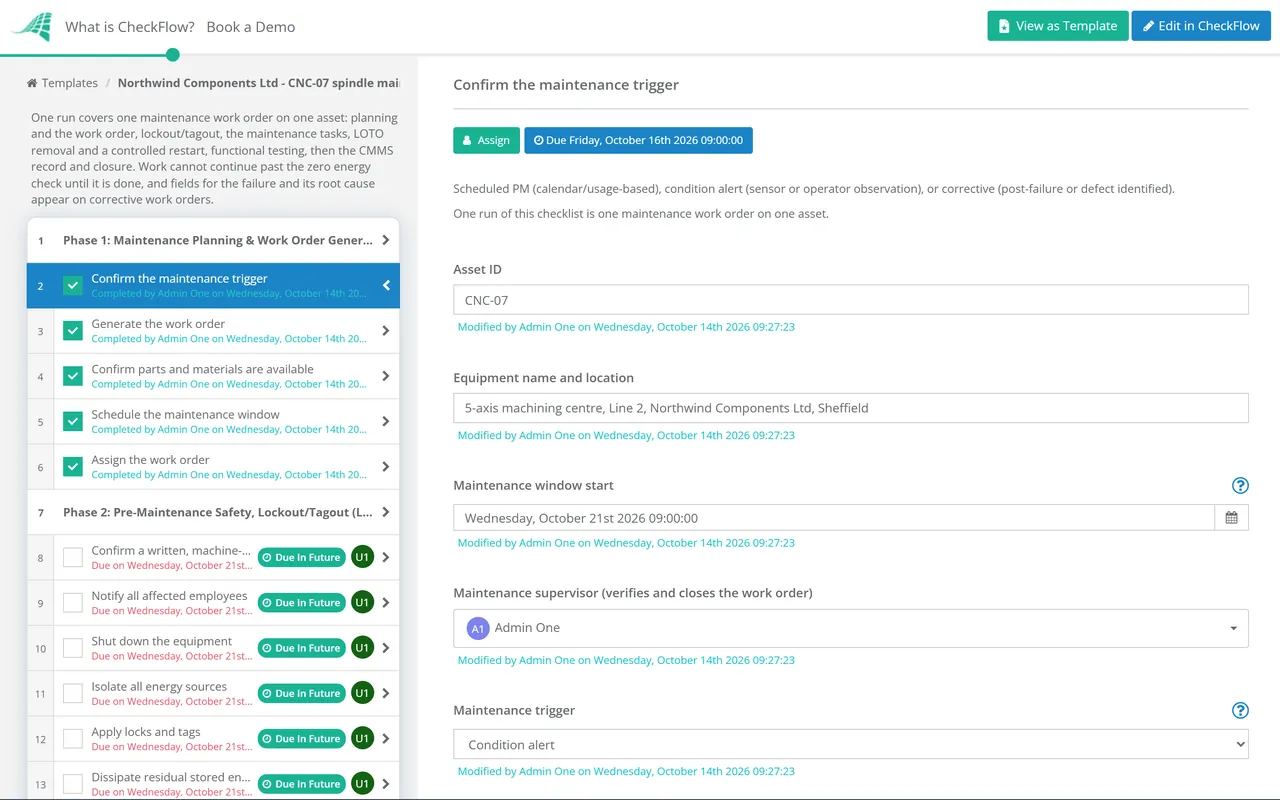
The Equipment Maintenance Workflow Checklist

Six phases covering the complete maintenance workflow — from work order generation through pre-maintenance safety, maintenance execution, LOTO removal, functional testing, and CMMS documentation.

Phase 1

Maintenance Planning & Work Order Generation

Every maintenance event begins with a work order — whether generated by a PM schedule, a condition trigger, or a breakdown report. A maintenance event without a work order is a maintenance event without a record.

  • Confirm the maintenance trigger — scheduled PM (calendar/usage-based), condition alert (sensor or operator observation), or corrective (post-failure or defect identified)
  • Generate the work order — in the CMMS or maintenance management system; with asset ID, location, required work description, required parts and tools, and estimated labour time
  • Confirm parts and materials are available — all required spare parts and consumables confirmed in stock before scheduling the maintenance event
  • Schedule the maintenance window — coordinated with production planning; planned during scheduled downtime where possible; equipment owner notified
  • Assign the work order — to a qualified technician with the skills for this equipment type; confirm training and authorisation for LOTO procedures
Phase 2

Pre-Maintenance Safety — Lockout/Tagout (LOTO)

Lockout/Tagout is the safety prerequisite for any maintenance work on equipment that could unexpectedly re-energise. OSHA 1910.147 requires a written, machine-specific LOTO procedure for each piece of equipment. 2,443 LOTO citations were issued in FY2024. Skipping LOTO to save time is the leading cause of maintenance worker fatalities.

  • Confirm a written, machine-specific LOTO procedure exists — posted at the equipment or accessible in the CMMS; for this specific asset
  • Notify all affected employees — that equipment will be shut down for maintenance; document notification in the work order
  • Shut down the equipment — following normal shutdown procedures; all energy sources (electrical, pneumatic, hydraulic, thermal, mechanical, gravity) identified and addressed
  • Isolate all energy sources — at each identified isolation point; disconnect switches, valves, and circuit breakers operated to the off position
  • Apply locks and tags — one lock per authorised employee working on the equipment; tag applied at each isolation point
  • Dissipate residual stored energy — bleed pneumatic pressure, discharge capacitors, block gravity loads, release spring tension; do not proceed until residual energy is at zero
  • Verify zero energy — attempt to start the equipment (using the normal controls) to confirm it does not energise; confirm zero energy state before proceeding
Phase 3

Maintenance Task Execution

  • Reference the equipment maintenance procedure — OEM manual or facility-specific SOP; follow the defined procedure, not improvised practice
  • Complete inspection checks — visual inspection for wear, corrosion, cracks, leaks, unusual erosion, or damage on all components
  • Lubricate all designated points — per the lubrication schedule and specifications; correct lubricant type and quantity; not over-lubricated
  • Inspect and replace wear components — belts, filters, seals, or other scheduled replacement items per the PM procedure
  • Check mechanical systems — moving parts for alignment, bearing condition, fastener torque, and proper operation; any unusual wear noted
  • Inspect electrical systems — wiring condition, connections, terminals, and electrical components for damage, overheating signs, or degradation; insulation integrity checked
  • Inspect hydraulic/pneumatic systems — hoses, fittings, cylinders, filters, fluid levels; check for leaks and proper pressure
  • Check safety devices — guards, interlocks, emergency stops, and safety sensors verified present, intact, and functional
  • Confirm equipment is clean — debris, dust, and buildup removed; cleanliness affects cooling, lubrication, and contamination risk
Phase 4

LOTO Removal & Controlled Restart

  • Confirm maintenance work is complete — all tools and materials accounted for; nothing left inside the equipment
  • Confirm all employees are clear — area around the equipment is clear of personnel before re-energisation
  • Remove LOTO devices in reverse order — each employee removes only their own lock; confirm all locks and tags are removed
  • Re-energise the equipment — in the correct sequence; gradually, monitoring for unusual sounds, vibrations, or conditions
  • Notify affected employees — that the equipment is operational again
Phase 5

Post-Maintenance Functional Testing

  • Run the equipment through its normal operating cycle — confirm all functions operate correctly; no unusual noise, vibration, temperature, or fluid leakage
  • Test safety devices — emergency stop function, guards, interlocks, and safety sensors operate correctly
  • Check performance against specifications — output, speed, accuracy, or other performance parameters within the defined acceptable range; recalibrate if required
  • Confirm no new issues identified — any defects found during testing that were not present at work order issue are documented and a corrective work order raised
Phase 6

Documentation & CMMS Update

What is not documented did not happen — for maintenance audits, equipment history tracking, and reliability engineering. A maintenance team that completes work without documentation is generating costs it cannot analyse.

  • Record all work performed — specific tasks completed, parts replaced (with part numbers), lubricants applied, measurements taken, and any anomalies found
  • Record actual labour time — by technician; against the estimated; variance feeds productivity analysis
  • Record any open findings — conditions noted during maintenance that require future attention but were not addressed in this work order; new work order raised
  • Update the equipment maintenance history — in the CMMS; every completed PM is the data point that drives the next schedule
  • Schedule the next PM — based on the maintenance interval; confirmed in the CMMS before closing the work order
  • Close the work order — with technician sign-off and supervisor verification; all fields complete

Why Unplanned Downtime Costs More Than the Repair Bill

Direct production loss

Every minute of unplanned downtime is a minute of production that cannot be recovered. For a line producing 200 units/hour at $50 margin per unit, one hour of unplanned downtime costs $10,000 in lost contribution — before any repair cost is counted.

Labour inefficiency

When a line stops unplanned, the production workforce idle time is still a payroll cost. A team of 20 operators at $25/hour represents $500/hour in idle labour cost — on top of the lost production.

Quality impact of rushed restart

Equipment that is restarted after an emergency repair, without the systematic functional testing that follows planned maintenance, produces quality problems at higher rates in the post-restart period. Scrap and rework costs compound the direct downtime cost.

Customer delivery and relationship impact

Unplanned downtime that breaches a delivery commitment produces customer penalties, expedited freight costs, and — over time — customer confidence erosion that is harder to quantify and harder to recover than the repair bill.

Why Run Your Maintenance Process in CheckFlow?

1

PM schedules that run automatically and cannot be forgotten

A preventive maintenance programme that relies on someone remembering to schedule the next PM is a reactive maintenance programme in disguise. CheckFlow's recurring checklist feature generates PM work orders automatically at the defined interval — whether daily, weekly, monthly, or usage-triggered — assigning them to the responsible technician with all required tasks, parts, and safety steps included. No PM is missed because no one had to remember it.

2

LOTO as a gated step that cannot be skipped

LOTO is most likely to be skipped when the maintenance feels routine and time pressure is high — exactly the conditions that produce the most serious injuries. CheckFlow makes the LOTO completion a required step before the maintenance execution phase can begin. Safety is structural, not discretionary.

3

A complete, searchable maintenance history for every asset

Equipment maintenance history is the data that drives reliability improvement — when failures cluster, which components wear fastest, whether PM intervals need adjustment. Every work order completed through CheckFlow is archived against the asset, timestamped, and fully searchable. The maintenance history that reliability engineers need is built automatically as the process runs.

Equipment maintenance safety depends on a rigorous facility safety inspection process. CheckFlow’s Safety Inspection Process for Manufacturing covers the structured facility safety audit that ensures LOTO procedures, machine guarding, and PPE requirements are systematically maintained. See the Manufacturing Safety Inspection Checklist →

Maintenance scheduling must coordinate with production planning to minimise production impact. CheckFlow’s Manufacturing Production Scheduling Checklist covers the production planning process that maintenance windows must align with. See the Production Scheduling Checklist →

Frequently Asked Questions

What should an equipment maintenance workflow checklist include?

+

An equipment maintenance workflow covers six phases: maintenance planning and work order generation (trigger identification, work order creation, parts availability, scheduling, and assignment), pre-maintenance safety via LOTO (shutdown, isolation of all energy sources, lock and tag application, stored energy dissipation, and zero-energy verification), maintenance execution (following OEM or facility-specific procedures, inspection, lubrication, component replacement, and safety device verification), LOTO removal and controlled restart, post-maintenance functional testing (performance verification and safety device testing), and CMMS documentation (work performed, parts used, labour time, anomalies, and next PM scheduling).

What is Lockout/Tagout and why is it required?

+

Lockout/Tagout (LOTO) is the procedure for controlling hazardous energy sources — electrical, pneumatic, hydraulic, thermal, mechanical, and gravitational — before equipment maintenance or servicing begins. OSHA standard 29 CFR 1910.147 requires that employers establish an energy control programme with written, machine-specific procedures for every piece of equipment. LOTO prevents accidental machine start-up or unexpected release of stored energy — which OSHA estimates causes approximately 50,000 injuries and 120 fatalities annually when inadequately controlled. LOTO was among OSHA’s top 10 most cited standards in FY2024, with 2,443 citations issued. Annual inspections of LOTO procedures are required by OSHA 1910.147(c)(6).

What is the difference between preventive and predictive maintenance?

+

Preventive maintenance (PM) is performed on a defined schedule — time-based (every 30 days), usage-based (every 10,000 cycles), or calendar-based — regardless of whether the equipment shows any symptoms of degradation. The PM schedule is set based on manufacturer recommendations, historical failure data, and criticality. Predictive maintenance (PdM) is performed when condition monitoring data — vibration analysis, oil analysis, thermal imaging, or other measurements — indicates that failure is approaching, allowing maintenance to be scheduled precisely when needed rather than on a fixed calendar. PdM requires investment in sensors and monitoring infrastructure. Most manufacturing environments use a hybrid approach: PM for well-understood wear patterns, PdM for high-value critical assets where early warning is detectable.

What data should be recorded after each maintenance event?

+

Post-maintenance documentation should include: work order number and equipment asset ID, date and actual duration of maintenance, names and IDs of technicians who performed the work, all tasks completed with pass/fail or measurement results, all parts replaced with part numbers and quantities, lubricants applied (type, quantity, and points), any anomalies or defects found during maintenance, any deferred work with a new work order reference, performance test results post-restart, and next scheduled PM date. This data is the foundation of equipment reliability analysis and maintenance programme optimisation.

Is CheckFlow free for this template?

+

You can start a free 14-day trial with no credit card required, giving you full access to all features including this template. The Business plan is $10 per user per month after the trial. Full details at checkflow.io/pricing.

Turn Every Maintenance Event Into a Documented, Trackable, Improvable Process

Free trial — no credit card required.