
Handled by the servicing workflow
- Book the engineer and confirm access and downtime
- Isolate the asset and apply lockout before work starts
- Carry out the task list and record readings
- Test, return to service and file the service report
Last reviewed: October 2026
No Credit Card Required
Printed from checkflow.io/templates/operations-facilities-management/preventive-maintenance-checklist
A preventive maintenance schedule is easy to write and hard to keep. Assets get added without task lists, intervals copied from the manual never change, and a statutory examination slips because the reminder went to someone who left. This free preventive maintenance checklist gives facilities managers, maintenance managers and operations managers a monthly control cycle for the whole programme. It covers checking the asset register and criticality, planning and assigning the month’s PM tasks, completing them with evidence, statutory examinations, PM compliance, backlog and deferral approval, and a quarterly review that adjusts intervals from real failure data. The statutory and quarterly phases appear only in the months they apply.
Every preventive maintenance task is a small job: isolate the machine, change the belts, grease the bearings, test, sign off. That job is well served by a servicing workflow, and our Equipment Servicing Workflow Checklist handles it from booking the engineer to filing the report. What a job checklist cannot tell you is whether the whole programme is working: whether every critical asset has a task list, whether this month’s tasks were done on time, and whether the intervals are right.
That is the job of this template. It runs once a month for the maintenance manager and planner, and it treats the PM schedule itself as the thing being maintained. Two numbers sit at the centre of it. PM compliance is the share of scheduled PM tasks completed within their window. Backlog is the work that is due or overdue but not yet done, usually expressed in labour hours or crew-weeks rather than a count of work orders, because ten filter changes and one gearbox rebuild are not the same size.
Triggers matter too. Time-based tasks run on the calendar; usage-based tasks run on a meter such as running hours, cycles or miles. A compressor running two shifts and one running four should not share a calendar interval, so record each task’s trigger and read the meters when planning.
Six phases take the programme from a checked asset register to a reviewed schedule. Phase 4 appears only in months when a statutory examination or inspection falls due, and Phase 6 only in the last month of each quarter.
The two scope questions decide whether this month’s checklist shows the statutory and quarterly review tasks.
Shown only when a statutory examination or inspection falls due this month.
Shown only in the last month of each quarter.
Some inspections are required by law, and an inspector or insurer will ask for the reports. Put them on the same schedule as everything else so they appear in the monthly plan, not in a contractor’s reminder email. The table covers the common UK and US examples for a commercial or industrial site.
| Equipment | United Kingdom | United States |
|---|---|---|
| Lifting equipment | LOLER: thorough examination by a competent person every 6 months for equipment used to lift people and for lifting accessories, every 12 months for other lifting equipment, or at the intervals in a written examination scheme; the report records defects and the next due date | OSHA 29 CFR 1910.179: overhead and gantry cranes get frequent inspections (daily to monthly) and periodic inspections (1 to 12 months); 1910.178(q)(7): forklifts examined before being placed in service, at least daily, or after each shift when used round the clock |
| Pressure systems | Pressure Systems Safety Regulations 2000: a written scheme of examination must be in place before the system is used, and the system examined by a competent person at the intervals the scheme sets; covers steam at any pressure, gases above 0.5 bar and pressurised hot water above 110 °C | Nearly all states, and some cities, require periodic inspection of boilers and pressure vessels by a commissioned inspector; intervals and scope vary by jurisdiction, so check the rules for each site |
| Work equipment and machinery | PUWER regulation 5: equipment kept in an efficient state, in efficient working order and in good repair, with any maintenance log kept up to date; regulation 6: inspection where deterioration could cause danger | OSHA 29 CFR 1910.147: energy control procedures for servicing and maintenance, each one inspected at least annually by an authorised employee and certified |
| Electrical systems | Electricity at Work Regulations 1989, regulation 4(2): systems maintained so as to prevent danger, so far as is reasonably practicable | NFPA 70B, a standard rather than a recommended practice since its 2023 edition: maintenance intervals set by an equipment condition assessment of physical condition, criticality and operating environment |
| Gas appliances and flues | Gas Safety (Installation and Use) Regulations 1998, regulation 35: employers keep gas appliances, pipework and flues at work in a safe condition, using Gas Safe registered engineers | Set by the fuel gas code each state or city adopts, usually the International Fuel Gas Code or NFPA 54, the National Fuel Gas Code |
Refrigeration and air conditioning have their own rules. Leak checks under the F-gas regulations, the TM44 air-conditioning inspection, and EPA Section 608 and AIM Act leak repair are covered in the HVAC Maintenance Checklist. Fire alarms, emergency lighting and extinguishers belong on this schedule too, and the Fire Risk Assessment Checklist sets out what your assessment says they need. Company vehicles follow road transport rules rather than workplace equipment rules, so run them through the Fleet Vehicle Inspection Checklist.
Standards give the programme a shape. ISO 55001:2024 sets the requirements for an asset management system and covers maintenance as one stage of the asset life cycle, alongside acquisition, renewal and disposal. You do not need certification to borrow its logic: let what each asset is worth to the business decide how much maintenance it gets. In practice that means a criticality rating on every asset. A critical asset gets the shortest intervals, the tightest compliance target and deferrals that need approval. A low-criticality asset may be cheaper to run to failure, as long as that decision is written down.
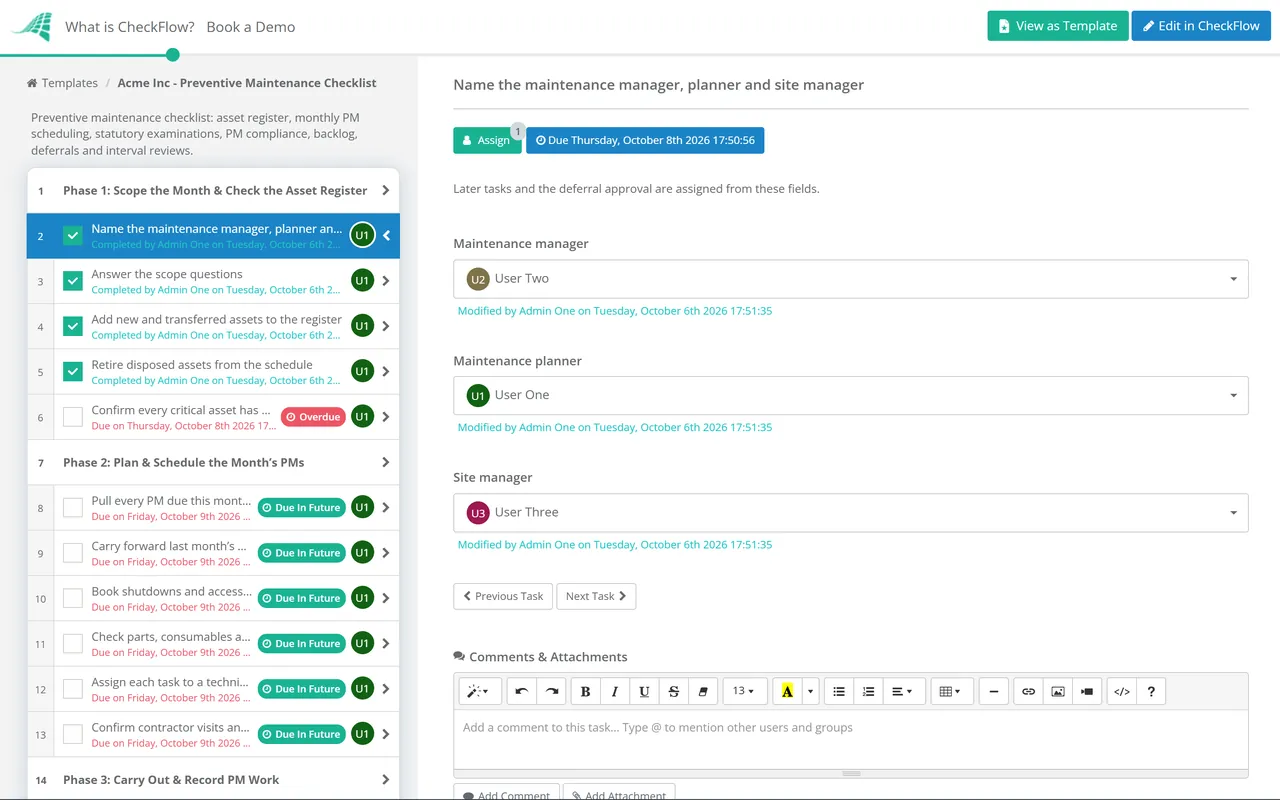
A monthly schedule creates the checklist on the first working day, with the maintenance manager, planner and site manager assigned and every task due on a date counted from the start.
Two questions in Phase 1 decide what the month shows. A month with no examinations due hides Phase 4; the quarterly review appears only when the quarter closes, so routine months stay short.
A critical PM cannot slip until the site manager answers the approval, and the checklist waits until they do. Examination reports and photos sit on the tasks that produced them, with a history of who did what and when.
This checklist manages the programme; individual jobs run elsewhere. The Equipment Servicing Workflow Checklist covers a single service visit, the Office Maintenance Schedule Checklist handles the daily-to-annual routine of an office, and the HVAC Maintenance Checklist runs the seasonal service on heating and cooling plant.
On a production site, pair this with the Equipment Maintenance Workflow Checklist for lockout and restart on each job, and see how CheckFlow for manufacturing handles shift handovers and safety inspections alongside the PM schedule. Monthly compliance and backlog figures can feed a dashboard through reporting.

Equipment Servicing Workflow Checklist
HVAC Maintenance Checklist

Seasonal Property Maintenance Checklist

Fleet Vehicle Inspection Checklist

Facility Inspection Checklist
Describe the process in a sentence and the AI checklist generator drafts the phases and tasks for you.
At the level of a single asset, it is the list of tasks a technician completes at each service. At the level of a site, which is what this template covers, it is the routine that keeps the whole PM programme on track: a current asset register, a planned and assigned month of PM tasks, statutory examinations in date, compliance and backlog measured, and intervals reviewed against failure history.
Start from the manufacturer’s recommended intervals and any statutory examination intervals, then adjust from experience. Calendar intervals suit assets that deteriorate with time; meter-based intervals, such as running hours or miles, suit assets whose wear depends on use. Review intervals at least quarterly: shorten them where failures happen between PMs and lengthen them where several PMs in a row found nothing to fix.
Divide the number of PM tasks completed within their window by the number scheduled in the period. Decide the window before you start measuring, for example within the scheduled week for monthly tasks, and do not count a task as compliant because it was eventually done. Report critical assets separately, because a high overall figure can hide overdue work on the equipment that matters most.
In the UK, thorough examinations of lifting equipment under LOLER and examinations of pressure systems under a written scheme are the most common specific requirements, alongside general duties to maintain work equipment, electrical systems and gas appliances in a safe condition. In the US, OSHA sets inspection requirements for equipment such as cranes and forklifts and requires annual inspection of lockout procedures, while boilers and pressure vessels fall under state law.
The asset, the task list used, the date, who did the work, readings taken, parts replaced, defects found and the corrective work raised, plus any contractor or examination report. Keep the next due date with it. That record proves the work was done and is the raw material for adjusting intervals.
14-day free trial, no card required. The Business plan is $10 per user per month after the trial. Full details at checkflow.io/pricing.
14-day free trial, no credit cardFull refund in your first 30 daysUS hosting, EU on request