Employee Relocation Checklist

Relocating someone is a job change, a tax event and a family house move all at once. Most of the problems come from the parts nobody owned: the package nobody approved in writing, the moving costs paid without tax, the visa booked too late.

This free employee relocation checklist runs one move from the first request to a settling-in check a month after arrival. It works for an existing employee taking a role in another city, state or country, and for a new hire who has to move to take the job. It covers the policy and the package, a signed approval, the repayment agreement, the tax treatment of every cost, payroll and contract changes, the move itself and the family’s first weeks. One answer, “International move?”, adds the visa, tax residence and social security tasks when the move crosses a border.

Use This Template Free See Live Example
No Credit Card Required

Why Relocations Go Wrong

Too many owners, no single list. A relocation touches HR, the hiring or receiving manager, payroll, finance, an immigration adviser, a removal company and the employee’s family. Each holds one piece. The employee is the only person who sees all of it, and they are also the person with the least time, because they are starting a new role while packing a house.

The money is promised before it is approved. A manager tells a candidate “we’ll cover the move”, and three months later finance is asked to pay for a second house-hunting trip, six weeks of serviced flat and a piano. A written package with caps, approved before anything is said to the employee, stops that.

Tax is treated as an afterthought. In the US, moving costs paid by an employer are taxable wages for almost everyone. In the UK, part of the cost can be tax-free, but only within a limit and a time window. Get it wrong and the employee faces an unexpected tax bill, or the employer faces a payroll correction.

This is not the same job as two neighbouring templates. The Internal Transfer & Role Change (Mover) Checklist handles the role change: new terms, access rights and the handover. Use it alongside this one when an existing employee moves, and let this checklist carry the relocation. The Office Relocation Checklist is a different job altogether: moving a whole office, its lease, IT and furniture, not one person and their family.

United States

Moving costs are pay

  • Since 2018 an employer’s payment or reimbursement of moving expenses is taxable income for most employees
  • The 2025 budget law, the One Big Beautiful Bill Act, made that rule permanent
  • Exceptions: active-duty Armed Forces moving under military orders, and from 2026 intelligence community employees moving because of a change of assignment
  • Payments go through payroll with withholding; some employers gross them up
  • A new work state can mean new state withholding and registrations
United Kingdom

Up to £8,000 can be tax-free

  • Qualifying relocation costs up to £8,000 per move are free of tax and National Insurance
  • The employee must change their main home because of a new job or a new place of work
  • The new home must be within reasonable daily travelling distance of the new workplace, and the old one must not
  • Costs must be met before the end of the tax year after the one in which the new job starts
  • Changed terms go in a written statement within one month of the change

Tax and immigration rules differ by country and, in the US, by state. This template turns the published rules into process steps; it is not tax or legal advice. For a cross-border move or a senior hire with a large package, take advice from an employment lawyer and a tax adviser on the specific case before the offer is made.

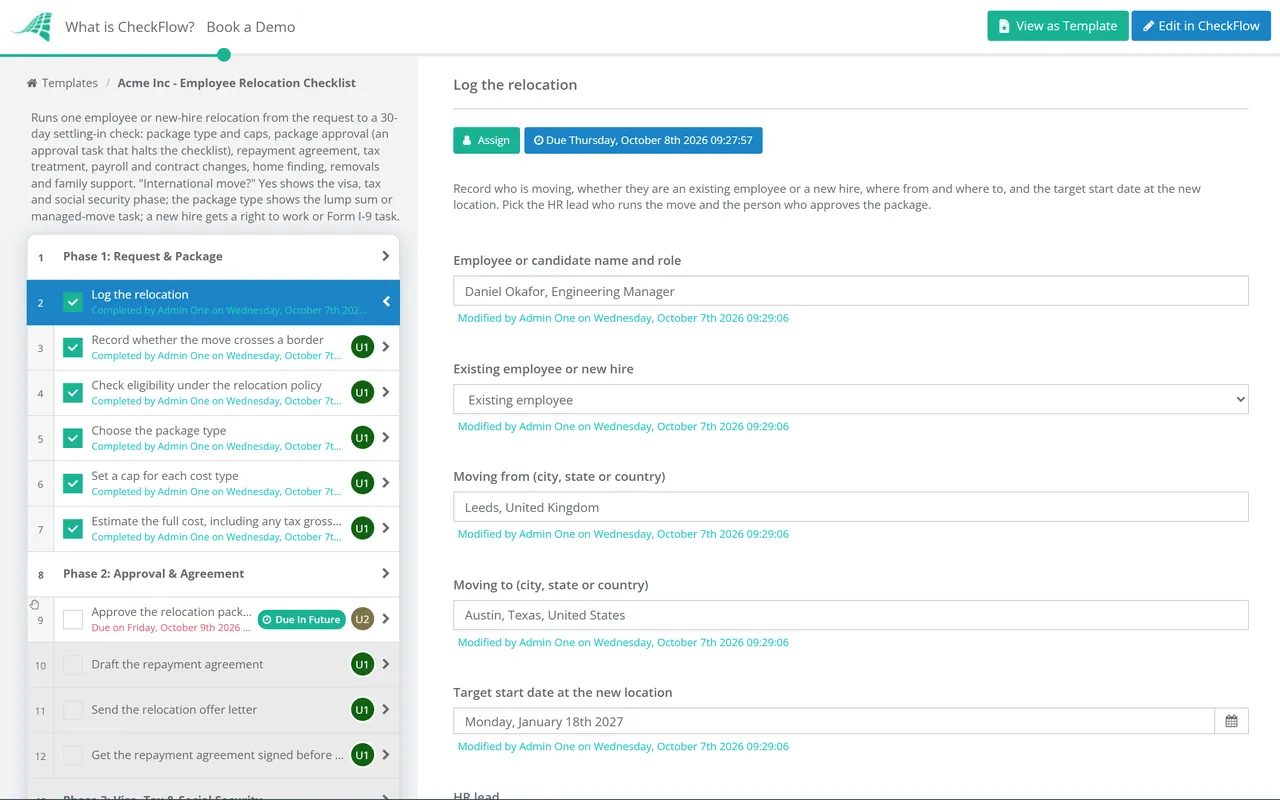
What the Employee Relocation Checklist Covers

Seven phases. The package is approved before anything is promised, the international phase appears only for cross-border moves, and the package type shows either the lump sum or the managed-move tasks.

Phase 1

Phase 1: Request & Package

  • Log the relocation — employee or new hire, from and to, target start date, HR lead and approver
  • Record whether the move crosses a border
  • Check eligibility under the relocation policy — role, grade, distance from the current home
  • Choose the package type — lump sum, capped reimbursement or managed move
  • Set a cap for each cost type — trips, temporary housing, removals, sale and purchase costs
  • Estimate the full cost, including any tax gross-up
Phase 2

Phase 2: Approval & Agreement

The approval halts the checklist. Nothing is offered or booked until it is signed off.

  • Approve the relocation package — by the approver picked in Phase 1
  • Draft the repayment agreement — what is repaid, when, and on what sliding scale
  • Send the relocation offer letter — package, caps, dates and how to claim
  • Get the repayment agreement signed before any payment
Phase 3 — If International

Phase 3: Visa, Tax & Social Security

Shown when the answer to “International move?” is Yes.

  • Confirm the right to work in the destination country — visa, work permit or sponsorship
  • Apply for the visa or work permit and track every date
  • Check social security cover — A1 or certificate of coverage
  • Get tax advice for both countries — residence, double taxation and any split year
  • Agree how pay, pension and benefits work abroad
Phase 4

Phase 4: Payroll, Tax & Contract

  • Classify each relocation cost for tax — UK qualifying or not; US taxable wages
  • Set up payroll tax for the new state or country — registrations and withholding
  • Update the work location, address and cost centre in HR and payroll
  • Issue the contract changes in writing — UK: within one month of the change
  • Check right to work or Form I-9 before the first day — shown for a new hire
Phase 5

Phase 5: Home Finding & Removals

The lump sum or managed-move task follows the package type chosen in Phase 1.

  • Pay the lump sum through payroll — shown for a lump sum package
  • Instruct the relocation provider — shown for a managed move
  • Book the home-finding visit
  • Arrange temporary housing with an end date
  • Book the removal company — quotes, insurance and a survey
  • Track claims and receipts against the caps
Phase 6

Phase 6: Family Support

  • Ask what the family needs — schools, childcare, partner’s work, care for relatives
  • Share school and childcare options for the new area
  • Help with healthcare registration and local services
  • Offer partner career support where the policy allows
Phase 7

Phase 7: Arrival & Settling In

  • Confirm arrival and the first day at the new location
  • Have the workspace, equipment and building access ready
  • Hold a settling-in check after 30 days — employee and family
  • Reconcile and close the relocation costs — and report them for tax
  • Record when the repayment period ends

Lump Sum, Capped or Managed: Choosing the Package

Most relocation policies offer one of three shapes of package, sometimes by grade. The choice decides how much administration HR takes on, how predictable the cost is and how the tax works. Use this table when choosing the package in Phase 1.

Package How it works Good for Watch out for
Lump sumA fixed amount paid through payroll; the employee arranges and pays for everythingJunior or single movers, short domestic moves, a predictable budgetUS: taxed as wages, so the net amount is much smaller unless grossed up. UK: the £8,000 exemption is for qualifying costs, so agree with payroll how the lump sum will be taxed
Capped reimbursementThe employee claims actual costs with receipts, up to a cap per cost typeMost domestic moves; UK moves that can use the £8,000 exemptionClaims arriving months later; receipts that do not match a cost type; tracking the UK time limit
Managed moveA relocation provider books and pays for home finding, removals and temporary housing, billed to the employerSenior hires, families, international movesProvider fees; the employee needs one contact who decides on exceptions
Core and flexA managed core (removals, trips) plus a flexible allowance the employee spends as they chooseMixed workforces where needs varyTwo sets of tax treatment on one move
The approval

What the approver should see

  • The role, the move and the reason the role needs it
  • The package type and the cap for each cost type
  • The estimated total, with any tax gross-up shown separately
  • Whether the move crosses a border, and who is advising on it
  • Any exception to the standard policy, named as an exception
The repayment agreement

What it should say

  • Which costs are repayable: often the lump sum or reimbursed costs, not the tax paid on them
  • The triggers: resignation or dismissal for misconduct within a set period
  • A sliding scale, such as 100% in the first year and 50% in the second
  • How repayment is made, and whether it can come from final pay
  • What happens if the employer ends the role, for example in a redundancy

Have the agreement signed before the first payment, not when the employee resigns. A clawback that appears for the first time in a leaving letter is hard to enforce and harder to defend. If you may recover the money from final pay, the agreement should say so in writing in advance: in the UK a deduction from wages needs that prior written agreement, and US states set their own rules on what employers may deduct.

Why Run Relocations in CheckFlow?

1

One approved package

The package is an approval task assigned to the approver picked on the first task, and the checklist halts until it is approved. The caps, the estimate and the decision sit on the record, so nobody negotiates a move from memory.

2

Only the tasks this move needs

Answer “International move?” with Yes and the visa, tax and social security phase appears. Pick the package type and only the matching tasks show. A domestic move stays short.

3

Dates that work back from the move

Due dates count from the target start date, so the visa, the contract statement and the removal booking fall due in the right order. Receipts and the signed agreement are uploaded to their tasks, and the audit trail shows who did what and when.

A relocation sits in the middle of the employee lifecycle. CheckFlow’s HR checklist software runs hiring, onboarding, moves and departures from templates, with assignments, due dates and approvals shared between HR, payroll and managers.

Moving someone across a border? Run the Right to Work Check Checklist (UK) or the Form I-9 & E-Verify Compliance Checklist for the destination, and the New Hire Payroll Setup Checklist when the person joins a new payroll.

Frequently Asked Questions

Are relocation payments taxable in the US?

+

For almost all employees, yes. The exclusion for qualified moving expense reimbursements was suspended for tax years beginning after 2017, and the One Big Beautiful Bill Act (Public Law 119-21) made the suspension permanent. Reimbursements, direct payments to movers and lump sums are taxable wages and go through payroll. The exceptions are members of the Armed Forces on active duty moving under military orders for a permanent change of station and, for tax years beginning after 31 December 2025, employees and new appointees of the intelligence community moving because of a change in assignment. IRS Publication 15-B covers the employer side.

Which relocation costs are tax-free in the UK?

+

Qualifying costs up to £8,000 per move: buying and selling a home, removals, some items for the new home and bridging loans. They qualify only when the employee changes their main home because they start a new job, or their duties or place of work change, and the new home is within reasonable daily travelling distance of the new workplace while the old one is not. The costs must be met before the end of the tax year after the one in which the new job starts; HMRC can extend that, for example while a child finishes exams. Qualifying costs above £8,000 go on form P11D with Class 1A National Insurance on the excess. Reimbursed costs that do not qualify are added to pay and taxed through payroll.

Can we ask an employee to repay relocation costs if they leave?

+

Yes, if they agreed to it in writing before the money was paid. A typical repayment agreement covers resignation within one or two years, on a sliding scale, and excludes cases where the employer ends the job. Make the amount proportionate to what was spent. If you want to recover it from final pay, the agreement must allow that: UK law requires the worker’s prior written agreement for a deduction from wages, and US state rules on wage deductions vary, so check the state before deducting.

How is this different from the internal transfer checklist?

+

The internal transfer checklist handles the change of role: the new terms, access rights, the handover and the first 90 days. It has a short relocation phase for when the location changes. This checklist is the full relocation: the package, its approval, the repayment agreement, tax, visas, home finding, removals and family support. For an existing employee who moves home for a new role, run both. For a new hire who relocates, run this one alongside your onboarding checklist.

What changes when the move is to another country?

+

Three things are added. First, the right to work: the employee needs a visa or permit for the destination, and the timing of that decides the start date. Second, tax: residence, double taxation and the payroll in each country, which needs specialist advice. Third, social security: a UK employee posted temporarily to the EU, Iceland, Liechtenstein, Norway or Switzerland can stay in UK National Insurance for up to two years with a certificate from HMRC, often called an A1, and the UK has agreements with some other countries too. For a UK employee, the written statement must also cover the period abroad, the currency of pay, any extra pay or benefits and the terms for coming back.

Is CheckFlow free for this template?

+

14-day free trial, no card required. The Business plan is $10 per user per month after the trial. Full details at checkflow.io/pricing.

Move People Without Losing Track of the Details

Free trial — no credit card required.